
According to John M. Last, epidemiology is “The study of the distribution and determinants of health-related states or events in specified populations, and the application of this study to the control of health problems”.
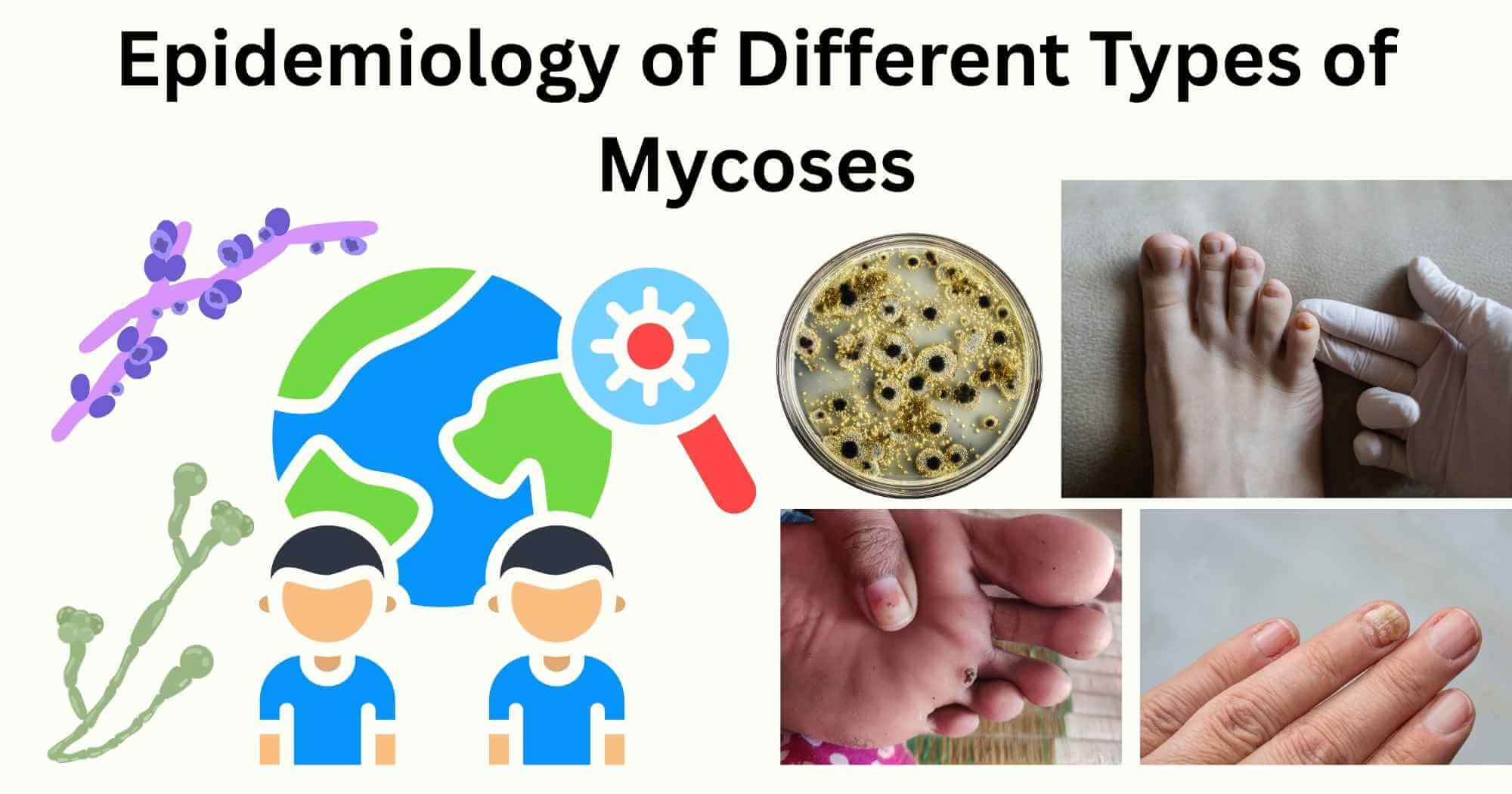
The definition meticulously elucidates the prevalence of diseases, how it is interconnected with the genetic predisposition and the environment of its host and through these findings, figure out a better solution (in the form of prevention or cure) for its minimization or eradication.
Through this principle, three main objectives of epidemiology were devised:
- To identify the etiological agent of the disease. By knowing this, a distinction will be created, like their mode of infection caused by variable microbial entities.
- To determine the magnitude of the disease. It shows the relevance of disease across different geographical locations, or its localization in a particular geographical area, or in a particular population.
- To construct the proper public health policy. It gives a solid foundation to prevent, control, or treat disease in a systematic approach, given the essential data for planning.
Epidemiology of Mycoses
- Historically, not much medical significance was given to fungi due to a lack of competent diagnostic protocols.
- Gradual progression of the biomedical protocols & technology and variable nature of patient profiles whose sole etiological agent was not attributed to only bacteria or virus, led to the branch of medical mycoses.
- A growing number of cases of immunosuppressed individuals have made them prone to the secondary infection of mycoses, which remains an increasing threat to public health, given the fact of ubiquitous nature of fungi in the environment (Aspergillus spp.) and also part of the normal human microbiota (Candida spp.).
- The fungal infection is generally not communicable; humans become accidental hosts through exposure to fungal spores by inhalation and traumatic inoculation (exogenous factor) or immunosuppressed condition (underlying disease/state (usage of immunosuppression) (endogenous factor).
- Humans are, to an extent, immune to most fungi, but exceptions are seen in dimorphic fungi (whose incidence is directly correlated to the degree of exposure via leisure activities and occupation).
Epidemiology of Different Types of Mycoses
Mycoses are divided into 5 groups according to the route of infection:
- Superficial mycoses
- Cutaneous mycoses
- Subcutaneous mycoses
- Systematic mycoses
- Opportunistic mycoses
Epidemiology of Superficial Mycoses
Pityriasis versicolor: Etiological agent: Malassezia furfur. It is part of the normal flora of the skin, so the mode of infection is endogenous. The infection is very persistent in hot, humid climates.
Epidemiology of Cutaneous Mycoses
Dermatophytosis (ringworm/tinea): Etiological agents: Trichophyton spp., Microsporum spp., and Epidermophyton spp.
- Some species are distributed worldwide, some are restricted to particular parts.
- The dermatophytes are divided into 3 types based on habitat: Soil (geophilic), animals (zoophilic), and man (anthrophilic). This distinction is useful in epidemiological assessment of its procurement, site, and transmission. All three are capable of causing infection, but the highly specific one is an anthrophilic species. They persistently target humans and prefer specific body sites, e.g., Epidermophyton floccosum mainly found in skin.
- Microsporum canis is a zoophilic species transmitted through cats, likewise Trichophyton verrucosum via cattle.
- Direct transmission occurs through fragments of keratin (remnants of skin, nail or hair of the infected) containing viable fungus or traumatic inoculation.
- Indirect transmission is via nail clippers, hair brushes, and towels.
- The viability of dermatophytes can persist for a longer period, which involves both accumulation and transmission.
Epidemiology of subcutaneous mycoses
Mycetoma: Etiological agent: Actinomycotic (bacterial) mycetoma: Nocardia, Actinomadura, and Streptomyces spp. Eumycotic (fungal) mycetoma: Madurella mycetomatis, Curvularia spp., Exophiala jeanselmeri, Pseudallescheria boydii.
- It is mainly distributed in tropical and subtropical regions. The people in agricultural occupations are mainly infected.
- The failure to wear proper protective clothing and walking on contaminated soil predisposes them to traumatic inoculation (via thorns/splinters) of the fungi into the subcutaneous tissue.
Chromoblastomycosis: Etiological agents: Cladophialophora carrionii, Phialophora verrucosa, Fonsecaea pedrosoi, and F. compacta.
- It is mainly distributed in tropical regions like South and Central America.
- The epidemiology is very similar to mycetoma, i.e., traumatic inoculation (via splinters) of fungi into the subcutaneous tissue.
Sporotrichosis: Etiological agent: Sporothrix schenckii
- The disease is distributed worldwide and is one of the most common mycotic infections in the United States.
- The disease is very prominent in gardeners and florists due to the omnipresence of fungus in soil, roses, barberry, baled hay, pine-bark mulch, and sphagnum moss.
- A puncture brought about by splinters or prior cuts, abrasion, which gets introduced to the contaminated soil, inoculates the fungus into the subcutaneous tissue.
Epidemiology of Systemic Mycoses
Blastomycosis: Etiological agent: Blastomyces dermatitidis
- This mycosis is endemic in North, Central, and South America. The moist soil of the Mississippi and the Ohio River basin has abundant organic matter, very favourable for its growth.
- The sole reason for transmission is the inhalation of blastopores.
Coccidioidomycosis (Desert rheumatism/Valley fever): Etiological agent: Coccidioides immitis
- The fungus is particularly prominent in the semiarid region and highly alkaline soil of Central and South America, Mexico, and the desert part of the United States.
- Ground disturbance by earthquake, excavation, construction, or wind turbulence disperses the arthroconidia in the air, and subsequent inhalation causes disease.
Paracoccidioidomycosis: Etiological agent: Paracoccidioides brasiliensis
- The infection is very recurrent in South American countries like Brazil, Venezuela, and Colombia, where the cases are highly prevalent.
- Their exact ecological niche is still unclear, as is their mode of transmission.
- The most common theory is the inhalation of spores due to mucosal lesions of the respiratory system.
Histoplasmosis: Etiological agent: Histoplasma capsulatum
- H. capsulatum var capsulatum is found throughout the world but is highly endemic in the Mississippi River, the Ohio River Valley, and the Appalachian Mountains. H. capsulatum var. duboisii is restricted to Africa.
- The fungus grows in soil as a saprophyte contaminated with bat or bird excrement. The microconidia get aerosolized in the air, and people cleaning the chicken coop, spelunkers (cave explorers), and bat guano miners are predominantly infected.
Cryptococosis: Etiological agent: Cryptococcus neoformans and Cryptococcus gatti
- C. neoformans is found in the avian excrement, particularly that of pigeons, throughout the world, and C. gatti has been isolated from decayed woods of Eucalyptus.
- Pigeons, due to their high body temperature, do not acquire the disease but are merely a reservoir of the fungus.
- The infection occurs via inhalation of aerosolized air of yeast cells.
Epidemiology of Opportunistic Mycoses
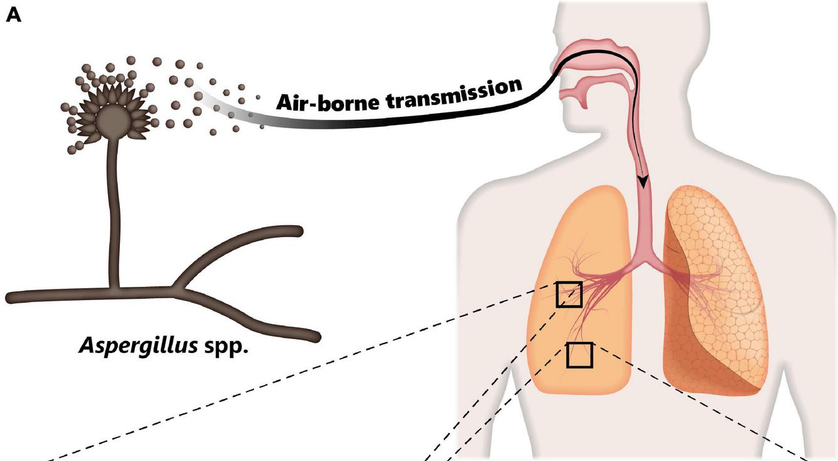
Aspergillosis: Etiological agents: Aspergillus fumigatus, A. flavus, A. niger, and A. nidulans.
- It is found everywhere, in water, soil, organic debris and household dust. Due to its ubiquity, it has caused life-threatening scenarios in immunocompromised patients.
- The most prominent species is A. fumigatus, the cause of aspergillosis, followed by A. flavus.
- The conidia are very easily dispersed in the air and are the major source of transmission. Less frequent transmission involves traumatic inoculation.
Candidiasis: Etiological agent: Candida albicans, C. glabrata, C. krusei, and C. tropicalis.
- C. albicans is the normal microbiota of the mouth, gastrointestinal tract, skin, and vagina that triggers the chances of endogenous infection during alteration of normal microbiota and host susceptibility.
- Communicable transmission is seen in neonatal oral candidiasis in infants whose mother is suffering from vaginal candidiasis. Other transmission is through sexual intercourse, which leads to balanitis in males.
- It is also the most common nosocomial mycoses. Cross-infection occurs due to hand carriage by health workers.
- Invasive candidiasis is attributed to contaminated devices like vascular catheters or parenteral nutrition.
While seemingly a normal saprophyte that is crucial for the environment or harmless commensals is a very negligible concern for a healthy person, the public health system continues to be depleted by growing cases of mycoses caused by these entities in the immunocompromised population.
The knowledge of epidemiology has been very crucial to detect these culprits, and even though new fungi may arise to be a menace, the provided principles will forever persist to tackle the problem very systematically.
References
- Willey, J.M., Sherwood, L.M. Woolverton, C.J. (2008). Prescott, Harley and Klein’s microbiology (7th edition). McGraw-Hill.
- Greenwood, D., Barer, M., Slack, R. & Irving, W. (2012). Medical microbiology (18th edition). Churchill Livingstone Elsevier.
- Gordis, L. (2014). Epidemiology (Fifth edition, pp. 2). Elsevier Saunders.
- Pelczar, M.J., Jr., Chan, E.C.S. & Krieg, N.R. (1993) Microbiology (5th edition, pp. 676-685). Tata McGraw Hill Education Private Limited.
- Palmieri, F., Koutsokera, A., Bernasconi, E., Junier. P., von Garnier, Christophe & Ubags, N. (2022). Recent Advances in Fungal Infections: From Lung Ecology to Therapeutic Strategies with a Focus on Aspergillus spp. Front. Med, 9, Article 832510. https://doi.org/10.3389/fmed.2022.832510
- Tille, P.M. (2014). Bailey & Scott’s Diagnostic Microbiology (13th edition, pp. 705-757). Elsevier Mosby.
