Different forms of DNA- A form, B form, Z form
The right-handed double-helical Watson – Crick Model for B-form DNA is the most commonly known DNA structure. In addition to this classic structure, several other forms of DNA have been … Read more
Molecular biology is a branch of biology that deals with the composition, structure, and function of cellular molecules like proteins and nucleic acids essential for the cellular functions and mechanisms.
The right-handed double-helical Watson – Crick Model for B-form DNA is the most commonly known DNA structure. In addition to this classic structure, several other forms of DNA have been … Read more
Image Source: https://orbitbiotech.com and https://en.wikibooks.org Structure of Yeast Artificial Chromosomes A yeast artificial chromosome cloning vector consists of two copies of a yeast telomeric sequence (telomeres are the sequences at the ends … Read more
What is Primer? Primer is a short stretch of sequence that serves as an initiation point for DNA synthesis. There can be a set of primers (forward and reverse) with … Read more
What are Plasmids? Plasmids are small circular DNA fragments, double-stranded, self-replicating extra chromosomal structures found in many microorganisms. The term Plasmid was coined by Joshua Lederberg in 1952. Plasmids are … Read more
This explanation is the simplest way in which the Central Dogma of Molecular Biology is interpreted. The Dogmas A. Three general transfers B. Three special transfers C. Three unknown transfers … Read more
Transposable elements definition Transposable elements (TE) or transposons can be defined as small, mobile DNA sequences that move around chromosomes with no regard for homology, and insertion of these elements … Read more
What is Nucleoside? A nucleoside is a molecule with a pentose sugar linked to a nitrogenous base or glycosylamines. A nucleoside can also be defined as a nucleotide without a … Read more
What is Anticodon? Anticodon is a trinucleotide sequence present on one arm of the tRNA (transfer RNA) which is complementary to the sequence or codon present on mRNA (messenger RNA). … Read more
DNA stands for Deoxyribonucleic acid, a molecule that contains the instructions an organism needs to develop, live and reproduce. It is a type of nucleic acid and is one of the … Read more
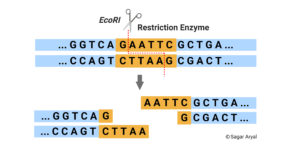
Image Source: Helixitta and Christopherrussell. Endonuclease Definition An endonuclease is a group of enzymes that cleave the phosphodiester bond present within a polynucleotide chain. Endonucleases are capable of breaking the … Read more