Skip to content
Microbe Notes

Microbe Notes

  • Home
  • All Study Notes
  • Agricultural Microbiology
  • Bacteriology
  • Basic Microbiology
  • Biochemical Test
  • Biochemistry
  • Bioinformatics
  • Biology
  • Biotechnology
  • Botany
  • Cell Biology
  • Culture Media
  • Diseases
  • Environmental Microbiology
  • Epidemiology
  • Food Microbiology
  • Genetics
  • Human Anatomy and Physiology
  • Immunology
  • Instrumentation
  • Microscopy
  • Molecular Biology
  • Mycology
  • Parasitology
  • Pharmacology
  • Phycology
  • Research Methodology
  • Staining
  • Virology
  • Zoology
  • Resources
    • Difference Between
    • Microorganisms Note
    • Microbiology Terms
    • Protocols
    • Syllabus

Parasitology

Parasitology is a discipline that studies the structure and physiology of parasites, their host, and host-parasite interactions.

  • In biology, parasites are not determined by the nature of the organism or the environment, but these are classified by their mode of life.
  • Although parasitology originated in the zoologic sciences, it is today an independent, interdisciplinary field, highly influenced by microbiology, immunology, biochemistry, and other life sciences.
  • Traditional medical parasitological studies have included studies related to three major groups of animals: parasitic protozoa, helminths, and arthropods that directly cause disease or act as vectors of various pathogens.
  • A large number of infections of humans are caused by parasites which range from relatively benign to fatal with some parasitic diseases being the cause for major human health problems throughout the world. 
  • Traditionally, parasitology has been limited to the identification of parasites, their mechanisms, and diseases caused in plants, animals, and humans.
  • Modern parasitology research is more focused on the determination of signal transduction mechanisms controlling the behavior, survival, virulence, and gene expression of parasites, which have a crucial role in influencing the outcome of the interaction between host and parasite. 
  • Parasitology has importance in veterinary and ecology, where the diseases caused by parasites in animals and the role of parasites in the ecosystem are the two major areas of focus.
  • Most parasites, unlike viruses, are not host-specific and can infect multiple hosts. These depend entirely on the living beings for their nutrients and survival.
  • Parasites can be differentiated from fungi based on their host as parasites rely on living beings while fungi depend on dead particles for survival.
  • Parasites are mostly macroscopic and belong to the invertebrate subphylum of the Animal kingdom.
  • Diagnosis of parasitic diseases is based on the identification of the infectious agent, which is mostly made through microscopic examination.
  • With the continuous emergence of new parasites and parasitic diseases, parasitology is considered a necessary scientific discipline.

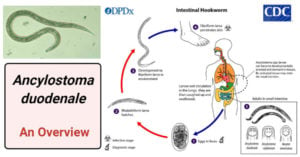
Ancylostoma duodenale- An Overview
May 4, 2022January 18, 2022 by Dr. Laxmi Neupane
Ancylostoma duodenale

What is Ancylostoma duodenale? Ancylostoma duodenale is the most dangerous parasitic roundworm, causing serious infection in humans. It is commonly known as Old World hookworm. It is common in the … Read more
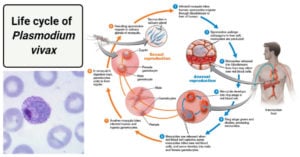
Plasmodium vivax- Life Cycle in Man and in Mosquito

January 15, 2022 by Dr. Laxmi Neupane
Life cycle of Plasmodium vivax

What is Plasmodium vivax? Plasmodium vivax is the most common of the human infecting malaria fever parasites. It is an intracellular parasite in man. It lives in the red blood … Read more

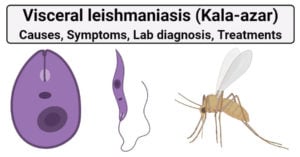
Visceral leishmaniasis (Kala-azar)- Causes, Lab diagnosis, Treatments

January 9, 2023January 14, 2022 by Dr. Laxmi Neupane
Visceral leishmaniasis (Kala-azar)

Visceral leishmaniasis is sometimes known as systemic leishmaniasis or kala-azar. Kala-azar also is known as black fever or Dumdum fever in Asia. It usually occurs 3 to 6 months after … Read more

Reproductive System of Ascaris lumbricoides

September 17, 2022January 13, 2022 by Dr. Laxmi Neupane
Reproductive system of Ascaris lumbricoides

Reproductive system of Ascaris lumbricoides Only sexual reproduction occurs in Ascaris. Sexes are separate i.e., dioecious in Ascaris and these roundworms also show distinct sexual dimorphism. Males are smaller than … Read more

Ascaris lumbricoides- Digestive, Respiration, Excretory, Nervous System

September 17, 2022January 13, 2022 by Dr. Laxmi Neupane
Ascaris lumbricoides- Digestive, Respiration, Excretory, Nervous System

Digestive System of Ascaris lumbricoides I) Alimentary canal: It is a straight and complete tube that starts with the mouth at the anterior end and ends with the anus at … Read more

Parasitology VIVA Question and Answer

September 15, 2022January 3, 2022 by Sushmita Baniya
Parasitology VIVA Question and Answer

1) What is a parasite? The organism that depends on the host (other organisms) for all of its lifecycle or for some parts of its lifecycle is known as a … Read more

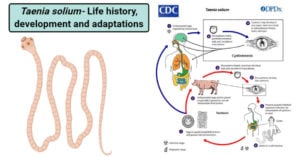
Taenia solium- Life history, development and adaptations

January 2, 2022 by Dr. Laxmi Neupane
Taenia solium- Life history ,development and adaptations

Image Source: Laboratory Diagnostic Assistance (DPDx), CDC. Life history and Development of Taenia solium 1. Copulation and fertilization The life cycle of Taenia solium is digenetic, involving two hosts. But … Read more

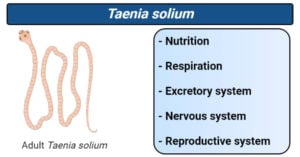
Taenia solium- Nutrition, respiration, excretory, nervous, reproductive system

January 2, 2022 by Dr. Laxmi Neupane
Taenia solium- Nutrition, respiration, excretory, nervous, reproductive system

Nutrition in Taenia solium Tapeworm completely lacks alimentation in all stages of life-history. It is clear that tapeworms absorb nutrients from their hosts and that such movement of materials from … Read more

Newer posts
← Previous Page1 Page2 Page3

Topics / Categories

  • Agricultural Microbiology (30)
  • Bacteriology (124)
  • Basic Microbiology (63)
  • Biochemical Test (114)
  • Biochemistry (177)
  • Bioinformatics (24)
  • Biology (136)
  • Biotechnology (34)
  • Botany (100)
  • Cell Biology (107)
  • Culture Media (67)
  • Difference Between (88)
  • Diseases (49)
  • Environmental Microbiology (11)
  • Epidemiology (28)
  • Food Microbiology (52)
  • Genetics (80)
  • Human Anatomy and Physiology (75)
  • Immunology (115)
  • Instrumentation (65)
  • Microscopy (31)
  • Molecular Biology (104)
  • Mycology (33)
  • Parasitology (28)
  • Pharmacology (15)
  • Phycology (2)
  • Protocols (9)
  • Research Methodology (20)
  • Staining (29)
  • Syllabus (20)
  • Virology (52)
  • Zoology (39)
Microbe Notes Android Application
  • Phytohormones (Plant Hormones): Types, Functions, Examples
  • Nipah Virus (NiV): An Overview
  • Nutrient Budget in Plants: Guide to Nutrient Management
  • Optimisation of bacterial growth analysis through microplate readers
  • Digestion and Absorption of Carbohydrates in Human Body
  • Our Team
  • Advisory Board
  • About Us
  • Contact Us
  • Editorial Policy
  • Privacy Policy
  • Cookie Policy
  • Disclaimer (Terms and Conditions)
© 2026 Microbe Notes. Made with ♡ by Sagar Aryal.