
Microscopes are instruments that are used in science laboratories to visualize very minute objects, such as cells and microorganisms, giving a contrasting image that is magnified.
Microscopes are made up of lenses for magnification, each with its own magnification powers. Depending on the type of lens, it will magnify the specimen according to its focal strength.
They function because they are constructed with specialized components that enable them to achieve high magnification. They can view very small specimens and distinguish their structural differences, for example, animal and plant cells and microscopic bacterial cells.
There are different types of microscopes, such as light, dark-field, phase-contrast, electron, and fluorescent microscopes.
Microscopes are generally made up of structural parts for holding and supporting the microscope and its components, and the optical parts that are used for magnification and viewing of the specimen images. Modern microscopes have additional electronics and display devices. This description defines the parts of a microscope and their functions that enable the visualization of specimens.
Structural parts of a microscope and their functions
There are three structural parts of the microscope, i.e., head, arm, and base.
- Head – The head is a cylindrical metal tube that holds the eyepiece lens at one end and connects to the nosepiece at the other. It is also called a body tube or eyepiece tube. It connects the eyepiece lens to the objective lens. The light coming from the objectives will bend inside this tube. In binocular microscopes, the eyepieces are adjustable so the viewer can set them for optimal viewing.
- Arm – This is the part connecting the base to the head and the eyepiece tube to the base of the microscope. It supports the microscope’s head and is also used when carrying it. Some high-quality microscopes have an articulated arm with more than one joint, allowing greater movement of the microscope head for better viewing.
- Base – The base is the lowermost part of the microscope that supports the entire microscope structure. It provides stability for the microscope. Illuminators, light switches, and electrical wiring systems are fitted in the base.

Optical parts of a microscope and their functions
The optical parts of the microscope are used to view, magnify, and produce an image from a specimen placed on a slide. These parts include:
- Eyepiece – The eyepiece (ocular Lens) is closest to the viewer’s eye. They are located at the top of the microscope. This part is used to look at the specimen. These lenses come in different magnification powers from 5X to 30X, but the most common ocular lenses are 10X or 15X. They magnify the image for the second time.
- Eyepiece tube – It’s the eyepiece holder. It carries the eyepiece just above the objective lens. In some microscopes, such as binoculars, the eyepiece tube is flexible and can be rotated to maximize visualization across varying distances. Monocular microscopes are non-flexible.
- Diopter Adjustment – A control knob present only in the binocular microscope that is used to adjust the focus of one eyepiece. It is used to correct differences in vision and compensate for differences between the viewer’s two eyes.
- Nose piece – A nose piece is a movable circular structure that houses all the objective lenses. It is also called the revolving turret. It is connected to the body tube and lies just above the stage. It can be rotated clockwise or counterclockwise to increase or decrease the magnification. The change in magnification results from a change in the objective lens.
- Objective lenses – The objective lens is the lens that is closest to the specimen. They are fitted on the nosepiece. A standard microscope has 3 to 4 objective lenses with different magnifications: 4X, 10X, 40X, and 100X. The objective lenses first receive light transmitted from the specimen and magnify the image. Objective lenses are color-coded and are of different sizes. Size and color depend on the lens’s power. The smallest lens is the lowest power, and the longest will be the highest power. The high-power lenses, i.e., 40X and 100X, are retractable; their ends can be pushed inward. In most optical microscopes, objective lenses with 100X or greater magnification are oil-immersion.
- The Adjustment knobs – Adjustment Knobs are the control knobs used to focus the microscope on the specimen. These knobs are of two types;
a. Fine Adjustment Knob: The Fine Adjustment Knob is used for fine adjustment. It is a smaller knob and is used to move the stage up or down very slowly. The stage covers a very small distance on each rotation of the fine adjustment knob. It is used to sharpen the image. It is mostly used while viewing under high power.
b. Coarse Adjustment Knob: The Coarse Adjustment Knob is used for focusing the image under low power magnification. It is a larger knob and is used to move the stage up or down very rapidly. The stage is raised or lowered rapidly using a coarse adjustment knob. - Stage – This is the section in which the specimen is placed for viewing. They have stage clips that hold the specimen slides in place. The most common stage is the mechanical stage, which allows control of the slides via mechanical knobs rather than manual movement.
- Stage Control Knobs – Stage Control Knobs are the control knobs used to move the stage mechanically. There are two knobs: one for moving left and right and the other for moving forward and backward. This will move the slide in the field of vision.
- Aperture – This is a hole in the microscope stage through which the transmitted light from the source reaches the stage.
- Microscopic illuminator – A microscopic illuminator is a light source. In some compound microscopes, a mirror that reflects light from an external source onto the sample is used. In other optical microscopes, low-voltage electric bulbs are used as a constant light source. Commonly used illuminators are tungsten-halogen lamps, 75-150W Xenon lamps, tin-halide lamps, mercury vapor lamps, etc. The selection of bulb types is based on the required intensity and wavelength for illumination.
- Condenser – These are lenses that are used to collect and focus light from the illuminator into the specimen. They are located under the stage, next to the microscope’s diaphragm. They play a major role in ensuring clear, sharp images are magnifications of 400X and above. The higher the condenser magnification, the clearer the image. More sophisticated microscopes come with an Abbe condenser that has a high magnification of about 1000X.
- Diaphragm – It’s also known as the iris. It is located under the stage of the microscope, and its primary role is to control the amount of light reaching the specimen. It’s an adjustable apparatus, thereby controlling the light intensity and the size of the beam of light that reaches the specimen. For high-quality microscopes, the diaphragm comes attached with an Abbe condenser, and combined, they are able to control the light focus and light intensity that reaches the specimen.
- Condenser focus knob – This knob moves the condenser up or down, controlling the focus of light on the specimen.
- Abbe Condenser – This condenser, specifically designed for high-quality microscopes, is movable and enables very high magnification above 400X. High-quality microscopes normally have a higher numerical aperture than objective lenses.
- The rack stop – The rack stop controls how far the stages can move, preventing the objective lens from getting too close to the specimen slide, which could damage the specimen. It is responsible for preventing the specimen slide from coming too far up and hitting the objective lens.
- Light Switch – An electrical control device. Light switches are used to turn the illuminator on and off.
- Brightness Adjustment – The brightness adjustment system controls the voltage supplied to the light bulb, thereby adjusting its intensity (brightness).
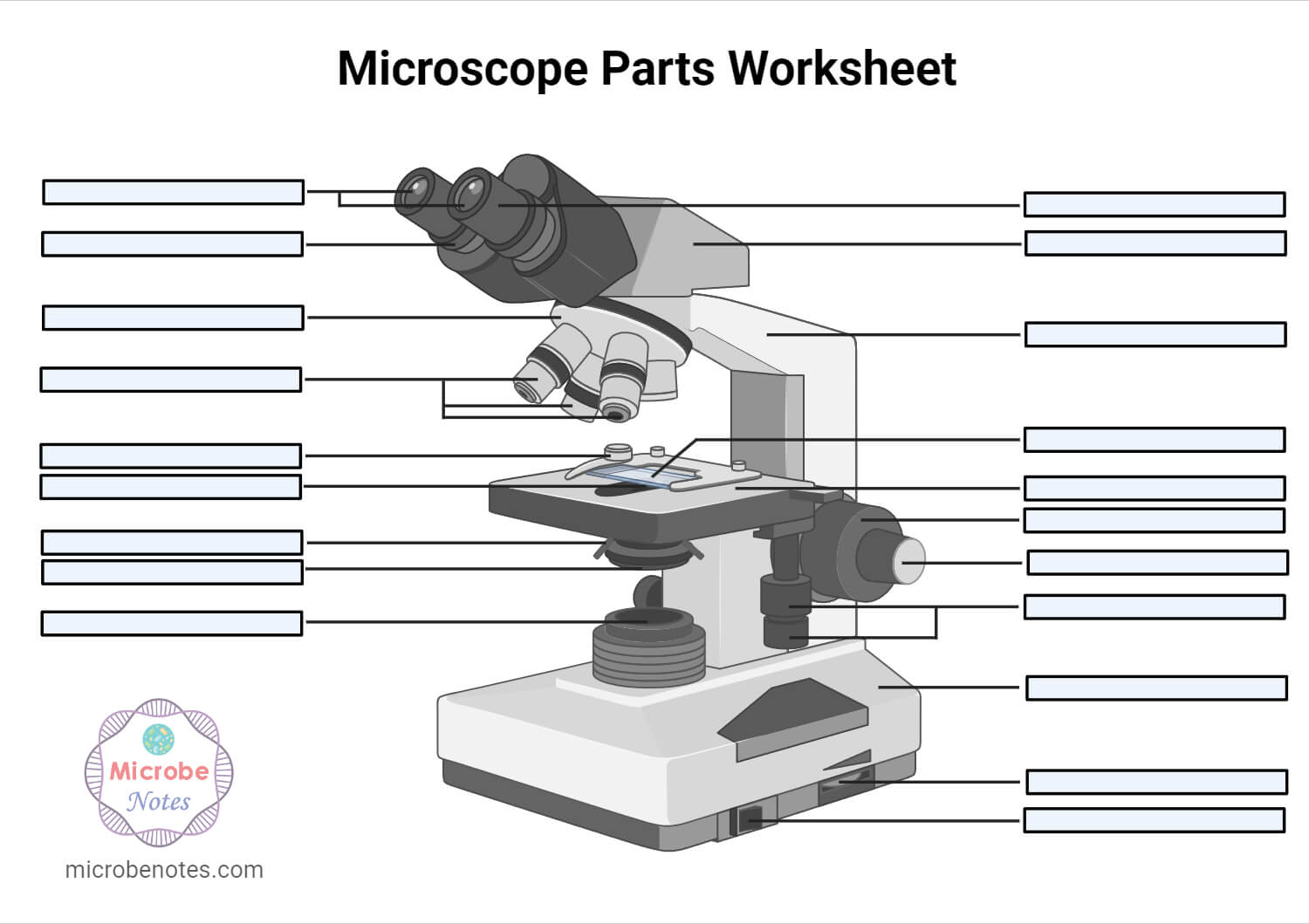
Microscope Parts Worksheet
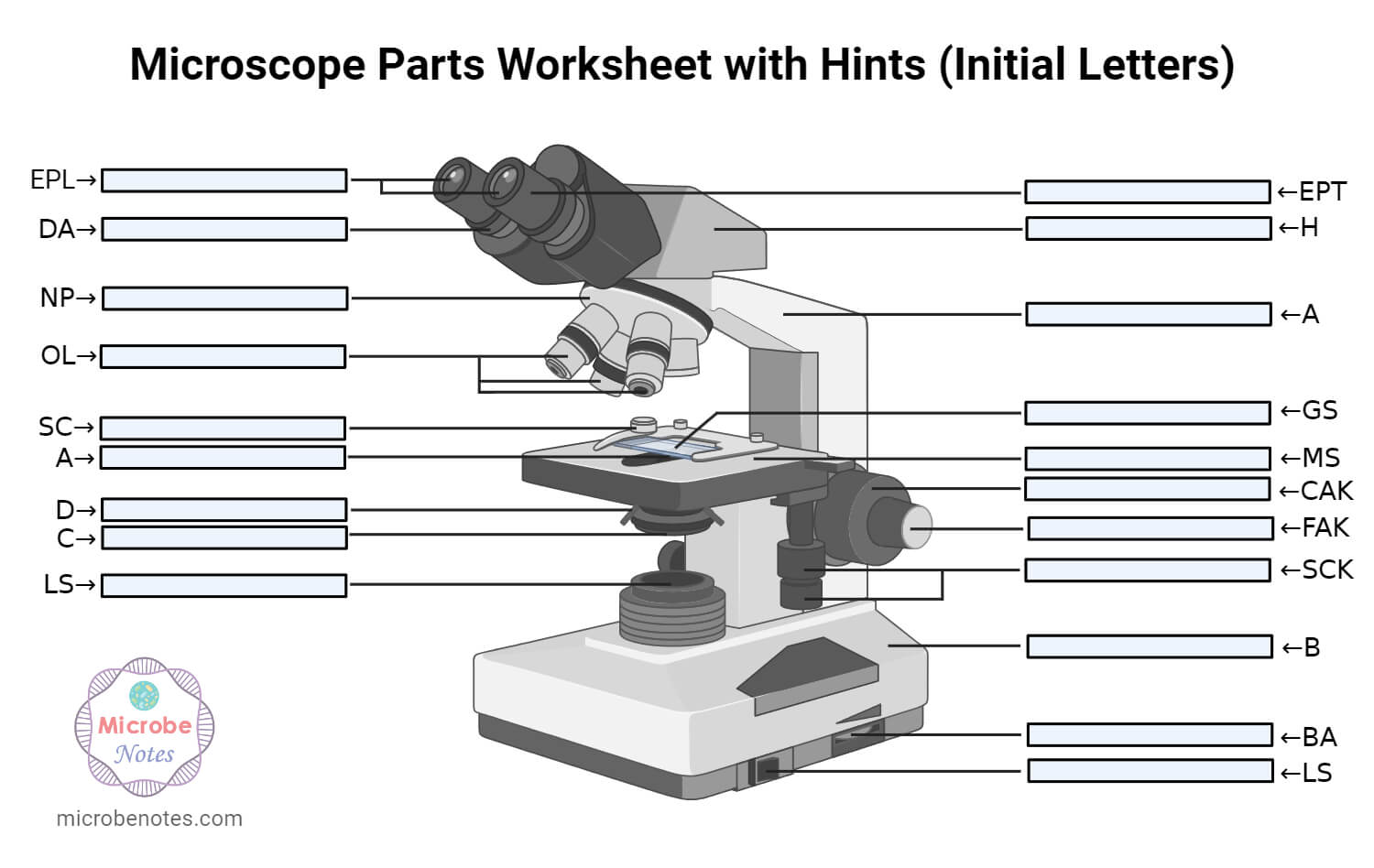
Microscope Parts Worksheet Hints
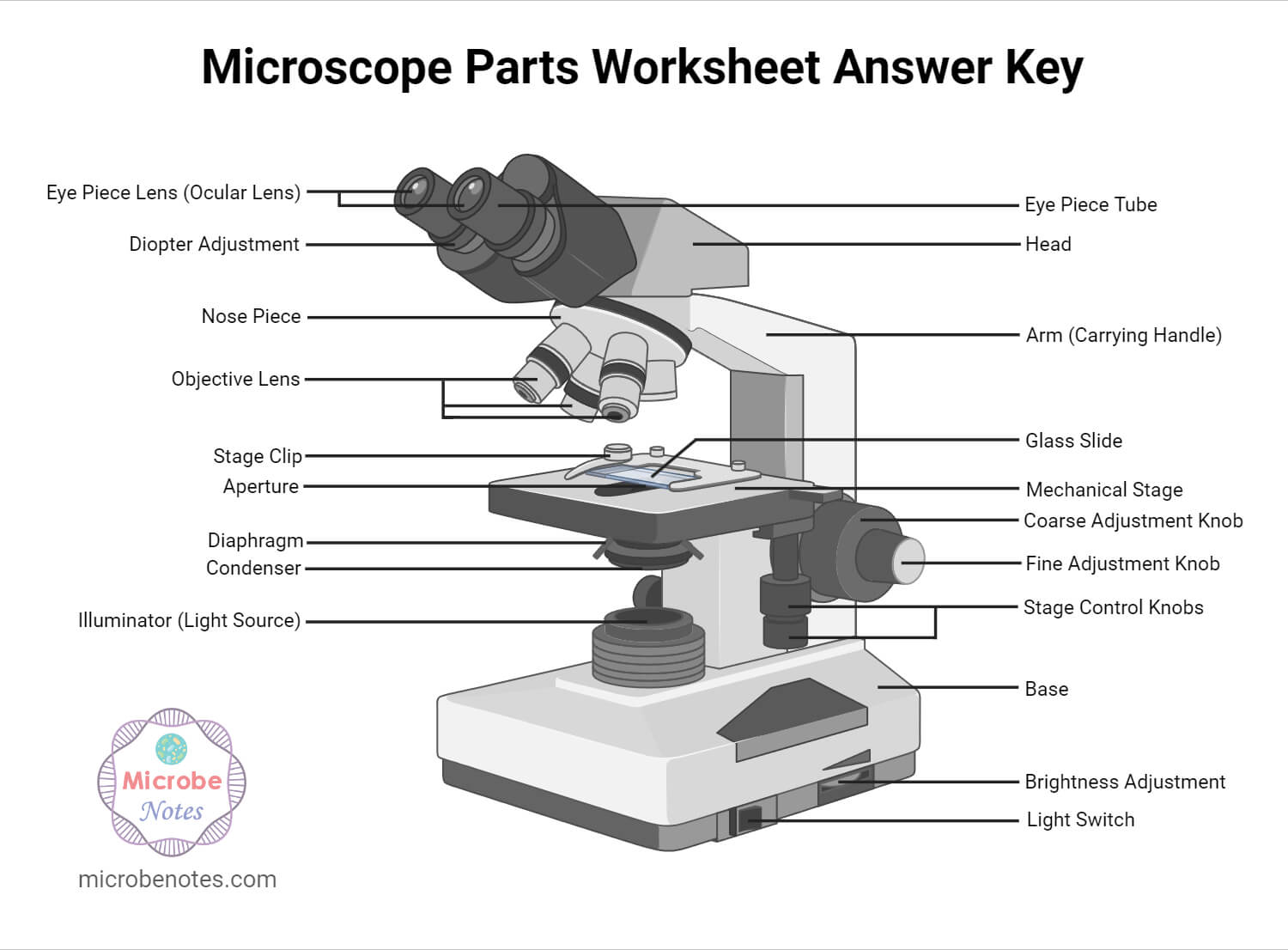
Microscope Parts Worksheet Answer Key
How Does a Microscope Work?
In a simple light microscope, a thin specimen on a slide is placed on the microscope’s stage.
A beam of light is passed through the condenser to the specimen. The light transmitted from the specimen enters the objective lens. As they pass through the objectives, the transmitted rays are spread so that they appear to come from the larger objects.
The light is then focused on the eyepiece lens. This lens further magnifies the image produced by the objectives.
Finally, a highly magnified image can be observed.
Microscope Parts Revision Questions
Q. Define a Microscope.
Ans. A microscope is an optical instrument with one or more lens systems that are used to get a clear, magnified image of minute objects or structures that can’t be viewed by the naked eye.
Add Image
Q. State the functions of a microscope.
Ans. A microscope is usually used to study microscopic algae, fungi, and other biological specimens.
Q. Differentiate between a condenser and an Abbe condenser.
Ans. Condensers are lenses that are used to collect and focus light from the illuminator onto the specimen. They are located under the stage, next to the microscope’s diaphragm. They play a major role in producing clear, sharp images that are magnifications of 400X and above. The Abbe condenser is a condenser specifically designed for high-quality microscopes, making it movable and enabling very high magnification above 400X. High-quality microscopes normally have a higher numerical aperture than objective lenses.
Q. What is the magnification power of the objective lenses?
Ans. Objective lenses have a magnification power of 40X to 100X.
Q. How does the eyepiece compare to the objective lens?
Ans. The eyepiece, also known as the ocular, is the part used to look through the microscope. It’s found at the top of the microscope. Its standard magnification is 10x, with an optional eyepiece offering magnifications from 5x to 30x. Objective Lens are the major lenses used for specimen visualization. They have a magnification power of 40x-100x. There are about 1-4 objective lenses on one microscope, with some facing forward and others facing backward.
Q. Why is the rack stop included in the microscope from the factory, and can it be replaced?
Ans. The rack stop is included in the microscope to prevent the specimen slide from coming too far up and hitting the objective lens.
Q. What is a magnification power?
Ans. The magnification of a lens is defined as the ratio of the height of an image to the height of an object. Microscope magnification measures the overall enlargement of an object’s image. Magnification power is the product of eyepiece lens power and objective lens power.
Q. Differentiate between the fine and the coarse adjustment knobs.
Ans. The coarse adjustment knob moves the stage up and down to bring the specimen into focus. The fine adjustment knob brings the specimen into sharp focus under low power and is used for all focusing when using high-power lenses.
Q. List down the 18 parts of a microscope.
- Ocular Lens (Eye Piece)
- Diopter Adjustment
- Head
- Nose Piece
- Objective Lens
- Arm (Carrying Handle)
- Mechanical Stage
- Stage Clip
- Aperture
- Diaphragm
- Condenser
- Coarse Adjustment
- Fine Adjustment
- Illuminator (Light Source)
- Stage Controls
- Base
- Brightness Adjustment
- Light Switch
Q. List down the three structural parts of a microscope.
- Head
- Arms
- Base
Q. List down the 17 parts of a microscope.
- Illuminator (Light Source)
- Diaphragm (Iris)
- Condenser
- Condenser Focus Knob
- Rack Stop
- Stage
- Stage Control Knobs
- Nose Piece
- Objective Lens
- Tube (Head)
- Eyepiece (Ocular Lens)
- Diopter Adjustment
- Adjustment Knobs (Fine Adjustment Knob and Coarse Adjustment Knob)
- Arm
- Base
- Light Switch
- Brightness Adjustment
References
- Microbiology by Lansing M. Prescott (5th Edition)
- https://www.pobschools.org/cms/lib/NY01001456/Centricity/Domain/349/TheMicroscope-howtouse.pdf
- https://sciencing.com/parts-microscope-uses-7431114.html
- https://www.amscope.com/microscope-parts-and-functions/
- https://cpb-us-e1.wpmucdn.com/cobblearning.net/dist/3/4204/files/2018/08/Parts-of-the-Microscope-103b21p.pdf
- https://www.microscope.com/compound-microscope-parts
- microscope | Types, Parts, History, Diagram, & Facts | BritannicaParts of the Microscope with Labeling (also Free Printouts) – Laboratoryinfo.com
- Parts of a Microscope – The Comprehensive Guide – Microscope and Laboratory Equipment Reviews (microscopespot.com)
- Microscope: Definition, Types, Uses, Parts & Examples | Toppr
- Simple Microscope Definition, Magnification, Parts And Uses (byjus.com)
- Phase Contrast Microscope – Definition, Principle, Parts, Uses (learninsta.com)
- What is Fluorescence Microscopy? Definition, Principle, Fluorescence & Parts – Biology Reader
- DARK FIELD MICROSCOPE: CHARACTERISTICS, PARTS, FUNCTIONS – SCIENCE (warbletoncouncil.org)
- Dissecting Stereo Microscope Parts and Functions (microscopemaster.com)

Tnk sir god bless you
Thanks very much may almighty god blessed you .you have made impact in my life
Thank you
thanks u help me in my test question
Thank So Much Sir
I Appreciate Sir
good job
awesome job we really appreciate so much for good job
Thank God bless u
Thank u and always: 67
Thanks God bless you
Thanks
verry helpful
Thank you very much for helping me in my biology homework
same.🙏🙏🙏🙏🙏🙏🙏🙏,Thank u prashant dahal for this ur nice,helpful &meaningfull work.may the almighty father bless you🙌🎉🙌🎊🙌🎉🙌🎊
Thank you for the great work 👍
thank you this was really helpful thank you
thanks very much for the update
Thanks a lot
ANHIANJOOK WAS HERE!!
WELL SUMMARIZED DEAR TUTOR!
11/08/2025
Thanks u
Good job
BRO THIS SAVED ME ON TEST DAY THANK YOU!!!!!!!!!!!!!!!!!!!!!!!!!!
thanks
Thanks
what is the name of this microscope
TRINOCULAR COMPOUND MICROSCOPE
This has shown me that making and viewing slides is an extremely important skill in Life Sciences .
Thanks
This information is self explanatory
Thanks for the explanation of the microscope I like them
thanks you so much for providing this topic for me it helps me in home work and assignment in my institutions of study
thanks you so much for providing this topic for me it helps me in home work and assignment in my institutions of study
Hello madam
Thanks for helping me to know the parts and functions of a light microscope. THANKS AGAIN AND I HOPE THAT I WILL DRAW IT IN MY EXAM
Thanks alot of your help and knowI can draw it well in my exams and write the functions.Thankyou very much for your help
It’s like you know what we are looking for, thanks!!!
(:
Thanks our bestie,, you have helped me so much,, now I will pass microbiology very well
Even me to it has help me alot
THANKS IT HELP ME ALOT SIR KEEP ON THE GOOD WORK GOD BLESS U
I’m very much thankful, I will surely pass my assignment.
Keep on the good job!
Thanks ???????? I’ll pass my assignment
Read hard
thanks for the good services
i love it
Thanks i will pass microbiology very well
Thank you it is good
Very good oogely boogely
good
Very impressive.. vivid explaination
Thanks alot
this really help me alot in my neco exam i really appreciate it
Nice work and more grace to your elbow
Thanks ????
Love it????
Nice one
this is a really good artical i used it to study my science i just wanted to point out to you that tere are a few spelling errors but other than that it is a 100% rating from me
Hello, thank you for your comment. We will correct those some spelling errors. Thanks for liking our post.
Okaay
No problem
Thanks very much dear and please continue doing so, am Gerald M from Uganda East Africa doing diploma in nursing at Mulago school of nursing and midwifery
Thanks very much dear and please continue doing so, am Gerald M from Uganda East Africa
Thank you so much it is very self explanatory you are such a person I appreciate
Tanks so much ????❤️
this is so helpful! Thank you!
THIS MAKES LEARNING EASIER
Thanks alot
Book name
This really good it helps us in
our academicks
it is really helpful giving even some self testing questions
this website has been very helpful in my assignment
it very good website i use in 4 grade right after i plai amog us and they vote me out using orang strat witch mad me sad 🙁
This is so amazing and helpful. I have learned alot????
Wow! Makes learning easier. Thanks ???????????? much.
Thanks
Thank you very much it really helped me with my science home work since i in 8th grade and this my home work to draw a microscope label all the parts and the function thank may the holy father of holy spirits bless you and give more wisdom thanks love you all keep up the good work and thank you again bye.
Thank you so much. Glad to hear that our website had helped you in your study and homework 🙂
keep up the good work.
i appreciate
its helpul
Thank you for the support u have done may the Holy Spirit from the Almighty shine upon you to have more knowledge 2 continue making more notes from various topics in microbiology????✍️
it is best work.
I am a laboratory student please send any useful informations for me please ?
yes
Well-done guys you did a great job.
It was really useful.
Really appreciated..
Thank you so much for the note that you have given to me i was so grateful to know that you are so bright people that extend your help to a student
Seriously, if i am not grateful, i am lying. This note is really helpeful to me to differet ways to different methology.
Thanks a lot for this wonderful note: It is really helpful, Really appreciate the way all the detail about microscope have been explained
Is really helping us This website thank
thank you we gland
Highly appreciated
Thank you very much
#semfungos
Phd pharmaceutical toxicology
Gisele Ferreira de Souza
Pharma D phd
I really appreciate this. Thank you God bless u
sir plz send me
“liver function test”( LFT)
We’re enjoying with all these your sensitive contribution,so that we are thanking you in advance.
Thanks and thanks
I really enjoyed thanks very much. Much love
I really appreciate for your help
Tnx alot
I can’t draw and label it. That’s the problem
It’s really helpful thanks
I love it coz it is great.????????????????????????????.
Thanks alot,,,, Like it ????????
I really appreciate your help and support, thanks a lot
Thank you it was really helpful
I love it
Enjoyable since one learns more about the microscope
it’s really good and helpful, thanks alot
I did NOT like this website sourse.
Wanna know why I didn’t like it??? I don’t like it BECAUSE my school wants me to use this website sourse. My new science teacher wants us to answer those 10 questions. I think its pretty dumb. No Offensen to anyne out there, because I am a nice person not a mean one.
Hi, all the questions of Revision Questions; Test your knowledge has been answered.
????????????????????????????????
I LOVE IT
This was really not helpful I mean do you even tell us the answers to your “test your knowledge”!
Hi, all the questions of Revision Questions; Test your knowledge has been answered.
Thanks alot it is really nice and helpful..
Thank you very much
Very good thanks
Thanks
Thank you it helps a lot but some of the parts were not indicated.. it helps alot
1. which objective lens focuses closest to object
2. what controls the light entering the binocular lenses
3. how can you enhance the resolving power of a microscope
4. what is useful and false magnification
PLEASE CAN YOU HELP ME IN ASWERING THOSE QUESTIONS
Thank you so much
I LIKE IT
understandable but small confusion
Thanks this helps more
Very helpful!!! Thank you.
Thanks much for this. We just did microscopy as a topic and the write-up has really helped me to understand better. Thanks again
Thank you very much for this great information????????
Really appreciate the way all the detail about microscope have been explained
Wonderful notes and really good work done
thats good
what are the colour codes for microscope objective and what is the purpose of these colour codes?
Same here. what is the author name?
The author’s name is Faith Mokobi
so sweet
Really appreciate to microscope producers, thank u
Thanks. It is really helpful
It is helpful.
Help me plies
Thanks this is very helpful
very intresting topic it help alot
Thanks
we done with our assignment
thank you for this but their were some parts left out like the corse adjustment knob and the fine adjustmentknob
This is very helpful
and highly appreciated
Thank you!! so much help
yes indeed it is really helpful more grace
thank you ! ❤️
Thank, it’s really helpful! I wish the writer name was there
Thanks
Thanks! This is really helpful!
This is awesome.for studies.
This is good thanks a lot
It is really helpful
Hi, Thanks for all the useful information!!!
It’s good for us to study thanks you so much
Thanks alot for this wonderful note ; it was really helpful!!!
Please author name ,books name ,published year
It is really helpful . Giving even some self testing questions!!!
good idea we can increase our performance
Hello! Thank u for helping me to do my assignment