
An epitope or antigenic determinant is a specific region or a molecular sequence present on the surface of an antigen that is recognized by a receptor of a B-cell or T- cell or by an antibody. They are immunologically active regions on a complex antigen.
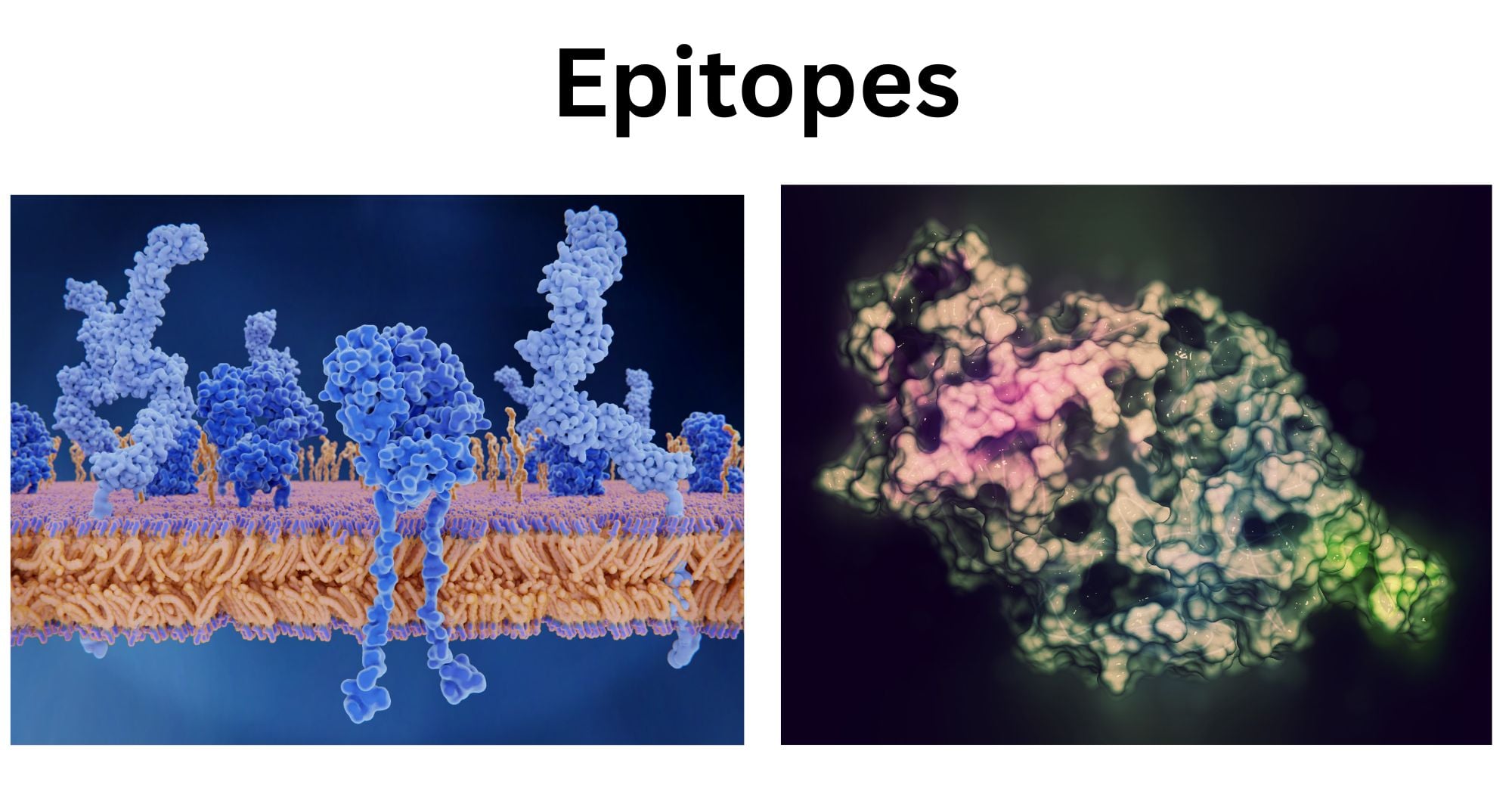
The immune response doesn’t recognize the large, complex antigen by its overall structure, but by a small, recognizable structure called an epitope. A single antigen complex might contain multiple recognition regions, or multiple epitopes, to interact with different types of antibody receptors.
Role, Size, Location, Function, and Discovery of Epitopes
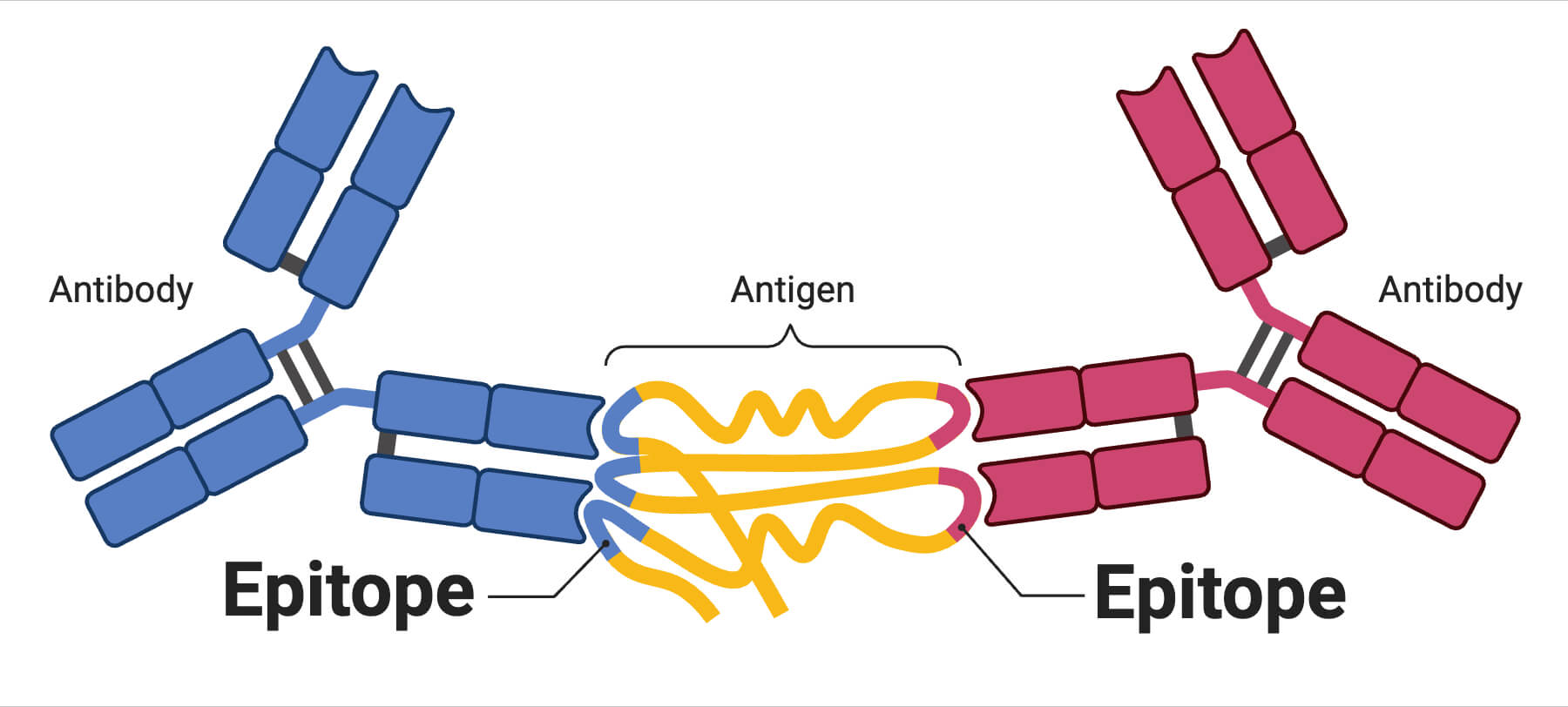
Role: Epitopes are responsible for triggering an immune response through binding, where epitopes on an antigen bind with the paratope of antibodies.
(Note: Paratope is the sequence in an antibody that binds with the epitope of an antigen)
Size: Epitopes usually comprise 5-15 amino acids or 3-4 residues of sugar.
Location: Epitopes are abundantly found on proteins and occasionally on polysaccharides.
Function: They are responsible for mediating immune responses by interacting with adaptive immune cells such as T-cells or B-cells, and other soluble antibodies.
Discovery of Epitopes: Epitopes were first described by Rachkov and Minoure in 2000, shedding light on how the immune response operates at the molecular level.
Types of Epitopes, i.e., Conformational and Linear
Epitopes are categorized into several types based on their structure and the interaction with the immune system:
Conformational epitopes
- These epitopes are formed from amino acids that are distant in the linear sequence of the protein but are brought together due to the folding of the polypeptide chain in the protein.
- They are typically folded 3-D structures arising from the tertiary and quaternary structure of proteins.
- Usually, interactions between antigen and antibody occur here.
Linear epitopes
- These types of epitopes are a contiguous sequence of amino acids.
- They are usually recognized based on their primary structure.
- Linear epitopes show resistance against denaturation as their recognition depends primarily on the linear sequence rather than the structure.
Discontinuous epitopes
- These epitopes are non-adjacent residual sequences that are brought into proximity with the folding of the protein, rather than being in linear sequence.
- They are mostly found in the case of large, folded proteins containing elements of both conformational and linear epitopes.
- Antibodies designed for vaccines mostly target discontinuous epitopes as they can induce a protective immune response.
Conformational vs. Linear Epitopes
- Linear Epitopes: Continuous sequences of amino acids.
- Conformational Epitopes: Non-linear, formed by protein folding, comprising amino acids brought together by the three-dimensional structure.
Additional Epitopes
Cryptotopes: They are hidden epitopes exposed only on denaturation or dissociation of the antigen.
Neotopes: They are formed by the juxtaposition of adjacent polypeptides. They arise from a newly formed structure within the antigen.
Metatopes: They are found both in the dissociated and polymerized forms of the antigen.
Neutralization epitopes: These are epitopes that are recognized by antibody which can neutralize the infectivity of viruses, hence efficient in vaccine development.
B-cell epitopes:
- These are specific regions in the antigen that, in their native state, are recognized by B cells.
- It is generally composed of 6-7 amino acids or sugar residues.
- It is hydrophilic, usually located at bends in protein structure and in the regions of high mobility
- B -cell epitopes have a comparatively flat structure, and smaller molecules fit into the binding grooves of the antibody molecules.
T-cell epitopes:
- These epitopes are short sequences of amino acids, not polysaccharides or nucleic acids, which are recognized by the T-cell receptor. (Proteins are T- dependent antigens, and polysaccharides are T-independent)
- T cells recognize linear epitopes derived from proteins processed by APCs.
- For a sequence to be a T-cell epitope or to be recognized by a T-cell receptor, the antigen molecule must bind to MHC molecules. Due to this, T-cell responses to the same antigen can differ across individuals due to the variability of MHC molecules among individuals.
- Peptides with higher binding affinity to MHC are more likely to be presented for TCR recognition.
- T-cell epitope size usually ranges from 8 to 15 amino acids
B-cell epitopes, which bind to immunoglobulins or antibodies, and T-cell epitopes, found on antigen-presenting cells bound to major histocompatibility complex (MHC) molecules, provide pathogen-specific immune responses. In some cases, antibodies can cross-react with similar epitopes on different antigens, although with lower affinity. This occurs when two antigens share a similar epitope, leading to potential cross-reactivity.
B-cell and T-cell Differences in Antigen Recognition
- B cells: Recognize antigens directly by interacting with the epitope.
- T cells: Recognize antigens only when the epitope is presented by antigen-presenting cells (APCs).
Binding of Epitope with Receptor
- The complementary structure of both the epitope of the antigen and the paratope of the antibody molecules results in their binding.
- The structure of the epitope and paratope fit together like the pieces of a puzzle, hence activating the B- cell production.
- Antibodies produced by B-cells due to their activation target the epitopes that bind to the antigen receptors.
- Antibodies targeting the same epitope can have different binding abilities.
- Multiple antigens can share an epitope, allowing antibodies targeted to one antigen to react with others carrying the same epitope.
(Note: Polyclonal response: Blood serum of an immunized individual often contains a mixture of antibodies that can bind with different epitopes on the surface of an antigen)
Epitope mapping
It is the process of identification of precise binding sites on an antigen that are recognized by antibodies or B-cell receptors.
Methods of mapping epitopes
- X-ray Co-crystallography: Widely used to directly visualize antibody-antigen interactions, but can be expensive and technically complex.
- Oligopeptide Scanning and HDX: Alternative methods, less expensive and easier to carry out.
- High-Throughput Methods:
- Yeast Display and Phage Display: Offer high-throughput but lack resolution, especially for conformational epitopes.
- Limited Proteolysis: Used for epitope mapping in large datasets.
Importance of epitope mapping
- It helps determine specific parts of an antigen involved in immune activation.
- It is critical for vaccine development, diagnostic purposes, and therapeutic development.
- It helps in the development of monoclonal antibodies, suggesting mechanisms such as trapping a protein in a non-functional state or blocking ligand binding.
- Therapeutic monoclonal antibodies often target conformational epitopes, present only in a protein’s native state. It is commonly used in vaccine development for diseases like Ebola and Zika.
References
- Potocnakova, L., Bhide, M., & Pulzova, L. B. (2016). An introduction to B‐cell epitope mapping and in silico epitope prediction. Journal of immunology research, 2016(1), 6760830.
- Gershoni, J. M., Roitburd-Berman, A., Siman-Tov, D. D., Freund, N. T., & Weiss, Y. (2007). Epitope mapping: the first step in developing epitope-based vaccines. BioDrugs, 21, 145-156.
- Weber, C. A., Mehta, P. J., Ardito, M., Moise, L., Martin, B., & De Groot, A. S. (2009). T cell epitope: friend or foe? Immunogenicity of biologics in context. Advanced drug delivery reviews, 61(11), 965-976.
- Parija, S. C. (2009). Textbook of Immunology (1st ed.). Elsevier.
- Kaiser, G. E. Antigens and epitopes. In Microbiology LibreTexts. Retrieved from https://bio.libretexts.org/Bookshelves/Microbiology/Microbiology_(Kaiser)/Unit_6%3A_Adaptive_Immunity/12%3A_Introduction_to_Adaptive_Immunity/12.2%3A_Antigens_and_Epitopes
- Britannica. Antibody. In Encyclopedia Britannica. Retrieved from https://www.britannica.com/science/antibody
- News-Medical. (2020). What is an Epitope? Retrieved from https://www.news-medical.net/life-sciences/What-is-an-Epitope.aspx
- Sidney, J., Peters, B., & Sette, A. (2020, August). Epitope prediction and identification-adaptive T cell responses in humans. In Seminars in immunology (Vol. 50, p. 101418). Academic Press.
