YEPD Agar- Composition, Principle, Preparation, Results, Uses

  • Yeasts are unicellular eukaryotes and extensively studied model organism in molecular genetics.
  • They are chemoorganotrophs as they utilize organic compounds as a source of energy.
  • Yeast extract peptone dextrose (YPD or YEPD) Growth Agar is used for the maintenance and propagation of yeasts including S. cerevisiae in various molecular microbiology procedures.
  • YPD functions as a complete medium for yeast growth.
Yeast Extract Peptone Dextrose (YPD or YEPD) Agar

Composition of YEPD Agar

IngredientsGms/liter
Peptone20.000
Yeast extract10.000
Dextrose20.000
Agar15.000

Final pH (at 25°C): 6.5±0.2

Principle of YEPD Agar

  • YEPD consists of yeast extract, peptone, and glucose or dextrose.
  • Yeasts grow well on a minimal medium containing only dextrose and salts.
  • The addition of protein and yeast cell extract hydrolysates allows faster growth so that during exponential or log-phase growth.
  • Yeast extract supplies B-complex vitamins and it contains all the amino acids necessary for growth.
  • Peptone acts as the source of nitrogen, vitamins, and minerals.
  • Dextrose serves as the carbon source.
  • This medium supports the vigorous growth of wild type as well as mutant strains of all kinds of budding yeast.

Preparation of YEPD Agar

  1. Suspend 65 grams of the powder in 1 liter of purified water.
  2. Mix thoroughly.
  3. Heat the agar medium with frequent agitation and boil for 1 minute to completely dissolve the powder.
  4. Autoclave the agar and broth media at 121°C for 15 minutes.
  5. Cool to 45-50ºC.
  6. Portion equally into Petri plates.

Result Interpretation on YEPD Agar

OrganismsGrowth
Kluyveromyces lactisLuxuriant growth
Saccharomyces cerevisiaeLuxuriant growth; smooth, moist, glistening colonies
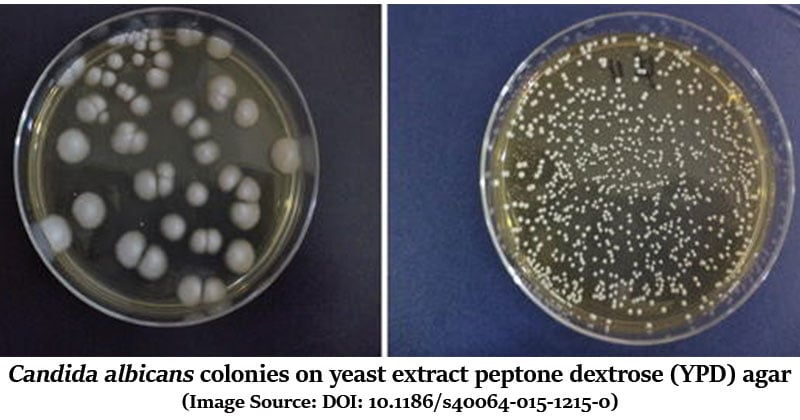
Candida albicansLuxuriant growth

 Uses of YEPD Agar

  • YEPD is used as a growth medium to grow yeast cultures.
  • It is used for the growth of Saccharomyces cerevisiae.
  • This medium supports the growth of most heterotrophic microorganisms but due to their simple composition, they have been adopted as the basal media for the routine cultivation of yeasts.
  • It is used for preparing culture media in molecular microbiology procedures.

Limitations of YEPD Agar

  • It is a non-selective medium.
  • By being a complete medium, YEPD cannot be used as a selection medium to test for auxotrophs.

References

  1. http://himedialabs.com/TD/ECG038CCL.pdf
  2. https://www.bd.com/europe/regulatory/Assets/IFU/Difco_BBL/242820.pdf
  3. http://himedialabs.com/TD/M1363.pdf
  4. http://cshprotocols.cshlp.org/content/2017/8/pdb.rec090563.full?text_only=true
  5. https://www.sigmaaldrich.com/catalog/product/sial/y1500?lang=en&region=US
  6. http://west2.amazonaws.com/owwfilespublic/8/88/DahlquistLab_YEPDliquidmedia.pdf
  7. https://www.fishersci.com/shop/products/bd-difco-dehydrated-culture-media-ypd-agar-2/p-4901518

About Author

Photo of author

Sagar Aryal, PhD

Dr. Sagar Aryal is a microbiologist, researcher, and science communicator from Nepal. He is also co-founder and Research Head of the Department of Natural Products at the Kathmandu Research Institute for Biological Sciences (KRIBS), where he leads research on natural product discovery and microbial biodiversity. Dr. Aryal earned his Ph.D. in Microbiology from Tribhuvan University, Kathmandu, Nepal, in 2025, supported by a DAAD Research Grant and a University Grants Commission (UGC) Nepal Ph.D. Fellowship. His research interests include Actinomycetes, Myxobacteria, microbial taxonomy, and natural products, particularly the discovery of bioactive compounds with potential pharmaceutical applications. He isolated and identified Nocardia nepalensis, a novel bacterial species from Nepal, contributing to understanding microbial diversity in the region. Dr. Aryal has published more than 16 research articles in international journals and contributed three book chapters to established academic publications. He has presented scientific research findings and developed international research collaborations through visits to more than 18 countries across Asia, Europe, North America, and Oceania. From 2023 to 2025, he served as the American Society for Microbiology (ASM) Young Ambassador to Nepal. Since December 2025, he has served as an Editorial Board Member of Scientific Reports, a Nature Portfolio journal. In recognition of his scientific contributions, Dr. Aryal received the NAST Science and Technology Youth Award 2025 from the Nepal Academy of Science and Technology. He previously received the Frs. Locke and Stiller Research Award (LSRA) for the 2017-2018 cycle from St. Xavier's College, Kathmandu, and a Nepal Academy of Science and Technology (NAST) Research Grant for 2017-2018. Alongside his scientific career, Dr. Aryal has more than 15 years of experience in blogging, content writing, and search engine optimization (SEO).