
Viroids are the smallest known causative agents of infectious disease, minute (246-401 nt), well-structured, circular, single-stranded RNAs devoid of detectable messenger RNA activity.
Whereas viruses have been termed ‘obligate parasites of the cell’s translational system’ and provide some or a majority of the genetic information necessary for their replication, viroids may be considered ‘obligate parasites of the cell’s transcriptional machinery’. Till today, viroids are known to infect plants only.
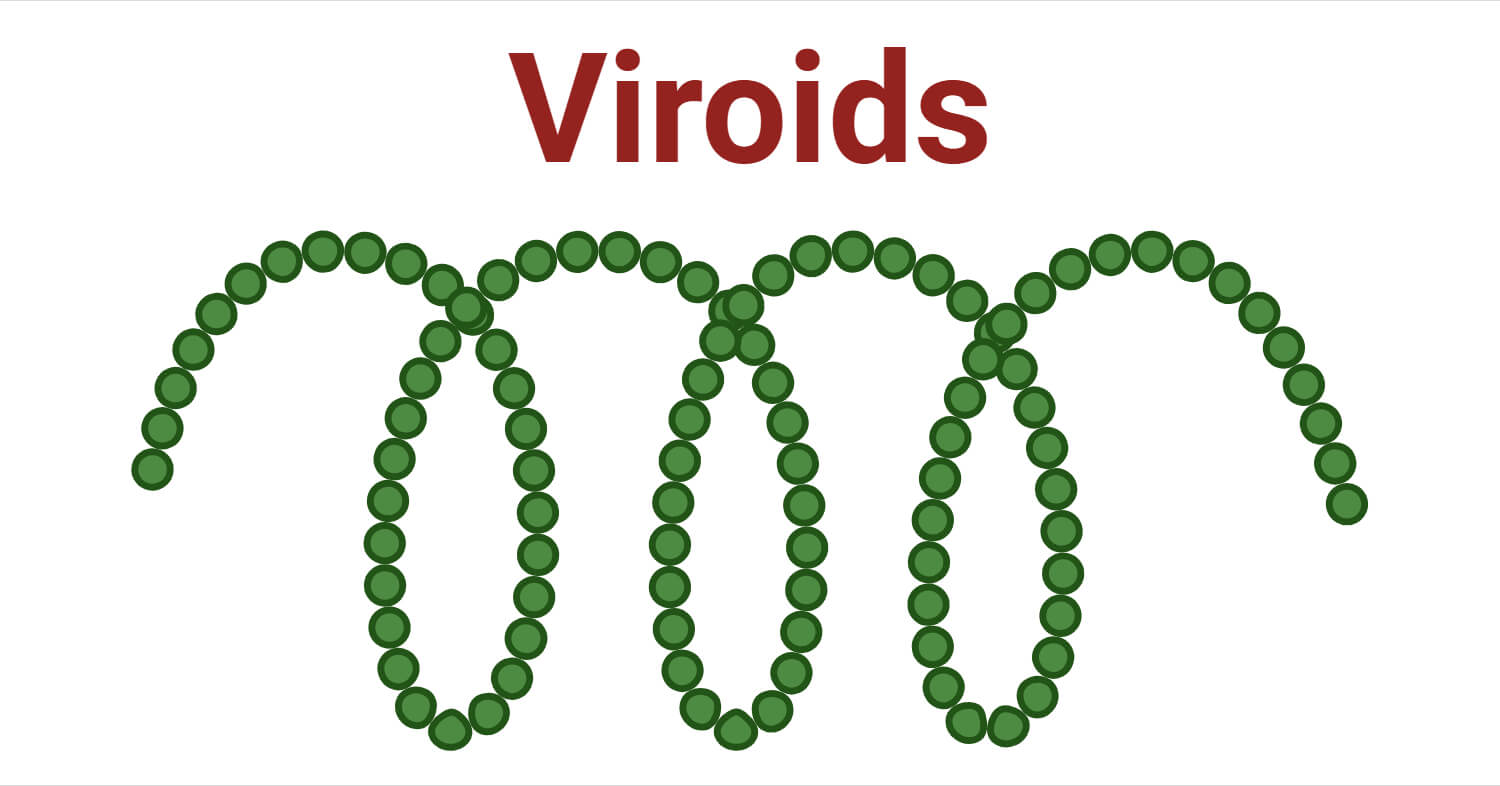
The earliest viroid disease to be investigated by plant pathologists was potato spindle tuber. In 1923, its infectivity and field transmissibility prompted Schultz and Folsom to classify potato spindle tuber disease with several other ‘degeneration diseases’ of potatoes. Almost 50 years were to pass before Diener’s demonstration in 1971 that the molecular characteristics of its causal agent, potato spindle tuber viroid (PSTVd), were qualitatively different from those of traditional plant viruses.
Classification of Viroids
According to structural and functional differences in their genomes, species of viroids are classified into either of two families, Pospiviroidae and Avsunviroidae.
Pospiviroidae
Members belonging to family Pospiviroidae (type member PSTVd) possess a rod-shaped secondary structure consisting of five structural–functional domains and several conserved motifs.
Avsunviroidae
The majority of family members Avsunviroidae (type member ASBVd), on the other hand, seem to form a branched conformation, and multimeric RNAs of all members of each family act as catalytic RNAs and perform spontaneous self-cleavage.
Distinctions in their replication sites also favor this scheme of classification; i.e., PSTVd and ASBVd replicate in the nucleus and the chloroplast, respectively, and likewise, the same seems to happen for members of each family. Each family is further divided into genera based on some demarcating criteria. Sets of sequence variants that have more than 90% pairwise sequence identity and possess some biological property in common are operationally defined as viroid species.
Within living organisms, a viroid species is a ‘quasispecies’, ie, a group of highly similar sequences undergoing a constant process of variation, competition, and selection. Phylogenetic evidence is available for an evolutionary relationship between viroids and other viroid-like subviral RNAs.
Rolling circle mechanism of Viroids
It is a different process of replication, which is employed by viroids in the host plant cells, and is quite different from that in viruses.
It occurs in the nucleus (in the Pospiviroidae family members) or in the chloroplast (in the Avsunviroidae family members).
It begins with the host DNA-directed RNA polymerase, which constructs long, multimeric, complementary-stranded RNA while operating as a template against circular viroid RNA. These multimeric strands then act as templates to form new strands of the same polarity as the parent viroid.
The newly made multimes RNAs are then processed by cleavage into unit-length monomers. In the case of Avsunviroidae, the self-cleaving ribozymes catalyse such cleavage. These linear monomers are then joined together and end up as circular molecules of viroid RNA, which enter a circle of replication. This happens without any need to synthesize protein, once more highlighting the economical and at the same time highly efficient viroid replication.
Major viroid diseases and economic impact
Different economically important crops are infected by viroids, which also result in huge agricultural losses across the world.
The most outstanding of them is Potato Spindle Tuber Viroid (PSTVd), which causes deformed, cracked, and spindle tubers and loss of up to 64 percent yields.
Coconut Cadang-Cadang Viroid (CCCVd) has destroyed Philippine coconut plantations through the induction of progressive yellowing, short linear growth, and death of affected palms.
Similarly, Citrus Exocortis Viroid (CEVd) is the causative agent of citrus plants and tomatoes that leads to scaling of the bark, reduced height growth, and produces less fruit.
Others, such as the Chrysanthemum Stunt Viroid (CSVd), which stunts flowers and height of the plant, and Hop Stunt Viroid (HSVd), which hurts hops, grapevine, and other crops.
The diseases not only limit the crops produced and quality, but also limit trade by the quarantine regulations, and incur a lot of costs to detect, eradicate, and control the diseases.
Transmission Pathways of Viroids: Seed, Pollen, Sap, and Vectors
Viroids are highly contagious pathogens, and they possess a number of mechanical and biological modes of transmission; therefore, they are so elusive that they are difficult to combat and eliminate.
Through seed– A very common route is through seed, and this is especially common in crops like potatoes and tomatoes, where contaminated seeds can be a key source of inoculum to young plants.
Pollen transmission– There have also been reported cases of pollen transmission. Viroids can be transmitted during the process of fertilization and even by the pollinating agents.
Through sap– The transpirational process of sap occurs when the tree is mechanically damaged or when some operations, such as pruning, grafting, and even the use of dirty hands and tools, occur. Viroids can enter healthy tissue via infected sap gushing into the tissue through wounds.
Through vectors– Moreover, in some studies, it has been established that insect vectors, such as aphids or sap-sucking insects, may foster indirect transmission of viroids, though they hardly cause such a phenomenon when referring to viruses. These different processes make it very important that growers, as well as authorities on plant health, should maintain high standards of hygiene and the use of certified disease-free planting stocks.
RT-PCR, Hybridization Detection, and Diagnostic Techniques of Viroids
Viroids are difficult to detect using conventional virus-detection methods because of their tiny size and the fact that they do not contain protein coats. That is why highly sensitive molecular techniques have been used in accurate detection and diagnosis.
One of the most accurate and frequently used techniques is reverse transcription polymerase chain reaction (RT-PCR), where viroid RNA may be amplified following reverse transcription to complementary DNA (cDNA). It is a highly sensitive technique that can detect low levels of viroid occurrence even in symptomless plants.
The second technique is nucleic acid hybridization, where the probe that consists of a DNA or RNA sequence complementary to the genome of the viroid will be used to bind with specific viroid RNA present in the sample. It is extensively used in the field of diagnosis and as a quarantine screening tool.
More rapid methods, such as real-time PCR, loop-mediated isothermal amplification (LAMP), and next-generation sequencing (NGS), are additionally sought after with the desire to attain greater speed and sensitivity of detection.
All these diagnostic aids are significant in surveillance, certification of the plant sources, and quarantine regulation.
Host range and symptom diversity of Viroids
Host plants of viroids are widely ranged and are known to infect more than 200 plant species, including the economically significant agricultural and horticultural crops. However, the symptoms of viroid infection can vary drastically depending on the host species and strain of the viroid, as well as some other environmental factors. In other cases, viroid infections are also symptomless, and thus they are very difficult to identify in time.
Stunting, leaf curling, leaf yellowing, epinasty (downcurving of the leaves), reduction in flowering, and abnormal fruit development are seen as symptomatic infections.
PSTVd in tomatoes causes dwarfism and brittle stems, and CEVd in citrus causes bark scaling and fruit quality. Viroids, including CSVd, stunt chrysanthemums, and HSVd, cause flower bud delay in hop and grapevine.
The symptoms of the different viroid diseases often appear to be like a nutrient deficiency or a viral infection and therefore can easily be mistaken, unless molecular resources are used. Understanding the species span and symptom variation is necessary to prevent outbreaks and manage crop losses.
Plant Defense Responses to Viroid Infection
The non-coding RNA structure of the viroid does not leave plants without defense mechanisms against the infection because many defense mechanisms are employed when it gets infected. The main defense mechanism is a set of RNA silencing, in particular, post-transcriptional silencing of genes (PTGS), which is activated by synthesis of viroid double-stranded RNA intermediates during replication.
Dicer-like (DCL)-recognizes these dsRNAs, which are cut into small interfering RNAs (siRNAs). The siRNAs subsequently trigger the mechanism causing Argonaute (AGO) proteins to target and destroy pairing viroid RNAs.
Moreover, systemic acquired resistance (SAR) and pattern-triggered immunity (PTI) can be activated by the influence of viroid infections, but this is less well comprehended. DNA methylation and histone modifications as epigenetic changes are also caused by some viroids that influence host gene expression.
Viroid infections are so subtle, and the ability to take advantage of host transcriptional machinery makes plant defense responses slow in some cases, incomplete, resulting in persistent infections. Therefore, knowledge of these responses is important in creating viroid-resistant plant varieties using biotechnology and breeding.
Quarantine methods and Control strategies of Viroids
Viroid infections are quite tricky to deal with because they are highly contagious and even have the resilience to stick around in the host. Thus, the control strategies of forming and early diagnosis are the most efficient ones.
It is imperative to use international certification for viroid-free seeds and propagation materials. Reduction can be obtained through cultural practices like sanitizing pruning tools, crop rotation, and elimination of diseased plants in the field.
The use of thermotherapy and meristem tip culture in tissue culture involves removal of viroids from plant stocks.
Tight quarantine policies and programs of surveillance are placed to avoid the importation and transfer of viroids, most particularly when it comes to international trade. Countries have specific exclusion lists with viroids and require molecular testing (such as RT-PCR) of trade or imported plant material.
It is also necessary to educate farmers and nursery operators on viroid symptoms and hygienic behaviours. The viroid control is still based on the integrated management practice of hygiene and regulatory measures, and achieving population awareness.
Main differences between viroids and viruses
- Although both viruses and viroids are infectious agents, they exist basically in different structures, makeup, and replication.
- The viroids are known to be the tiniest plant pathogens, which contain naked circular single-stranded RNA without a protein jacket. They do not code any protein and depend completely on host enzymes to replicate.
- Viruses, however, consist of either RNA or DNA and are embedded in a protein shell (capsid), and most viruses also carry the code to make their proteins to trigger replication and infection.
- Viroids only infect plants and not animals or humans, unlike viruses. Change in the replication process is on a rolling-circle process, in the nucleus or chloroplasts of viroid, and in the cytoplasm or nucleus, depending on the virus.
Directions of Future Research on Viroids
The future scientific interest is expected to be on the host-viroid, such as on the molecular level interaction and host gene regulation and evasion of immune challenges by the viroids.
A viable prospect is the production of plant varieties resistant to viroids with CRISPR/Cas systems and RNA interference.
Bioinformatics and high-throughput sequencing will assist in discovering new species of viroids and strain variation in asymptomatic hosts. Besides, research characterizing the epigenetic effects of viroid infection and its consequences to crop yield and crop development will also be relevant to plant biotechnology.
Research on the effect of climate change on viroid distribution and virulence is also coming into focus as environmental research. The development of global data and common diagnostic procedures will increase collaborative surveillance, quarantine, and control.
Conclusion
Viroids, in their simple RNA-based form, are a major agricultural threat to world agriculture with their capability to infect silently and destroy economically valuable crops. Their characteristic replication mode, absence of coding ability, and complex interactions with plant defense systems make them both biologically interesting and agriculturally vital. Concerted activities in diagnostics, breeding, molecular studies, and quarantine regulation are needed to contain their spread and influence. With increasing knowledge about viroids, it will open up avenues for more efficient and durable methods of crop protection.
References
- Sharma, O. P. (2022). Plant Pathology. Meerut: Rastogi Publications.
- Singh, R. S. (2017). Plant Diseases (10th ed.). Lucknow: Oxford & IBH Publishing Co. Pvt. Ltd.
- Saraswat, K. (2025, June 4). Viroids, Definition, Types, Characteristics, and diseases. Physics Wallah. https://www.pw.live/neet/exams/viroids
- Kumar, V. (2025, June 30). Overview of Viroids, Satellites and prions. Microbiology Notes. https://microbiologynotes.org/overview-of-viroids-satellites-and-prions/
- P, A. (2016, November 28). Viroids: Origin, Meaning and Replication | Microbiology. Biology Discussion. https://www.biologydiscussion.com/viruses/plant-viruses/viroids-origin-meaning-and-replication-microbiology/65632
- Ortolá, B., & Daròs, J. (2023). Viroids: Non-Coding circular RNAs able to autonomously replicate and infect higher plants. Biology, 12(2), 172. https://doi.org/10.3390/biology12020172
- National Council of Educational Research and Training. (2006). Biology: Textbook for Class XI (pp. 123–125). NCERT. https://ncert.nic.in/textbook.php?keeb1=0-13
- Dev. (n.d.). Viroids. SlideShare. https://www.slideshare.net/slideshow/viroids/35174855
- Gerald J. Tritz, Ph.D., Department of Microbiology/Immunology, KCOM. (n.d.). Prions & viroids. https://www.atsu.edu/faculty/chamberlain/website/lects/prions.htm
- Libretexts. (2024, November 23). 9.6B: Viroids. Biology LibreTexts. https://bio.libretexts.org/Bookshelves/Microbiology/Microbiology_(Boundless)/09%3A_Viruses/9.06%3A_Subviral_Entities/9.6B%3A_Viroids
