
One Health is an approach to studying infectious diseases that acknowledges the strong interconnections between humans, animals, plants, and the environment (Pitt and Gunn, 2024). This approach is essential for addressing intertwined health and environmental challenges while advancing global health.
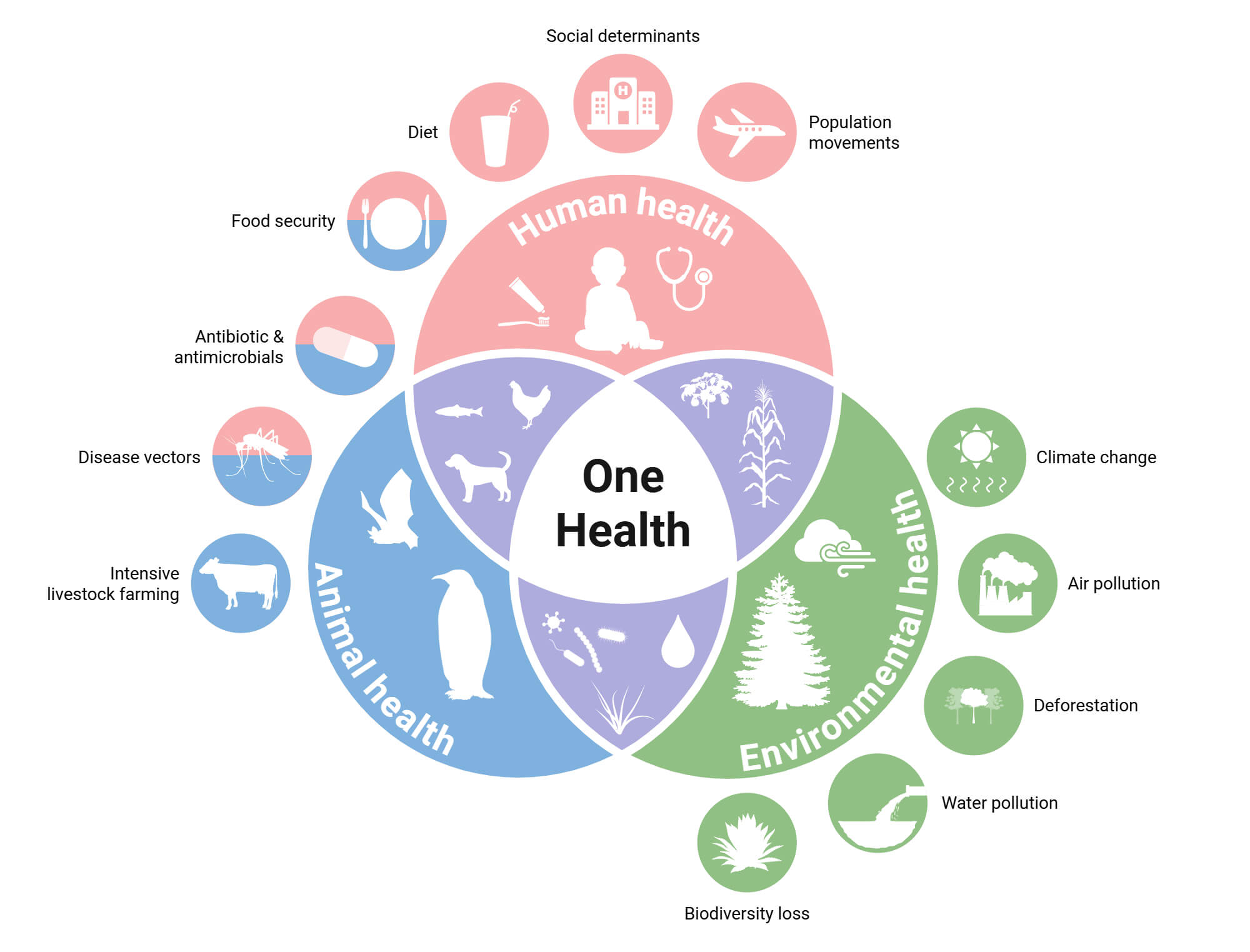
Collaborative efforts across various sectors are crucial for achieving sustainable development goals and tackling emerging health threats. Consequently, national and international cooperation has been strengthened in response to factors such as climate change and the COVID-19 pandemic (Pitt and Gunn, 2024; Danasekaran, 2024).
Understanding the One Health Approach
The United Nations (UN) Sustainable Development Goals (SDGs) are closely aligned with the one health approach, as they encompass objectives related to health and well-being, clean water and sanitation, climate action, and the sustainability of both marine and terrestrial ecosystems. Recognizing the necessity of cross-disciplinary and multinational collaboration, four major global organizations have formed the One Health Quadripartite:
- The World Health Organization (WHO)
- The World Organization for Animal Health (WOAH, formerly OIE)
- The United Nations Food and Agriculture Organization (FAO)
- The United Nations Environment Programme (UNEP)
These organizations have identified six key focus areas within the One Health framework;
- Laboratory Services
- Control of Zoonotic Diseases
- Neglected Tropical Diseases
- Antimicrobial Resistance (AMR)
- Food Safety
- Environmental Health
Historical Development of the One Health Concept
The concept of One Health is not new. It was previously known as “One Medicine and One World” before evolving into “One Health” (Danasekaran, 2024). The interactions between ecosystems, animal populations, and human populations have consistently influenced historical events. Below are some of the historical developments that have contributed to the One Health approach.
Ancient Foundation:
The concept of One Health has deep historical roots. Hippocrates (460-370 BCE), in his work “On Airs, Waters, and Places”, emphasized the connection between human health and the environment, laying an early foundation for One Health thinking (Evans and Leighton, 2014). Similarly, in ancient India, King Ashoka (304-232 BCE) implemented policies to enhance both human and animal health, such as planting medicinal herbs and constructing wells for communal use (Lerner and Berg, 2015).
19th Century Developments:
German physician and pathologist Rudolf Virchow (1821-1902) introduced the term “zoonosis” to describe diseases transmissible between animals and humans. He strongly advocated for an integrated approach to studying both animal and human health (Evans and Leighton, 2014). During this period, the recognition of similarities in disease processes between humans and animals began to gain traction, further reinforcing the foundations of the one health approach (Evans and Leighton, 2014).
20th Century Developments:
Calvin Schwabe (1927-2006), often regarded as the father of modern One Health, introduced the term “One Medicine” in the mid-20th century. He emphasized the importance of collaboration between veterinary and medical sciences to address zoonotic diseases (Pitt and Gunn, 2024; Evans and Leighton, 2014). Early efforts primarily focused on infectious diseases and zoonoses, laying the groundwork for the broader integration of disciplines within the One Health approach.
Modern Era (21st Century):
The One Health framework was formalized with the Manhattan Principles at the “One World, One Health” conference organized by the Wildlife Conservation Society in 2004. These Principles emphasized the need for collaboration among global organizations, including the World Health Organization (WHO), the Food and Agriculture Organization (FAO), and the Centers for Disease Control and Prevention (CDC), to address health at the human-animal-environment interface (Pettan-Brewer et.al., 2024; Evans and Leighton, 2014). Building on this, the One Health Initiative, established in 2007 through collaboration between the American Veterinary Medical Association (AVMA) and the American Medical Association (AMA), led to the formalized effort to promote One Health globally (Pettan-Brewer et.al., 2024). Over time, the concept has expanded to incorporate ecosystem health and planetary health perspectives (CDC, 2024).
Core Principles of One Health
Interconnection between Human, Animal, and Environmental Health
The interconnection between human, animal, and environmental health is evident in the shared health risks and environmental influences. Zoonotic diseases, such as Rabies, Ebola, and Lyme disease, demonstrate how pathogens can transfer between animals and humans due to close interactions, with environmental factors like deforestation and climate change playing a significant role in their spread (CDC, 2024). Animals often act as early indicators of environmental hazards that can affect human health; for instance, bird deaths from West Nile Virus can signal risks to nearby human populations (CDC, 2024). Changes in land use, such as deforestation and urbanization, as well as climate disruptions, create opportunities for diseases to emerge and spread. Intensive farming practices further contribute to antimicrobial resistance and food safety concerns (CDC, 2024; World Health Organization, 2022). Additionally, pollution and habitat destruction impact ecosystems, which in turn affect the health of both humans and animals (World Health Organization, 2023; Evans and Leighton, 2014).
Collaborative Multisectoral and Transdisciplinary Strategies
One Health promotes collaboration across human health, animal health, and environmental sectors, emphasizing joint planning, resource sharing, and integrated responses to health threats (World Health Organization, 2022; TDR, 2025). Organizations such as WHO, FAO, UNEP, and OIE collaborate through initiatives like the One Health Joint Plan of Action to mainstream and operationalize One Health at global, regional, and national levels (Dar et.al., 2024; WHO, 2022). Community engagement is also crucial, as involving local communities and stakeholders ensures that interventions are culturally appropriate and sustainable, which includes participatory meetings and joint training programs (Breakthrough ACTION, 2024; Zinsstag and Crump, 2023).
In terms of multisectoral strategies, coordinated surveillance systems across human, animal, and environmental health sectors enhance early detection and responses to zoonotic diseases and other health threats (Ghai et.al., 2022; ICF, 2021). Joint outbreak investigations by multisectoral teams improve response efficiency and reduce costs, as seen in response to monkeypox, leptospirosis, and Rift Valley fever (Ghai et.al., 2022).
The transdisciplinary approach of One Health integrates expertise from diverse fields, including public health, veterinary medicine, ecology, and social sciences, to address health challenges comprehensively (Dar et.al., 2024; Kelly et.al., 2017). Capacity building through training programs and workshops fosters interdisciplinary collaboration, equipping professionals with the skills necessary to implement One Health approaches (World Health Organization, 2022; Breakthrough ACTION, 2024).
Furthermore, research and innovation are essential, with initiatives like the PREDICT project focusing on the early detection of zoonotic viruses and health risks at the human-animal-environment interface (Kelly et.al., 2017).
Importance of One Health in Addressing Global Health Challenges
Emerging Infectious Diseases and Zoonoses
Over 75% of emerging infectious diseases are zoonotic, originating from animals. One Health promotes early detection and response to zoonotic diseases, such as Ebola, Rabies, and Avian flu, by integrating surveillance across human, animal, and environmental sectors (Erkyihun and Alemayehu, 2022; Ghai et.al., 2022). Mitigating pandemic risks became particularly evident during the COVID-19 pandemic, which underscored the need for One Health in addressing zoonotic spillover events. Collaborative efforts help reduce risks associated with factors like wildlife trade, deforestation, and climate change (World Health Organization, 2022; Bayerlein and Villarreal Lizárraga, 2023).
Antimicrobial Resistance and Its Global Impact
One Health addresses the misuse and overuse of antimicrobials in human medicine, agriculture, and animal husbandry, which contribute to antimicrobial resistance (AMR). Collaborative strategies across sectors are essential for implementing stewardship programs and reducing the spread of resistant pathogens (Global AMR R&D Hub, 2024; Velázquez-Meza et al., 2022). Holistic Solutions: By linking human, animal, and environment, One Health fosters research and policies aimed at preserving the effectiveness of antimicrobials and mitigating global AMR threats (Global AMR R&D Hub, 2024; Velázquez-Meza et al., 2022).
Food Safety and Security Concerns
One Health promotes a holistic approach to food safety by addressing contamination risks at every stage of the food chain, from production to consumption. This approach helps reduce foodborne illness, which affects millions annually, particularly in vulnerable populations (Food and Agriculture Organization of the United Nations, World Health Organization for Animal Health, and World Health Organization, 2022).
Initiatives like the One Health Joint Plan of Action (OH JPA) and the Quadripartite (FAO, UNEP, WHO, WOAH) provide structured pathways for countries to implement One Health strategies, enhancing global health security (Food and Agriculture Organization of the United Nations, 2025). Policy Integration: One health advocates for multi-sectoral policies that address health risks holistically, ensuring efficient resource use and coordinated responses to health emergencies (Food and Agriculture Organization of the United Nations, 2025; Bayerlein & Villarreal Lizárraga, 2023).
Applications of One Health
One Health links human, animal, and environmental health to prevent zoonotic diseases, combating antimicrobial resistance through responsible antibiotic use, and food safety by uniting medical and veterinary sciences. It promotes biodiversity, addresses climate change, and strengthens global health security through coordinated action by organizations such as WHO, FAO, OIE, and UNEP (WHO, 2022; Feng et.al., 2022; Agarwal et.al., 2024; Rai et.al., 2024).
- Prevention and Control of Zoonotic Diseases
- Antimicrobial Resistance (AMR)
- Food Safety and Security
- Ecosystem Health and Biodiversity Conservation
- Global Health Security
- Climate Change and Vector-Borne Diseases
Case Studies Demonstrating One Health in Action
Role in Pandemic preparedness and responses: The COVID-19 pandemic has highlighted the need for a coordinated strategy that connects human, animal, and environmental health. The One Health approach improves pandemic preparedness and response by focusing on early detection, rapid action, and preventive measures. It supports the development of predictive models and risk assessment tools to forecast pandemics and identify factors like habitat destruction, wildlife trade, and climate change. One health drives investment in research on emerging infectious diseases to understand their origins and transmission. By integrating these elements, One Health provides a proactive framework to prevent future pandemics (Danasekaran, 2024).
Organizations and Initiatives Promoting One Health
World Health Organization (WHO)
WHO integrates the One Health approach into global health policies, focusing on the prevention, detection, preparedness, and management of zoonotic diseases, antimicrobial resistance, and food safety (WHO, 2022).
Centers for Disease Control and Prevention (CDC)
CDC applies the One Health approach to address zoonotic diseases, antimicrobial resistance, vector-borne diseases, and environmental contamination. It fosters collaboration among human health professionals, veterinarians, ecologists, policymakers, and communities to enhance global health security (CDC, 2024).
Food and Agriculture Organization (FAO)
FAO promotes One Health in agriculture by focusing on food safety, livestock health, and the prevention of zoonotic diseases (WHO, 2023).
World Organization for Animal Health (WOAH)
WOAH focuses on animal health as a critical component of One Health. It contributes to disease surveillance, veterinary capacity building, and reducing zoonotic risks (WHO, 2023).
United Nations Environment Programme (UNEP)
UNEP focuses on the environmental dimension of One Health by addressing issues like habitat fragmentation, biodiversity loss, and climate change’s impact on health (WHO, 2023).
Global Health Security Agenda (GHSA)
GHSA promotes international collaboration to strengthen surveillance systems and response mechanisms for zoonotic diseases and antimicrobial resistance through One Health (Delesalle et.al., 2022).
Challenges and Future Directions in Implementing One Health
There have few challenges in implementing One Health. Among these, a few are given below (Pepin et.al., 2024; Kaylor, 2025; WHO, 2023).
- Lack of Cross-sector Coordination
- Data Sharing and Governance Issues
- Resource Constraints
- Disciplinary Bias and Communication Barriers
- Infrastructure Limitations
- Overlap with other Models
- Global Alignment Challenges
There are a few future directions according to Mumford et.al., WHO (2023), 2023; Kaylor, 2025, which are given below,
- Expanding Scope and Inclusivity
- Strengthening Governance Frameworks
- Improving Data Systems
- Capacity Building
- Community Engagement
- Long-term Investment in Research
- Global Collaboration
Barriers to Multisectoral Collaboration
Governance and leadership deficits, resource constraints, sectoral silos, and communication gaps present significant challenges in the implementation of the One Health approach. A lack of political will and a weak institutional framework often prevent governments from prioritizing One Health (Sanga et.al., 2024). Policy fragmentation across sectors, such as health, agriculture, and the environment, hinders coordination, with Nepal’s federal restructuring causing delays in multisectoral action plans (Yopa et.al., 2023; Hussein et.al., 2025). Gaps in institutional awareness and limited evidence on the health benefits of conservation efforts weaken intersectoral collaboration (Sanga et.al., 2024; International Union for Conservation of Nature, 2024).
Strategies for Enhancing Global Health Security through One Health
- Strengthening multi-sectoral Governance
- Enhancing Surveillance and Data Sharing
- Combating Antimicrobial Resistance
- Fostering Global and Regional Collaboration
- Prioritizing Equity and Community Engagement
Conclusion
The One Health approach offers a powerful, integrated framework to address the complex and interconnected health challenges. This approach connects human, animal, and environmental health to tackle global health challenges like zoonotic diseases, antimicrobial resistance (AMR), food safety, and climate change. It also emphasizes cross-sector collaboration despite various challenges. This approach will be a key to realizing in building a healthier, more resilient world.
References
- Agarwal, K., Srivastava, S., Singh, V., Rohilla, R., Zaman, K., Rukadikar, A., Singh, P., Hada, V., Mohanty, A., Rath, R. S., Kishore, S., & Sah, R. (2024). One health concept and its applications in clinical practice: A comprehensive review. The Evidence, 2(1). https://doi.org/10.61505/evidence.2024.2.1.16
- Bayerlein, M., & Villarreal Lizárraga, P. A. (2023, July 27). “One health” and global health governance. Stiftung Wissenschaft Und Politik (SWP). https://www.swp-berlin.org/publikation/one-health-and-global-health-governance
- Breakthrough ACTION. (2024, September 3). Promoting multisectoral collaboration for resilient health systems through one health. Breakthrough ACTION and RESEARCH. https://breakthroughactionandresearch.org/resource-library/promoting-multisectoral-collaboration-for-resilient-health-systems-through-one-health/
- CDC. (2024a, April 24). One health history. One Health. https://www.cdc.gov/one-health/about/one-health-history.html
- CDC. (2024b, November 21). About one health. One Health. https://www.cdc.gov/one-health/about/index.html
- Convention on Biological Diversity. (2016). One Health in action: Case studies to support implementation. https://www.cbd.int/health/onehealth-casestudies2016-final-en.pdf
- Danasekaran, R. (2024, April). One health: A holistic approach to tackling global health: Indian Journal of Community Medicine. LWW. https://journals.lww.com/ijcm/fulltext/2024/49020/one_health__a_holistic_approach_to_tackling_global.5.aspx
- Dar, O. A., Akhbari, M., & Nacer, H. (2024a). Multisectoral One Health collaborations across human, animal and environmental health: A protocol paper for an umbrella systematic review of conceptual and analytical approaches to sustainability – PMC. BMJ Open, 14(12). https://doi.org/10.1136/bmjopen-2024-086248
- Dar, O. A., Akhbari, M., & Nacer, H. (2024b). Multisectoral One Health collaborations across human, animal and environmental health: A protocol paper for an umbrella systematic review of conceptual and analytical approaches to sustainability – PMC. BMJ Open, 14(12). https://doi.org/10.1136/bmjopen-2024-086248
- Delesalle, L., Sadoine, M. L., Mediouni, S., Denis-Robichaud, J., Zinszer, K., Zarowsky, C., Aenishaenslin, C., & Carabin, H. (2022). How are large-scale One Health initiatives targeting infectious diseases and antimicrobial resistance evaluated? A scoping review. One Health, 14, 100380. https://doi.org/10.1016/j.onehlt.2022.100380
- Erkyihun, G. A., & Alemayehu, M. B. (2022). One health approach for the control of zoonotic diseases. Zoonoses, 2. https://doi.org/10.15212/ZOONOSES-2022-0037
- Evans, B. R., & Leighton, F. A. (2014). A history of One Health. Rev Sci Tech, 33(2), 413-420.
- Feng, X., Wang, S., Cheng, G., Guo, X., & Zhou, X. (2022). Frontiers. Frontiers in Microbiology, 13. https://doi.org/10.3389/fmicb.2022.1089174
- Food and Agriculture Organization of the United Nations. (2025, February 25). One Health global policies and declarations. OneHealth. https://www.fao.org/one-health/highlights/one-health-global-policies-and-declarations/en
- Food and Agriculture Organization of the United Nations, World Organisation for Animal Health, & World Health Organization. (2022). One Health and food safety. https://rr-asia.woah.org/app/uploads/2022/06/20220602-leaflet_one-health-food-safety_final.pdf
- Ghai, R. R., Wallace, R. M., Kile, J. C., Shoemaker, T. R., Vieira, A. R., Negron, M. E., Shadomy, S. V., Sinclair, J. R., Goryoka, G. W., Salyer, S. J., & Behravesh, C. B. (2022). A generalizable one health framework for the control of zoonotic diseases. Scientific Reports, 12(1), 1–11. https://doi.org/10.1038/s41598-022-12619-1
- Global AMR R&D Hub. (2024, February 7). One health. Global AMR R&D Hub. https://globalamrhub.org/one-health/
- Global Health Network. (2023, July 10). The Lancet Series on One Health and Global Health Security • IHR-SP. The Global Health Network. https://gphihr.tghn.org/news/lancet-series-one-health-and-global-health-security/
- Gronvall, G., Boddie, C., Knutsson, R., & Colby, M. (2014). One health security: An important component of the global health security agenda – PMC. Biosecurity and Bioterrorism : Biodefense Strategy, Practice, and Science, 12(5). https://doi.org/10.1089/bsp.2014.0044
- Hussein, H. E., Hassanain, S., Okwarah, P., Mohamedahmed, H., Elbadri, O., Alzaki, Z., Hashim, M., & Magboul, B. (2025). Achievement of one health multi-sectoral collaboration in containment of Rift Valley Fever outbreak, Sudan, Red Sea State 2019. European Journal of Public Health, 35(Supplement_1), i66–i72. https://doi.org/10.1093/eurpub/ckae163
- ICF. (2021, December 23). One Health: Using a holistic approach to combat global disease and improve population health. ICF. https://www.icf.com/insights/health/one-health-surveillance
- International Union for Conservation of Nature. (2024). A case for intersectoral health-conservation collaboration: Barriers and opportunities. IUCN. https://iucn.org/resources/grey-literature/case-intersectoral-health-conservation-collaboration-barriers-and
- Kaylor, A. (2025, January 16). National One Health Framework tackles global public health. TechTarget. https://www.techtarget.com/pharmalifesciences/news/366618212/National-One-Health-Framework-tackles-global-public-health
- Kelly, T. R., Karesh, W. B., Johnson, C. K., Gilardi, K. V. K., Anthony, S. J., Goldstein, T., Olson, S. H., Machalaba, C., & Mazet, J. A. K. (2017). One Health proof of concept: Bringing a transdisciplinary approach to surveillance for zoonotic viruses at the human-wild animal interface. Preventive Veterinary Medicine, 137, 112–118. https://doi.org/10.1016/j.prevetmed.2016.11.023
- Lerner, H., & Berg, C. (2015). The concept of health in One Health and some practical implications for research and education: What is One Health? Infection Ecology & Epidemiology, 5(1), 25300. https://doi.org/10.3402/iee.v5.25300
- Mumford, E. L., Martinez, D. J., Tyance-Hassell, K., Cook, A., Hansen, G. R., Labonté, R., Mazet, J. A. K., Mumford, E. C., Rizzo, D. M., Togami, E., Vreedzaam, A., & Parrish-Sprowl, J. (2023). Frontiers. Frontiers in Public Health, 10. https://doi.org/10.3389/fpubh.2022.1056459
- Pepin, K. M., Carlisle, K., Anderson, D., Baker, M. G., Chipman, R. B., Benschop, J., French, N. P., Greenhalgh, S., McDougall, S., Muellner, P., Murphy, E., O’Neale, D. R. J., Plank, M. J., & Hayman, D. T. S. (2024). Steps towards operationalizing One Health approaches. One Health, 18, 100740. https://doi.org/10.1016/j.onehlt.2024.100740
- Pettan-Brewer, C., Penn, G., Biondo, A. W., Jaenisch, T., Grützmacher, K., & Kahn, L. H. (2024). Who coined the term “One Health”? Cooperation amid the siloization. One Health, 18, 100678. https://doi.org/10.1016/j.onehlt.2024.100678
- Pitt, S. J., & Gunn, A. (2024a). The one health concept. British Journal of Biomedical Science, 81. https://doi.org/10.3389/bjbs.2024.12366
- Pitt, S. J., & Gunn, A. (2024b). The one health concept. British Journal of Biomedical Science, 81. https://doi.org/10.3389/bjbs.2024.12366
- Rai, B. D., Tessema, G. A., Fritschi, L., & Pereira, G. (2024). The application of the One Health approach in the management of five major zoonotic diseases using the World Bank domains: A scoping review. One Health, 18, 100695.
- Roger, R. of R. (2021). One Health Strategic Plan 2021-2026. Food and Agriculture Organization Legal Office.
- Sanga, V. T., Karimuribo, E. D., & Hoza, A. S. (2024). One Health in practice: Benefits and challenges of multisectoral coordination and collaboration in managing public health risks: A meta-analysis. International Journal of One Health, 10(1), 26–36. https://doi.org/10.14202/IJOH.2024.26-36
- https://doi.org/10.1017/one.2024.12
- TDR. (2025). Operationalizing One Health. https://tdr.who.int/activities/operationalizing-one-health
- The Lancet. (2023). The Lancet Series on One Health and Global Health Security • IHR-SP. The Global Health Network. https://gphihr.tghn.org/news/lancet-series-one-health-and-global-health-security/
- The Pandemic Fund. (2024). One health: A holistic approach to tackling global health: Indian Journal of Community Medicine. LWW. http://journals.lww.com/ijcm/fulltext/2024/49020/one_health__a_holistic_approach_to_tackling_global.5.aspx
- Traviss, M. (2025, February 12). Transforming veterinary medicine with the One Health approach. Innovation News Network. https://www.innovationnewsnetwork.com/transforming-veterinary-medicine-with-the-one-health-approach/55462/
- Velázquez-Meza, M. E., Galarde-Lópe, M., Carrillo-Quiróz, B., & Alpuche-Aranda, C. M. (2022). Antimicrobial resistance: One Health approach. Veterinary World. https://www.veterinaryworld.org/Vol.15/March-2022/27.html
- WOAH, F., UNEP, WHO, (2022). Enhancing One Health intelligence to strengthen global health security.
- World Organization for Animal Health. (2020). Chatham House tripartite meeting on One Health: Summary report. https://rr-asia.woah.org/app/uploads/2020/01/5-11_chatham-house_tripartite-meeting.pdf
- World Health Organization: WHO. (2022, May 9). One health. World Health Organization: WHO. https://www.who.int/health-topics/one-health?page=20
- World Health Organization: WHO. (2023, July 18). Environment and one health. World Health Organization: WHO. https://www.who.int/europe/news-room/fact-sheets/item/environment-and-one-health
- World Organization for Animal Health. (2022, November 2). One health. WOAH – World Organisation for Animal Health. https://www.woah.org/en/what-we-do/global-initiatives/one-health/
- Yopa, D. S., Massom, D. M., Kiki, G. M., Sophie, R. W., Fasine, S., Thiam, O., Zinaba, L., & Ngangue, P. (2023). Barriers and enablers to the implementation of one health strategies in developing countries: A systematic review. Frontiers in Public Health, 11. https://doi.org/10.3389/fpubh.2023.1252428
- Zinsstag, J., & Crump, L. (2023, February 28). Spotlight on Transdisciplinarity, a pillar of One Health approaches. Blogs. https://www.cabidigitallibrary.org/do/10.5555/blog-spotlight-on-transdisciplinarity-a-pillar-of-one-health-approaches/abs/
