
Visual inspection in quality control involves a quality control technician visually inspecting every medical device to ensure that each product reaching a patient is safe and free from defects.
Overview of Visual Inspection in Quality Control
Visual inspection is a systematic approach of examining products to verify that containers, packaging, and device surfaces are free of particles, cracks, deformation, and other non-conformities, using either the human eye, automated systems, or both. In sterile products, 100% visual inspection is mandated by regulatory agencies such as the FDA, EMA, and national pharmacopeial bodies as part of current Good Manufacturing Practice (cGMP) compliance.
It follows a statistical acceptance check based on sampling plans and acceptable quality limits (AQL) such as ISO 2859-1. These detailed practices were first formalized for sterile drug products, which are now increasingly applied to medical devices and combination products. Visual inspection is a critical checkpoint that reliably identifies defects before a product leaves the manufacturing facility. Visual inspection is highly influenced by lighting, background, product type, and inspector capability.
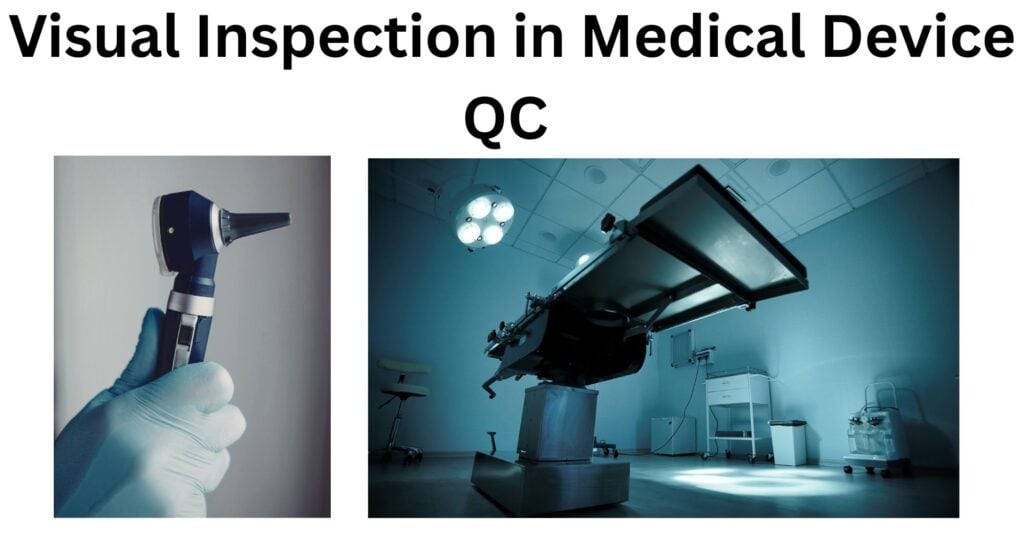
Manual Visual Inspection (MVI) Standards
Manual visual inspection is the process of inspecting products by trained human individuals who examine them under controlled conditions. It is a dominant method in many pharmaceutical and medical device industries because trained humans excel at handling complex and context-dependent judgments. There is no single global “MVI standard” for medical devices only, but expectations are defined indirectly in ISO 13485, ISO 14971, and ISO/IEC 17020. ISO 13485 requires documented procedures, competent personnel, and controlled inspection processes. ISO 14971 demands that inspection controls correspond with device risk. ISO/IEC 17020 is used for competent inspection bodies that assess devices by measuring. For 100% MVI checks, guidance is provided in Ph. Eur. 2.9.20 or USP <790> for pharmacopeial drugs, which is also adopted for device designs.
Automated Visual Inspection (AVI) Technologies
AVI refers to the examination of devices using computer systems, using cameras, optics, and image processing without human intervention. This system inspects devices at a high speed that no humans can match. Automated systems are deployed mostly for the examination of complex biomechanical devices, catheters, and others in real time. The major advantage of AVI technology is its speed and ability to perform consistently without tiring. However, to fully trust the AVI process, it should be thoroughly validated, as it cannot be reliable in context-based judgments. The AVI technique is useful as it is non-destructive and performs in process monitoring instead of destructive sampling. It is a highly promising technique that can be used for many devices, but it still needs to be qualified as part of a regulated process for the highest-risk medical devices (i.e., Class III devices) under MDR/FDA QSR and the EU Act.
Defect Classification: Critical, Major, and Minor
The defects observed during visual inspection are classified based on the impact and risk of the defect on patient and product functionality. They may be critical, major, minor, and cosmetic defects.
Critical defects are major problems that might directly cause injury or harm to patient health or even death. E.g.: breach of sterile barriers in sterile products, broken seal, missing component, etc. Major defects are defects that degrade the performance, efficacy, and usability of the product. They may be harmful but are not immediately life-threatening. Minor defects are smaller defects that have a limited impact on the function of the device. Cosmetic defects are those affecting appearance only and have no impact on safety or function.
This tiered approach for classifying defects in quality control inspections is applied so that actions can be taken based on severity, probability of occurrence, and prioritize resources to solve them.
Inspection Conditions and Lighting Requirements
The environment in which inspection takes place is a tightly controlled one. Light is a major player in visual inspections. According to pharmacopeial standards and GMP guidelines, light of 2,000 to 3,750 lux is mandatory for general inspections, with higher-intensity lighting for finer observation. The light should be of minimal glare and stable illumination. The viewing distance, inspection time, and placement of light are also important factors to be considered. The environmental conditions in the visual inspection area should also be ambient, as they may affect human inspectors’ performance. For automated systems, LED systems can improve defect detectability and efficiency.
The Role of Background Contrast (Black vs. White)
Contrast between the product and background is essential to maintain because this way, defects are more visible and easily detected. The visibility of particles, fibers, cracks, dust, or discoloration depends on background contrast. Light or transparent defects are more visible against black backgrounds, and dark defects stand out against white backgrounds. Therefore, inspectors examine against a black or white background according to the product color or both backgrounds, depending on the situation. In AVI techniques, black or white fixtures are also carefully chosen to maximize contrast, which increases precision.
Acceptance Quality Limits (AQL) in Visual Inspection
AQL is a documented and validated component of QMS in medical device manufacturing. It defines the maximum number of defective units that can be considered in a batch by statistical sampling. AQL is important where targeted or 100% inspection is not possible, like a product that needs to be destroyed while testing or large batches. With this in mind, the ISO sampling plan (ISO 2859) is used to define acceptable defect limits for each class of defect, and set sample sizes for incoming, in-process, and final inspections. Typical AQL for a critical defect is 0 or 0.0065%, for a major defect 0.65%, and for a minor defect 1.0-2.5%. AQL is operationalized through ISO 2859-1 internationally, and it works by first determining the batch size to be evaluated, then choosing an inspection level (General Inspection Levels I, II, and III), finding a sample size code letter (A-R) from a standardized table, and lastly, determining the sample size and acceptance numbers. Therefore, it is a statistical risk management tool.
Validation of Inspection Processes (The Knapp Test)
To know whether the inspection process actually works and is reliable, process validation is necessary. Knapp’s test is one of the most widely used methods for validating inspection processes. Knapp’s work evaluates sensitivity (true defect detection), false rejects, and inter-inspector variability by a statistical approach. It defines inspection performance in terms of a probability of detection (POD) curve (plot between defect size and likelihood of detection). It was developed for human inspectors; however, nowadays it is applied to AVI and AI systems as well. Validation of AVI systems uses representative defect and non-defect images to demonstrate performance. In device manufacturing, such validations are documented under ISO 13485 and linked to process validation and qualification protocols.
Inspector Qualification and Fatigue Management
Manual visual inspection is largely affected by the inspector’s ability, qualification, and fatigue, which makes MVI highly variable. Personnel must have proper visual capacity and formal training on device-specific defects and acceptance criteria. Qualification and training test sets are prepared for inspectors to check their understanding and capacity to detect defects.
Inspection tasks are mentally demanding, and errors increase when inspectors are working continuously or fatigued. To ensure quality devices, manufacturers must limit continuous inspection time, schedule regular breaks between sessions, and design workstations accordingly. Rotation between work and ergonomic work space design can further help preserve inspector alertness and accuracy.
Regulatory compliance (USP <790>, Ph. Eur., and ISO)
For sterile medicinal products, USP <790> and Ph. Eur. 2.9.20 are key references for visual inspection processes, supported by USP <1790> and Ph. Eur. 5.17.2. These documents require 100% visual inspection, describe methods for MVI and AVI, and emphasize the removal of defective containers. Although these were written for drug products in these standards, many principles are carried over to medical device QC, especially for prefilled syringes, catheters, and other combination products.
ISO standards also shape visual inspections. ISO 2859-1 provides AQL sampling plans while ISO 13485 and related QMS define a framework for manufacturing, including documentation, validation, and complaint handling. AVI must additionally satisfy MDR/FDA software validation expectations.
Conclusion
Visual inspection in medical device QC combines controlled processes, risk-based defect limit, and validation process with regulatory structures. It seems simple on the surface, but very demanding and necessary to execute for patient safety. It relies on well-defined defect classifications, controlled inspection conditions, robust AQL-based sampling strategies, and validation of inspection processes. By integrating rigorous MVI, thoughtfully designed AVI, and a strong quality system, manufacturers can reduce variability, support compliance, and ensure that medical devices are fit for their intended purposes while reaching patients.
References
- Diaz, J. Z., Brennan, T., & Corcoran, P. (2025). Navigating the EU AI Act: Foreseeable Challenges in Qualifying Deep Learning-Based Automated Inspections of Class III Medical Devices. The International Journal of Advanced Manufacturing Technology, 140(11–12), 5869–5883. https://doi.org/10.1007/s00170-025-16648-8
- Mahler, H.-C., Folzer, E., Ananthavettivelu, R., Koehler, J., Ferrari, M., & Allmendinger, A. (2025). Science-Based Risk Assessment for the Categorization of Visual Inspection Defects of Sterile Dosage Forms. Pharmaceutics, 17(9), 1121. https://doi.org/10.3390/pharmaceutics17091121
- Quality control and standards in manufacturing of medical devices. (2020). In Metallic Biomaterials Processing and Medical Device Manufacturing (pp. 549–568). Woodhead Publishing. https://doi.org/10.1016/B978-0-08-102965-7.00016-3
