
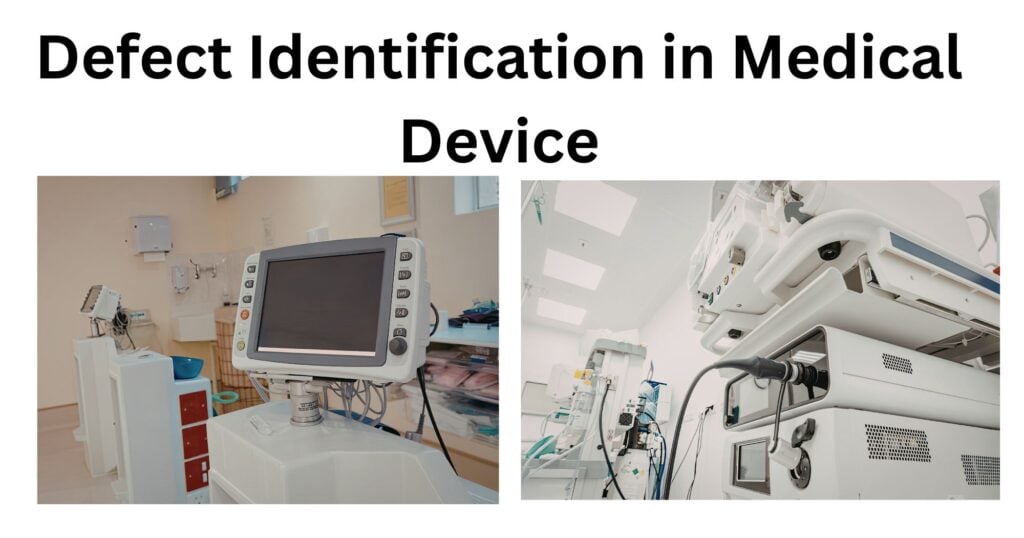
The first step in manufacturing a defect-free product is identifying the defect. Identifying defects in the product during manufacturing is crucial to ensuring patient safety, regulatory compliance, and a positive reputation.
Overview of Defect Identification
Defect identification in medical devices involves visual inspections, nondestructive testing (NDT), dimensional measurements, and risk-based evaluation. Its objective is to detect issues before products reach patients. NDT and advanced measurement techniques allow early detection of internal problems, material inconsistencies, and structural weaknesses. The detection of defects early in the manufacturing process reduces recall from the market and improves reliability of the product (for customers) and the process (for manufacturers). Nowadays, automated and AI-based inspections are integrated into manufacturing processes to improve consistency and diligence in quality control.
Classification: Critical, Major, and Minor Defects
The defects are classified according to their severity of consequence in the industry, allowing for prioritization of actions based on the type of defect. Broadly, it is classified into: critical, major, minor (and sometimes cosmetic).
Critical defects indicate serious issues such as loss of sterility, serious malfunction, or risk of patient harm (e.g., non-sealed vials, leaks, compromised integrity, biological particle contamination). These are the highest risk defects in risk-based systems.
Major defects are those that do not directly threaten safety but may impact function, usability, or content (e.g., significant cosmetic flaws affecting use, or particles in contact with the product).
Minor defects are those defects that have no impact on product quality or patient safety and are often process-related cosmetic issues.
For determining corrective actions, risk-based frameworks use defect severity, likelihood of occurrence, and likelihood of detection to classify visual defects across vials, prefilled syringes, and cartridges.
Common Defects in Injection Molding (Flash, Short Shots, Sinks)
Defects in injection molding are common problems that may arise due to improper mold design, initial formation, or inadequate mold maintenance. These problems may seem insignificant, but they have a significant impact on product functionality and appearance. However, they are highly predictable and avoidable. Some common defects in injection molding are:
Flash: It appears as excess material along parting lines due to mold mismatch, excessive injection pressure, or insufficient clamping force.
Short shot: It occurs due to incomplete filling of the mold, leaving missing sections when the melt solidifies before filling the cavity. It is due to insufficient melt flow, low temperature, venting issues, or improper settings.
Sinks: These are local surface depressions caused by non-uniform cooling and thick sections.
Other such defects in medical devices include weld lines, burn marks, bubbles and voids, and surface delamination.
Packaging Integrity Failures
Packaging defects such as improper sealing or material incompatibility can lead to costly recalls and regulatory non-compliance. It is especially crucial for sterile barrier systems like pouches and trays for maintaining sterility until use. Common packaging defects are:
- Incomplete or non-uniform heat seals, leakages, and wrinkles
- Seal contamination (trapped fibers, uncleaned debris)
- Material damage, such as holes or tears.
Analysis of surgical instrument packaging demonstrates that packaging defects waste resources and threaten patient safety. Application of healthcare Failure Mode and Effects Analysis (FMEA) has been found to reduce defect rates.
Visual Inspection Techniques
Visual inspection is an important part of QC in sterile products and the medical device industry, and is followed by statistically based Acceptable Quality Level (AQL) sampling. Visual inspection can be manual (human) visual inspection, automated visual inspection, or a combination of both. In a GMP-compliant environment, VI is performed under defined and validated conditions.
MVI is done by qualified inspectors under controlled lighting, background, and inspection time, supported by risk-based defect categorization to ensure consistent decisions. AVI systems are supported by machine learning and deep learning, used for surface inspection, cosmetic defects, and seal integrity tests.
Visual defect classification is inherently subjective, so establishing defect catalogs and training is crucial to reducing variability in results.
Non-Destructive Testing (NDT) Methods
Visual inspection has its limits at internal structures, subsurface defects, and hidden assembly defects. This is where Non-Destructive Methods come in handy, as it provides deeper visibility without compromising the product’s integrity and usability. Common techniques in medical devices and equipment are:
- X-ray and computed tomography (XCT) reveal internal voids, inclusions, misalignments, and assembly in complex components.
- Ultrasonic testing and scanning acoustic microscopy (SAM) identify delamination, cracks, and voids in plastic packages and bonded assemblies.
- Infrared thermography, eddy current, and magnetic methods are used for detecting cracks, corrosion, or conductive anomalies in certain types of devices.
- Optical coherence tomography (OCT) and advanced optical methods enable high-resolution inspection of layered structures and coatings.
Integration of NDT in production workflows supports real-time defect detection, process optimization, and regulatory compliance, reducing the chances of defective devices reaching the market.
Leak Testing and Seal Integrity
Leak testing and seal integrity assessment are essential for sterility and containment of sterile medical products. Detection methods include dye penetration, bubble emission, pressure/vacuum decay, trace gas, and electrical conductance tests, and advanced techniques for more flexible and rigid packages. For sealed pouches and trays, automatic image-based seal inspection techniques are also emerging. For parenteral containers, container closure integrity (CCI) failures (e.g., non-sealed vials, compromised stopper systems) are treated as critical defects. These methods help verify that sterile barriers remain intact throughout shelf life and distribution. Many QA programs use multiple methods in combination to ensure validation of seal integrity.
Dimensional Analysis and Tolerance Stack-up
Dimensional accuracy is vital for fit, function, and safety, particularly for assemblies with multiple components fitted together or micro-scale features. Nanometrology and precision dimensional metrology (e.g, white-light interferometry, atomic force microscopy, high-resolution microscopy) verify surface topography, tolerances, and coating uniformity in implants and micro-devices. Tolerance stack-up analysis assesses how dimensional variations across multiple components combine and whether they risk misalignment, leakage, or mechanical failure. In microwell-based devices, maintaining consistent well dimensions and pitch is important for fluidics and single-cell capture.
Root Cause Analysis (Fishbone and 5 Whys)
When defects are found, systematic root cause analysis (RCA) prevents recurrence.
Fishbone (Ishikawa) diagram’s structure potential causes under categories such as materials, methods, machines, environment, and personnel. It gives a visual resemblance to a fish skeleton, where major categories branch off a single spine. It is a hypothesis-generating tool that does not confirm causes but ensures consideration of all possible causes before finding the one root cause.
5 Whys analysis involves asking for the underlying reasons beyond the immediate symptom. “Why” is asked at each level so that investigators reach towards the most possible root cause.
In medical device QMS, both these tools are deployed within the CAPA process and documented for causal analysis.
Reporting and CAPA Implementation
Regulatory frameworks such as ISO 13485 and FDA 21 CFR Part 820 require formal control of nonconforming products and corrective and preventive action (CAPA) systems. CA addresses the root cause of a nonconformance to prevent its recurrence, and PA addresses potential causes of nonconformances that have not occurred yet. CAPA uses investigation results and trend data to implement corrective actions and preventative actions supporting continuous improvement. Non-conforming product control includes detection, documentation, segregation, evaluation, and disposition to prevent unintended use or distribution. Tools like Non-Conforming Material Reports (NCMRs) and structured flowcharts for recalls enhance traceability and regulatory compliance. Effective CAPA not only safeguards patient safety but also reduces recall risk and overall operating costs.
The major defect areas and defects observed in medical device manufacturing are:
- Injection-molded components: Flash, short shot, sink, flow marks
- Sterile packaging and seals: seal channels, leaks, tears, contamination
- Sterile drug/ device units: particles, CCI failures, cosmetic defects
- Internal structure and joins: voids, delamination, cracks, misalignments
- System-level failures: electrical or software faults, mechanical wear
Conclusion
Defect detection in medical devices involves a multidisciplinary approach that includes risk-based defect classification, thorough visual and NDT inspections, dimensional and packaging integrity checks, and systematic root cause analysis (RCA) and corrective and preventative actions (CAPA). Evidence indicates that structured methods like FMEA, RCA, and modern automated techniques can significantly lower defect rates and improve patient safety.
Reference
- Aryan, P., Sampath, S., & Sohn, H. (2018). An Overview of Non-Destructive Testing Methods for Integrated Circuit Packaging Inspection. Sensors, 18(7), 1981. https://doi.org/10.3390/s18071981
- Mahler, H.-C., Folzer, E., Ananthavettivelu, R., Koehler, J., Ferrari, M., & Allmendinger, A. (2025). Science-Based Risk Assessment for the Categorization of Visual Inspection Defects of Sterile Dosage Forms. Pharmaceutics, 17(9), 1121. https://doi.org/10.3390/pharmaceutics17091121
- Sulung Wibawansyah, S. W. (2024). Identify Product Defects In The Injection Molding Process. Procedia of Engineering and Life Science, 7, 223–226. https://doi.org/10.21070/pels.v7i0.1448
- Thompson Odion Igunma, Adeniyi Kehinde Adeleke, & Zamathula Sikhakhane Nwokediegwu. (2025). Developing Nanometrology and non-destructive testing methods to ensure medical device manufacturing accuracy and safety. Gulf Journal of Advance Business Research, 3(2), 712–744. https://doi.org/10.51594/gjabr.v3i2.105
