
Heterochromatin is a densely packed form of chromatin that remains transcriptionally inactive and typically encompasses large genomic regions beyond individual genes or regulatory elements.
The term “heterochromatin” was introduced by Emil Heitz in 1928. Heterochromatin is a crucial structural component of eukaryotic chromosomes that imparts unique functional characteristics to specific genomic regions.
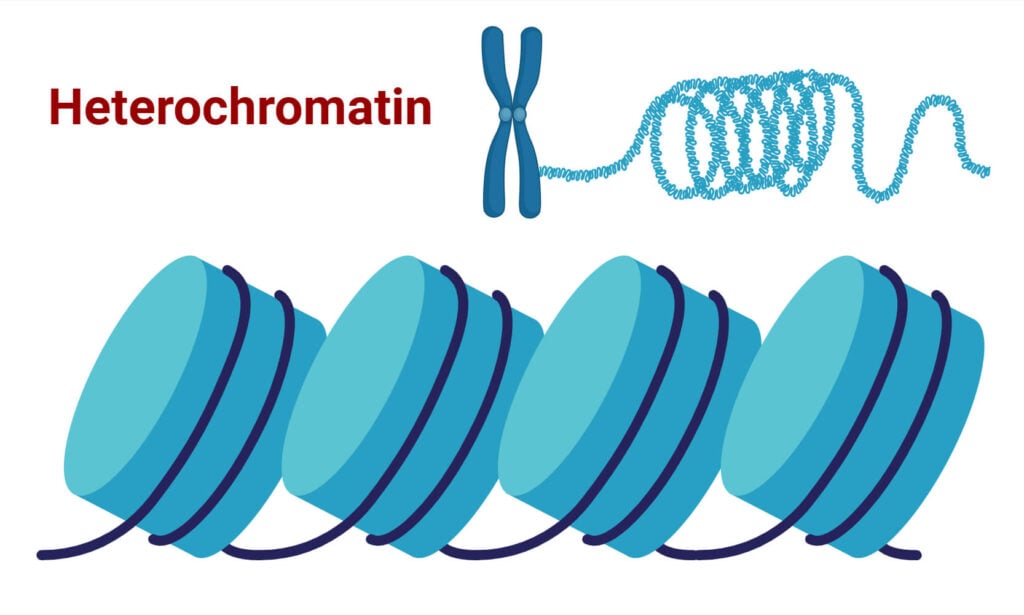
Originally coined to describe chromosomal regions that displayed differential staining, the term “heterochromatin” now broadly refers to molecular subtypes of transcriptionally inactive chromatin domains that encompass areas beyond a single gene or regulatory element (Allshire & Madhani, 2018; Dillon, 2004).
Types of Heterochromatins
Heterochromatin is classified into two primary types: constitutive heterochromatin (CH) and facultative heterochromatin (FH).
Constitutive Heterochromatin (CH)
Constitutive heterochromatin (CH) consists of highly condensed chromosomal regions that remain inactive in all cell types of an organism. It includes pericentromeric and telomeric sequences, transposons, and gene-poor regions. This type of heterochromatin is characterized by the presence of H3K9me3 histone modification, which is catalyzed by histone methyltransferases (HMTs). For instance, mammals, Drosophila, and yeast possess HMTs Suv39h, Su(var)3-9, and Clr4, respectively. These enzymes can propagate heterochromatin by recognizing nucleosomes. Proteins like heterochromatin protein 1a (HP1a) in Drosophila and its orthologs in mammals and S. pombe play a crucial role in heterochromatin spreading by interacting with HMTs by recruiting chromatin-modifying proteins (Penagos-Puig & Furlan-Magaril, 2020).
Facultative Heterochromatin (FH)
Facultative heterochromatin (FH) comprises heterochromatic regions in a cell-type-specific manner. It can be changed to euchromatin in response to specific signals. It gets associated with developmental genes that are marked by Polycomb repressive complexes 1 and 2, which are responsible for depositing H3K27me3 histone modification, which is a key marker of FH. Despite being repressive in the environment, heterochromatin permits low levels of RNA synthesis, such as siRNAs, long non-coding RNAs like Xist, and piRNAs. These RNAs contribute to heterochromatin formation and maintenance. Studies in various organisms highlight the role of RNA in regulating heterochromatin stability. Further research is necessary to unravel the molecular details of heterochromatin formation and to identify new factors that are involved in remodeling (Penagos-Puig & Furlan-Magaril, 2020).
Structural Features of Heterochromatin
Heterochromatin constitutes 25% to 90% of multicellular eukaryotic genomes, which are marked by specific histone modifications along with proteins. It also contains repetitive sequences, including satellite DNA, transposons, and ribosomal DNA, which are crucial for maintaining its structural integrity (Janssen et al., 2018).
A key characteristic of heterochromatin is its compact, higher-order structure, observable throughout the cell cycle. Sucrose density gradient analysis reveals that satellite-containing heterochromatin sediments faster than that of bulk chromatin, suggesting a more regular arrangement compared to the irregular, disrupted structure of euchromatin. Further insights come from studying transgenes integrated into pericentromeric heterochromatin. In transgenic mice, a transgene with a DNase I hypersensitive site (HS) downstream of the k5 gene localized outside the heterochromatin, while its deletion embedded the transgene within. This relocation depended on transcription factor dosage, indicating that local disruptions in nucleosome structure by bound factors can prevent folding into a regular heterochromatin structure. Despite such disruptions, non-expressed transgenes remain largely inaccessible to restriction enzyme digestion (Dillon, 2004).
Formation and Maintenance of Heterochromatin
The formation of heterochromatin is regulated by several factors, which include
- Histone modifications: This modification is catalyzed by histone methyltransferases such as SUV39. It also serves as a binding site for a protein that plays a crucial role in heterochromatin formation and stability.
- Non-coding RNAs: These are involved in guiding the assembly of heterochromatin by targeting specific genomic regions for silencing.
Histone methylation plays an important role in the formation of heterochromatin with the help of methyltransferases, facilitating the modification. Small non-coding RNAs also contribute by directing proteins to particular regions of the genome, supporting heterochromatin formation. Chromatin remodeling complexes are involved in establishing and maintaining heterochromatin through mechanisms such as chromatin compaction and separation (Janssen et al., 2018).
For the maintenance of heterochromatin, dynamic responses, phase separation, and compartmentalization mechanisms play a crucial role.
Functions of Heterochromatin
- Role in Genome Organization: It is essential for maintaining the organization and integrity of the genome. It also provides distinct functional properties to specific genomic regions, influencing gene expression, DNA replication, and chromosomal stability (Allshire & Madhani, 2018).
- Clonal inheritance: It is clonally inherited during cell division, ensuring the maintenance of specific gene expression (Allshire & Madhani, 2018).
- Genome integrity: It prevents aberrant recombination and supports the DNA repair process (Allshire & Madhani, 2018).
- Cancer implications: Dysfunctional heterochromatin contributes to genetic instability that promotes cancer progression (Janssen et al., 2018).
Heterochromatin Dynamics
The protein of heterochromatin, HP1, plays an important role in dynamics by interacting with modified histone proteins, particularly H3K9me3. This interaction is essential for the formation and maintenance of heterochromatic regions. Recent studies reveal that HP1 exhibits high turnover rates within heterochromatic clusters, suggesting that the structure of heterochromatin remains stable and the proteins involved are quite mobile. Recovery experiments have shown that HP1 can rapidly exchange in these regions, allowing transcription factors to access genes located within heterochromatin. The dynamics of H3K9me3-enriched heterochromatin are particularly significant in pluripotent cells. Research has also identified that two mechanisms, viz., passive dilution and active removal, maintain/decay the domain. As the cell divides, the stability of H3K9me3 is influenced and is removed. For instance, in mouse embryonic stem cells, depletion of the enzyme responsible for adding H3K9me3 causes H1 to dissociate from heterochromatin, leading to chromatin opening and a loss of pluripotency within hours. This dynamic behavior highlights the intricate regulatory networks that control gene expression (Hathaway et al., 2012; Straub, 2003).
Heterochromatin in Different Organisms
(Allshire & Madhani, 2018; Hughes & Hawley, 2009; Liu et al., 2020; Rodriguez Inigo et al., 1993)
| Name of organisms | Key features |
| Drosophila melanogaster | Heterochromatin is located in centromeres. Distinguishable from euchromatin using cytological staining. Pericentric heterochromatin fails to replicate in polytene chromosomes, allowing clear demarcation from euchromatin. |
| Plants | Significant variation in heterochromatin composition. |
| Mammals | Crucial for genome stability and gene expression. Inactive X chromosome in female mammals. Chromosomal integrity. |
| Evolutionary Perspectives | Rapid evolutionary changes across species. Nucleoside sequence and regulatory proteins evolve quickly, influencing developmental and evolutionary roles. |
Heterochromatin and Epigenetics
This concept of epigenetics has evolved since the time of Conrad Waddington, describing stable cell fate acquisition during development. Later definitions were given by Robin Holliday and Arthur Riggs, who emphasized heritable changes in gene function independent of DNA sequence alterations. Adrian Bird has described epigenetics as the structural adaptation of chromosomal regions to register, signal, or perpetuate altered activity states (Allshire & Madhani, 2018; Dillon, 2004).
Despite varying definitions, epigenetics often refers to chemical modifications of histone proteins and DNA that influence gene expression. The modification impacts nucleosome structure and serves as a binding motif for chromatin-associated proteins. Studies using acetylation-specific antibodies have shown that pericentromeric heterochromatin and the inactive X chromosome are under-acetylated compared to euchromatin (Allshire & Madhani, 2018; Dillon, 2004).
Techniques for Studying Heterochromatin
Fluorescence In Situ hybridization (FISH) is a technique that employs the visualization of specific DNA sequences within the context of whole chromosomes. This technique can be used to assess the localization of heterochromatic regions, particularly repetitive sequences found in pericentromeric areas. This technique allows for the observation of chromatin organization and can reveal the spatial arrangement of heterochromatin in interphase nuclei (Allshire & Madhani, 2018).
Heterochromatin and Human Disease
Understanding the role of heterochromatin in disease has led to
- Developmental Disorders: Altered heterochromatic states can impair normal gene expression patterns during development, leading to various developmental disorders. This disruption of gene silencing mechanisms mediated by heterochromatin can result in appropriate activation or repression of genes critical for development (Hahn et al., 2010).
- Therapeutic Implications: Therapeutic strategies have aimed at resetting epigenetic states where an existing treatment targets epigenetic machinery and may introduce severe side effects due to their global effects on gene regulation (Hahn et al., 2010).
Recent Advances and Future Perspectives in Heterochromatin Research
Recent studies have highlighted the role of heterochromatin in cell migration, revealing that increased heterochromatin levels. It can enhance nuclear rigidity, which facilitates faster cell movement in three-dimensional environments. Techniques like Hi-C have been employed to analyze chromosome conformations during cell migration, showing that heterochromatin regions undergo significant changes under mechanical stress (Gerlitz, 2020).
The establishment of databases such as HHCDB provides researchers with a unified platform for identifying and analyzing heterochromatin regions across various human tissues and cell types. This resource integrates data on histone modifications, gene structures, and expression profiles, enabling more efficient exploration of the role of heterochromatin in development and disease (Wang et al., 2024).
Conclusion
Heterochromatin is a structural and functional component of eukaryotic chromosomes that plays an important role in maintaining genome stability, regulating gene expression, and ensuring chromosomal integrity. It is classified into two types, which reflect its cellular process, gene silencing for developmental regulation. The dynamic nature of heterochromatin involves histone modifications, non-coding RNAs, and chromatin remodeling. It also underscores the importance of epigenetic regulation and inheritance. Dysfunction in heterochromatin has been linked to developmental disorders and cancer, highlighting clinical significance. Recent advances in research and technology provide new insights into its complex regulatory mechanisms, paving the way for therapeutic interventions and a deeper understanding of its evolutionary and developmental roles.
References
- Allshire, R. C., & Madhani, H. D. (2018). Ten principles of heterochromatin formation and function. Nature Reviews Molecular Cell Biology, 19(4), pp. 229–244. https://doi.org/10.1038/nrm.2017.119
- Dillon, N. (2004). Heterochromatin structure and function. Biology of the Cell, 96(8), pp. 631–637. https://doi.org/10.1016/j.biolcel.2004.06.003
- Gerlitz, G. (2020). The Emerging Roles of Heterochromatin in Cell Migration. Frontiers in Cell and Developmental Biology, 8. https://doi.org/10.3389/fcell.2020.00394
- Hahn, M., Dambacher, S., & Schotta, G. (2010). Heterochromatin dysregulation in human diseases. HIGHLIGHTED TOPIC Epigenetics in Health and Disease J Appl Physiol, 109, 232–242. https://doi.org/10.1152/japplphysiol.00053.2010.-Heterochromatin
- Hathaway, N. A., Bell, O., Hodges, C., Miller, E. L., Neel, D. S., & Crabtree, G. R. (2012). Dynamics and memory of heterochromatin in living cells. Cell, 149(7), 1447–1460. https://doi.org/10.1016/j.cell.2012.03.052
- Hughes, S. E., & Hawley, R. S. (2009). Heterochromatin: A rapidly evolving species barrier. PLoS Biology, 7(10). https://doi.org/10.1371/journal.pbio.1000233
- Janssen, A., Colmenares, S. U., & Karpen, G. H. (2018). Heterochromatin: Guardian of the Genome. Downloaded from Www.Annualreviews.Org. Guest. https://doi.org/10.1146/annurev-cellbio-100617
- Liu, J., Ali, M., & Zhou, Q. (2020). Establishment and evolution of heterochromatin. Annals of the New York Academy of Sciences, 1476(1), pp. 59–77. https://doi.org/10.1111/nyas.14303
- Penagos-Puig, A., & Furlan-Magaril, M. (2020). Heterochromatin as an Important Driver of Genome Organization. Frontiers in Cell and Developmental Biology, 8. https://doi.org/10.3389/fcell.2020.579137
- Rodriguez Inigo, E., B Ella, J. L., & Garcia La Vega, C. DE. (1993). Heterochromatin differentiation between two species of the genus Dociostaurus (Orthoptera: Acrididae). Heredity, 70.
- Straub, T. (2003). Heterochromatin dynamics. PLoS Biology, 1(1). https://doi.org/10.1371/journal.pbio.0000014
- Wang, H., Su, M., Xing, J., Zhou, J., Wang, J., Chen, L., Dong, H., Xue, W., Liu, Y., Wu, Q., & Zhang, Y. (2024). HHCDB: a database of human heterochromatin regions. Nucleic Acids Research, 52(1), 145–153. https://doi.org/10.1093/nar/gkad954
