
The term “Environment” originates from the French word “environner“, meaning to surround. It encompasses everything that surrounds us: biotic components (plants, animals, microbes, and humans) and abiotic components (air, water, soil, light, etc.).
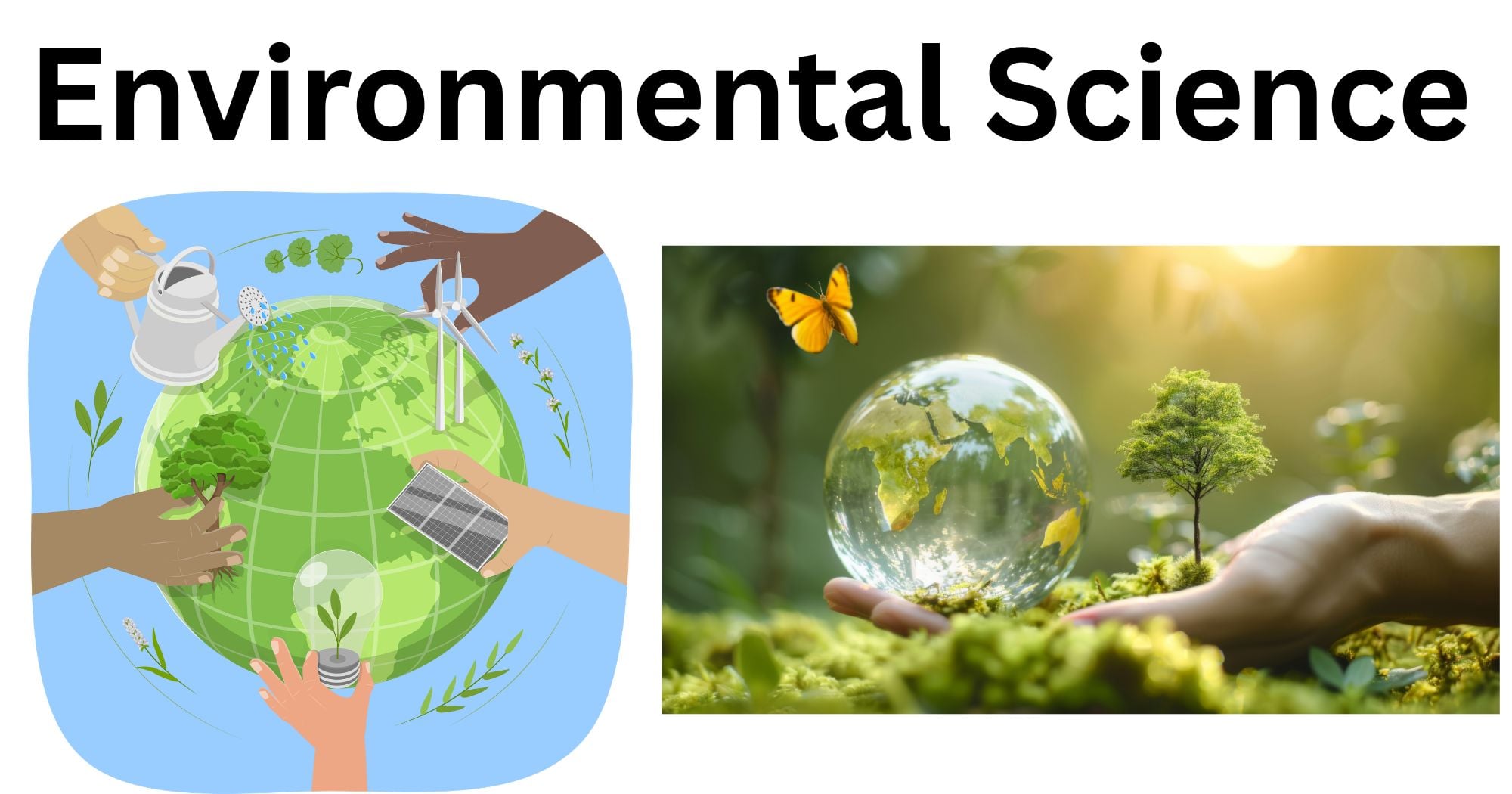
The Environment is the total of physical, chemical, biological, social, and cultural elements, all interacting to support life.
According to UNEP, the Environment is “the whole outer physical and biological system in which man and other organisms live.” Moreover, as per the Environment Protection Act of 1986, “Environment” refers to the “total of air, water, and land and the interrelationships among themselves and also with human beings, other living organisms or property.”
Environmental Science is an interdisciplinary academic field that studies the interactions between the natural Environment and human activities. It seeks to understand the complex systems of the Earth, how humans impact the Environment, and how we can solve environmental problems to create a sustainable future.
This field integrates knowledge from all disciplines (biology, chemistry, physics, geology, geography, ecology, and social sciences) to understand environmental systems and human influences.
Objectives of Studying Environmental Science
- To study and analyze the causes, effects, and scale of environmental problems that could be both natural and human-induced. This involves identifying pollution sources, understanding ecosystem degradation, and other related factors.
- To understand the complex relationship between living organisms and their Environment and how human activities disrupt or modify these natural processes.
- To research, develop, and propose practical and sustainable solutions to environmental challenges.
- To foster a deeper understanding and appreciation of the Environment, encouraging responsible human actions and promoting the principles of sustainable development for the long-term well-being of both humanity and the planet.
- To track changes in environmental conditions over time, using various tools and techniques (remote sensing, field measurements, data analysis) to detect trends and assess the effectiveness of management interventions
Importance of Environmental Science
Environmental science deals with the study of the Environment and the solution of ecological problems. Some of its importance includes the following:
- It helps us understand pollution (air, water, land, noise, radiation) and study its causes, effects, and preventive measures.
- It teaches us how to use natural resources in a way that meets our needs without compromising the ability of future generations to meet theirs.
- It promotes the protection and wise use of natural resources like forests, water, fossil fuels, and wildlife.
- It educates individuals, communities, and policymakers about the value of nature and the consequences of its degradation.
- Environmental science emphasizes the importance of biodiversity in maintaining ecosystem services, such as pollination, nutrient cycling, and climate regulation.
- It helps identify environmental hazards that threaten public health, such as airborne diseases, water contamination, and toxic wastes.
- It encourages the innovation of environmentally friendly technologies, such as renewable energy, eco-friendly packaging, electric vehicles, and sustainable agriculture.
Components of Environment
The Environment is a complex system composed of interacting parts, which can be broadly categorized into three main components: Physical, Biological, and Social Environments.
Physical Environment
The Physical Environment comprises all the non-living or abiotic components that influence living organisms. These are the fundamental elements that dictate the conditions for life and geological processes.
Land (Lithosphere): The lithosphere refers to the solid, outermost layer of the Earth, encompassing continents, islands, mountains, plains, valleys, and the underlying soil and rocks.
The components provide a habitat for terrestrial organisms. A habitat is a natural environment where an organism typically lives. It represents a set of environmental conditions suitable for growth and survival.
The lithosphere is fractured into a mosaic of large and small tectonic plates, which are constantly moving and are responsible for all geological activity occurring on Earth, such as mountain building, Volcanic eruptions, and earthquakes.
The lithosphere is the source of natural resources like minerals, metals, fossil fuels, and fertile soil. These resources are essential for industry, technology, primary energy sources such as fossil fuels, and construction processes.
Water (Hydrosphere): The Hydrosphere encompasses all water bodies on Earth, including oceans, seas, rivers, lakes, glaciers, groundwater, and water vapor. It covers about 71% of Earth’s surface. Water has a fundamental role in sustaining all life on Earth.
The hydrosphere plays a crucial role in maintaining healthy ecosystems, participating in the hydrological cycle (evaporation, condensation, precipitation, and infiltration), and influencing weather patterns. This component supports aquatic ecosystems and biodiversity.
Water has a very high specific heat capacity, which allows it to absorb and release large amounts of heat without experiencing significant changes in its temperature. Hence, it is crucial in moderating Earth’s climate.
Air (Atmosphere): The gaseous layer surrounding the Earth is known as the Atmosphere. It is composed mainly of Nitrogen (78%), Oxygen (21%), and trace gases like carbon dioxide, argon, and water vapor. This component is divided into different layers (Troposphere, Stratosphere, Mesosphere, Thermosphere, and Exosphere).
A significant role of the Atmosphere is that it harbors Oxygen, an essential gas to carry out respiration in most living organisms. It also harbors carbon dioxide, which autotrophs use for photosynthesis.
The Atmosphere, particularly the ozone layer in the stratosphere, absorbs most of the Sun’s harmful ultraviolet radiation, which can cause skin cancer, eye damage, and harm to ecosystems.
The Atmosphere is integral to the Earth’s water cycle, as it holds moisture, leading to precipitation, and influences weather patterns, including winds, storms, and the global distribution of heat.
The pressure exerted by the Atmosphere on the Earth’s surface is necessary for the existence of liquid water.
Biological Components
The biological components of the Environment refer to the living organisms that interact with each other and with the abiotic components in an environment. These biological components are also referred to as biotic factors, and they play a crucial role in maintaining ecological balance. This component of the Environment where life exists is called the Biosphere, and it can cover land, water bodies, or air.
The members of this component can be categorized into three major groups based on their roles in the ecosystem:
Producers (Autotrophs): These organisms can produce their food using Carbon Dioxide as their primary carbon source. They can either use sunlight (Photoautotrophs) or chemical substances (chemoautotrophs) as their energy source. These organisms are the primary source of energy for all other organisms.
Consumers (Heterotrophs): These organisms cannot make their food and rely on other organisms for nutrition. Based on what they consume, they can be grouped as :
Primary consumers(Herbivores): They feed directly on producers. Examples: Deer, Rabbits
Secondary consumers (Carnivores): They feed on primary consumers. Examples: Frogs, Snakes.
Tertiary consumers: Feed on secondary consumers. Hawks, Lion.
Omnivores: Consume both plants and animals. Example: Humans, Bears, Crows.
Detritivores: Consume dead organic matter. Example: Earthworm, Dung beetles.
Decomposers (Saprotrophs)
Organisms that break down dead plants and animals and convert them into simpler substances can be recycled back into the Environment. These decomposers include Soil microorganisms, such as bacteria and Fungi.
Biological components interact with each other in various ways, including predation, Competition, mutualism, Commensalism, and Parasitism.
Social Environment
The social environment refers to the immediate physical and social surroundings in which people live, work, and interact with others. It encompasses relationships, institutions, culture, customs, values, and norms that influence human behavior, lifestyle, development, and social interactions. The Social Environment can be categorized into several elements:
Family: Basic and primary social unit where individuals first learn values, beliefs, behaviors, and social norms. It shapes early emotional, psychological, and moral development.
Community: A group of people living in the same area or sharing common interests and resources. It provides social support, safety, interactions, and a sense of belonging.
Culture: A collection of beliefs, traditions, customs, languages, art, and more values shared by a group of people. Culture influences people’s lifestyles, identities, and social behaviors.
Mass Media: Platforms like TV, newspapers, radio, the internet, and social media that disseminate information, shape opinions, influence trends, and connect societies globally.
Politics: A system of governance, laws, rights, and policies that manage how a society is organized and how power is distributed and exercised among its people.
Multidisciplinary Nature of Environmental Science and relation to other sciences
Environmental Science is an interdisciplinary academic field integrating physical, biological, and information sciences to study the Environment and provide solutions to environmental challenges. The major disciplines involved in the relation are as follows:
Natural Sciences
- Biology: Studies living organisms, ecosystems, biodiversity, conservation, and the impact of pollutants on life forms.
- Chemistry: Analyzes chemical processes in the Environment, such as pollution, toxicology, and geochemical cycles (Including Nitrogen, Carbon, and Phosphorus cycles).
- Physics: Helps in understanding energy flow, thermodynamics in ecosystems, sound and light pollution, and climate dynamics.
- Geology: Studies the Earth’s structure, natural resources, soil formation, earthquakes, and processes such as erosion and sedimentation.
Social Sciences
- Economics: Assesses the cost-benefit analysis of environmental policies, resource management, and sustainable development.
- Sociology: Examines human society’s interaction with the Environment, cultural practices, urbanization, and demographic impacts.
- Political Science: Deals with environmental laws, regulations, and international treaties.
Engineering and technology
- Environmental Engineering: Designs water treatment plants, waste management systems, and pollution control technologies.
- Information technology: Used for environmental mapping, monitoring natural disasters, and land-use planning.
Medical and Health Science
- Public Health: Studies disease outbreaks due to environmental pollution, vector-borne disease, and occupational hazards.
- Toxicology: Examines the harmful effects of chemicals and pollutants on human and ecological health.
The integration of environmental science studies is crucial for addressing complex, interconnected ecological issues, including climate change, biodiversity loss, pollution, and resource depletion.
References
- Bharucha, E. (2005). Textbook of Environmental Studies for Undergraduate Courses. Hyderabad: Universities Press.
- Encyclopædia Britannica. (n.d.). Public Opinion: Mass Media and Social Media. Britannica. Retrieved from https://www.britannica.com/topic/public-opinion/Mass-media-and-social-media
- Number Analytics. (n.d.). Understanding Social Environment. Retrieved from https://www.numberanalytics.com/blog/understanding-social-environment
- ResearchGate. (2019). Basics of environmental science [Publication]. Retrieved from https://www.researchgate.net/publication/330901267_BASICS_OF_ENVIRONMENTAL_SCIENCE
- United Nations Environment Programme (UNEP). (2023). Global environment outlook – GEO-6: Healthy planet, healthy people. Retrieved from https://www.unep.org/resources/global-environment-outlook-6
