
Electrocompetent cells are bacterial cells that have been specifically prepared to take up foreign DNA, such as plasmids, via electroporation.
Significance of Electrocompetent Cells
Electrocompetent cells are significant to modern molecular biology, serving as an essential tool for various laboratory procedures such as cloning, the construction of DNA libraries, and mutagenesis because of their ability to take up exogenous DNA, a process essential for genetic engineering and the study of microorganisms.
Key significances include:
- Among the various methods available to introduce foreign DNA into bacteria, such as chemical treatment with divalent cations (like Ca2+), electroporation is known to provide the highest transformation efficiency (10⁸–10¹⁰ transformants/µg DNA).
- Electrocompetent cells facilitate the cloning and manipulation of large DNA molecules, such as Bacterial Artificial Chromosomes (BACs), from genomic or metagenomics samples.
- These cells are used routinely for the amplification of plasmid DNA, gene expression studies, and PCR cloning. Electrocompetent cells can be prepared at room temperature (24°–28 °C), which significantly improves their efficiency and makes them less fragile than traditional ice-cold preparation.
- Electrocompetent cells can work across different cell types, such as yeast, plant cells, and mammalian cells.
The Mechanism of Electroporation
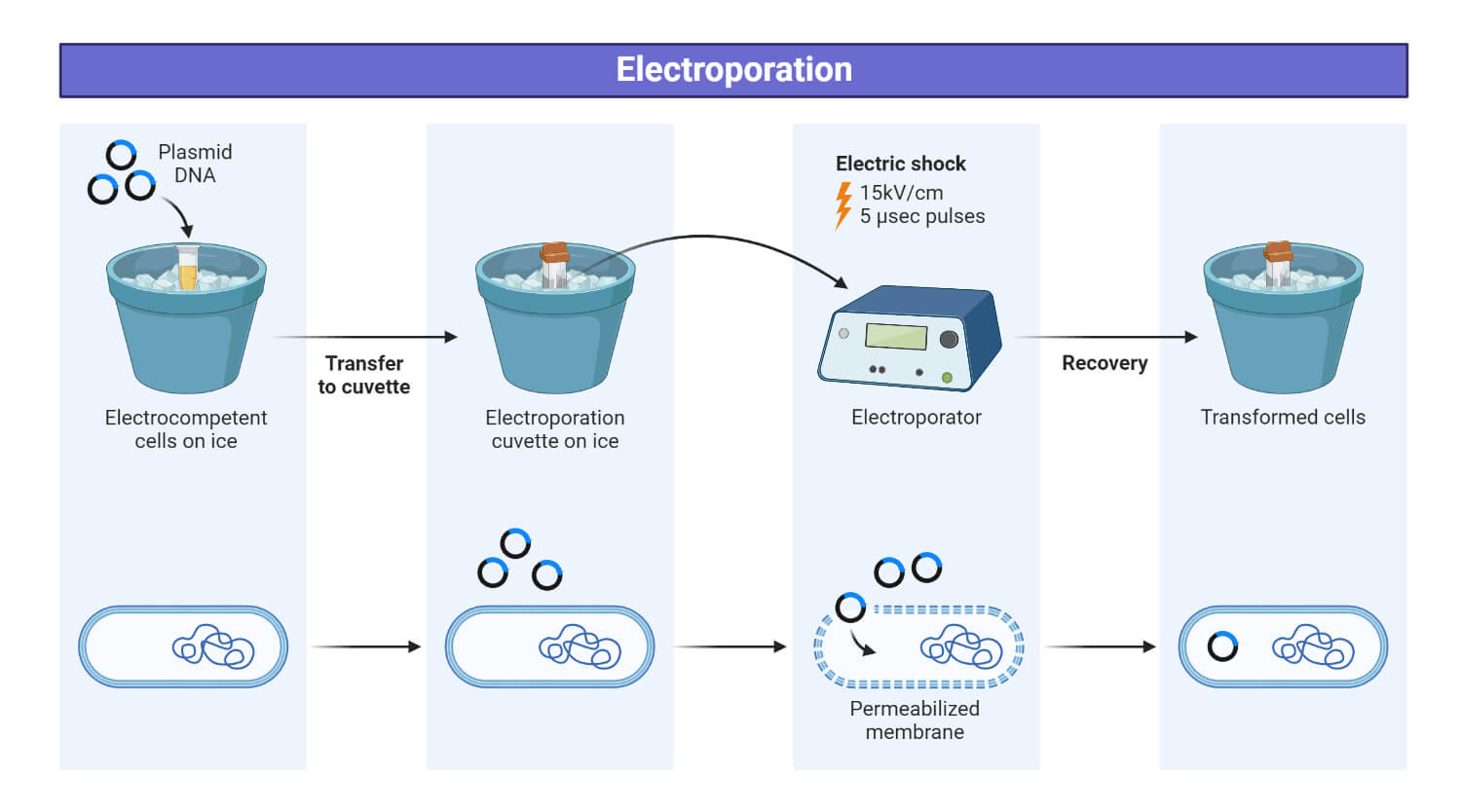
The mechanism of electroporation involves the use of a high-voltage pulse to introduce exogenous DNA into bacterial cells. This process relies on several physical and biological changes within the cellular membrane. When a high-voltage pulse is applied, the cell membrane, which usually acts as a stable barrier, becomes transiently permeabilized. This temporary state of permeability allows foreign material to bypass the phospholipid bilayer and enter the cell.
The electric field causes the formation of temporary pores in the cellular membrane. These hydrophobic pores are formed spontaneously by the lateral thermal fluctuations of lipid molecules. The formation of these hydrophobic pores is enhanced by increased temperature. At higher temperatures, such as room temperature (24°–28 °C), the cell membrane and wall may have better permeability, making it easier for DNA to enter.
Critical Factors: Why Low Salt and Cold Temperatures Matter
In manual plasmid isolation, maintaining low salt concentrations and cold temperatures are critical technical requirements for ensuring both the stability of the DNA and successful transformation.
Why Low Salt Matters?
Maintaining a low salt concentration is primarily essential for the efficiency of bacterial transformation, particularly when using electroporation.
- For successful electroporation (often conducted at 1.8 kV), the salt concentration in the DNA sample must be extremely low. Too much salt causes excess current flow during the pulse that can lead to arcing (sparking inside the cuvette ). This can lead to degradation of DNA and can damage the electroporator.
- Low salt concentration allows proper pore formation instead of arcing. Hence, cells are often washed with ice-cold salt-free buffers ( for example, glycerol or sterile water), keeping the DNA in a low ionic strength environment.
Why Cold Temperatures Matter?
Cold temperatures (ranging from 0°C to -20°C) are utilized throughout the isolation process to control enzymatic activity and facilitate the physical separation of macromolecules.
- Cold temperature stabilizes the cells by slowing down the metabolism, which makes the membrane less fluid, preventing premature damage.
- Cold temperature also reduces thermal damage from electric current during electroporation.
Step-by-Step Protocol: Preparing High-Efficiency Electrocompetent Cells (DH5 Alpha cells)
- Streak DH5α cells from a frozen glycerol stock onto a fresh LB or SOB agar plate and incubate overnight at 37°C (16-18 hours).
- Take a single well-isolated colony from the plate and inoculate it into 5 mL of SOB/LB medium and incubate at 37°C overnight with vigorous shaking at 200 rpm.
- From the O/N culture, inoculate 900 ul in 50 mL of fresh LB media ( secondary culture) and incubate at 37 °C with shaking at 200 rpm.
- Check OD of the secondary culture until it becomes 0.4 to 0.5.
- Once the appropriate OD is reached, keep the grown culture on ice for 15 mins.
- Centrifuge the cells at 4000 rpm at 4°C for 10 mins.
- Discard the supernatant and resuspend the pellet in 15 mL sterile cold distilled water.
- Centrifuge at 4000 rpm for 10 mins at 4°C.
- Repeat the washing step with sterile water.
- Discard the supernatant and resuspend the pellet in 1 ml of ice cold 10% glycerol.
- Centrifuge at 4000 rpm for 10 mins at 4°C.
- Discard the supernatant and resuspend in 900 ul of 10 % glycerol.
- Aliquot 50ul in different epitubes and store at -80°C.
Harvesting at the Right Time
Harvesting cells at the precise growth stage is one of the most critical factors for ensuring high transformation efficiency.
- Ideal growth period: Cells must be harvested during the mid-exponential (log) phase when they are actively dividing and most receptive to becoming competent. The standard target is an OD600 of 0.4.
- Monitoring strategy: Initially, the OD600 must be measured every hour. Once the OD reaches 0.2, one must increase monitoring frequency to every 15–20 minutes because cells grow exponentially at this stage, and they can quickly surpass the target threshold.
- Estimated time: For E coli cells, cultures typically reach the target OD in 2.5 to 4 hours, depending on the strain and the volume of the initial starter culture.
- Immediate growth arrest action: The moment the culture reaches the target OD, it must be immediately moved to an ice-water bath. Swirling the flask for 10–15 minutes until the culture is ice-cold is necessary to completely arrest growth before starting the wash steps.
The Washing Process: Removing Salts to Prevent Arcing
The washing process is the most critical step in preparing electrocompetent cells because it removes conductive salts and solutes from the growth medium. If the electrical resistance of the cell suspension is too low due to residual salt, arcing occurs, a phenomenon where an electrical current passes through the cells instead of across the membrane, effectively killing them.
- To prevent arcing, cells must be washed multiple times (usually 2–3 times) in a non-ionic medium to ensure the conductivity of the bacterial suspension is sufficiently low.
- Using growth media like SOB(Mg−) or LB-Lennox (5 g/L NaCl) instead of Miller LB (10 g/L NaCl) reduces the initial salt load that must be washed away.
- Beyond salt, air bubbles in the cuvette can cause arcing; therefore, the cuvette must be tapped firmly on the table to level the cells and remove bubbles before pulsing.
- Moisture on the outside of the cuvette can also lead to arcing, so electrodes must be wiped with tissue immediately before insertion into the electroporator.
- For washing the cells, most commonly used agents are double-distilled sterile water, glycerol, or HEPES.
Storage and Maintenance: Flash Freezing in Glycerol
Glycerol is used as a cryoprotectant in the storage of electrocompetent cells because it is a nonionic medium that provides osmotic balance and allows for frozen storage without killing the cells.
- Cells are typically resuspended in 10% glycerol (molecular biology grade) before storage.
- It is critical to perform aliquotting in a cold room (4°C) or on pre-chilled cold blocks/ice. Touching the tubes directly with your hands should be minimized to avoid warming them.
- Flash freezing (also referred to as snap freezing) is a process used to rapidly cool and solidify aliquotted competent cells to preserve their transformation efficiency for long-term storage. It is the preferred method as it is reported to retain higher competence than standard freezing. The most common method of flash freezing is dropping the microfuge tubes directly into a liquid nitrogen bath. Alternatively, a dry-ice/ethanol bath can be used.
- Immediate transferring of the frozen tubes to pre-chilled, labeled boxes in a −80°C freezer is necessary.
Calculating Transformation Efficiency: Method and Formula
Measuring transformation efficiency is the primary quality control (QC) test for competent cells. Transformation Efficiency (TrE) is a quantitative measurement used to determine how many bacterial cells successfully took up a plasmid during a transformation protocol. It is expressed as colony-forming units per microgram (cfu/µg) of plasmid DNA.
By definition, transformation efficiency is the number of colony-forming units produced by transforming 1 µg of plasmid DNA into a given volume of competent cells.
TrE = Number of colonies (cfu)/Amount of DNA used (µg) ×Dilution Factor
Where,
Number of Colonies (cfu): The manual count of bacterial colonies growing on the selective agar plate
Amount of DNA used (µg): The mass of the plasmid added to the competent cells, converted to micrograms
Dilution Factor: This accounts for the fraction of the total recovery mixture that was actually spread on the plate
Example: Calculation of Transformation Efficiency (TrE)
Given:
Amount of plasmid DNA used = 10 ng
Total recovery volume after transformation = 1000µL
Volume plated on LB + antibiotic plate = 100 µL
Number of colonies observed on the plate = 120 colonies
Step 1: Convert DNA amount to micrograms
0 ng=0.01 µg
Step 2: Calculation of dilution factor
Since 100 µL was plated,
Dilution factor = 1000/100 = 10
Step 3: Apply the transformation efficiency formula
TrE =Number of colonies (cfu)/Amount of DNA used (µg) ×Dilution Factor
=1200.01 ×10
= 120,000 cfu/µg
Hence, transformation efficiency = 120,000 cfu/µg
≥ 10⁹ CFU/µg – Excellent (high efficiency, cloning grade)
< 10⁵ CFU/µg – Poor ( not recommended)
Troubleshooting and Common Issues
Troubleshooting and common issues in preparing and using electrocompetent cells center primarily on preventing arcing and maintaining high transformation efficiency (TE).
Arcing
It is the most frequent failure during electroporation, occurring when the sample’s electrical resistance is too low to maintain the applied voltage.
Causes:
- High Salt Concentration
- Air Bubbles in the cuvette
- Surface Moisture of the cuvette.
Solutions:
- Tap the cuvette firmly on a table to level cells and remove bubbles; wipe electrodes with a paper towel immediately before pulsing.
- If a test aliquot arcs, wash the remaining cells again with 10% glycerol or GYT medium to further lower conductivity.
Low Transformation Efficiency
- Overgrowth: Harvesting cells at a high optical density (OD600 > 0.45) significantly drops efficiency, especially for large plasmids.
- Centrifuge Stress: Spinning cells too fast, such as increasing speed from 800× g to 2000× g, can reduce the TE.
- Delayed Recovery: There is a critical window for adding recovery medium (SOC). A 1-minute delay reduces efficiency threefold, while a 10-minute delay results in a 20-fold drop.
Cell Death and Fragility
- Temperature Stress: In cold protocols, it is vital to keep all materials (bottles, water, glycerol) at 4°C. If cells are allowed to warm up during washing or aliquotting, their survival and competence drop.
- Reusing Cuvettes: While cuvettes can be washed and reused, you should never reuse a cuvette in which arcing has occurred, as the electrodes may be damaged
Large Plasmid (>50 kb) Failures
- Optimization Issues: Standard 37°C growth in SOB/LB often fails for large plasmids. Using 21°C growth with SOC-sucrose can provide a 500–1000 fold boost in efficiency.
Conclusion
Electrocompetent cells are essential tools in molecular biology for efficient DNA uptake via electroporation. Their successful preparation depends on key factors such as harvesting at the mid-log phase, thorough removal of salts, maintaining cold conditions, and proper storage in glycerol.
Careful optimization of these steps ensures high transformation efficiency, while troubleshooting common issues like arcing and cell damage improves reliability. Overall, with precise handling, electrocompetent cells provide a powerful and high-efficiency method for genetic engineering and cloning applications.
References
- Gonzales, M. F., Brooks, T., Pukatzki, S. U., & Provenzano, D. (2013). Rapid Protocol for Preparation of Electrocompetent Escherichia coli and Vibrio cholerae. October, 6–11. https://doi.org/10.3791/50684
- Notes, I., & Od, T. (n.d.). Making Electrocompetent Cells. 5–7.Preparation, C. C. (n.d.). Electrotransformation. 2–3.
- Tu, Q., Yin, J., Fu, J., Herrmann, J., Li, Y., & Yin, Y. (2016). Room temperature electrocompetent bacterial cells improve DNA transformation and recombineering efficiency. Nature Publishing Group, December 2015, 1–8. https://doi.org/10.1038/srep24648
- Chan, W., Verma, C. S., David, P., & Gan, S. K. (2013). A comparison and optimization of methods and factors affecting the transformation of Escherichia coli. https://doi.org/10.1042/BSR20130098
- Transformation in Escherichia coli : Stages in the Process. (1981). 146(2), 564–570.
