
Immunogens are substances that, when introduced into the body, are capable of inducing a specific immune response (such as production of antibodies or activation of T cells) in a susceptible host (Janeway et al., 2001; Abbas et al., 2025).
The response involves the activation of lymphocytes and the production of effector molecules, such as antibodies and cytotoxic T lymphocytes (Murphy & Weaver, 2022). Immunogens form the proper foundation for both basic immunology and the rational design of vaccines and therapeutics (Pulendran et al., 2021).
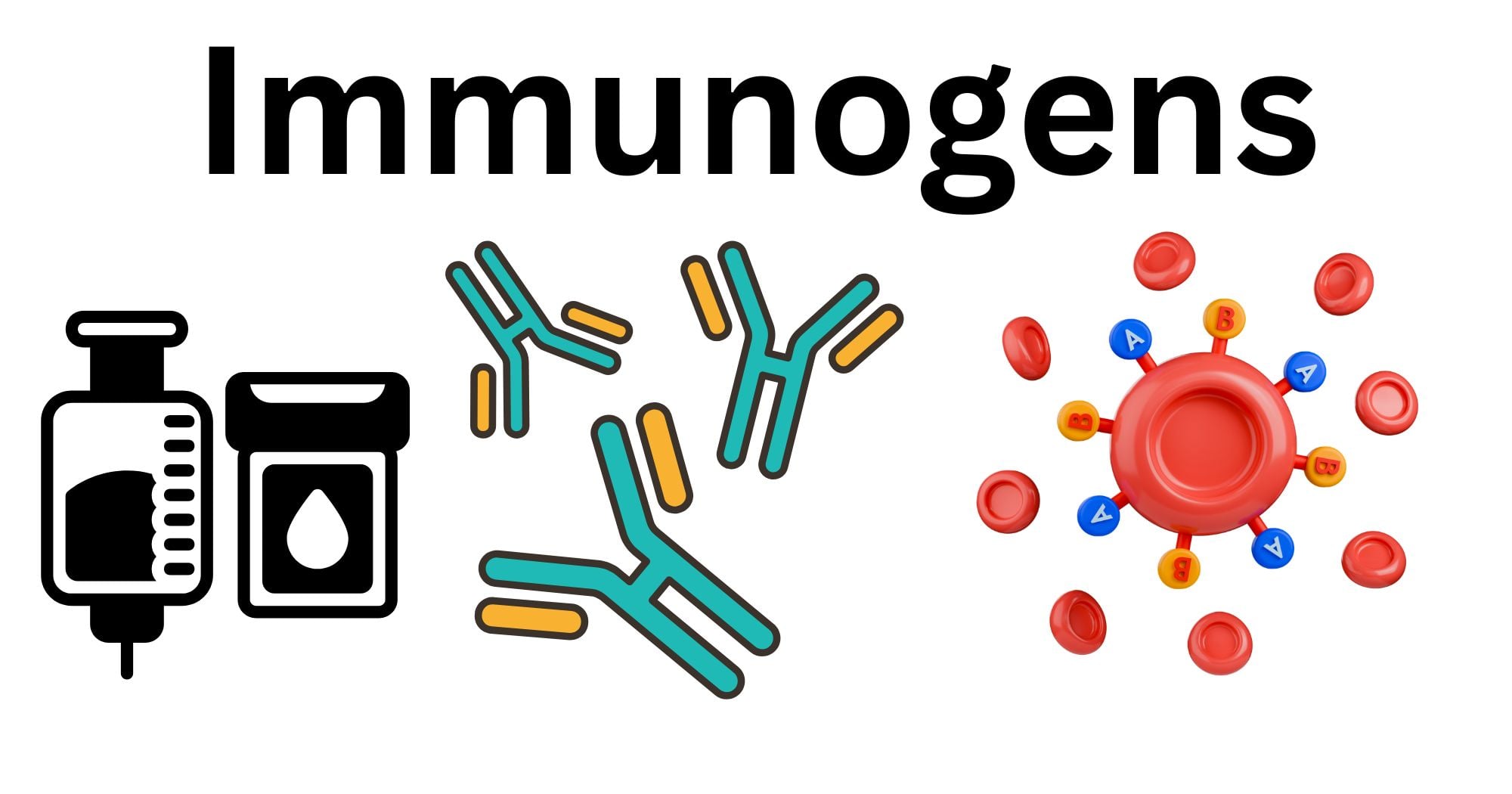
Immunogen vs. Antigen: Understanding the Difference
| Immunogen | Antigen |
| An immunogen is a substance capable of triggering an adaptive immune response (Abbas et al., 2025). | An antigen is a molecule capable of binding to an antibody or lymphocyte receptor (Abbas et al., 2025). |
| All immunogens are antigens (Murphy & Weaver, 2022). | Not all antigens are immunogens (Murphy & Weaver, 2022). |
| It has molecules with molecular size generally > 10kDa (Murphy & Weaver, 2022) | It has molecules with molecular size < 1kDa (Abbas et al., 2025) |
| Examples: Whole proteins, such as toxoid, live-attenuated vaccines, and conjugated vaccines (Pulendran et al., 2021) | Examples: DNA, lipids, drug molecules, haptens, and polysaccharides (Chaplin, 2020) |
Key Features That Make a Molecule Immunogenic
3 principal properties determine immunogenicity
Molecular size: Molecules exceeding ~10 kDa in molecular weight tend to be stronger immunogens. Their larger structure provides multiple epitopes for immune recognition (Abbas et al., 2025; Murphy & Weaver, 2022).
Chemical complexity: Chemical heterogeneity, including branched side chains and aromatic residues, increases immunogenicity (Murphy & Weaver, 2022; Chaplin, 2020).
Foreignness to the host: Self-molecules are generally tolerated through central and peripheral tolerance mechanisms (Chaplin, 2020).
Common Types of Immunogens
Proteins: They are the most potent immunogens as they contain both T-cell and B-cell epitopes, which enable full adaptive immune activation (Abbas et al., 2025).
Polysaccharides: These induce T-cell-independent IgM response primarily and are less immunogenic unless conjugated to protein carriers, as in conjugated vaccines (Murphy & Weaver, 2022).
Cells and pathogens: Whole cells and intact pathogens carry an array of pathogen-associated molecular patterns (PAMPs) that engage innate and adaptive immune pathways, making them highly immunogenic (Pulendran et al., 2021).
Epitopes and Determinants: Where Immune Cells Recognize Immunogens
Epitopes (antigenic determinants) are the discrete regions of an immunogen that are recognised by an antibody or T-cell receptor (Murphy & Weaver, 2022). B-cell epitopes are conformational (i.e., three-dimensional) surface patches, while T-cell epitopes are linear peptide sequences of 8-25 amino acids presented in MHC class I or class II molecules (Abbas et al., 2025).
Haptens: Why Some Antigens Are Not Immunogens Alone
Haptens are small molecules that are antigenic and capable of binding to antibodies (Abbas et al., 2025). When a hapten is covalently coupled to a larger carrier protein, it gains immunogenicity, which provides the T-cell epitopes necessary for T-cell help (Murphy & Weaver, 2022). The resulting hapten-carrier antibodies against drugs, hormones, and environmental chemicals for both research and diagnostic purposes (Chaplin, 2020).
Role of Adjuvants in Enhancing Immunogen Response
Adjuvants are the substances co-administered with immunogens to enhance the magnitude, quality, and durability of the immune response. They promote antigen uptake and presentation by dendritic cells by activating innate immune receptors, such as Toll-like receptors (TLRs), and create inflammatory environments that prolong antigen bioavailability. A few clinically approved adjuvants include aluminium salts (aka alum), the oil-in-water emulsion MF59, and AS01B, which is a combination of the TLR4 agonist MPL and the saponin QS-21, and is primarily used in the recombinant shingles vaccine (Pulendran et al., 2021).
How Immunogens Activate B-Cells and T-Cells: Humoral and Cell-Mediated Immunity
Antigen-presenting cells process and take up antigens, on which peptide fragments are loaded and displayed to naive T lymphocytes in secondary lymphoid organs, triggering their activation and clonal expansion (Abbas et al., 2025). Similarly, T cell helper cells provide signals and cytokines that help with B-cell proliferation, somatic hypermutation, affinity maturation, and differentiation into antibody-secreting plasma cells, which constitute humoral immunity (Murphy & Weaver, 2022). CD8+ cytotoxic T cell lymphocytes mediate cell-mediated immunity, recognizing MHC class I-restricted peptides on infected or malignant cells and destroying them directly (Chaplin, 2020).
Factors Affecting Immunogenicity: Dose, Route, and Host Genetics
Immunogenicity can be affected by various factors, such as dose, route, and host Genetics. The immune response can be affected by the dose of antigen: very low doses may be insufficient to activate lymphocytes, while very high doses can induce clonal deletion (a phenomenon known as high-zone tolerance) (Murphy & Weaver, 2022). The route determines the engagement with the lymphoid compartments and mucosal immune responses (Pulendran et al., 2021). Host genetics, such as MHC polymorphisms, governs which epitope peptides can be presented to T lymphocytes, influencing the breadth and magnitude of the adaptive immune response to any given immunogen (Abbas et al., 2025).
Immunogen Design in Vaccines: From Natural Pathogens to Synthetic Constructs
Modern vaccine designs leverage structural biology to engineer immunogens that preferentially display protective epitopes while minimizing immunodominant ones (Boyoglu-Barnum et al., 2021). RSV and SARS-COV-2 spikes are targeted by neutralizing antibodies because of the stabilization of the prefusion conformation of viral fusion proteins (Boyoglu-Barnum et al., 2021). mRNA vaccines directly encode optimized antigen sequences, enabling rapid iterative design and delivering conformationally correct immunogens via lipid nanoparticles (Pardi et al., 2018).
Risks and Challenges: Autoimmunity, Tolerance, and Immunopathology
When immune responses are directed against self-tissues, they can result in autoimmune pathology through mechanisms such as molecular mimicry or bystander activation (Abbas et al., 2025). Immunological tolerance is maintained through the central deletion of self-reactive lymphocytes in the thymus and bone marrow, as well as peripheral regulatory mechanisms that normally prevent misdirected responses (Murphy & Weaver, 2022). Such excessive or dysregulated immunogen-driven responses can cause immunopathology, as exemplified by the cytokine storm observed during severe infectious diseases, making adjuvant selection and immunogen dose optimization critical for safety (Pulendran et al., 2021).
Laboratory Use of Immunogens: Generating Antibodies and Experimental Immunology
In the laboratory, immunogens are used to raise polyclonal antisera or to produce monoclonal antibodies via hybridoma technology for use in assays, including ELISA, Western blotting, immunohistochemistry, and flow cytometry (Murphy & Weaver, 2022). Hapten-carrier conjugates enable antibody production against small molecules of pharmacological or toxicological relevance (Chaplin, 2020). Recombinant protein expression platforms, along with nanoparticle antigen display systems, have expanded the range of immunogens available for research, allowing precise control over epitope presentation and immunogen valency (Boyoglu-Barnum et al., 2021).
Conclusion
Immunogens are central to both protective immunity and biomedical innovation. They underpin vaccine design, antibody generation, and the understanding of immune activation and tolerance (Abbas et al., 2025). The properties that govern immunogenicity, such as size, complexity, foreignness, route, and dose, must be considered carefully in any immunological application (Murphy & Weaver, 2022). Continued advancement in structural vaccinology, adjuvant science, and nucleic acid delivery platforms that are reshaping the landscape of immunogen design, enabling precisely targeted, potent, and safe immune interventions (Pulendran et al., 2021).
References
- Abbas, A. K., Lichtman, A. H., Pillai, S., & Henrickson, S. (2025). Cellular and molecular immunology – edition 11 – by abul K. Abbas, MBBS, andrew H. Lichtman, MD, phd, shiv pillai, MD, phd and sarah henrickson, MD, phd elsevier health inspection copies. https://www.inspectioncopy.elsevier.com/book/details/9780443283581 (2025)
- Boyoglu-Barnum, S., Ellis, D., Gillespie, R. A., Hutchinson, G. B., Park, Y.-J., Moin, S. M., Acton, O. J., Ravichandran, R., Murphy, M., Pettie, D., Matheson, N., Carter, L., Creanga, A., Watson, M. J., Kephart, S., Ataca, S., Vaile, J. R., Ueda, G., Crank, M. C., Kanekiyo, M. (2021). Quadrivalent influenza nanoparticle vaccines induce broad protection. Nature, 592(7855), 623–628. https://doi.org/10.1038/s41586-021-03365-x
- Chaplin, D. D. (2010). Overview of the immune response. The Journal of Allergy and Clinical Immunology, 125(2 Suppl 2), S3-23. https://doi.org/10.1016/j.jaci.2009.12.980
- Murphy, K. M., Weaver, C., & Berg, L. J. (2022). Janeway’s immunobiology. W. W. Norton & Company. https://wwnorton.com/books/9780393884890
- Pardi, N., Hogan, M. J., Porter, F. W., & Weissman, D. (2018). mRNA vaccines — a new era in vaccinology. Nature Reviews Drug Discovery, 17(4), 261–279. https://doi.org/10.1038/nrd.2017.243
- Pulendran, B., Arunachalam, P. S., & O’Hagan, D. T. (2021). Emerging concepts in the science of vaccine adjuvants. Nature Reviews Drug Discovery, 20(6), 454–475. https://doi.org/10.1038/s41573-021-00163-y
