
Corals are marine invertebrates belonging to the class Anthozoa of the phylum Cnidaria (or Coelenterata). These organisms form colonies of genetically identical structures called polyps, renowned for building an intricate Coral reef network.
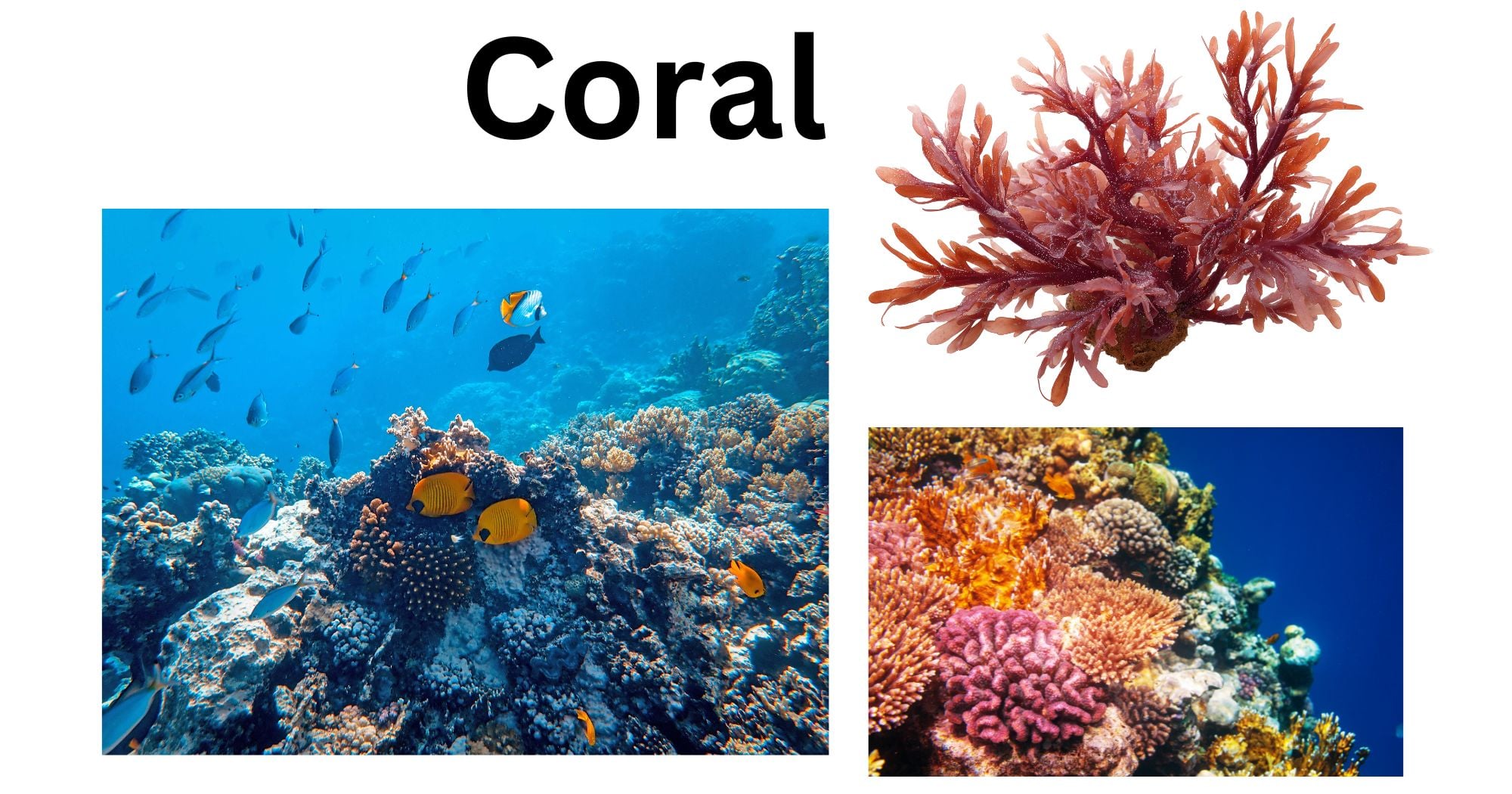
Vaughan (1919) defined a coral reef as “a ridge or mound of limestone primarily formed of calcium carbonate by the action of organisms, with its upper surface located near the sea’s surface. In other words, Coral reefs are shallow marine ecosystems marked by complex limestone structures formed of calcium carbonate built primarily by hermatypic(reef-building) corals. These reefs lying close to the ocean surface appear colorful and patterned. These patterns of Coral reefs are dependent on the amount of sediments, depth, presence of nutrients, and salinity of water.
Coral reefs are one of the most biodiverse and productive ecosystems on Earth. They are often referred to as the “rainforests of the sea.”
Distribution of the Coral
Coral reefs are found mostly in the tropical and subtropical regions between 30°N and 30°S latitudes. Most coral reefs are found in the Indo-Pacific region, where the largest coral reef system, the Great Barrier Reef of Australia, is located. In the Indian Ocean, the East Coast of Kenya, Madagascar, the Maldives, and Lakshadweep are popular locations of Coral reefs. In the Pacific Ocean, the Philippines, the southern coast of Japan, Polynesia, Micronesia, and Queensland, Australia are popular. Furthermore, the Atlantic Ocean, the Caribbean Sea, and the East Coast of Brazil have coral reefs.
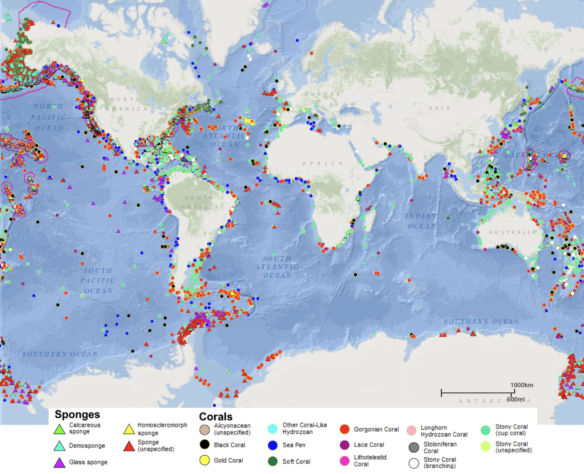
Image source: https://coastalcare.org/coral-reefs/
Other coral reefs include the Belize Barrier Reef of the Caribbean Sea, the Red Sea Coral Reef, the Maldives Coral Reef, etc. Coral reefs grow optimally at a depth of 30 meters in warm water up to 20°C. The growth also depends on the amount of light penetrating and the sediments present.
Solitary Coral can be found at a depth of 8000 meters.
Types of Coral
Corals can be classified in various ways. One type of classification is based on their roles in reef formation and symbiotic relationships:
Hermatypic Corals (Reef-building Corals)
Hermatypic corals belong to the Order Scleractinia and Subclass Hexacorallia of Class Anthozoa. They are known as stony corals because their calcareous skeletons contribute to the formation of coral reefs. They are also called Hard coral because they secrete calcium carbonate.
Reef-building corals have a symbiotic relationship with photosynthetic dinoflagellates (Zooxanthellae) that live within the coral’s tissues. These algae perform photosynthesis, producing sugar, oxygen, and necessary nutrients for corals. In return, the coral provides a protected environment for the algae and an opportunity to utilize waste products such as nitrogen, carbon dioxide, and phosphorus for growth and photosynthesis. This symbiosis requires sunlight, shallow, clear water, and an optimal temperature of 20°C to 28°C.
Examples of hard corals include Acropora(staghorn coral), Meandrina (Brain coral), Montipora (rice coral), and Porites.
Ahermatypic Corals (Non-Reef-building Corals)
Ahermatypic Corals belong to the Order Alcyonacea and Subclass Octocorallia of Class Anthozoa. They are Soft corals that do not play any role in reef formation. They possess minute spiny skeletons called sclerites, which are useful for species identification.
These types of coral lack symbiosis with zooxanthellae and rely on capturing plankton and organic particles for nutrition. They are solitary and can also inhabit deeper regions where sunlight is limited. Examples: Pachyclavularia violacea (Green star polyp), Leptogorgia, Pseudopterogorgia (Sea whip)
The three Orders of Coral, Helioporacea, Rugosa, and Tabulata are extinct groups. Helioporacea were known for their blue skeleton made of calcium carbonate. The coral secreted a specific mineral, aragonite, with reef-building capability. Tabulata could be distinguished by horizontal skeleton plates (tabulae).
Forms of Coral
Based on the growth structure and pattern of Corals. They exist in two primary forms:
Solitary Corals
Solitary Corals consist of a single polyp, and they grow independently.
They are known to inhabit deep waters and sometimes shallow regions.
Solitary Corals have a disc-like, cup-like, or mushroom-like appearance. They are attached to the substratum by a peduncle.
Example: Fungia, Flabellum, Caryophyllia.
Colonial Corals
Colonial Corals consist of multiple polyps that are connected by living tissue and share nutrients.
They are known to inhabit shallow marine environments.
They form massive structures that are often Plate-like, cup-like, spherical, or vase-shaped.
Example: Acropora, Porites.
Types of Coral Reefs
Reef-building Corals require a solid substratum for settlement and form layers of calcium carbonate deposits that grow upward. This coral supports a variety of marine life and can be categorized into the following types based on their physical structure and formation process.
Fringing Coral reef
- They are the most common and simplest reef structures.
- They lie directly on the outskirts of a non-reef island and developed along the continental margins.
- They are found at depths below 2 meters.
- The coral colonies develop on rocky coastlines and expand outward and upward towards the sunlight in the shallow water.
- Structures of Fringing coral reefs include the reef flat (back reef), the reef crest (highest point), and the reef slope (fore reef).
- Examples: Reefs along the Red Sea coastline and Ningaloo Reef in Australia (The largest fringing reef stretching 260 km along the coast).
Barrier Coral Reef
- Barrier reefs are similar to fringing reefs but separated from the shoreline by a water body called a lagoon. The water between the mainland and the coral reef is separated by half a mile to 10 miles or more.
- Barrier reefs are the largest, most extensive, and widest type of coral reefs.
- They measure thousands of kilometers in length and are often found as continuous chains rather than broken at places.
- Some notable examples are the Great Barrier Reef, located in the Coral Sea, off the coast of Queensland, Australia.
Atoll
- An Atoll is a circular or ring-shaped coral reef that encloses a lagoon with a depth of 50 meters or more.
- This type is also called the coral island.
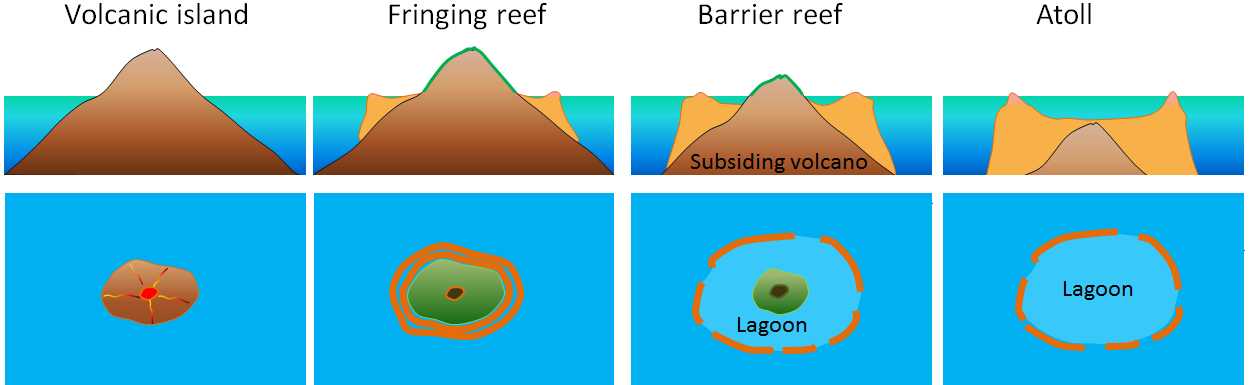
- Atolls form from submerged volcanic islands and result in the continued growth of coral upward and outward.
- Examples of atolls include the Great Chagos Bank of the Indian Ocean, which is the largest atoll, and Aldabra Atoll of Seychelles.
Patch Reef
- Patch reefs are small, isolated coral reefs that occur in discontinuous patches and are considered a localized ecosystem.
- They occur at depths of 3-6 meters and are surrounded by sand or seagrass beds.
- Patch reefs provide essential habitat for a variety of fish, invertebrates, and other marine species. Example: Virgin Island Patch Reefs in the Caribbean.
Bank reef
- Bank reefs are larger than patch reefs and are found in deeper water (2-24 meters).
- They are also called platform reefs and consist of linear, semi-circular clusters.
- Photosynthesis is not the primary energy source for these reef systems; instead, they rely on organic debris and plankton.
- Examples: Carysfort Reef of Key Largo, Florida.
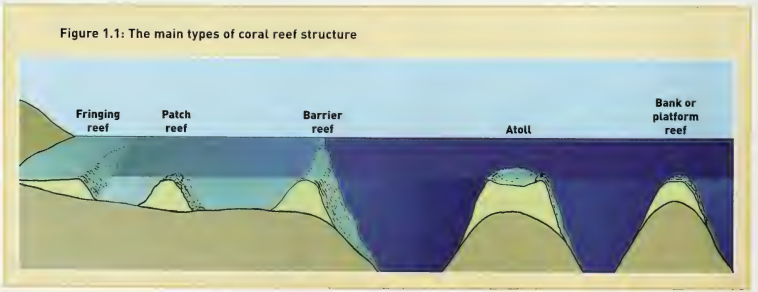
Image source: https://artpictures.club/autumn-2023.html
Formation of a Coral Reef
- Substrate Settlement: When an adult coral releases its larvae (planulae), they drift with the current before settling on hard surfaces. As the condition becomes stable, nutrient-rich, and shallow, it allows planulae to settle on surfaces such as submerged rock.
- Colonization: Once the planulae settle, they develop into polyps, soft-bodied building blocks of the reef. Each polyp remains enclosed, secreting calcium carbonate beneath its base over time. These skeletons accumulate to form the reef structure.
- Coral Growth and Reef Expansion: Through asexual reproduction, corals produce new polyps and expand themselves. They grow larger, secreting more calcium carbonate and giving the reef a characteristic structure. This process continues for thousands of years, forming the framework of coral reefs.
Formation of different types of coral reefs
Charles Darwin first developed the theory of coral reef formation in his 1842 work. He stated in his work that corals initially formed fringing reefs and evolved through successive stages into barrier reefs and atolls. His observation of a sinking island in the regions where coral reefs are found led to this theory.
Source: Roger Williams University Open Publishing
Economic Importance of Coral Reef
Biodiversity Hotspot and Ecological Importance
- Coral reefs are home to 25% of marine species, including clownfish, parrotfish, butterflyfish, sea turtles (such as hawksbill turtles), certain octopuses, and squids.
- They serve as a primary breeding, feeding, or nursery site for these animals.
- Coral reefs play an important role in nutrient cycling within symbiotic associations with algae, sponges, and microbes. Processes such as Nitrogen cycling and the modification of dissolved organic matter are essential for the ecosystem.
Coastal Protection: Coral reefs are a natural barrier that dissipates wave energy and protects coastlines from erosion. These protections reduce the need for costly man-made infrastructure.
Tourism and Economic Importance
- Coral reefs like the Great Barrier Reef attract millions of tourists annually for snorkeling, diving, and boating activities.
- They are significant contributors to the national economies of places such as Lakshadweep, the Philippines, Mauritius, Seychelles, and Fiji. Fiji is known as the soft coral capital of the world due to its beautiful underwater ecosystem.
- Coral reefs are also a major attraction for eco-tourism, offering activities such as underwater photography.
- As a natural source of calcium carbonate, coral reefs can be used in cement production.
Medicinal value
- Coral reefs are a rich source of natural products. Studies on Sarcophytol, produced by the soft coral Sarcophyton, have demonstrated anti-tumor and anti-inflammatory properties.
- Similarly, compounds from sponges like Halichondria have led to the development of Ara-C, a chemotherapy drug used to treat leukemia and lymphoma. Coral reef organisms are thus crucial for the discovery of novel drugs and therapies for human diseases.
References
- Fine, M., & Loya, Y. (2002). Endolithic algae: An alternative phototrophic energy source for corals bleaching under stress. Marine Biology, 140(4), 639–646. https://doi.org/10.1007/s00227-001-0713-0
- World atlas of coral reefs. (n.d.). Retrieved from https://ia600208.us.archive.org/6/items/worldatlasofcora01spal/worldatlasofcora01spal.pdf
- Dive.site. (n.d.). The five different types of coral reefs (with examples). Retrieved from https://dive.site/blog/different-types-coral-reefs
- Britannica. (n.d.). Atoll. In Encyclopaedia Britannica. Retrieved from https://www.britannica.com/science/atoll
- Coral Digest. (n.d.). Bank reefs. Retrieved from http://coraldigest.org/index.php/BankReefs#:~:text=Bank%20reefs%20are%20unique%20in,reefs%20from%20the%20sea%20floor
- Britannica. (n.d.). Fringing reef. In Encyclopaedia Britannica. Retrieved from https://www.britannica.com/science/fringing-reef
- Britannica. (n.d.). Barrier reef. In Encyclopaedia Britannica. Retrieved from https://www.britannica.com/science/barrier-reef
- Corals of the world. (n.d.). Retrieved from https://www.coralsoftheworld.org/page/classification/
- Online Biology Notes. (n.d.). Coral reefs: Types, formation, and economic importance. Retrieved from https://www.onlinebiologynotes.com/coral-reefs-types-formation-and-economic-importance
- Natural History Museum. (n.d.). Charles Darwin and his coral conundrum. Retrieved from https://www.nhm.ac.uk/discover/charles-darwin-coral-conundrum.html#:~:text=Darwin%20also%20proposed%20a%20theory,reef%20as%20an%20isolated%20circle
- SOTC. (n.d.). Fiji’s the soft coral capital of the world, but that’s a small part of their story. Retrieved from https://www.sotc.in/blog/international-holidays/fiji-s-the-soft-coral-capital-of-the-world-but-that-s-a-small-part-of-their-story#:~:text=Although%20it%20is%20a%20narrow,corals%20teeming%20with%20beautiful%20fishes
- Fiore Lab Symbiosis. (n.d.). Nutrient cycling on coral reefs. Retrieved from https://fiorelabsymbiosis.org/nutrient-cycling-on-coral-reefs/#:~:text=We%20now%20know%20that%20the,limiting%20nutrient%20on%20coral%20reefs
- The development of coral concretes and their upgrading technologies. (n.d.). Retrieved from https://www.sciencedirect.com/article/abs/pii
- Slideshare. (n.d.). Coral reefs: Theory, types, formation [PowerPoint slides]. Retrieved from https://www.slideshare.net/slideshow/coral-reefs-theory-types-formation/78934914
- Griggs, G. (n.d.). Distinguished professor of Earth sciences. University of California Santa Cruz. Retrieved from https://coastalcare.org/coral-reefs/
- Khalifa, S. A. M., Elias, N., Farag, M. A., Chen, L., Saeed, A., Hegazy, M.-E. F., Moustafa, M. S., Abd El-Wahed, A., Al-Mousawi, S. M., Musharraf, S. G., Chang, F.-R., Iwasaki, A., Suenaga, K., Alajlani, M., Göransson, U., & El-Seedi, H. R. (2020). Marine natural products: A source of novel anticancer drugs. National Institutes of Health (NIH). https://pmc.ncbi.nlm.nih.gov/articles/PMC6780632/
