Skip to content
Microbe Notes

Microbe Notes

  • Home
  • Biological Sciences
    • Biochemistry
    • Bioinformatics
    • Biology
    • Biotechnology
    • Botany
    • Cell Biology
    • Genetics
    • Molecular Biology
    • Zoology
  • Microbiology
    • Agricultural Microbiology
    • Bacteriology
    • Basic Microbiology
    • Environmental Microbiology
    • Food Microbiology
    • Immunology
    • Mycology
    • Parasitology
    • Virology
  • Laboratory Methods
    • Biochemical Test
    • Culture Media
    • Instrumentation
    • Microscopy
    • Staining
  • Health and Medical
    • Diseases
    • Epidemiology
    • Human Anatomy and Physiology
    • Medical Devices
    • Pharmacology
  • Resources
    • Difference Between
    • Microbiology Terms
    • Microorganisms Note
    • Protocols
    • Research Methodology
    • Syllabus

Immunology

Immunology is an emerging branch of medical science that deals with studies related to different aspects of the immune system like the cells, structure, function, response against antigens, and disorders.

  • The immune system consists of a collection of cells, chemicals, processes, and mechanisms that function to protect the body from foreign antigens, such as microbes (organisms such as bacteria, fungi, and parasites), viruses, cancer cells, and toxins.
  • Beyond, the structural and chemical barriers which protect us from infection, the immune system consists of two lines of defense; innate immunity and adaptive immunity.
  • The innate immunity represents the first line of defense against the antigen, and it is an antigen-independent defense mechanism used by the host immediately or within hours of encountering an antigen.
  • On the other hand, adaptive immunity is antigen-dependent and antigen-specific and, therefore, includes a lag time between exposure to the antigen and maximal response.
  • Studies conducted in immunology are related to the measurement of physiological functioning of the immune system in both healthy and disease conditions, malfunctioning of the system in the case of disorders, and physical, chemical, and physiological characteristics of the cells of the immune system.
  • Immunology is fast becoming an important branch of clinical medicine as it has a close relationship with organ transplantation, oncology, virology, bacteriology, and even dermatology.
  • Immunology is focused on certain organs of the body like the bone marrow and the lymphatic system and the white blood cells found in the blood.
  • These cells or organs producing these cells are responsible, directly or indirectly, for the defense mechanism of the body against a pathogenic agent or other antigens.
  • These cells keep on circulating throughout the body via blood or lymph so that they can detect antigens entering the body from different sources.
  • An important aspect of immunology is immunotherapy, where components of the immune system or antigens are used to treat a disease or disorder as a form of treatment.

Lymph Nodes- Structure and Functions

September 5, 2022June 13, 2022 by Sagar Aryal, PhD
Lymph Nodes- Structure and Functions

Lymph nodes are small solid structures placed at varying points along the lymphatic system such as the groin, armpit and mesentery. They contain both T and B lymphocytes as well … Read more
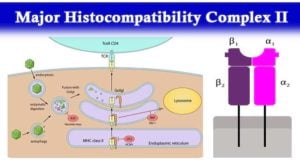
Major Histocompatibility Complex II- Structure, Mechanism and Functions

September 5, 2022June 12, 2022 by Sagar Aryal, PhD
Major Histocompatibility Complex II- Structure, Mechanism and Functions

Major Histocompatibility Complex (MHC) is a part of the genome of all vertebrates that code for molecules which are important in immune recognition. In humans, the MHC is a cluster … Read more

Thymus- Structure and Functions

September 5, 2022June 11, 2022 by Sagar Aryal, PhD
Thymus- Structure and Functions

The thymus is a lymphocyte-rich, bilobed, encapsulated organ located behind the sternum, above and in front of the heart. The activity of the thymus is maximal in the fetus and … Read more

Type IV (Cell Mediated) Hypersensitivity- Mechanism and Examples

September 5, 2022June 11, 2022 by Sagar Aryal, PhD
Type IV (Cell Mediated) Hypersensitivity- Mechanism and Examples

Hypersensitivity refers to increased reactivity or exaggerated immune response of a host to an antigen to which it has been previously exposed. According to the most widely accepted classification of … Read more

Major Histocompatibility Complex I- Structure, Mechanism, Functions

September 5, 2022June 10, 2022 by Sagar Aryal, PhD
Major Histocompatibility Complex I- Structure, Mechanism and Functions

Major Histocompatibility Complex (MHC) is a part of the genome of all vertebrates that code for molecules which are important in immune recognition. In humans, the MHC is a cluster … Read more

Type III (Immune Complex) Hypersensitivity- Mechanism, Examples

September 5, 2022June 9, 2022 by Sagar Aryal, PhD
Type III (Immune Complex) Hypersensitivity- Mechanism and Examples

The term hypersensitivity denotes a condition in which an exaggerated immune response of a host results in inappropriate reactions that leads to destruction of host tissues. According to the most … Read more

Type II (Cytotoxic) Hypersensitivity: Mechanism, Examples

May 25, 2025June 8, 2022 by Sagar Aryal, PhD
Type II (Cytotoxic) Hypersensitivity- Mechanism and Examples

Mechanism of Type II Hypersensitivity Reactions Examples of Type II Hypersensitivity Rhesus incompatibility (Rh hemolytic disease) During subsequent pregnancies, when Rh –ve mother conceive Rh +ve fetus, small numbers of fetal … Read more

Type 1 (Anaphylactic) Hypersensitivity Reaction

September 5, 2022June 5, 2022 by Sagar Aryal, PhD
Type 1 (Anaphylactic) Hypersensitivity Reaction

Hypersensitivity is increased reactivity or increased sensitivity by the animal body to an antigen to which it has been previously exposed. The most widely adopted current classification is that of … Read more

Eastern Blot- Definition, Principle, Steps, Results, Applications

October 21, 2022May 28, 2022 by Anupama Sapkota
Eastern Blot

Eastern blot is a molecular biology technique that is used to detect post-translational modifications in proteins and the presence of components like lipids and carbohydrates. Eastern blot was discovered as … Read more

MHC Molecule and Autoimmunity with Examples and Diagrams

July 26, 2022May 28, 2022 by Khushi Jain
MHC Molecule and Autoimmunity with Examples

What is an MHC Molecule? Human leukocyte antigen is a major histocompatibility complex present on chromosome 6 of the human genome. Size: 3.6 Mb approx. They are divided into 3 … Read more

Older posts
Newer posts
← Previous Page1 … Page5 Page6 Page7 … Page12 Next →

Topics / Categories

  • Agricultural Microbiology (30)
  • Bacteriology (134)
  • Basic Microbiology (63)
  • Biochemical Test (114)
  • Biochemistry (211)
  • Bioinformatics (26)
  • Biology (142)
  • Biotechnology (43)
  • Botany (112)
  • Cell Biology (108)
  • Culture Media (68)
  • Difference Between (89)
  • Diseases (53)
  • Environmental Microbiology (15)
  • Epidemiology (29)
  • Food Microbiology (52)
  • Genetics (82)
  • Human Anatomy and Physiology (75)
  • Immunology (118)
  • Instrumentation (72)
  • Medical Devices (5)
  • Microscopy (31)
  • Molecular Biology (118)
  • Mycology (43)
  • Parasitology (28)
  • Pharmacology (25)
  • Protocols (9)
  • Research Methodology (20)
  • Staining (30)
  • Syllabus (20)
  • Virology (62)
  • Zoology (39)
  • Phagocytosis: Phagocytes, Steps, Mechanisms, Examples
  • Nucleosomes: Components, Structure, Functions
  • Heterochromatin: Types, Features, Formation, Functions
  • One Health: Interdependence Between Human, Animal, and Environmental Health
  • iNKT Cells: Development, Maturation, Activation, Roles
  • Our Team
  • Advisory Board
  • About Us
  • Contact Us
  • Editorial Policy
  • Privacy Policy
  • Cookie Policy
  • Disclaimer (Terms and Conditions)
© 2026 Microbe Notes. Made with ♡ by Sagar Aryal.