
Biogeography is a discipline in biology that attempts to explain possible patterns of biodiversity distribution and to connect the processes that have shaped these patterns across various geological times.
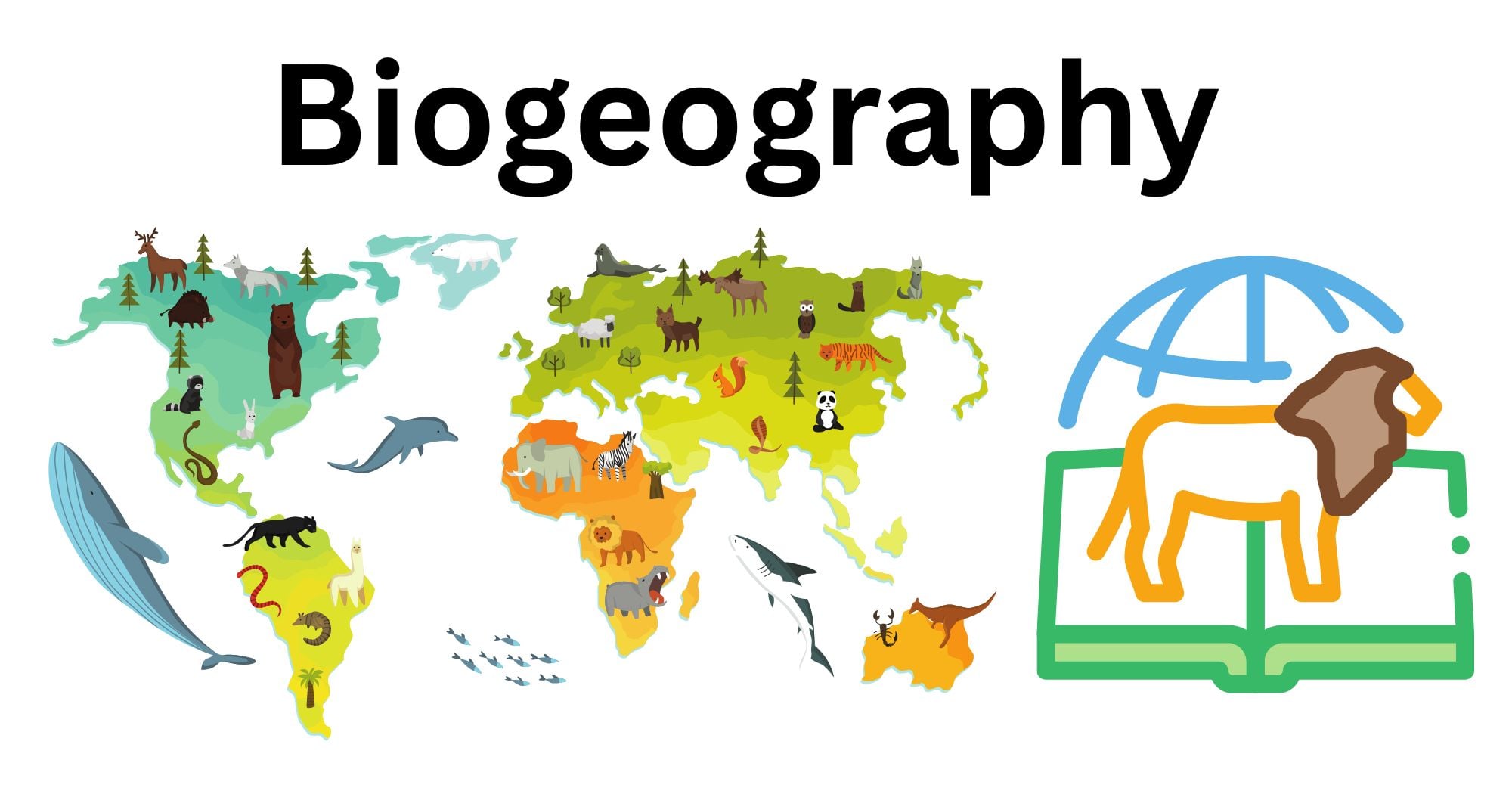
This branch integrates concepts and information from other disciplines, such as ecology, evolutionary biology, taxonomy, geology, physical geography, paleontology, and climatology.
Two approaches to Biogeography include Ecological Biogeography and Historical Biogeography:
Ecological Biogeography
Ecological Biogeography studies environmental factors like soil, climate, latitude, topography, and interactions between organisms (competition, symbiosis, predation). That shapes the distribution of individuals at a local scale.
This approach focuses on questions like:
- Why do species exist in their current ranges?
- What prevents them from spreading to other areas?
- Why do certain areas, such as the tropics, have higher species diversity?
- Why do some environments have more endemic species than others?
Historical Biogeography
Historical Biogeography concerns the study of the distribution of organisms through its evolutionary time scales and how it was shaped by past geological events like continental drift, glaciation, and other major phenomena. It deals with large-scale distribution over a long evolutionary period.
The approach focuses on questions like:
- How did species come to be confined to their present ranges?
- How have specific taxa evolved and spread across different continents?
- What is the uniqueness of flora and fauna in isolated regions like Australia or Madagascar?
The spread of living things in an ecosystem can be referred to as the distribution of organisms. Distribution can be categorized based on how species are spread across environmental contexts such as space (geographical and bathymetric) and time (geological).
Spatial Distribution
Distribution of species across Earth’s surface in a physical space as a natural habitat.
The two kinds of spatial distribution are
Geographical distribution (horizontal)
It is the distribution of species focusing on horizontal spread across lands and various climatic zones. It takes into consideration various climates, habitat availability, dispersal, barriers to dispersal, human influences, and varying altitudes in the terrestrial ecosystem.
Examples: Polar bears (Ursus maritimus) are restricted to the Arctic region due to their adaptation to cold environments and dependence on sea ice for hunting.
Bathymetric Distribution (vertical)
It is the distribution of species over the vertical range from the deepest part of the ocean to the top of the mountains.
The distribution of organisms in the ocean can be classified based on various depth zones, and they are:
- Intertidal Zone: It refers to areas that experience high and low tides. Organisms here include Crabs, Sea stars, Barnacles, etc.
- Neritic Zone: It refers to that zone from the intertidal to the continental shelf. Animals here include Fish, Marine mammals, and Sea turtles.
- Pelagic Zone: It refers to a zone with organisms that live in the open ocean.
- Benthic Zone: It refers to a zone with organisms that live on or near the ocean floor
- Hadalpelagic Zone: It refers to a zone of organisms that live in the deepest ocean trenches.
The distribution of organisms on Land can also be classified based on various elevation zonation with increasing altitude, and they are:
- Lowland Zone: Zone with the warmest temperature that includes tropical and subtropical forests, grasslands, and wetlands.
- Montane Zone: The zone features cooler temperatures and is divided into sub-zones called biomes. It often contains temperate forests and grasslands.
- Subalpine Zone: The zone is characterized by colder temperatures with shorter seasons and harsher environmental conditions. Vegetation becomes sparse, and alpine meadows appear.
- Alpine Zone: The zone is defined by high altitude and harsh environmental conditions such as extreme cold, strong winds, and thin air. Vegetation is limited and consists of low shrubs, mosses, and lichens. Animal species include mountain goats, marmots, and birds like the snow bunting.
- Nival Zone: The zone is above the permanent snowline, where conditions are extreme with perpetual snow and ice. It consists of minimal biodiversity with only specially adapted organisms living.
Geological Distribution
It is the distribution of species on the Earth in the course of geological time being affected by various geological events like continental drift, plate tectonics, and the formation of landmasses. This distribution is significant in explaining the evolutionary history of a species. It is revealed by fossil evidence where geological strata provide records of ancient species. Key aspects of Geological distribution include the distribution of rock types, minerals, fossils, and geological structures, and how these elements influence biological communities and ecosystems.
Examples: The Grand Canyon of Colorado, United States of America, serves as an invaluable resource for studying Earth’s history. It showcases geological distribution through its stratigraphy, highlighting the Law of Superposition, where older rocks lie beneath younger ones. It features three main rock types (Igneous, Sedimentary, and Metamorphic). There are remains of two billion years of Earth’s history, and fossils like trilobites and brachiopods reveal past marine environments.
Patterns of Distribution
The distribution pattern is the arrangement and the frequency of occurrence of a species across different geographical areas or habitats. It describes how the organisms are spread out about one another and their environment. Different patterns of Distribution of species are:
Cosmopolitan Distribution
Species with cosmopolitan distribution are found across a wide range of geographic locations in the world. These organisms have certain adaptations to overcome environmental barriers and, hence, are called Eurytopic. However, they can inhabit certain continents or ecosystems.
Examples of Eurytopic organisms with Cosmopolitan distribution are
Human beings (Homo sapiens), Killer whales (Orcinus orca), Common pigeons (Columba livia) that are found globally in cities and rural areas, and dandelions (Taraxacum officinale) that are found thriving in diverse environments, especially lawns and fields.
Endemic Distribution
Species with endemic distribution are native to specific geographic areas and not found elsewhere. They remain isolated to a particular region, island, or specific ecological niche. Geographical barriers such as mountains, rivers, and oceans can lead to species, resulting in isolation and endemism (Vicariance).
Examples of endemic organisms include
Galapagos Tortoise(Chelonoidis nigra): Found only on the Galapagos Islands.
Aglaia Ceramica is a species of plant belonging to the Meliaceae family, which is endemic to the Maluku Islands in Indonesia.
Nilgai (endemic to the Indian subcontinent)
Monotremes (Egg-laying mammals) are found only in the Australian region.
Disjunct/ Discontinuous Distribution
Species with populations separated by large distances can be discontinuous, and hence, it is a disjunct distribution. This is a result of historical events or environmental changes.
Examples of species with disjunct distribution are:
Flightless birds: Ostriches in Africa and Arabia, Cassowaries and Emus in Australia, Kiwis in New Zealand, and Rheas in South America.
American Alligator (Alligator mississippiensis): found in the southeastern United States and parts of China, but differs completely over large distances.
Eastern and Western Redbud Trees (Cercis canadensis and Cercis occidentalis): This disjunct population of Redbud trees extends from eastern North America to western North America with no continuity between them.
Lungfish: The three genera of Lungfish, Protopterus, Lepidosiren, and Neoceratodus, inhabit marshlands of different continents: Africa, South America, and Australia, respectively.
According to Darlington, several key points explain the occurrence of discontinuous distribution, such as:
- Geographical Isolation: Species may have become separated by bodies of water or land barriers(Islands), leading to population development in isolation.
- Extinction Events: Species that once inhabited continuous areas may have faced extinction in intermediate regions, resulting in isolation.
- Land Mass Changes: Geological events, such as the submergence of land masses, can divide populations, leading to discontinuous distribution.
Bipolar Distribution
Species with bipolar distribution can be found only in the extreme cold in both polar regions (Arctic and Antarctic), with no distribution between them.
Examples include:
Antarctic Krill (Euphausia superba) is A key species in the Southern Ocean, which is crucial for the Antarctic and the Arctic food web with bipolar distribution.
Marine fishes like Basking sharks, Anchovies, and Porbeagle sharks are found only in the northern and southern temperate latitudes.
Cryophilic Tardigrada (Cyroconicus) has been investigated to be distributed bipolarly in the glaciers of the Arctic and Antarctic, with discontinuous distribution in between in the Central Asian mountain ranges.
References
- Khan S. M ( 2020), Types of Animal Distribution [Slide Show], Slideshare, Available at https://www.slideshare.net/slideshow/types-of-animal-distribution/238355716 (Accessed on 22nd October 2024)
- ThejassPunatil ( 2020), Animal Distribution [Slide Show], Slideshare, Available at https://www.slideshare.net/slideshow/animal-distribution-237794758/237794758 (Accessed on 22nd October 2024)
- Cox, C Barry, and Peter Moore(2005), Biogeography: an ecological and evolutionary approach. Malden, MA: Blackwell Publications.
- Sanmartín, I. (2012). Historical Biogeography: Evolution in time and space. Evolution Education and Outreach, 5(4), 555–568. Available at https://doi.org/10.1007/s12052-012-0421-2
- Zawierucha, K., Kašparová, E. Š., McInnes, S., Buda, J., Ambrosini, R., Devetter, M., Ficetola, G. F., Franzetti, A., Takeuchi, N., Horna, P., Jaroměřská, T. N., Ono, M., Šabacká, M., & Janko, K. (2023). Cryophilic Tardigrada has disjunct and bipolar distribution and establishes long-term stable, low-density demes. Polar Biology, 46(10), 1011–1027. https://doi.org/10.1007/s00300-023-03170-4
- Grand Canyon National Park. (n.d.). Geology of the Grand Canyon. National Park Service. Available at https://www.nps.gov/grca/learn/nature/geology.htm
- Shree D. ( 2013), Biogeography [Slide Show], Slideshare, Available at https://www.slideshare.net/slideshow/biogeography-23731574/23731574 (Accessed on 22nd October 2024)
- Jenkins, D. G., & Ricklefs, R. E. (2011). Biogeography and ecology: two views of one world. Philosophical Transactions of the Royal Society B Biological Sciences, 366(1576), 2331–2335. Available at https://doi.org/10.1098/rstb.2011.0064
- Patre S ( 2021), Bathymetric Distribution of Animals[Slide Show], Slideshare, Available at https://www.slideshare.net/slideshow/bathymetric-distribution-of-animals/250052420 (Accessed on 22nd October 2024)
