
Zoogeographic realms (or regions) are the divisions of the land surface on Earth characterized by their faunal and floral diversity. The distributions are dissimilar to each other as these geographical regions (or continents) are isolated. They are separated by mountain ranges or physiographic features.
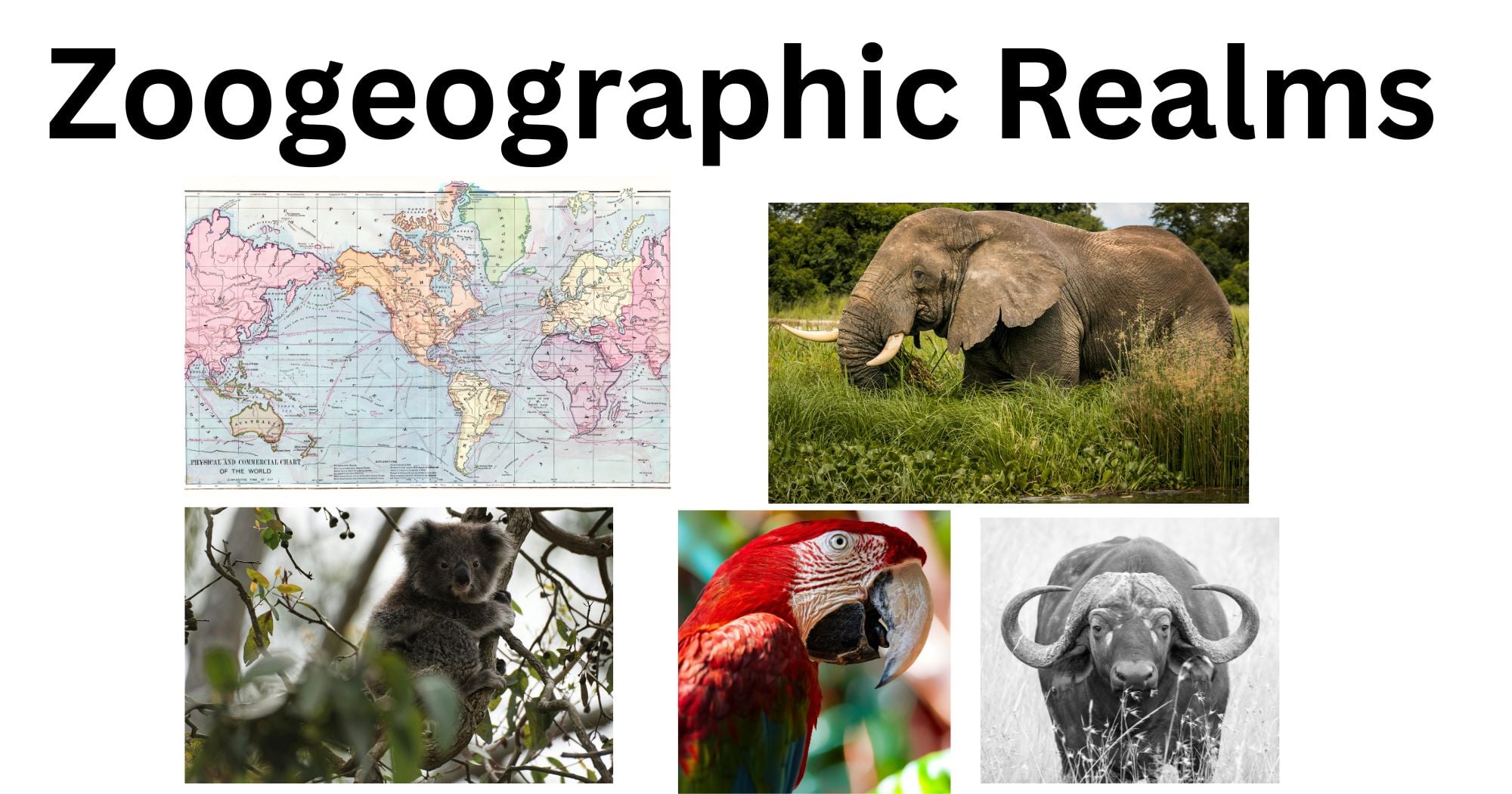
One of the most influential contributors to the zoogeographic realms is Alfred Russel Wallace, who is considered the “Father of Zoogeography.” He proposed the system of dividing the Earth into different, distinct regions based on differences in the diversity of animals. Mammals were chosen as a model organism to study patterns of animal distribution.
In his work “The Geographical Distribution of Animals: Volume 1”, published in 1876, the Earth can be divided into six zoological realms or regions hosting a distinct animal diversity. These realms are:
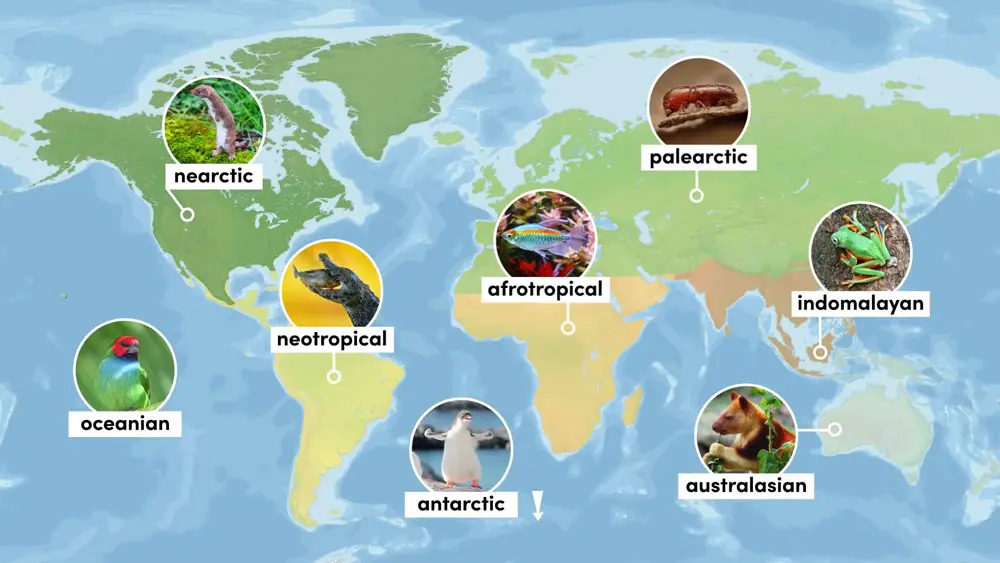
Source: Textbooktravel
Nearctic Realm
The Nearctic realm includes North America and Greenland. Some two to three million years ago, North America separated from South America due to the phenomenon of continental drift, giving rise to unique landscapes, diversified ecosystems, and representative fauna and flora in each continent.
Climate and Physical Features
The Nearctic realm has a great variation in climate, ranging from ice in Greenland to deserts in North America.
The landscape features can be divided into the following:
- The northernmost portion includes the Arctic region, characterized by the Tundra and Boreal forests.
- The temperate portion includes regions of Canada and the United States with grasslands (Prairie), the Great Plains, the Canadian Shield, deserts, and the Rocky Mountains.
- The Southwestern portion extends towards Mexico, characterized by desert and semi-arid climate.
Representative Fauna
The varying landscape of the Nearctic region features great faunal diversity. Animals such as Monarch Butterflies are known to migrate thousands of miles from Canada to Mexico.
| Category | Examples / Endemic species |
| Fish | Channel Catfish, Mooneye, American Bass, Sturgeon, Sockeye Salmon, Garpike, Bowfin. |
| Amphibian | Tiger Salamander, American Bullfrog, Ascaphus(Tailed frog), Limbless Lizard, Horned Toad. |
| Reptile | The Nearctic realm is rich in reptilian diversity. Rattlesnakes, Garter snakes, Alligator, Geckos, Horned Iguanids, Gila monster, the only poisonous lizard (Heloderma), Anniella (Legless lizards), Gopher tortoises. |
| Bird | Golden eagle, Bald eagle, Canada goose, Peregrine falcon, Hummingbirds, Hawk, Pelicans, Kingfisher, Cardinal Crane. Ocellated turkey in the Yucatan Peninsula, and the Blue Macaw of Central Mexico. |
| Mammal | Blue whale, Cougar, American bison, Grey Wolf, Polar Bear, Pronghorn, Mountain beaver, Pocket gopher, and Pocket mice. |
Palearctic Realm
The Palearctic realm is the largest and covers Europe and northern Asia, including the foothills of the Himalayas, parts of the Arabian Peninsula, and northern Africa.
Like the Nearctic region, this region exhibits varied climatic diversity. The divisions include Tundra, Boreal Forest, Grasslands (Steppes), Coastal areas (as it is bounded by the ocean on three sides), Mountains of the Himalayas, Deserts, and large bodies of inland water.
Representative Fauna
The Palearctic realm’s most faunal diversity coincides with the Nearctic realm. Hence, they are combined and called the Holarctic realm.
| Category | Examples/ Endemic species |
| Fish | Common Carp, Atlantic Salmon, Pike, Chinese Sturgeon, and Lamprey. |
| Amphibian | Giant Salamander, Midwife Toad, European Flying Frog, Tree Frog. |
| Reptile | Sand Boa, Steppe Viper, Trionyx turtle, Pond turtle |
| Bird | Pheasants, Crane, Hedge Sparrow, Common Pochard, Great Bustard, Laurel pigeon, Snowy owl, Caucasian Black grouse, and Snowcock. |
| Mammal | Mole rat, Bactrian Camel, Hyena, Otter, Dormice, Wild horse, Prezevalski’s horse, Snow leopard, Cheetah, Tiger, Brown, Narwhal, Walrus, Blue Whale, Long-eared Bat. |
Neotropical Realm
The Neotropical region encompasses South America, the southern parts of North America, and the West Indies.
Climate and Physical Features
This region does not have any desert, but it is home to a diverse ecosystem, also known as a megadiverse continent. The ecosystem includes tropical rainforests, savannas, and temperate forests. The neotropical realm can be divided into the following.
Chillian Sub-region: The west coast of South America contains the Andes Mountains. With the physical features of cloud forests and high-altitude paramos, it is said that it is home to most mammals of the world, like llamas, alpacas, and condors.
Brazilian Sub-region: This sub-region consists mostly of Brazil. It includes the Tropical forests in the northern region, which have a year-round rainfall, creating the largest tropical rainforest, the Amazon. The Brazilian Highlands occupy the central and southern regions.
Mexican Sub-region: The Mexico sub-region is a desert-like region with rocky mountains, the Sierra Madre.
West Indies Sub-region: The West Indies sub-region is an island with a tropical climate. It features volcanic mountains and a coastal plain.
Representative Fauna
| Category | Example / Endemic species |
| Fish | Piranha, Arapaima, Electric eel, South American Lungfish. |
| Amphibian | Poison Dart Frog, Glass Frog, Red-eyed Tree Frog, Surinam toad. |
| Reptile | Coral snakes, Xantusiid Lizards, Caiman crocodile, Boa constrictor, Galapagos Tortoise, Green Iguana |
| Bird | Harpy eagle, Scarlet macaw, Toucan, Great Curassow, Greater Rhea |
| Mammal | Anteater, Armadillo, Llama, Sloth, Jaguar, Brown-eared woolly Opossum, South American Tapir, Amazon River Dolphin, Capybara. Vampire bat |
Ethiopian Realm
The Ethiopian Realm (or Africotropical realm) covers Sub-Saharan Africa, Madagascar, and a few parts of southern Arabia.
Climate and Physical Features
The Ethiopian region has a tropical climate, experiencing high temperatures and seasonal rainfall. Africa has a vast tropical grassland called the savanna with tall grasses as compared to temperate climates. The highlands of the Ethiopian realm have a cooler temperature, whereas the lowlands experience hot, arid conditions. Madagascar has a unique maritime climate supporting a variety of ecosystems.
Representative Fauna
| Category | Examples / Endemic Species |
| Fish | Nile Perch, African Catfish, Electric Fish, Sardine, Tigerfish, Spotted Lungfish. |
| Amphibian | Ethiopian Highland Toad, Mertens’ Water Frog, African Dwarf Frog. |
| Reptile | Nile Crocodile, Abyssinian Cat Snake, Black Mamba, African Chamaleon. |
| Bird | Secretary Bird, African Grey Parrot, Ostrich, Olive Bee-eaters. |
| Mammal | Lion, Hippopotamus, Gorilla, African Elephant, Giraffe, Tail-less Tenrec, Chimpanzee, Mountain Gorilla, Zebra, Giant Fruit Bat. |
Oriental Realm (or Indomalayan)
The geographical realm includes Pakistan, India, Southeast Asia, the Philippines, and western Indonesia. It is separated from the Palearctic region by the Himalaya in the north and bounded by the Indian Ocean and the Pacific Ocean on the other sides.
Climate and Physical Features
The Oriental realm is marked by diverse climates and topographical features. Although the climate is mainly tropical, this region has a variety of landscapes, such as tropical forests, mountains, arid deserts, and many water bodies.
Representative Fauna
| Category | Example / Endemic species |
| Fish | President’s Fish of the Philippines: Giant Freshwater Stingray, Indian Carp, Clownfish, and Asian Arowana. |
| Amphibian | Chinese Giant Salamander, Axolotl, Flying Frog, and Fire-bellied Toad. |
| Reptile | Gavialis, Gecko, Typhlops, Reticulated Python, Indian Monitor Lizard, King Cobra, Oriental Garden Lizard, Komodo Dragon, Indian Star Tortoise, Saltwater crocodile. |
| Bird | Fairy Bluebird (Philippines), Leaf birds, Monkey-eating Eagle, Hornbills, Parrots, Cuckoos, Sunbirds, Spiny babbler, Mynah, |
| Mammal | Calugo, Tree shrew, Rhinoceros, Pangolin, Tapir, Bamboo rats, Snow leopard, Giant Panda, Bengal Tiger, Himalayan water shrew, Flying fox, Bumblebee bat. |
Some authors regard the Oriental and Ethiopian regions as similar and place them as Paleotropical regions.
Australian Realm
The Australian realm (or Notogaea Realm) is a zoogeographic region that includes the continent of Australia and neighboring islands in the southwestern Pacific, like Tasmania.
Climate and Physical Features
This realm is notable for a unique geography suited for highly specialized fauna resulting from isolation. It has a variety of ecological habitats like deserts, temperate forests, tropical rainforests, and coastal regions. The northern region has a Tropical climate. The interior region is a large desert, including the Great Victoria and Great Sandy deserts. Tasmania has a cool and temperate climate.
Representative fauna
| Category | Example/ Endemic species |
| Fish | Barramundi, Murray Cod, Blue Mackerel, Great White Shark, Australian Salmon, Australian (Queensland) Lungfish, |
| Amphibian | Australian Green tree frog, Newt, Cane frog, Murray River frog. |
| Reptile | Green Sea turtle,Tiger snake, Brown snake, Bearded Dragon, Frilled-neck lizard, Leatherback sea turtle. |
| Bird | Emu, Kookaburra, Cockatoo, Lyrebird, Magpie |
| Mammal | Kangaroo, Koala, Tasmanian Devil, Wombat, Platypus, Wallabies, Ghost bat. |
Later on, other realms were also introduced, like the Oceanic realm and the Antarctic realm, as mentioned by Miklos Udvardy in his publication “A Classification of the Biogeographical Provinces of the World.”
Oceanic Realm
This zoogeographical region includes the islands of the Pacific Ocean, including New Guinea, Bismarck, Solomon Islands, Bonin and Volcano Islands, Mariana, Caroline, Marshall, Palau Island, Hawaiian Island, Easter Island, Juan Fernandez Islands (Polynesia). This realm has a high degree of endemism as it is isolated from mainland biota.
| Category | Example/ Endemis species |
| Fish | Goboid fishes (Gobidae, Eleotridae) |
| Amphibian | Fiji tree frog, Palau frog. |
| Reptile | Saltwater crocodile, Mourning gecko |
| Bird | Bird of Paradise, Hawai’i honeycreepers |
| Mammal | Endangered Hawaiian monk seal, Black Dorcopsis, |
Antarctic Realm
The region includes the continent, Antarctica, the sub-Antarctic islands, and southwestern New Zealand. It features extreme cold, icy landscapes with fauna adapted to these harsh conditions. The region is dominated by snow and strong winds. Hence, it is mostly cold.
Representative Fauna
| Category | Example / Endemic species |
| Fish | Icefish, Antarctic Toothfish, Antarctic Silverfish |
| Birds | Antarctic Snow petrel, Wandering Albatross, Grey-headed Albatross, Sooty Shearwater, King Penguin, Antarctic Tern, Antarctic Cormorant, Snowy sheathbill, Emperor Penguin. |
| Mammals | Leopard seal, Crabeater seal, Killer whale, Sperm whale, Elephant seal. |
References
- Animalia.bio. (n.d.). Afrotropical realm. Retrieved from https://animalia.bio/Afrotropical
- Animalia.bio. (n.d.). Nearctic realm. Retrieved from https://animalia.bio/Nearctic
- Animalia.bio. (n.d.). Indomalayan realm. Retrieved from https://animalia.bio/Indomalayan
- Animalia.bio. (n.d.). Palearctic realm. Retrieved from https://animalia.bio/Palearctic
- Britannica (n.d.). Notogaea realm. Retrieved from https://www.britannica.com/science/Notogaea-realm
- Britannica. (n.d.). Tailed frog. Retrieved from https://www.britannica.com/animal/tailed-frog
- U.S. Fish and Wildlife Service (n.d), Five Super stops on the Monarch butterfly migration. Retrieved from https://www.fws.gov/story/five-super-stops-monarch-migration-trail
- Gregory, K. (2000). Andes Mountains. In World Book Encyclopedia (Vol. 1A, pp. 453–454). World Book Inc.
- Knapp, G. (n.d.). The Andes: Climate and weather. ResearchGate. Retrieved from https://www.researchgate.net/publication/228643992_The_Andes_Climate_and_Weather
- One Earth. (n.d.). Australasia realm. Retrieved from https://www.oneearth.org/realms/australasia/
- One Earth. (n.d.). Oceania realm. Retrieved from https://www.oneearth.org/realms/oceania/
- Textbook Travel. (n.d.). All eight biogeographical realms: Animals and geography. Retrieved from https://www.textbooktravel.com/all-8-biogeographical-realms-animals-geography/
- Udvardy, M. D. F. (1987). The biogeographical realm Antarctica: A proposal. Journal of the Royal Society of New Zealand, 17(2), 187–194. https://doi.org/10.1080/03036758.1987.10423347
- Udvardy, M. D. F. (n.d.). Nearctic region. BioZoomer. Retrieved from https://biozoomer.com/2011/01/nearctic-region.html
- Zoology IAS. (n.d.). Nearctic region. Retrieved from https://www.iaszoology.com/nearctic/
- Zoology IAS. (n.d.). Oriental region. Retrieved from https://www.iaszoology.com/oriental-region/
- Zoology IAS. (n.d.). Palaearctic region. Retrieved from https://www.iaszoology.com/palaearctic/
- Zoology IAS. (n.d.). Polynesia-Micronesia species. Critical Ecosystem Partnership Fund. Retrieved from https://www.cepf.net/our-work/biodiversity-hotspots/polynesia-micronesia/species
- Zoology LCWU. (n.d.). Nearctic region PDF. Lahore College for Women University. Retrieved from https://ocd.lcwu.edu.pk/cfiles/Zoology/M.Sc./Zoo-403/NearcticRegion.pdf
- SlideShare. (n.d.). Wallace’s zoogeographical realms. Retrieved from https://www.slideshare.net/slideshow/wallaces-zoogeographical-realms-238356888/238356888
