
Islands are areas of land that are surrounded by water on all sides. Islands have been formed by a variety of geological, biological, and environmental processes in that area over geological time. Volcanic islands like the Hawaiian Islands were formed by volcanic activity, in which rising magma cools.
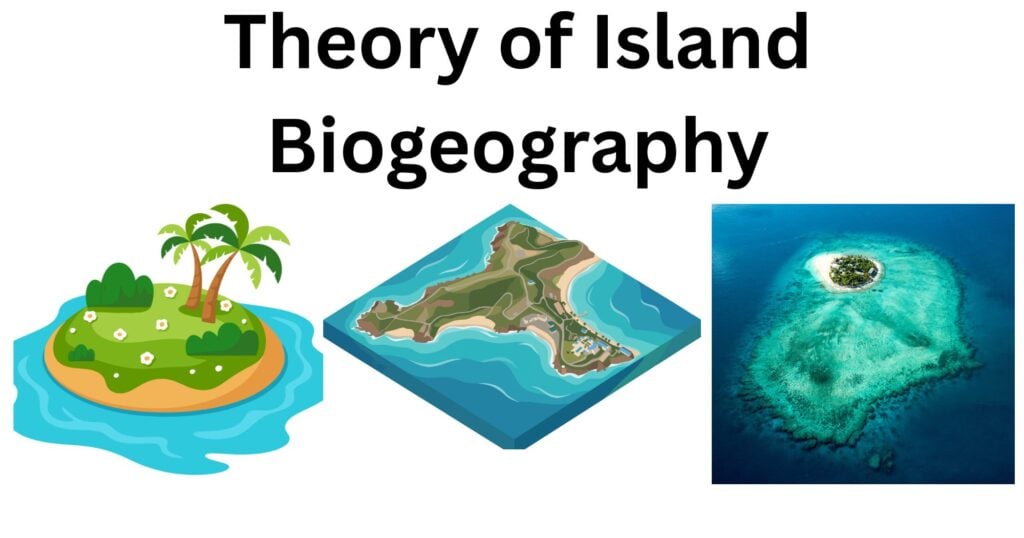
Barrier islands and Coral Islands, like those in the Maldives, were formed by the sedimentation and accumulation of sand, silt, and organic material, creating a ring-linked structure.
Animals were able to reach islands through dispersal, which included flying, drifting, or floating. However, when the animals reach an island, they colonize without migration. The animals become isolated and evolve independently, resulting in speciation.
Island Biogeography is a branch of Biogeography that studies the pattern of distribution and diversity of species on an island.
History of Island Biogeography
One of the earliest and most remarkable contributions to the field of Island Biogeography was made by Charles Darwin during his voyage aboard the HMS Beagle. He introduced the concept of speciation in his book “The Origin of Species.”
He studied the flora and fauna of the Galapagos Islands, particularly the finches, which appeared to have adapted to different environments on the islands. He stated that isolated environments could lead to the evolution of new species (Speciation) with advantageous traits that increase survival and reproduction rates (Natural Selection). Darwin noted the unique characteristics of isolated habitats, such as the island. His ideas led to the development of other theories related to the Island, even though he did not formulate the theory of island biogeography.
The Theory of Island Biogeography, proposed by Robert H. MacArthur and Edward O. Wilson in 1967, is one of the major theories in ecology that predicts species diversity on an island. This theory explains how an island’s species richness is determined by the rates of immigration and extinction.
Immigration of Species
Immigration is the arrival of new species from the mainland or another island.
It depends on the following factors:
- Distance from the mainland: If an island is closer to the mainland, then the immigration rate is higher due to the shorter distance. However, if it is farther, a lower immigration rate occurs, and fewer species are able to reach it.
- Island Size: If an island is larger, then it offers more habitat and resources for species to occupy and successfully colonize the island.
- Human activity: The introduction of human-mediated transport has increased the immigration rate. Sometimes, the introduction of invasive species causes rapid evolutionary change in native island species.
Extinction of Species
Extinction refers to the loss of a species. The risk of extinction is higher on islands than on mainland areas.
Factors affecting extinction include
- Island Size: Smaller islands typically have higher extinction rates due to limited resources and habitat, making survival difficult.
- Population Size: Islands with small populations are more vulnerable to extinction because they are susceptible to factors such as predation and genetic problems (e.g., inbreeding).
Equilibrium model of Island Biogeography
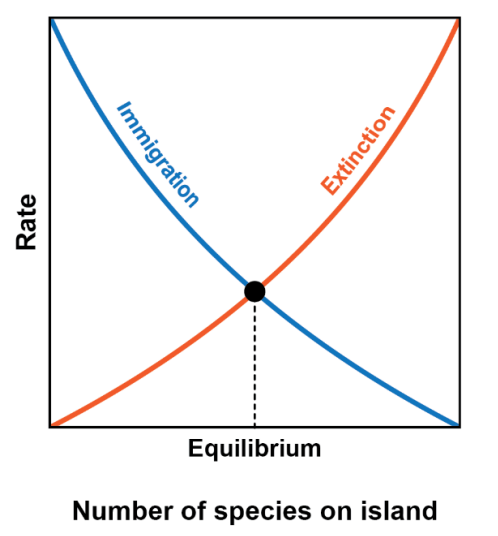
The model describes the balance of species on an island as a dynamic equilibrium. The equilibrium is achieved when the rate at which new species immigrate to the island equals the rate at which existing species go extinct. The key factors influencing this balance are the island’s size and its distance from the mainland.
When an island initially has only a few species, immigration rates are high, and extinction rates are low. As the number of species increases through immigration from the nearby mainland, the immigration rate decreases. Meanwhile, competition for available niches intensifies, making it harder for newly arrived species to establish. This increases the extinction rate. The equilibrium point, denoted by S, represents the stable number of species where the rates of immigration and extinction are balanced. The equilibrium points on the island, influenced by the factors described, vary, as shown in the graph below. In this graph, the x-axis represents the number of species, while the y-axis shows the rates of immigration (blue) and extinction (red).
Source: https://www.biointeractive.org/sites/default/files/media/file/2021-12/ExploringIBTData-StudentHO-BuildingModel-act.pdf
Species-Area Relationship
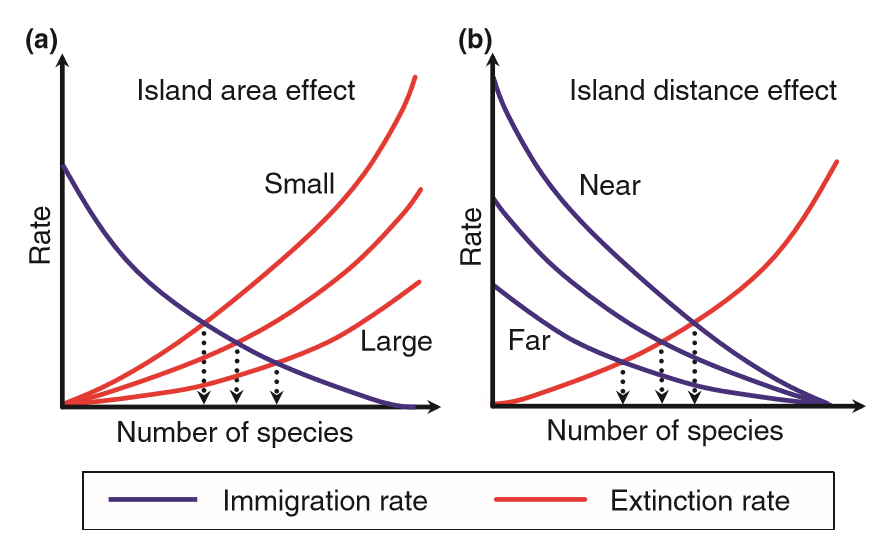
The species-area relationship describes how the number of species on an island increases with island size. In general, larger islands tend to support more species because they offer a greater variety of habitats and resources, which reduces extinction rates. In contrast, smaller islands often have limited habitats and resources, leading to higher competition and vulnerability to extinction.
Species-Isolation Relationship
The species-isolation relation describes how the number of species is influenced by the distance between the island and the nearby mainland. In general, Islands that are located closer to the mainland have higher immigration rates due to easier dispersal, allowing species to colonize more frequently. However, if islands are isolated, i.e., farther away, species must travel greater distances to reach them, making it harder for new species to arrive. Hence, lower immigration rates are observed, along with an increase in extinction rates.
Source: https://biol420eres525.wordpress.com/2019/04/12/is-the-equilibrium-theory-of-island-biogeography-still-useful-in-conservation-today/
Application of the Theory of Island Biogeography
- Isolated habitats such as national parks, grasslands, and wetlands are fragmented by human activities for urbanization or agriculture. This leads to a lower immigration rate and disrupts ecosystem functioning. Hence, this theory is applied as a conservation strategy, emphasizing the importance of size and connectivity in promoting biodiversity.
- The theory highlights the importance of habitat size and isolation in non-island habitats, such as individual plants, caves, lakes, mountaintops, and patches of terrestrial ecosystems, in shaping ecological and evolutionary processes.
- The theory is applicable for predicting and managing the spread of invasive species. Smaller habitats are less likely to receive new species and are more likely to experience higher extinction rates. Management efforts focus on biosecurity measures to prevent invasive species from reaching vulnerable areas.
- The theory is used to identify biological hotspots that are species-rich and at risk due to fragmentation.
- It can guide ecological restoration efforts in reforestation projects and increase the chance of species establishment.
- The principles of Island biogeography are applied in agroforestry practices to create patches of forest or natural habitat to support wildlife and biodiversity.
- The theory of island biogeography greatly influenced the design of nature reserves during the 1970s, favoring large, single reserves over small or fragmented ones to maximize species diversity.
References
- Darwin’s Theory of Evolution: Definition & Evidence. (n.d.). Live Science. Retrieved from https://www.livescience.com
- Darwin and Island Ecology. (1995). Retrieved from https://www.jstor.org/stable/2096885
- DeGruyter. (1995). The Theory of Island Biogeography Revisited. Retrieved from https://www.degruyter.com/document/doi/10.7208/9780226736877-011/pdf
- D’Allan, L. (n.d.). Lecture outline on island biogeography. Retrieved from https://websites.umich.edu/~dallan/nre220/outline15.htm
- Jankowski, J. (2020). Island biogeography. Retrieved from https://www.zoology.ubc.ca/~jankowsk/BIOL413-8-032320-IslandBiogeo.pdf
- NOAA. (n.d.). Hawaiian Islands formation. Retrieved from https://oceanservice.noaa.gov/facts/hawaii.html
- SlideShare. (n.d.). Theory of island biogeography. Retrieved from https://www.slideshare.net/slideshow/island-biogeography-theory-of-island-biogeography-pptx
- Whittaker, R. J., & Fernández-Palacios, J. M. (2007). Island biogeography: Ecology, evolution, and conservation. National Center for Biotechnology Information. Retrieved from https://pmc.ncbi.nlm.nih.gov/articles/PMC6468070/
- Wu, J., & Vankat, J. L. (1995). Island biogeography: Theory and applications. Retrieved from https://www.researchgate.net/publication/252108193_Island_Biogeography_Theory_and_Applications
