
Dedifferentiation is a developmental process where differentiated and functionally specialized cells lose their stable characteristics and become actively divisible again. It is a process of returning cells that have already developed a certain shape, size, and activity to a meristematic state. Such cells are reinstated to mitosis and developmental plasticity.
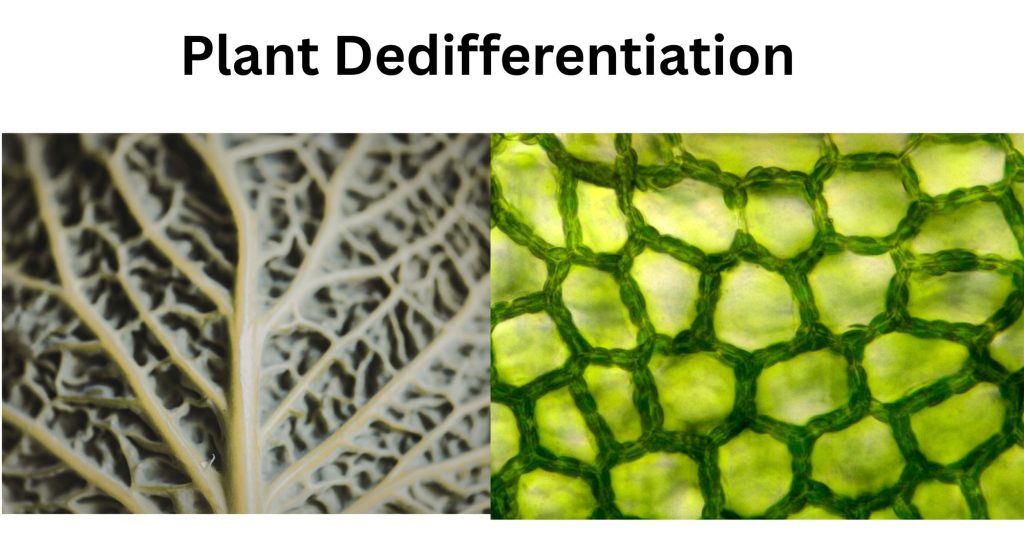
The regeneration, wound healing, secondary growth, and plant tissue culture in vitro are all based on this phenomenon.
Factors that induce dedifferentiation
Dedifferentiation is induced by a complex of physiological, biochemical, and environmental factors, which are as follows-
Physical wound or injury
Physical injury is one of the important triggers that induce dedifferentiation by releasing the signalling molecules that stimulate the differentiated cells near the wounded area. Degradation of tissues causes changes in the ionic balance, oxidative stress, and binding of wound hormones, which leads to dedifferentiation.
Environmental factors
Environmental stress factors are also important causes that induce dedifferentiation. Change in any parameters, such as drought, salinity, nutrients, temperature, and pathogen, also leads to dedifferentiation.
Biochemical factors
Some of the biochemical factors are the changed hormonal gradient, mostly high concentration of auxin triggers the mobilization of signal transduction pathways, which inhibit differentiation-specific genes and trigger cell division, cell repair, and cell regeneration genes.
Cellular events during dedifferentiation
A deep structural modification occurs in the cell during dedifferentiation. The central vacuole that is characteristic of differentiated cells is broken or reduced, increasing cytoplasmic density.
The nucleus and distinct nucleoli are expanded and centrally localized, indicating an increase in ribosomal RNA production.
Loss of polarity of the cell is common, and degeneration of special organelles for some functions may occur. These processes of structural adjustments prepare the cell for another metabolic and mitotic action.
Changes in the patterns of gene expression
Dedifferentiation implies massive rearrangement of gene expression. The genes that code to carry out specialized cellular processes, including activities in the secondary cell wall or storage, are suppressed. Meanwhile, the genes related to cell division, replication, repair, and meristem identity are turned on.
Transcription factors that control pluripotency and growth competence are very active. This changes gene expression, causing a transformation of the functional identity of the cell to be proliferation instead of specialization.
Chromatin Remodeling/ Epigenetic Reprogramming
Dedifferentiation is a response that involves reorganization of chromatin composition. Condensed areas of heterochromatin are diluted to form euchromatin, which is active for transcription. The key factor in the process of reactivating previously silenced genes is the epigenetic changes, such as the DNA demethylation and the histone acetylation. These reversible changes in epigenetics enable the cell to respond dynamically to developmental signals but not the underlying DNA sequence. This is necessary to accomplish cellular reprogramming and regeneration.
Re-entry into the Cell Cycle
A majority of the differentiated plant cells are at G0 of the cell cycle. Dedifferentiation allows these cells to renew the cell cycle, going through G1, S, G2, and M stages. This transition is regulated by increased production of cyclins and cyclin-dependent kinases. Increased metabolic rate provides energy and molecular constituents needed in the synthesis of DNA and mitosis. Consequently, the cells that are already dormant revert to active division.
Hormonal Control- Auxin, Cytokinin, and Other Plant Growth Regulators
Plant dedifferentiation is highly controlled by the presence of plant hormones or plant growth regulators that coordinate the re-entry of cells into the cell cycle as well as cellular reprogramming. The most dominant among them are auxin and cytokinin, and the other hormones have supporting or modulatory roles.
Auxin
Auxin is regarded as the leading hormone that leads to dedifferentiation. It causes the differentiated mature plant cells to lose their specific structural and functional features and become meristematic once again. Auxin favors the expression of genes that deal with DNA replication, cell division, and the cell cycle. It also affects cell wall loosening by modulating expansins and enzymes that act in the wall remodeling process to promote the enlargement and division of cells. Auxin concentration is very useful in promoting the development of callus during natural wound healing, as well as in unnatural tissue culture environments.
Cytokinin
Cytokinin supplements the role of auxin by ensuring long-term mitotic division of dedifferentiated cells. Whereas the dedifferentiation process is triggered by auxin, cytokinin controls further cell proliferation and avoids its premature differentiation. Development of dedifferentiated cells depends on the concentration and ratio of auxin and cytokinin, which are relative. When the ratio between auxin and cytokinin is large, root development is preferential, whereas when the ratio between cytokinin and auxin is high, shoot formation occurs, and when the ratio is in the middle, the callus tissue is formed and sustained.
Other plant growth regulators
Dedifferentiation is also affected by other plant growth regulators. Gibberellins stimulate metabolism and aid in cell elongation in the healing of tissues. Ethylene, which is usually formed during wounding and stress, facilitates dedifferentiation by acting on the auxin signaling pathways.
Brassinosteroids enhance cell division and tolerance to stress, which is indirectly beneficial to dedifferentiation.
Abscisic acid is typically an inhibitory hormone, although it can also control dedifferentiation in unfavorable environmental conditions. Therefore, dedifferentiation is a dynamic and concerted effort of various growth regulators through hormonal regulation.
Dedifferentiation in wound repair and regeneration of Plants
Dedifferentiation is an important process in the repair and regeneration of plants wounded by mechanical damage, grazing, pruning, infection, or environmental stress. Upon damage to plants, tissues are disrupted due to the breaking of their continuity. As a result, cells in the vicinity of the injured tissues detect signals in the form of changes in the concentration of plant hormones, accumulation of wound factors, and changes in cellular metabolism.
Upon detection of these signals, differentiated cells undergo dedifferentiation in plants wounded by mechanical damage, grazing, pruning, infection, or environmental stress. During the process of repairing a wound, differentiated parenchyma cells lose their differentiation and re-enter the cell cycle. These dedifferentiated cells proliferate in large numbers to produce a mass of actively proliferating cells called wound callus that covers the damaged region and acts as a barrier to prevent water and pathogens from entering.
As this regenerative process continues, some cells in the callus differentiate to form a wound meristem. This meristem gives rise to new tissues, such as xylem, phloem, cortex, and epidermis, depending upon the site of injury.
Vascular tissue regeneration ensures water, minerals, and photosynthetic transportation, hence allowing survival to occur in the injured plant organ. Thus, dedifferentiation is an important phenomenon in plants that provides them with immense regenerative capabilities.
Callus formation and totipotency
Callus formation and totipotency are the main outcomes of dedifferentiation. A callus refers to an organ or mass of cells that is an unorganized and loose mass of cells with thin walls and cells actively engaged in division, which arises as a result of the differentiated cells or cells becoming meristematic.
During the process of dedifferentiation and subsequent callus formation, there is inhibition of gene expression related to differentiated functions and gene expression related to cell division and basic metabolism. A high concentration of auxin is largely effective for inducing callus formation, and cytokinin accelerates the proliferation of cells.
Callus cells exhibit the property of totipotency, which is the ability of a single cell to regenerate into a complete plant under suitable conditions. Totipotency forms the biological basis of plant tissue culture, micropropagation, somatic embryogenesis, and genetic transformation.
Examples of dedifferentiation in Plants
One of the well-known instances of dedifferentiation in plants is seen in the case of vascular cambium. In several dicot plants, differentiated parenchyma cells present between the primary xylem and primary phloem undergo dedifferentiation and give rise to vascular cambium. This lateral meristem differentiates into secondary xylem inside and secondary phloem on the outer side, and this leads to a secondary increase in the size of the stem and the root.
The differentiation into callus can also be considered a good example of dedifferentiation in plants. Mature cells, including the cortical or pith parenchyma, in plants, undergo dedifferentiation and start dividing heavily to produce callus tissues when the plants come into contact with injurious substances or when the plants are subjected to in vitro culture. The callus tissues can also differentiate into roots, shoots, or the whole plant in several instances of plants.
Besides, dedifferentiation also helps in the formation or replacement of stem cells in plants. Mature or differentiated cells undergo dedifferentiation and stem cell replacement in plants when the plants are subjected to certain conditions that require the formation or replenishment of stem cells in the apical or lateral meristem.
Molecular and Epigenetic Basis of the Dedifferentiation
The dedifferentiation process of the cell in a plant follows a set of complex mechanisms, basically making it possible to reverse the differentiated cell to a meristematic cell.
Among the key gene products driving cells from the quiescent state of G₀ to mitotic activity are cyclins, cyclin-dependent kinases, and DNA polymerases. These become the main causes of the dedifferentiation process because they determine the gene expression program, hence the identity of meristematic cells. They regulate cell proliferation pathways, turning them on while turning off the pathways associated with the terminal differentiation process.
Constraints and risks of dedifferentiation
Genetic Instability and Somaclonal Variation
Nevertheless, in spite of the importance of cell dedifferentiation, there are some risks and disadvantages to this process, especially when it happens in a laboratory setting. These dangers are primarily because of genetic instability developed from genetic changes during cell division.
Somaclonal variation can be described as genetic and epigenetic changes in plants produced from cells differentiated in a culture and dedifferentiated. This variation can develop from genetic changes such as point mutation, chromosomal changes, activation of transposons, and epigenetic changes, including DNA methylation differences. Although somaclonal variation can sometimes be advantageous, this type of genetic change is actually detrimental to plants because of undesirable genetic variations.
The signal transduction mechanisms involved in gene expression regulation, hormonal, stress, and wound responses control the transcription activity of the aforementioned transcription factors.
Epigenetics plays a major role in cell dedifferentiation because this allows for reversal of cell differentiation status without changing DNA sequence information. DNA methylation is normally reduced in cell dedifferentiation. This process leads to the activation of silent genes. Histone modification includes histone acetylation and methylation.
Histone acetylation enhances the openness of chromatin to transcription activation. The chromatin-remodeling enzymes have the capacity to reorganize the structure of the nucleosomes in order to facilitate the regulatory elements of the genes required for cell division.
Applications in Biotechnology
The biological basis of most of the modern biotechnologies of plants consists of dedifferentiation.
The most common use of dedifferentiation is plant tissue culture. The key to this technology involves the capacity of the cells isolated from differentiated explants to dedifferentiate in vitro to form a mass of cells called a callus. The callus can give rise to shoots and roots through the process of organogenesis or somatic embryogenesis.
Clonal propagation helps in producing a large number of genetically similar plants from a single plant. This technique helps in having identical growth and quality in plants. Plants such as banana trees, sugarcane, potatoes, and flowering plants are reproduced through tissue culture.
Dedifferentiation is required for genetic engineering and to bring forth the creation of transgenic plants. For the expression of the novel character, the transformed cells must dedifferentiate.
Methods for enhancing the quality of the crops include the use of the dedifferentiation process in the production of quality lines of the crops that show attributes such as heightened resistance to diseases, insects, and the environment, increased production, and quality in nutritional values.
Lastly, the process of dedifferentiation is employed in the conservation of rare plant species, most often when they are on the verge of extinction.
The somaclonal variations resulting from the process include abnormalities in morphology, problems with fertility, altered rates of growth, and a reduction in yields.
These variations interfere with the uniformity required in crop growth necessary for mass production, in addition to interfering with the precision required in the clone propagation systems. Therefore, in regenerations using processes of dedifferentiation, attention must be paid to the times involved in the process and the concentration of the plant hormones.
Environmental factors influencing dedifferentiation
Environmental conditions have some effect on the induction and maintenance of the dedifferentiation process in plant cells.
Light
Light regulation is involved in the dedifferentiation process mediated by hormonal control and gene expression. The absence of light or no light conditions would rather stimulate the cell dedifferentiation process, with different light wavelengths affecting cell cycle entry and metabolism.
Nutrition
Nutrition availability is another important factor. Proper availability of macronutrients like nitrogen, phosphorus, and potassium, along with micronutrients, is necessary for cell division processes, which take place in the course of dedifferentiation. Lack of such nutrition not only hinders the progression of cell dedifferentiation but also indicates that the cell now turns its attention towards the stress response signaling pathway.
Other sources of stress, such as drought, salinity, and low or high temperature, may also initiate the process of dedifferentiation.
Stresses trigger the modification of cell metabolism rhythms and the level of certain hormone concentrations, primarily those of auxin and ethylene.
Future Directions of dedifferentiations
The recent breakthrough in molecular biology and biotechnology has indicated new horizons for engineering dedifferentiation to ensure further improvement in plant regeneration. The isolation and manipulation of major genes playing crucial roles in both dedifferentiation and regeneration processes may further improve the efficiency of plant regeneration and minimize variability.
Epigenetic engineering certainly holds promising approaches for manipulating dedifferentiation with precision and reversibility. DNA methylation and histone modification approaches will aid in improving genetic stability during plant regeneration. Growth regulator formula, altered tissue culture technology certainly helps in somaclonal variability. Going forward in upcoming years, dedifferentiation technology shall have vital applications in agricultural science because it shall aid in rapid improvement in crop species, preservation of plant biodiversity, and development of crop species tolerant to climatic changes.
Future studies in the molecular aspects of dedifferentiation shall further make plant regeneration technology more efficient.
Conclusion
In plants, dedifferentiation is a basic developmental process with the functional implication of their high cellular plasticity and regeneration capability.
This dedifferentiation process is mediated through a complex interplay between internal factors like plant hormones and transcriptional regulators and external factors such as mechanical injury, nutrient availability, light, and abiotic stress.
On the whole, the process of dedifferentiation is an immensely significant adaptational mechanism by which plants can regenerate, sustain, and adapt themselves in a fluctuating environment. There will be an improved efficacy of the regeneration process once the intricacies of the molecular, hormonal, or epigenetic control of the process are well elucidated.
References
- Sugimoto, K., Gordon, S. P., & Meyerowitz, E. M. (2011). Regeneration in plants and animals: Dedifferentiation, transdifferentiation, or just differentiation? Science, 333(6041), 1420–1424. https://doi.org/10.1126/science.1210487
- Grafi, G., & Barak, S. (2015). Stress induces cell dedifferentiation in plants. Biochimica et Biophysica Acta (BBA) – Gene Regulatory Mechanisms, 1849(4), 378–384. https://doi.org/10.1016/j.bbagrm.2014.07.015
- Zhang, H., Lang, Z., & Zhu, J. K. (2018). Dynamics and function of DNA methylation in plants. Nature Reviews Molecular Cell Biology, 19(8), 489–506. https://doi.org/10.1038/s41580-018-0016-z
- National Council of Educational Research and Training. (2023). Biology textbook for class XI & XII. NCERT. https://ncert.nic.in
- Buchanan, B. B., Gruissem, W., & Jones, R. L. (2015). Biochemistry and molecular biology of plants (2nd ed.). Wiley Blackwell.
- Frontiers in Plant Science. (2024). Articles on plant dedifferentiation and regeneration. https://www.frontiersin.org/journals/plant-science
- EduRev. (2026). NCERT Summary: Plant Growth and Development – Plant Growth & Development (Class 11 Biology). EduRev. https://edurev.in/t/468022/NCERT-Summary-Plant-Growth-and-Development
- Sakshi Education. (2025). Plant Tissue Culture – Totipotency, Dedifferentiation and Organogenesis in Culture. Sakshi Education. https://education.sakshi.com/en/csir-net/study-material/plant-physiology/plant-tissue-culture-67175
- Biology Discussion. (n.d.). Dedifferentiation in plants: Meaning, process and significance. Biology Discussion.
https://www.biologydiscussion.com/plants/dedifferentiation-in-plants - Vedantu. (n.d.). Plant tissue culture – callus formation and applications. Vedantu Biology.
https://www.vedantu.com/biology/plant-tissue-culture - BYJU’S. (n.d.). Dedifferentiation and redifferentiation. BYJU’S Biology.
https://byjus.com/biology/dedifferentiation-and-redifferentiation/ - BYJU’S. (n.d.). Plant growth and development. BYJU’S Biology.
https://byjus.com/biology/plant-growth-and-development/ - BYJU’S. (n.d.). Plant tissue culture. BYJU’S Biology.
https://byjus.com/biology/plant-tissue-culture/
