
Traceability and documentation are of utmost importance to ensure comparable results, support investigations, and meet regulatory requirements.
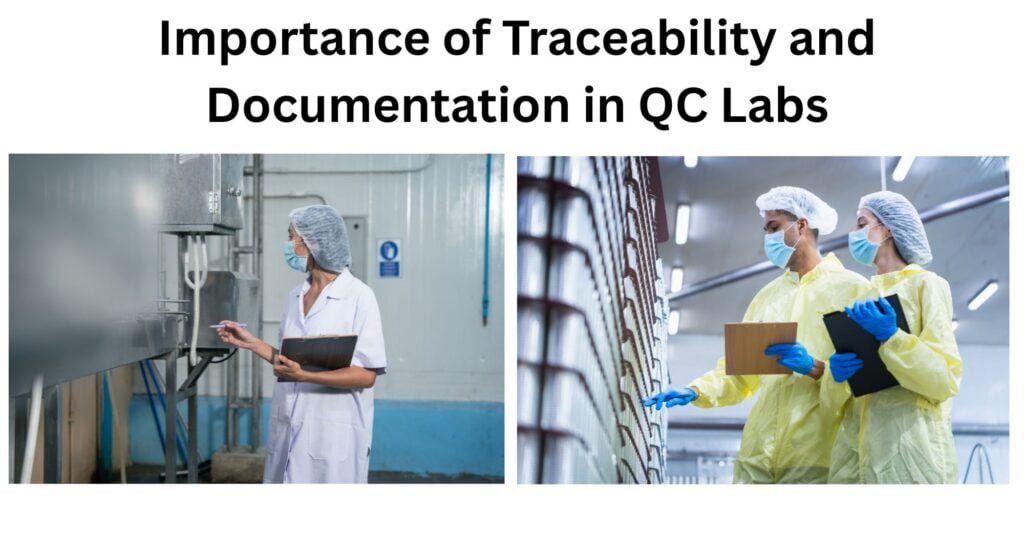
Importance of Traceability and Documentation in QC Labs
Reliable quality control (QC) data is the backbone for safe medicines, valid diagnostics, and defensible scientific decisions.
Overview of Traceability in Quality Control
Traceability is the ability to reconstruct a certain process using documents and records. It links each result back to the origin through methods, calibrators, equipment, people, and samples so that results are comparable over time and between labs. The International Organization for Standardization defines traceability, in the context of measurement, as “the property of a measurement result whereby the result can be related to a reference through a documented unbroken chain of calibrations, each contributing to the measurement uncertainty” (ISO/IEC 17025:2017). Regulatory and accreditation bodies require measurements to be linked to an internationally accepted reference and to have clear measurement ranges for the safe clinical use of tests in laboratory medicine. QA systems emphasize traceable workflows.
The Golden Rule: “If It Isn’t Written, It Didn’t Happen”
Good Documentation Practices (GDP) require that work be fully and accurately recorded; otherwise, it is not considered complete. It is a foundational principle of QC documentation. Studies show that documentation and data integrity failures are among the most frequent and serious GMP violations. Gaps typically include missing raw data, untraceable results, absent logbooks, and destroyed original records. Robust QC documentation, i.e., SOPs, batch records, test reports, and deviation investigations, provides the evidence that products and results meet defined standards. So, everything that is done should be documented in a QC environment.
Defining Data Integrity (ALCOA+ Principles)
Data integrity means data are complete, consistent, and reliable over the data life cycle. The ALCOA framework was originally developed by the FDA and defines the core attributes of laboratory data: Attributable, Legible, Contemporaneous, Original, and Accurate (ALCOA). The expanded ALCOA+ includes more attributes like Complete, Consistent, Enduring, and Available. This is a principle that defines how records should look in practice. Pharmaceutical manufacturers explicitly use ALCOA to design systems that deliver authentic, immutable, auditable data and compliant audit trails.
Sample Tracking and Chain of Custody
Sample mix-ups or lost samples can invalidate entire studies and tests. So, every sample that enters a QC laboratory should carry a documented identity from receipt through disposal. QC communities recommend formal sample tracking and chain-of-custody systems to record where each sample came from, how it was stored, and who handled it. In pharmaceutical QC, this involves unique sample identifiers, receipt logs, storage condition records, and sign-off at each point. International standards like ISO/IEC 17025:2017 require procedures for preventing mix-ups and protecting sample integrity throughout the QC process. A break in the chain of process can invalidate results entirely and induce a full investigation in every batch associated with that sample.
Managing Raw Data and Metadata
A high-quality QC document includes raw data and metadata. Raw data contain instrument outputs, worksheets, etc., whereas metadata includes contextual information on who, when, how, and the conditions of data. Both of these are equally important, as metadata without raw data is meaningless and raw data without metadata cannot be verified. Pharmaceutical and QC reviews highlight that all intermediate calculations, raw analytical outputs, deviations, and change controls must be retained and traceable to support decisions and investigations.
Electronic Records and Audit Trails (21 CFR Part 11)
FDA 21 CFR Part 11 governs electronic records and electronic signatures when laboratories use computerized systems. Regulators expect electronic records to be as trustworthy as paper. Guidance such as 21 CFR Part 11 requires secure access, electronic signatures, and tamper-evident audit trails. It requires that systems generate secure, computer-generated, time-stamped audit trails. This audit trail must be reviewed regularly and not just during investigations. Data-integrity analyses emphasize that electronic systems can improve compliance through enforced user rights, automatic time stamps, and built-in audit trails. Staff must be trained on Part 11 requirements and audit trail reviews. Lack of training is a root cause of data integrity issues.
Equipment Usage and Calibration Logs
In a QC laboratory, every step of equipment usage, cleaning, maintenance, calibration, and servicing must be documented with time stamps and the person involved. Common good practices include logbooks or files documenting maintenance, calibration, and deviation reports. If an instrument is found to be out of calibration, complete logs enable a risk assessment of all results generated during that period.
Document Control and Version Management
Formal document control systems ensure that only current and approved versions of SOPs, methods, and forms are used. Each document has a unique identifier, a revision history, defined approval signatures, and a controlled distribution list.
Pharmaceutical good document practices reviews describe document control as a central component of good manufacturing practices. It mainly emphasizes managing SOPs, batch records, change controls, CAPAs, and investigation reports so that history is traceable and obsolete procedures cannot be mistakenly followed. There is a document control and version management system that ensures only current, updated, and approved documents reach the manufacturing area. In an industry, each SOP and document must be pre-approved and updated to ensure smooth manufacturing.
The Role of Documentation in Root Cause Analysis
When something goes wrong, like out-of-specification results, failed batch, or instrument deviation, investigators rely on documented sample history, equipment logs, deviations, and CAPAs. Quality control documentation helps identify where a process deviated from expectations. It is useful in tracing issues back to specific lots, calibration changes, or process steps. Documentation is crucial in demonstrating that corrective actions were defined, implemented, and monitored. Therefore, well-structured records directly support continuous improvement and prevent recurrence of failures.
Regulatory Consequences of Poor Documentation
Documentation and data integrity violations are among the leading causes of regulatory action worldwide. The major regulatory findings in documentation are incomplete or missing raw data, untraceable results, duplicate records, absent logbooks, and destruction of original documents and data. About 20-25% of CGMP-related warning letters are due to deficiencies in documentation practices and data integrity. The consequences for such deficiencies range from FDA warning letters and import alerts to product recalls and reputational damage. So, laboratories and manufacturers should be proactive in maintaining proper documentation and a strong quality culture, not just minimal compliance.
Conclusion
Documentation and traceability across clinical, pharmaceutical, and research QC labs are not just formality or “extra paperwork” but are the core components that make results credible and defensible. Principles like ALCOA+ are a guiding light to maintain data integrity. Structured sample tracking, controlled electronic records with audit trails, and equipment and document management are all important aspects to ensure data integrity. If documentation is weak, laboratories face increased errors, failed investigations, and regulatory risk. But when documentation is strong, laboratories gain reliable results, smooth inspections, better problem-solving, and overall protection for patients, products, and the laboratory.
References
- Braga, F., Pasqualetti, S., Aloisio, E., & Panteghini, M. (2021). The internal quality control in the traceability era. Clinical Chemistry and Laboratory Medicine (CCLM), 59(2), 291–300. https://doi.org/10.1515/cclm-2020-0371
- Charoo, N. A., Khan, M. A., & Rahman, Z. (2023). Data integrity issues in pharmaceutical industry: Common observations, challenges and mitigations strategies. International Journal of Pharmaceutics, 631, 122503. https://doi.org/10.1016/j.ijpharm.2022.122503
- Hayes, K., Meyers, N., Sweet, C., Ashenef, A., Johann, T., Lieberman, M., & Kochalko, D. (2022). Securing the Chain of Custody and Integrity of Data in a Global North-South Partnership to Monitor the Quality of Essential Medicines. Blockchain in Healthcare Today. https://doi.org/10.30953/bhty.v5.230
