
Hydrophobic interaction chromatography (HIC) is a liquid chromatography method that is used to separate and purify proteins and other biomolecules based on differences in their surface hydrophobicity.
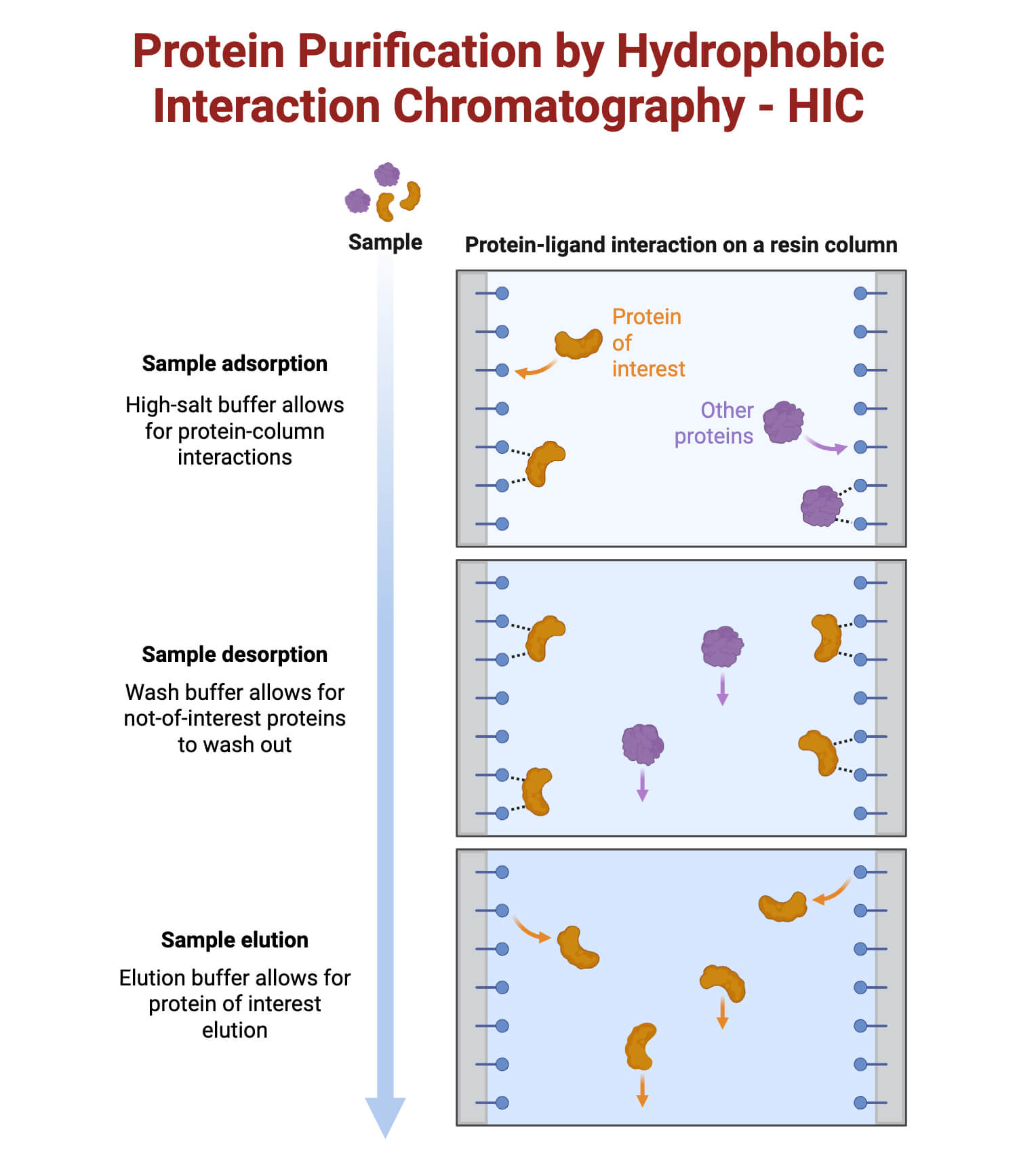
Hydrophobic surface regions on the sample bind reversibly to hydrophobic ligands attached to the stationary phase. High-salt buffer conditions promote this binding, and reducing the salt concentration releases the bound target molecule.
HIC works under mild or non-denaturing conditions, which preserve the native structure and biological activity of proteins. This differentiates HIC from reversed-phase chromatography (RPC), which also separates based on hydrophobicity but uses stronger organic solvents and highly hydrophobic stationary phases that increase the risk of protein denaturation. So, HIC is preferred when biological activity needs to be preserved.
The concept of HIC was first described by Tiselius in 1948 as ‘adsorption separation by salting out’ and was later formally introduced as HIC by Hjerten in 1973. At present, HIC is widely used in the biopharmaceutical industry for purifying monoclonal antibodies, therapeutic proteins, and antibody-drug conjugates.
Principle of Hydrophobic Interaction Chromatography (HIC)
The separation principle of HIC is based on the reversible interactions between hydrophobic regions on the protein surface and hydrophobic ligands attached to the stationary phase. Proteins bind to hydrophobic ligands when the surrounding salt concentration is high and are released from those ligands when the salt concentration is reduced.
Proteins are composed of amino acids with different chemical properties, and most proteins contain both hydrophilic and hydrophobic regions. During protein folding or in aqueous solutions, most of the hydrophobic residues are hidden within the protein core to minimize contact with water. However, some hydrophobic regions remain exposed on the protein surface as hydrophobic patches, which allow proteins to interact with other hydrophobic molecules. HIC uses these interactions to separate and purify proteins.
HIC can be performed in two modes: bind-and-elute and flow-through mode. The bind-and-elute mode is the most commonly used. In this mode, the target protein binds to the hydrophobic ligands under high-salt conditions. The unbound contaminants are washed away, and the target protein is recovered by decreasing the salt concentration. In flow-through mode, the target protein passes directly through the column without binding, while the more hydrophobic contaminants are retained on the stationary phase. This mode is suitable when the target protein has low surface hydrophobicity.
Mechanisms involved in Hydrophobic Interaction Chromatography (HIC)
The two main mechanisms to explain the hydrophobic interaction in HIC are based on thermodynamics and the salting-out effect.
Thermodynamic basis
In aqueous solution, hydrophobic surface regions cannot form hydrogen bonds with water, so surrounding water molecules reorganize into a highly ordered arrangement. This structured arrangement reduces the overall entropy of the system and is thermodynamically unfavorable. When hydrophobic patches on the protein surface interact with hydrophobic ligands on the stationary phase, these ordered water molecules are released into the bulk solution and move freely. This release increases the entropy of the system and makes the interaction thermodynamically favorable.
Salting-out effect and Hofmeister series
High salt concentrations promote hydrophobic interactions in HIC through the salting-out effect. Salt ions attract water molecules, which reduces the solvation of proteins. This disrupts the hydration shells around the hydrophobic regions and exposes hydrophobic regions for interaction with the stationary phase. The strength of hydrophobic interactions depends on the type of salt used. The effectiveness of salt ions can be described using the Hofmeister series, which ranks the ability of different ions to promote or disrupt hydrophobic interactions. Kosmotropic ions like sulfate and phosphate strengthen hydrophobic interactions and are used as binding salts in HIC. Chaotropic ions like guanidinium destabilize protein structure and weaken hydrophobic interactions. They may be used at low concentrations in elution buffer to remove very strongly bound proteins.
Components of Hydrophobic Interaction Chromatography (HIC)
Stationary phase: The stationary phase in HIC contains three elements: base matrix, spacer, and hydrophobic ligands.
- The base matrix provides structural support and allows the flow of mobile phase through the column. The matrix is made chemically inert to ensure that separation is based purely on hydrophobic interactions. Cross-linked agarose is most commonly used as a matrix.
- An uncharged spacer arm is attached to the matrix, which connects the hydrophobic ligand to the matrix surface.
- The ligand contains alkyl or aryl chains. Ligands like phenyl, octyl, butyl, and hexyl are commonly used in HIC.
Mobile phase and buffers: The mobile phase in HIC contains an aqueous buffer with a high concentration of kosmotropic salt. Ammonium sulfate is the most widely used binding salt. Other commonly used salts include sodium sulfate, potassium sulfate, and sodium chloride. Buffer pH is usually maintained at a range of 6-7 to minimize ion-exchange interactions while maintaining protein stability. Elution in HIC occurs by using a low-salt or salt-free buffer. Organic modifiers like glycerol and ethylene glycol may be added to the elution buffer to disrupt strong hydrophobic interactions.
Column: HIC columns are packed with the stationary phase to form a packed bed through which the mobile phase flows. The column material is usually inert and chemically resistant to high salt concentrations and buffers. Prepacked columns are also available for use.
Pump: The pump delivers mobile phase through the system at a controlled flow rate. Gradient pumps are used to mix the mobile phase to generate the decreasing salt gradient, which is necessary for elution.
Sample injection system: The sample is introduced into the column using a sample injector or autosampler.
Detector: Protein elution is monitored by UV absorbance, usually at 280 nm, which corresponds to aromatic amino acids.
Conductivity monitor: Conductivity monitors are used to measure the ionic strength of the mobile phase throughout the run and track the salt gradient.
Procedure and Steps of Hydrophobic Interaction Chromatography (HIC)
Buffer preparation
The binding buffer is prepared using a kosmotropic salt at high concentration in a suitable aqueous buffer at pH 6-7. Ammonium sulfate at 1-2 M with 50 mM sodium phosphate is most commonly used. The elution buffer is also prepared using the same base buffer without salt or at a reduced salt concentration. All buffers are filtered and degassed before use to prevent air bubbles from disrupting column flow.
Sample preparation
The sample must be adjusted to match the concentration and pH of the binding buffer before loading. The sample should also be clarified by centrifugation or filtration. Viscous samples should be diluted, as high viscosity can cause irregular flow patterns and backpressure problems.
Column equilibration
A suitable column is selected and initially washed with water or buffer to remove storage solution and preservatives, which can interfere with protein binding. Then, the column is equilibrated with the binding buffer until the UV baseline and conductivity are stable. Equilibration is done to prepare the column in the correct environment that promotes hydrophobic interactions with sample proteins.
Sample Loading and Washing
The prepared sample is introduced into the column at a controlled flow rate. Proteins with exposed hydrophobic regions bind to the hydrophobic ligands. Binding occurs because the salt reduces the solvation of the hydrophobic surface regions and exposes them to interact with the ligand. After binding occurs, the column is washed with buffer to remove unbound contaminants.
Elution
The bound proteins are eluted by decreasing salt concentration in the running buffer. As the ionic strength of the buffer decreases, hydrophobic interactions weaken, and proteins detach from the stationary phase in order of increasing hydrophobicity. Less hydrophobic proteins elute first, while those with stronger hydrophobic interactions elute later. Strongly bound proteins may be removed by adding mild organic solvents, detergents, or chaotropic agents to the elution buffer. Elution can be done using gradient elution or stepwise elution.
- In gradient elution, salt concentration is gradually reduced over a defined volume of buffer. This is commonly used during method development and for high-resolution separation.
- In stepwise elution, the buffer composition is changed abruptly from a high salt concentration to a lower salt concentration. This is simpler and faster than gradient elution but provides lower resolution.
Fraction Collection and Analysis
The eluted fractions are collected and analyzed. UV absorbance, usually at 280 nm, and conductivity are monitored in real time to track protein elution and gradient progression. The output is displayed as a chromatogram showing peaks that correspond to eluting proteins. The collected fractions are further analyzed to identify fractions containing the target protein.
Column regeneration and storage
After elution, the column is washed with low-salt or salt-free buffer to remove any remaining tightly bound material, including proteins, lipids, and other contaminants. If strongly bound material remains, organic solvents can be used to clean the column. After regeneration, the column is re-equilibrated with storage buffer and stored at 4°C for long-term storage.
Factors Affecting Hydrophobic Interaction Chromatography (HIC)
- Ligand type: The type of hydrophobic ligand used can determine the strength of the hydrophobic interaction. More hydrophobic ligands produce stronger protein binding but can cause irreversible binding of proteins.
- Salt type and concentration: Higher salt concentrations promote hydrophobic interactions, while lower salt weakens hydrophobic interactions. While high salt concentration increases protein binding, it also increases the risk of protein precipitation. Salt type is also important. Different ions influence hydrophobic interactions differently according to the Hofmeister series. Salts with a stronger salting-out effect enhance protein binding.
- Matrix properties: Particle size, pore size, and particle size distribution can affect the binding capacity and flow properties. Smaller particles usually produce higher resolution but can increase backpressure.
- pH: As pH increases, acidic groups on the protein become negatively charged and make the protein more hydrophilic. This weakens the hydrophobic interactions. However, moderate changes in pH within the operating range have comparatively little impact on separation.
- Temperature: Increasing temperature usually strengthens hydrophobic interactions, while decreasing temperature weakens them. Temperature also affects protein structure, solubility, and interaction with the HIC matrix. However, these effects are difficult to predict, and temperature is generally kept constant. It is not used to control separation.
Common Products and Manufacturers of Hydrophobic Interaction Chromatography (HIC)
| Common Products | Manufacturers |
| Butyl Sepharose 4 Fast Flow, Capto Butyl, Capto Octyl, Capto Phenyl, HiPrep Butyl FF columns, HiTrap Capto Butyl | Cytiva |
| TOYOPEARL HIC Resins, TSKgel HIC Resins | Tosoh Bioscience |
| POROS Benzyl Ultra HIC resins, POROS Benzyl HIC, POROS Ethyl HIC | Thermo Fisher Scientific |
| Macro-Prep HIC Resin | Bio-Rad Laboratories |
| PolyMETHYL A, PolyETHYL A, PolyPROPYL A, PolyBUTYL A | PolyLC Inc. |
| BioSuite Phenyl Column, Protein-Pak Hi Res HIC | Waters Corporation |
| AdvanceBio HIC Columns | Agilent Technologies |
Applications of Hydrophobic Interaction Chromatography (HIC)
- HIC is used in biopharmaceutical industries to purify monoclonal antibodies and therapeutic proteins. It can be used to remove protein aggregates, oxidized variants, misfolded proteins, and impurities like host cell proteins during downstream processing.
- It is also used in antibody-drug conjugate (ADC) characterization to separate species with different drug-to-antibody ratios (DAR).
- It is used in multistep purification processes in combination with ion-exchange and size exclusion chromatography. It can be used at different stages of purification, including initial capture, intermediate purification, and the final polishing step.
- It is used in vaccine manufacturing for the purification of virus-like particles and viral antigens.
- It uses surface hydrophobicity to provide information about protein conformation, stability, and folding state.
Advantages of Hydrophobic Interaction Chromatography (HIC)
- HIC works under mild or gentle purification conditions, which preserve the native structure and function of proteins being purified.
- It provides selective separation of biomolecules based on their hydrophobicity, which makes it useful and complementary to methods in multistep purification workflows.
- Samples from ammonium sulfate precipitation or ion-exchange chromatography can be loaded directly onto the HIC column, which reduces processing time and minimizes sample handling.
- It is readily scalable from analytical to industrial scale.
Limitations of Hydrophobic Interaction Chromatography (HIC)
- HIC requires a high salt concentration, which can be expensive to prepare and dispose. High concentrations of kosmotropic salts, especially ammonium sulfate, can also cause hardware corrosion and create waste disposal issues.
- Some proteins can precipitate at high salt conditions.
- It requires careful optimization of conditions. The strength of hydrophobic interactions can change depending on different experimental conditions.
- Method development for HIC can be more time-consuming compared to other chromatographic techniques.
- Proteins with very low surface hydrophobicity may not bind even under high salt conditions, while extremely hydrophobic proteins may bind too tightly to be eluted under mild conditions. So, HIC is not universally applicable.
Troubleshooting and Safety Considerations
Troubleshooting
- Protein elutes too early when the hydrophobic interaction is too weak. The separation should be repeated at a higher salt concentration or by using a salt with a stronger salting-out effect.
- Protein elutes too late or not at all when the hydrophobic interaction is too strong. To resolve this, the salt concentration in the elution buffer should be lowered. If this does not help, a less hydrophobic resin should be used, or organic modifiers like ethylene glycol can be added to weaken hydrophobic interactions.
- Poor resolution between peaks can occur due to a poorly packed column, column overloading, too steep a gradient, or high flow rate. Prepacked columns can be used to avoid this problem. If the column is overloaded, the sample load should be reduced. A shallower and longer gradient should be used to give proteins more time to separate during elution. Flow rates should also be reduced to improve resolution.
- Protein aggregation or loss of biological activity is a result of protein precipitation. Some proteins are sensitive to high salt concentrations. A milder kosmotropic salt like sodium citrate can be used to reduce the risk of precipitation while maintaining binding conditions.
- No flow through the column occurs due to a blocked filter, pump leakage, or highly viscous samples. Pumps should be checked for leakage, and blocked filters should be cleaned or replaced. If the sample is too viscous, it should be diluted before loading.
Safety considerations
- Chemicals and organic solvents used in HIC should be handled carefully in a well-ventilated area using appropriate protective equipment.
- High salt concentrations can precipitate and accumulate in a chromatography instrument. Chromatography systems and columns should always be rinsed thoroughly with deionized water after each HIC run to prevent salt buildup.
- Ammonium sulfate and other salt solutions should be disposed of properly according to local environmental regulations.
- All biological samples should be handled according to biosafety guidelines. Biological waste should be decontaminated before disposal.
Recent Advances and Innovations of Hydrophobic Interaction Chromatography (HIC)
- HIC is widely combined with other analytical methods, especially mass spectrometry (MS). HIC-MS allows the separation and characterization of intact biomolecules simultaneously.
- Advanced high-throughput screening technologies are being used, which allow the rapid optimization of HIC parameters like salt concentration, type, pH, and ligand selection.
- New ligand chemistries like alkylamide and multialkylamide ligands have been developed for improving chromatographic selectivity. These novel ligands allow better separation of closely related protein variants that are difficult to resolve using conventional HIC resins.
- Mixed-mode resins combining hydrophobic and ionic interactions are also being used for the purification of complex protein mixtures.
- Flow-through HIC has been combined with multicolumn continuous chromatography systems, which allows recovery of more product yield and purity.
Conclusion
Hydrophobic interaction chromatography (HIC) is a widely used method for separating and purifying proteins based on differences in surface hydrophobicity while preserving their native structure and biological activity. Its ability to separate proteins under mild conditions makes it especially important for many research and biopharmaceutical applications.
References
- Cytiva. (2022). Hydrophobic interaction and reversed phase chromatography: Principles and methods. https://cdn.cytivalifesciences.com/api/public/content/7-_H1gO0ikaVp8rY9IKlRg-pdf
- Cytiva. (2024, November 13). Fundamentals of hydrophobic interaction chromatography. https://www.cytivalifesciences.com/en/us/insights/hydrophobic-interaction-chromatography
- Ewonde, R. E., Lingg, N., Eßer, D., & Eeltink, S. (2022). A protocol for setting‐up robust hydrophobic interaction chromatography targeting the analysis of intact proteins and monoclonal antibodies. Analytical Science Advances, 3(11–12), 304–312. https://doi.org/10.1002/ansa.202200058
- Hydrophobic Interaction Chromatography setup. (n.d.). Sigma-Aldrich. https://www.sigmaaldrich.com/NP/en/technical-documents/technical-article/protein-biology/protein-purification/column-media-and-sample-preparation
- Hydrophobic Interaction Chromatography. Thermo Fisher Scientific. https://www.thermofisher.com/np/en/home/bioprocessing/products/chromatography-purification/bioprocess-resins/hydrophobic-interaction-chromatography.html
- Introduction to Hydrophobic Interaction Chromatography. Bio-Rad Laboratories. https://www.bio-rad.com/en-np/applications-technologies/introduction-hydrophobic-interaction-chromatography?ID=LUSN8F4VY#Principle
- McCue, J. T. (2014). Use and Application of Hydrophobic Interaction Chromatography for Protein Purification. In Methods in Enzymology (pp. 51–65). Elsevier. https://doi.org/10.1016/b978-0-12-420119-4.00005-7
- O’Connor, B. F., & Cummins, P. M. (2016). Hydrophobic Interaction Chromatography. Methods in Molecular Biology, 355–363. https://doi.org/10.1007/978-1-4939-6412-3_18
- O’Farrell, P.A. (2004). Hydrophobic Interaction Chromatography. In: Cutler, P. (eds) Protein Purification Protocols. Methods in Molecular Biology, vol 244. Humana Press. https://doi.org/10.1385/1-59259-655-X:133
- PolyLC. (2025, March 18). Hydrophobic Interaction Chromatography Columns. POLYLC. https://polylc.com/hic/
- Wang, Y., Bhaskar, U., Chennamsetty, N., Noyes, S., Guo, J., Song, Y., Lewandowski, A., & Ghose, S. (2024). Hydrophobic interaction chromatography in continuous flow-through mode for product-related variant removal. Journal of Chromatography A, 1736, 465356. https://doi.org/10.1016/j.chroma.2024.465356
- Watson, D. W. (2020, November 12). Hydrophobic interaction chromatography for biopharmaceutical analysis. LCGC International – Separation Science News &Amp; Chromatography Insights. https://www.chromatographyonline.com/view/hydrophobic-interaction-chromatography-biopharmaceutical-analysis
