
Flash chromatography is a method used for the rapid separation and purification of chemical compounds in a mixture. It is also known as flash column chromatography or medium-pressure liquid chromatography.
This method is a modified form of traditional column chromatography that uses medium pressure to move the solvent through the column at a faster rate. While it operates at lower pressures compared to methods like high-performance liquid chromatography (HPLC), flash chromatography is faster, simpler, and cost-effective for routine lab-scale use.
This method was developed in 1978 by Dr. W. Clark Still and his team at Columbia University to overcome the limitations of traditional gravity-based chromatography. In gravity-based methods, the mobile phase flows through the column solely due to gravity which makes the process slow and less efficient especially for large or complex samples. Flash chromatography overcomes this limitation by using compressed gas or pressure which increases the speed and resolution of the separation process.
Principle of Flash Chromatography
Flash chromatography works on the same basic principle as traditional column chromatography where molecules are separated based on their affinities for the stationary and mobile phases. However, flash chromatography uses compressed gas to accelerate the flow of mobile phase which reduces the separation time.
The process begins by packing a vertical column with a solid stationary phase. The sample is loaded in the column and a suitable liquid mobile phase is passed through the column under controlled pressure. The sample components interact differently with the stationary and mobile phases. Components that are more soluble in the mobile phase will move through the column faster and elute first while those that interact more strongly with the stationary phase move more slowly. This leads to separation of individual components in the mixture. The separated compounds are collected in fractions and analyzed for further use.
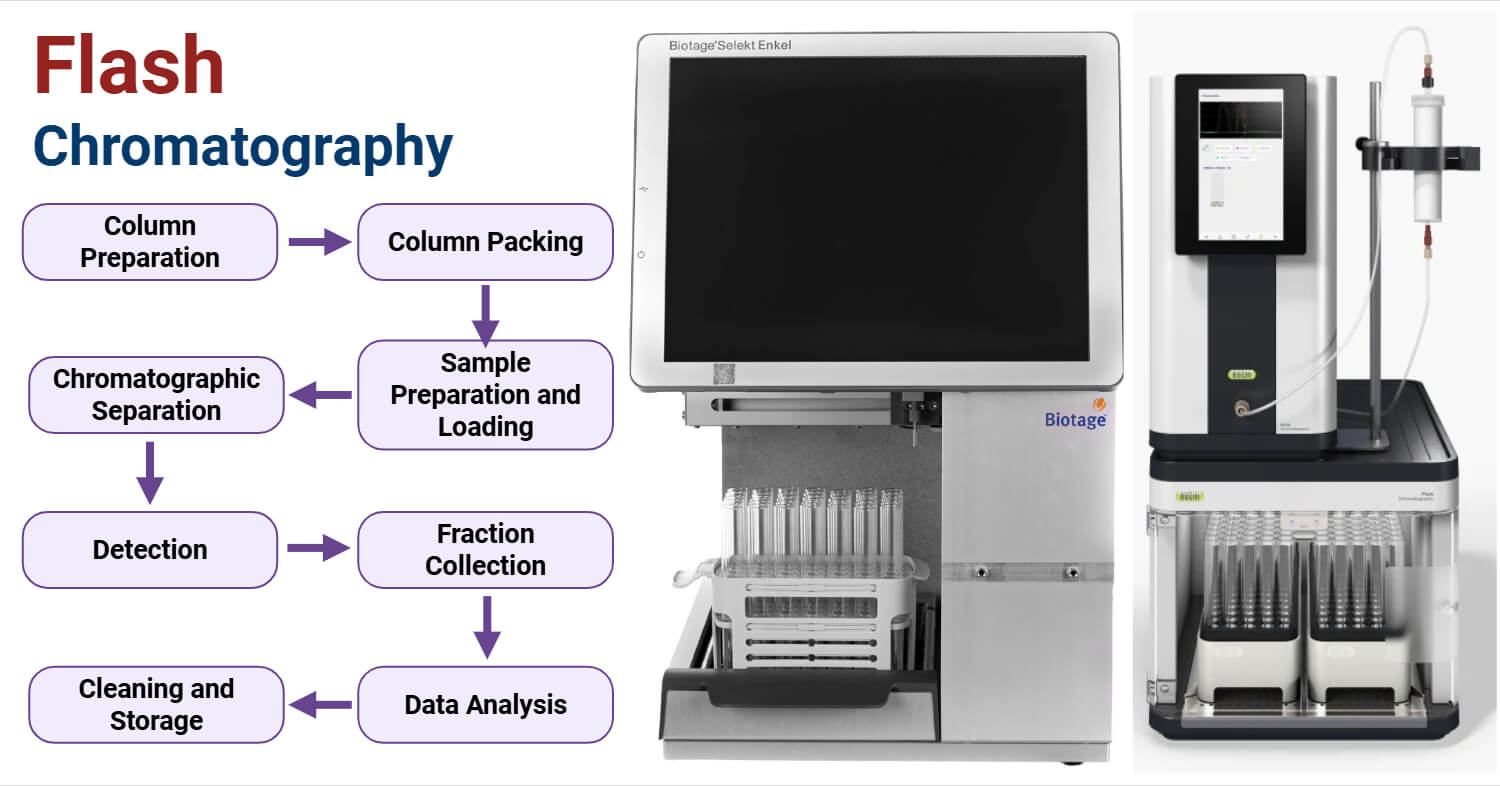
Components of Flash Chromatography
1. Column
This is the component where separation occurs. A vertical glass column is commonly used in flash chromatography which is manually packed with suitable stationary phase. Modern flash systems use pre-packed columns or plastic cartridges. Flash columns are available in different sizes and materials for different purification scales from laboratory to industrial applications.
2. Stationary phase
It is the solid adsorbent packed into the column. Commonly used stationary phase in flash chromatography are silica gel and alumina. It is selected based on the properties of the sample.
3. Mobile phase
It is the liquid solvent that moves through the column and carries the sample components. It is selected based on the polarity of the sample and the stationary phase. Common solvents used are hexane, n-heptane, dichloromethane (DCM), tetrahydrofuran (THF), ethanol, ethyl acetate, methanol, and water. The solvent systems in flash chromatography are usually mixtures of compatible solvents. For example: Hexane/Ethyl acetate and Dichloromethane/Methanol.
4. Mobile phase modifier
Sample compounds with acidic or basic groups can interact with silanol groups on silica-based stationary phase which can cause peak tailing. Mobile phase modifiers can be used to reduce this. These are chemical reagents that sharpen peaks and improve resolution. Commonly used modifiers are triethylamine, acetic acid, trifluoroacetic acid, and ammonium hydroxide.
5. Pump system
The pump system controls the flow rate and pressure of the mobile phase through the column. Early flash systems used gas pressure but modern systems use precision pumps for more accurate flow.
6. Detector
It is used to monitor and detect compounds as they elute from the column. UV-visible detector is commonly used which detects compounds absorbing ultraviolet light. Advanced systems may also include refractive index detector (RID), fluorescence detector, and evaporative light scattering detector (ELSD).
7. Fraction collector
It is used to collect the separated compounds in individual tubes or vials as they elute based on time, volume, or detector signal.
Types of Flash Chromatography
1. Normal Phase Flash Chromatography
- It uses a polar stationary phase and a non-polar or moderately polar mobile phase.
- Common stationary phases for this method include silica, alumina, NH2–bonded silica, and diol-bonded silica.
- Commonly used normal phase solvent systems are hexane or heptane with ethyl acetate and dichloromethane with methanol.
- Non-polar compounds elute first while polar compounds are retained longer due to stronger adsorption to stationary phase.
2. Reversed Phase Flash Chromatography
- It is the opposite of normal phase. It uses a non-polar stationary phase and polar solvent.
- Stationary phases like octadecylsilane (C18), octylsilane (C8), butylsilane (C4), and other alkyl-bonded silica variants are commonly used.
- Reversed phase solvent systems include water with methanol or acetonitrile.
- In contrast to normal phase, polar compounds elute first while non-polar or less polar compounds are retained longer due to stronger interactions with the non-polar stationary phase.
Procedure or Steps of Flash Chromatography
1. Column Preparation
- At first, a column with suitable size and material is selected based on the scale and purpose of purification.
- Then, stationary phase and mobile phase are also selected accordingly.
- Thin layer chromatography (TLC) can be performed to determine the best solvent system for the sample.
2. Column Packing
- The column is packed with the selected stationary phase.
- First, a small piece of glass wool or frit is placed at the bottom to retain the adsorbent.
- Then, a thin layer of sand is added on top of the glass wool to create a flat base for packing.
- There are two methods of column packing:
Dry packing is used in small-scale or simple experiments. In this method, the dry stationary phase is scooped or poured directly into the column. After filling, the column is gently tapped to settle the solid. Then, elution solvent is added into the column to fully wet the solid media and remove trapped air. This method is faster but can form air pockets if not carefully packed.
Slurry packing is preferred for preparative-scale separations. In this method, the stationary phase is mixed with a small volume of solvent to form a slurry. Then, it is poured into the column while gently tapping the sides to remove air bubbles.
- After packing, the stationary phase is covered by another layer of sand to protect it during sample loading.
- Then, the column is flushed with elution solvent to equilibrate it before sample loading.
- In modern flash systems, pre-packed columns are used which removes this manual packing step.
3. Sample Preparation and Loading
- The sample is dissolved in a small volume of solvent and gently loaded using a long glass pipette along the walls of the column to avoid disturbing the stationary phase.
- The sample flask is rinsed with small volumes of solvent and carefully added to the column. This is repeated 2-3 times to ensure all sample is transferred.
- Two different methods can be used for loading the sample:
Wet loading method: In this method, the sample is dissolved in a small volume of solvent and directly loaded onto the top of the stationary phase.
Dry loading method: Here, the sample is dissolved in a small volume of solvent and the stationary phase is added to the solution. The solvent is evaporated until only the dry powder remains. This dry powder is transferred to the top of the column.
- For automated systems, syringe injection or cartridges are used for sample loading.
4. Chromatographic Separation
- After loading the sample, the elution solvent is carefully added into the column.
- An automated pump or gas pressure system is used to deliver the solvent through the column.
- The solvent level must always be maintained above the stationary phase to prevent drying.
- As the mobile phase flows, the sample components interact with the stationary phase and separate based on their polarity and affinity.
- Elution can be isocratic or gradient. Isocratic elution involves constant solvent composition while gradient elution involves changing the mobile phase composition over time.
5. Detection
- The eluted fractions are detected using different in-line detectors like UV detectors and ELSD.
- These detectors monitor the elution in real time and generate chromatograms that show peaks of eluted compounds.
6. Fraction Collection and Analysis
- The eluted fractions are collected in clearly labeled individual tubes for further analysis.
- Fraction collection can be done either manually or using an automated fraction collector.
- The collected fractions can be analyzed using methods like TLC, nuclear magnetic resonance (NMR), infrared spectroscopy (IR), and mass spectrometry (MS) to identify and isolate the target compounds.
7. Cleaning and Storage
- After the separation process, the column is washed with a suitable solvent to remove residual compounds.
- The column can be stored in an appropriate solvent if it is reusable.
Factors Affecting Flash Chromatography
- The solvent used in flash chromatography can affect the separation, retention time, and movement of compounds through the column. Using a solvent compatible with both the stationary phase and the sample improves separation.
- The flow rate of the solvent affects the speed and resolution of elution. Faster flow rates reduce time but slower flow rates improve separation. The optimal flow rate depends on column size and particle size.
- The selection of stationary phase is also an important factor. It should be selected based on the properties of the sample.
- The particle size of stationary phase can affect how well the compounds separate. Smaller particles provide better resolution but can increase backpressure.
- Column dimensions also affect the separation process. Longer columns improve separation but use more solvent and time. Wider columns allow higher sample loading but can reduce resolution.
- The elution modes are also important. Isocratic elution is simpler but gradient elution allows better separation for complex mixtures.
Common Products and Manufacturers of Flash Chromatography
| Common Products | Manufacturers |
| Flash 400, Isolera system, Selekt system, Selekt Enkel system, SPE columns, Biotage Sfar columns | Biotage |
| Pure Essential Flash Chromatography systems (Pure C-805, C-810), FlashPure cartridges | Buchi |
| CombiFlash NextGen systems, RediSep Flash columns | Teledyne ISCO |
| Smart Flash AKROS | Yamazen |
| PuriFlash series | Advion Interchim Scientific |
| Claricep Flash columns | Phenomenex |
Applications of Flash Chromatography
- Flash chromatography is useful in pharmaceutical industry for the isolation and purification of active compounds.
- It is used to separate and analyze pollutants from environmental samples.
- It is used to isolate and purify bioactive compounds from natural products like plant extracts. For example: isolation of catechins from green tea extract.
- It is also used for the separation of lipid classes and derivatives.
- It can help in separation and identification of compounds in forensic samples like toxic substances or samples found at crime scenes.
- It is also used in food science for the separation and analysis of food additives, contaminants, and flavor compounds. This helps to ensure food safety and quality.
Advantages of Flash Chromatography
- Flash chromatography requires simpler equipment and less solvent than HPLC which makes it low cost and more accessible.
- It supports both isocratic and gradient elution modes and is compatible with different solvents.
- The use of pressurized flow allows faster separation compared to traditional methods.
- Modern flash chromatography systems are fully automated which reduces manual handling and improves efficiency of the separation process.
- It can separate large quantities of compounds which is useful for industrial applications.
Limitations of Flash Chromatography
- Flash chromatography has lower resolution compared to automated systems or other advanced chromatographic techniques like HPLC.
- It can be time-consuming for complex mixtures.
- It is less effective at separating closely related compounds with similar structure or polarity.
- Some compounds may bind strongly to the stationary phase which leads to sample loss.
- Flash systems still require manual optimization using TLC to find the best solvent system.
- Most standard flash systems still rely on UV detection which does not work for compounds without chromophores. Advanced detection is available but it is not common.
Troubleshooting and Safety Considerations
- Incorrect solvent polarity can result in incomplete separation or overlapping peaks. Solvent polarity must be adjusted according to the properties of the compound and the stationary phase.
- The flow rate must be adjusted according to column size and particle size to prevent poor resolution or longer run times.
- Overly diluted samples or excessive injection volume can cause overlapping peaks. Concentrated sample and reduced injection volume should be used.
- Undissolved particles can clog the column so it must be ensured that the sample is fully dissolved in a compatible solvent.
- Poor column maintenance and use of improper column materials can also clog the column and increase backpressure which reduces performance. Regular cleaning and maintenance are necessary.
- Personal protective equipment (PPE) must always be worn.
- When working with volatile or hazardous solvents, well-ventilated area or fume hood must be used.
- All chemicals and waste containers must be clearly labeled and stored in appropriate cabinets.
- Solvents and waste materials must be discarded according to safety guidelines.
Recent Advances and Innovations
- Modern flash chromatography systems are highly automated which reduces manual steps and improves efficiency of the process. Automated systems include built-in gradient pumps, software interfaces, in-line detectors, and automated fraction collectors.
- Modern flash systems replace traditional glass columns with pre-packed plastic cartridges which are safer and more consistent. It also removes the need for manual packing.
- While traditional systems relied mostly on UV detection, advanced flash systems now support multiple detection methods including MS and ELSD.
- Green and sustainable approaches are being used like eco-friendly solvents and recycling systems.
- Microscale versions of flash chromatography are used in different applications. This reduces the sample and solvent requirements. It also allows faster purification of small-scale compounds.
Conclusion
Flash chromatography is a rapid method used for the purification of chemical compounds. It offers advantages over traditional column chromatography by using pressure-driven flow of solvent. It is a simple method that has become an important tool in both research and industrial laboratories for different routine purification applications.
References
- Advantages and disadvantages of flash chromatography. (n.d.). Retrieved from https://chrominfo.blogspot.com/2020/04/advantages-and-disadvantages-of-flash.html
- Bickler, B. (n.d.). Six key factors that impact flash chromatography. Biotage. https://www.biotage.com/blog/six-key-factors-that-impact-flash-chromatography
- Biotage. (n.d.). Flash chromatography. Retrieved from https://www.biotage.com/flash-chromatography
- Cudiamat, G. (2020, March 1). Flash chromatography. Chromatography Online. Retrieved from https://www.chromatographyonline.com
- Flash Chromatography | OpenOCHEM Learn. (n.d.). Retrieved from https://learn.openochem.org/learn/organic-chemistry-lab/flash-chromatography
- Flash chromatography explained: A comprehensive guide. (n.d.). Retrieved from https://chromtech.com/blog/flash-chromatography-explained-a-comprehensive-guide/
- Flash chromatography: Easy Principle, equipment, procedure, application – Chemistry Notes. (2023, March 17). Retrieved from https://chemistnotes.com/organic/flash-chromatography-principle/
- Flash Chromatography: Principles & Applications | Phenomenex. (n.d.). Retrieved from https://www.phenomenex.com/knowledge-center/hplc-knowledge-center/flash-chromatography
- Moore, S. (2020, October 22). What is Flash Column Chromatography?. News-Medical. Retrieved on July 28, 2025 from https://www.news-medical.net/life-sciences/What-is-Flash-Column-Chromatography.aspx.
- Najid, M. (2025, January 16). Flash Chromatography – efficient separation technique. Retrieved from https://cancerbiologyresearch.com/flash-chromatography-efficient-separation-technique/
- Pan, S. (2024, April 3). Flash chromatography – Principle, Instrumentation, Protocol, Applications – Biology Notes Online. Retrieved from https://biologynotesonline.com/flash-chromatography-principle-instrumentation-protocol-applications/
- Stevens, W. C., & Hill, D. C. (2009). General methods for flash chromatography using disposable columns. Molecular Diversity, 13(2). https://doi.org/10.1007/s11030-008-9104-x
- What are Flash Columns? (2024, July 29). Retrieved from https://www.millennialscientific.com/post/what-are-flash-columns
