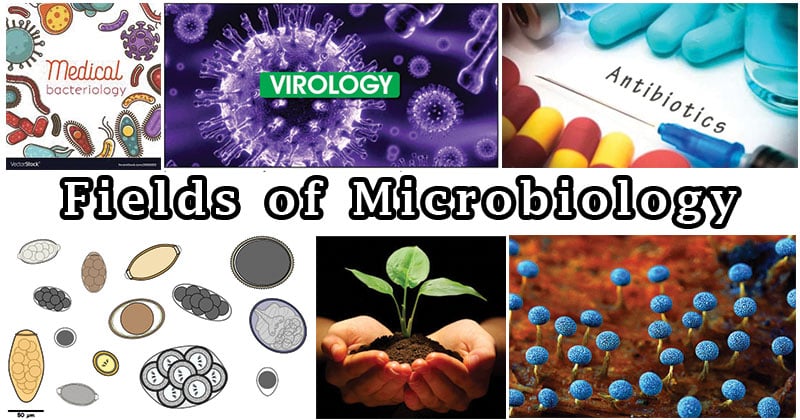
Fields of Microbiology

  • Microbiology is one of the most applied of all the biological sciences which did not exist as a true science before the later part of 19th century.
  • It is defined as the study of microorganisms that is the organisms which are of microscopic dimensions and too small to be clearly perceived by the unaided human eye.
  • Because most of the microorganisms are only a few thousand of a mm in size, they can only be seen with the aid of microscope.
  • Due to the invisibility of microbes to the naked eye and the need for special techniques to study them, microbiology was the last of the three major divisions in biology (the other two are botany and zoology) to develop.
  • The branches that come under the large and expanding umbrella of microbiology are categorized into pure and applied sciences.

Fields of Microbiology

Major Fields of Pure Sciences

  • Bacteriology: Study of bacteria
  • Mycology: Study of fungi (achlorophyllous, heterotrophic, eukaryotic with a rigid cell wall containing chitin/cellulose)
  • Protozoology: Study of protozoans (animal like single celled eukaryotic organisms).
  • Virology: Study of viruses and viral diseases.
  • Algology or Phycology: Study of algae.
  • Parasitology: Study of parasitism and parasites (include pathogenic protozoa, helminthes worms and certain insects).
  • Microbial ecology: Study of interrelationships between microbes and environment.
  • Microbial morphology: Study of detailed structure of microorganism.
  • Microbial taxonomy: Concerned with classification, naming and identification of microorganism.
  • Microbial Physiology: Study of metabolism of microbes at cellular and molecular levels.
  • Microbial genetics and Molecular Biology: Study of genetic material, structure and function and biochemical reactions of microbial cells involved in metabolism and growth.

Major Fields of Applied Microbiology

  • Industrial Microbiology: Concerned with industrial uses of microbes in production of alcoholic beverages, vitamins, NH2-acids, enzymes, antibiotics and other drugs.
  • Agricultural Microbiology: Study of relationships of microbes and crops and on control of plant diseases and improvement of yields.
  • Food Microbiology: Deals with interaction of microorganisms and food in relation to food’ processing, food spoilage, food borne disease and their prevention
  • Dairy Microbiology: Deals with production and maintenance in quality control of dairy products.
  • Aquatic Microbiology: Study of microorganisms found in fresh estuarine and marine waters.
  • Air Microbiology: Deals with the role of aerospora in contamination and spoilage of food and dissemination of plant and animal diseases through air.
  • Exomicrobiology: Deals with exploration for microbial life in outer space.
  • Medical Microbiology: Causative agents of disease, diagnostic procedure for identification of causative agents, preventive measures.
  • Immunology: Deals with the immune system that protects against infection and to study serology reactions.
  • Public Health Microbiology: Concerns with monitoring, control and spread of diseases in communities.
  • Biotechnology: Scientific manipulation of living organisms especially at molecular and genetic level to produce useful products.

About Author

Photo of author

Sagar Aryal, PhD

Dr. Sagar Aryal is a microbiologist, researcher, and science communicator from Nepal. He is also co-founder and Research Head of the Department of Natural Products at the Kathmandu Research Institute for Biological Sciences (KRIBS), where he leads research on natural product discovery and microbial biodiversity. Dr. Aryal earned his Ph.D. in Microbiology from Tribhuvan University, Kathmandu, Nepal, in 2025, supported by a DAAD Research Grant and a University Grants Commission (UGC) Nepal Ph.D. Fellowship. His research interests include Actinomycetes, Myxobacteria, microbial taxonomy, and natural products, particularly the discovery of bioactive compounds with potential pharmaceutical applications. He isolated and identified Nocardia nepalensis, a novel bacterial species from Nepal, contributing to understanding microbial diversity in the region. Dr. Aryal has published more than 16 research articles in international journals and contributed three book chapters to established academic publications. He has presented scientific research findings and developed international research collaborations through visits to more than 18 countries across Asia, Europe, North America, and Oceania. From 2023 to 2025, he served as the American Society for Microbiology (ASM) Young Ambassador to Nepal. Since December 2025, he has served as an Editorial Board Member of Scientific Reports, a Nature Portfolio journal. In recognition of his scientific contributions, Dr. Aryal received the NAST Science and Technology Youth Award 2025 from the Nepal Academy of Science and Technology. He previously received the Frs. Locke and Stiller Research Award (LSRA) for the 2017-2018 cycle from St. Xavier's College, Kathmandu, and a Nepal Academy of Science and Technology (NAST) Research Grant for 2017-2018. Alongside his scientific career, Dr. Aryal has more than 15 years of experience in blogging, content writing, and search engine optimization (SEO).