
DNA isolation from plant tissues is a fundamental procedure in plant molecular biology, genetics, taxonomy, and biotechnology. Unlike animal cells, plant cells possess rigid cell walls composed of cellulose and hemicellulose, as well as high levels of polysaccharides, polyphenols, and secondary metabolites. These compounds can interfere with DNA purity, inhibit enzymatic reactions, and complicate downstream applications such as PCR, sequencing, and restriction digestion. As a result, plant DNA extraction requires robust and selective methods that efficiently separate DNA from cellular contaminants.
The cetyltrimethylammonium bromide (CTAB) method is one of the most widely used and reliable techniques for isolating genomic DNA from plant tissues. Originally described by Doyle and Doyle (1987), the CTAB protocol has become a classic method due to its effectiveness across a wide range of plant species, including those rich in secondary metabolites. The method relies on the selective precipitation of nucleic acids using CTAB in high-salt conditions, while polysaccharides and proteins are removed during organic extraction steps.
Over the years, numerous modifications of the CTAB method have been developed to improve DNA yield and quality, particularly for challenging samples such as silica-dried leaves, herbarium specimens, and plants with high phenolic content (Sahu et al., 2016; Schenk et al., 2023a; Schenk et al., 2023b). Commercial and academic protocols, such as those described by Zymo Research (2022) and Biotech Beacon (2025), further refine the method for routine laboratory use. Together, these sources establish CTAB extraction as a robust, adaptable, and cost-effective approach for plant DNA isolation.
Key Reagents of DNA Isolation from Plant Tissues
The CTAB method employs a combination of detergents, salts, organic solvents, and enzymatic agents to achieve efficient cell lysis, contaminant removal, and DNA precipitation. Each reagent plays a specific biochemical role in ensuring high-quality DNA isolation.
| Reagent | Typical Concentration / Amount | Purpose |
| CTAB (Cetyltrimethylammonium bromide) | 2% (w/v) | Lyses cell membranes and forms complexes with polysaccharides |
| Tris-HCl | 100 mM (pH 8.0) | Maintains stable pH for DNA integrity |
| EDTA | 20 mM | Chelates divalent cations and inhibits DNases |
| NaCl | 1.4–2.5 M | Promotes separation of DNA from polysaccharides |
| β-mercaptoethanol | 0.2–1% (v/v) | Reduces oxidation of phenolic compounds |
| Chloroform: Isoamyl alcohol | 24:1 (v/v) | Removes proteins and lipids |
| Isopropanol | Equal volume | Precipitates DNA |
| Ethanol (70%) | Wash step | Removes residual salts |
| RNase A | Optional | Removes RNA contamination |
Principle of DNA Isolation from Plant Tissues
The CTAB method is based on the differential solubility of nucleic acids and cellular contaminants under high-salt and detergent conditions. The initial step involves mechanical and chemical disruption of plant cell walls and membranes using CTAB buffer. CTAB, a cationic detergent, solubilizes membrane lipids and binds strongly to acidic polysaccharides, forming insoluble complexes in the presence of high concentrations of NaCl (Doyle & Doyle, 1987).
EDTA protects DNA by chelating magnesium and calcium ions required by nucleases, while Tris-HCl stabilizes the pH. β-mercaptoethanol plays a critical role in reducing oxidized phenolic compounds that would otherwise bind to DNA and reduce its purity (Sahu et al., 2016). After cell lysis, proteins and other debris are removed by organic extraction using chloroform: isoamyl alcohol, leaving DNA in the aqueous phase.
DNA is subsequently precipitated using alcohol, exploiting its reduced solubility in alcohol-rich environments. The final wash steps remove residual salts and detergents, yielding purified genomic DNA suitable for molecular analysis.
Protocol of DNA Extraction from Plant Tissues (CTAB Method)
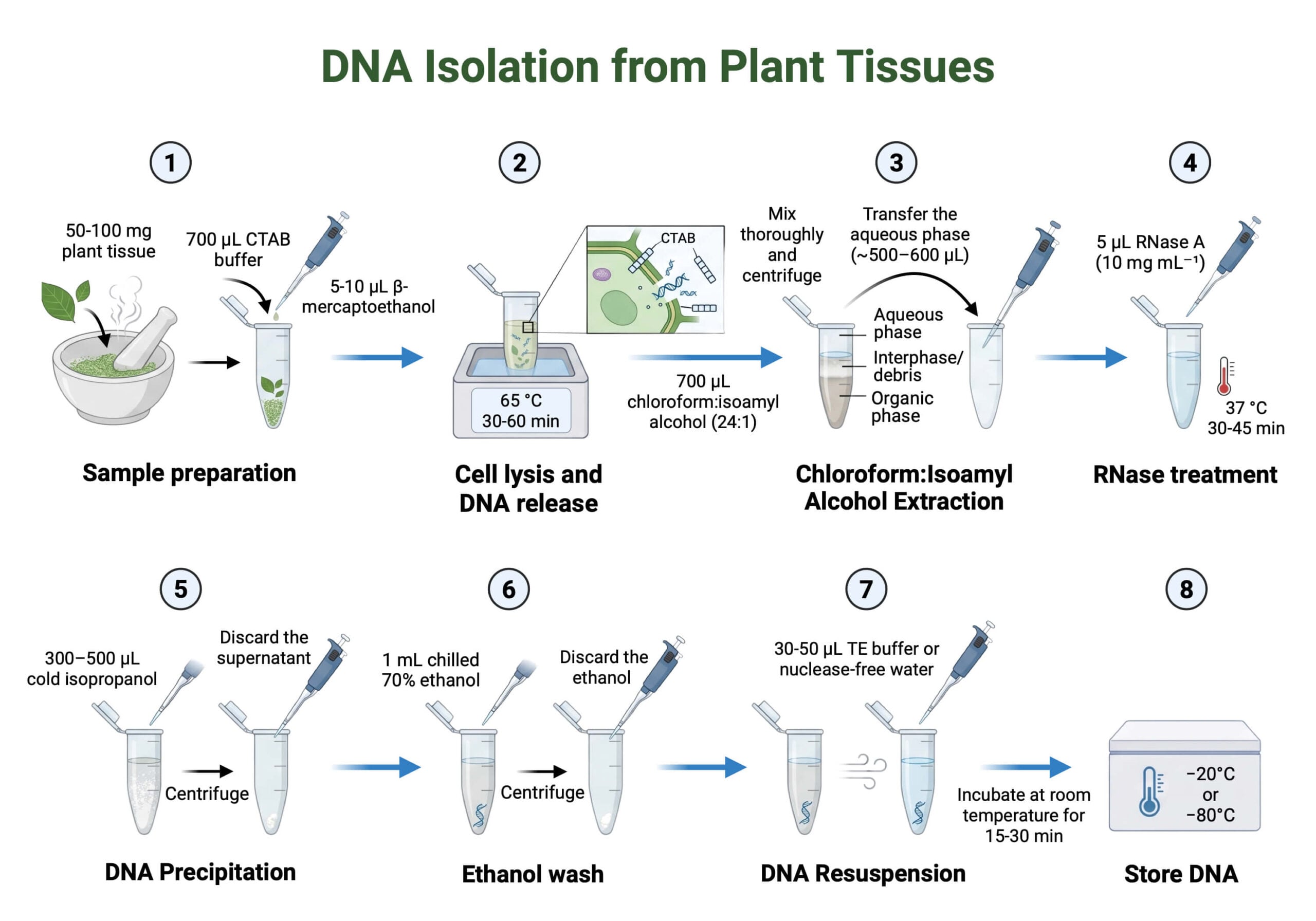
Sample Preparation
- Weigh 50-100 mg of fresh, silica-dried, or preserved plant tissue.
- Clean the tissue to remove surface contaminants and excess moisture.
- Freeze the tissue using liquid nitrogen.
- Grind the frozen tissue in a pre-chilled mortar and pestle until a fine powder is obtained.
- Immediately transfer the powdered tissue into a sterile 1.5 mL microcentrifuge tube.
- Add 700 µL of pre-warmed CTAB extraction buffer containing:
- 2 % (w/v) CTAB
- 100 mM Tris-HCl (pH 8.0)
- 20 mM EDTA
- 1.4-2.5 M NaCl
- Add 5-10 µL β-mercaptoethanol (0.2-1 % final concentration) freshly before use.
- Mix gently by inversion to ensure complete suspension of the tissue powder.
Cell Lysis
- Incubate the tube at 60-65 °C for 30-60 min.
- Gently invert the tube every 10 min to ensure uniform lysis.
- During incubation:
- CTAB disrupts cell and nuclear membranes.
- High salt promotes the separation of DNA from polysaccharides.
- β-mercaptoethanol prevents oxidation of phenolic compounds.
- Allow the lysate to cool to room temperature (5 min) before extraction.
Chloroform-Isoamyl Alcohol Extraction
- Add 700 µL of chloroform: isoamyl alcohol (24:1) to the lysate.
- Mix gently by inversion for 5–10 min (do not vortex).
- Centrifuge at 12,000–16,000 g for 10 min at room temperature.
- Observe three layers:
- Lower organic phase: chloroform with proteins and lipids
- Interphase: protein and polysaccharide debris
- Upper aqueous phase: DNA-containing solution
- Carefully transfer the aqueous phase (~500–600 µL) to a fresh sterile tube.
- Repeat the extraction once if the interphase is cloudy (Zymo Research, 2022).
RNA Removal (Optional)
- Add 5 µL RNase A (10 mg mL⁻¹) to the aqueous phase.
- Mix gently by inversion.
- Incubate at 37 °C for 30–45 min.
- Briefly centrifuge to collect condensation.
DNA Precipitation
- Add 0.6–1.0 volume of cold isopropanol (300–500 µL).
- Gently invert the tube 10–15 times until the solution becomes cloudy.
- Incubate at -20 °C for 20–30 min to enhance DNA precipitation.
- Centrifuge at 12,000–16,000 g for 10-15 min at 4 °C.
- Carefully discard the supernatant without disturbing the DNA pellet.
DNA Recovery and Washing
- Add 1 mL of chilled 70 % ethanol to the DNA pellet.
- Gently invert the tube to wash the pellet.
- Centrifuge at 10,000 g for 5 min at 4 °C.
- Discard the ethanol wash carefully.
- Repeat the ethanol wash once more if salt contamination is suspected.
- Air-dry the DNA pellet at room temperature for 5–10 min (do not over-dry).
DNA Resuspension and Storage
- Resuspend the DNA pellet in 30–50 µL of:
- TE buffer (10 mM Tris-HCl, 1 mM EDTA, pH 8.0) or
- Nuclease-free water
- Incubate at room temperature for 15-30 min or at 4 °C overnight to ensure complete dissolution.
- Store DNA.
Observations and Results
DNA extracted using the CTAB method typically appears as a white or translucent pellet after precipitation. Upon gel electrophoresis, intact genomic DNA shows minimal degradation and strong band intensity. Spectrophotometric readings generally indicate acceptable purity ratios when protocol conditions are optimized for the plant species being studied.
Modifications of DNA Isolation from Plant Tissues
Several modifications have been developed to adapt the CTAB protocol to diverse plant tissues, metabolite composition, and preservation conditions, thereby improving DNA yield, purity, and suitability for downstream molecular applications.
- Increased NaCl concentration: Higher salt concentrations enhance the separation of DNA from polysaccharides by preventing their co-precipitation during alcohol precipitation, which is particularly important for mucilaginous or carbohydrate-rich plant tissues (Sahu et al., 2016).
- Addition of PVP (polyvinylpyrrolidone): PVP binds oxidized polyphenolic compounds released during cell lysis, preventing their irreversible interaction with DNA and thereby improving DNA purity and amplifiability in phenolic-rich plant species (Sahu et al., 2016).
- Extended lysis time: Prolonged incubation in CTAB buffer allows more efficient breakdown of rigid cell walls and release of DNA, especially from silica-dried, aged, or herbarium specimens with degraded cellular structures (Schenk et al., 2023a).
- Modified CTAB buffer composition: Alterations in CTAB, salt, and chelating agent concentrations are used to optimize extraction efficiency for specific plant taxa, collectively referred to as “modified CTAB protocols” in methodological studies (Schenk et al., 2023b).
- Reduced tissue input: Optimized protocols enable reliable DNA extraction from very small amounts of plant material, which is valuable when working with rare species, limited samples, or minimally destructive sampling approaches (Doyle & Doyle, 1987).
Troubleshooting of DNA Isolation from Plant Tissues
| Problem | Likely Cause | Solution |
| Low DNA yield | Incomplete lysis or old tissue | Increase incubation time or grind tissue thoroughly |
| DNA degradation | DNase activity | Ensure EDTA presence and work quickly |
| Brown or viscous DNA | Polyphenol contamination | Add β-mercaptoethanol or PVP |
| Poor PCR amplification | Salt contamination | Perform an additional ethanol wash |
| RNA contamination | Absence of RNase | Treat with RNase A |
Quality Assessment of the Isolated DNA
- Agarose gel electrophoresis: Intact DNA appears as a high-molecular-weight band with minimal smearing.
- Spectrophotometric analysis: A260/A280 ratio of ~1.8 indicates good purity (Biotech Beacon, 2025).
- Amplifiability: Successful PCR confirms functional DNA quality.
Safety Tips and Precautions of DNA Isolation from Plant Tissues
- Handle β-mercaptoethanol in fume hoods: It is volatile and toxic.
- Use gloves and eye protection: Prevents exposure to chemicals and biological material.
- Dispose of chloroform waste properly: Organic solvents require regulated disposal (Zymo Research, 2022).
Storage and Long‑Term Stability of Isolated DNA
- Short-term storage at 4 °C: Suitable for immediate use.
- Long-term storage at −20 °C or −80 °C: Prevents degradation over extended periods.
- Use TE buffer for stability: EDTA inhibits nuclease activity.
Applications of DNA Isolation from Plant Tissues
- PCR and qPCR: Enable gene amplification for detecting specific genetic sequences, quantifying gene expression levels, validating transgenes, identifying pathogens, and supporting molecular diagnostics and functional genomics studies in diverse plant species.
- Genotyping and phylogenetics: Supports population genetic analysis, assessment of genetic diversity, construction of phylogenetic trees, identification of species and cultivars, and investigation of evolutionary relationships among closely related plant taxa.
- Plant breeding and biotechnology: Facilitates marker-assisted selection, identification of desirable agronomic traits, verification of genetically modified plants, trait introgression studies, and development of improved crop varieties with enhanced yield or stress tolerance.
- Herbarium and conservation genetics: Allows analysis of preserved specimens for studying historical genetic variation, species identification, phylogeography, and conservation planning, even when only degraded or limited plant material is available (Schenk et al., 2023a).
Advantages of DNA Isolation from Plant Tissues
- Cost-effective: Requires readily available reagents.
- Highly versatile: Applicable to diverse plant species.
- High DNA yield and purity: Effective removal of contaminants.
Limitations of DNA Isolation from Plant Tissues
- Labor-intensive: Requires multiple manual steps.
- Use of hazardous chemicals: Chloroform and β-mercaptoethanol pose risks.
- Time-consuming: Not ideal for high-throughput automation (Zymo Research, 2022).
Conclusion
The CTAB method remains a cornerstone technique for DNA isolation from plant tissues due to its robustness, adaptability, and effectiveness in overcoming plant-specific challenges. Since its introduction by Doyle and Doyle (1987), the method has evolved through numerous refinements that enhance DNA quality from difficult samples, including metabolite-rich and preserved tissues.
Despite requiring careful handling and multiple steps, CTAB-based extraction continues to be a preferred choice in academic and research laboratories. Its continued relevance highlights the importance of understanding both the biochemical principles and practical considerations underlying plant DNA extraction.
References
- Biotech Beacon. (2025). DNA isolation from plant tissue using CTAB method—Complete guide. https://www.biotechbeacon.com/dna-isolation-from-plant-tissue-using-ctab-method-complete-guide
- Doyle, J. J., & Doyle, J. L. (1987). A rapid DNA isolation procedure for small quantities of fresh leaf tissue. Phytochemical Bulletin, 19, 11–15.
- Schenk, J. J., Becklund, L. E., Carey, S. J., & Fabre, P. P. (2023). What is the “modified” CTAB protocol? Characterizing modifications to the CTAB DNA extraction protocol. Applications in Plant Sciences, 11(3), e11541. https://doi.org/10.1002/aps3.11541
- Sahu, S. K., Thangaraj, M., & Kathiresan, K. (2012). DNA extraction protocol for plants with high levels of secondary metabolites and polysaccharides (CTAB-based method). ISRN Molecular Biology, 2012, Article 205049. https://doi.org/10.5402/2012/205049
- Schenk, M. F., Thoen, M. A., Brøndum, R. F., Boyd, R. K., Suda, R., & Viljoen, C. (2023a). Optimizing the lysis step in CTAB DNA extractions of silica-dried and herbarium leaf tissues. Applications in Plant Sciences, 11(3), Article e12100. https://doi.org/10.1002/aps3.12100
- Schenk, M. F., Thoen, M. A., Brøndum, R. F., Boyd, R. K., Suda, R., & Viljoen, C. (2023b). What is the “modified” CTAB protocol? Characterizing modifications to a classic DNA extraction method. Applications in Plant Sciences, 11(6), Article e12121. https://doi.org/10.1002/aps3.12121
- Zymo Research. (2022). CTAB protocol for isolating DNA from plant tissues. https://www.zymoresearch.com/blogs/blog/ctab-protocol-for-isolating-dna-from-plant-tissues
- Kathmandu University. (2025). Phenol–chloroform extraction manual for human urine samples. Unpublished laboratory protocol.
