
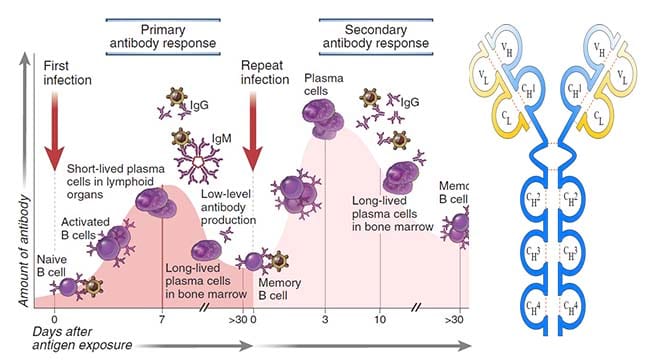
In a primary immune response, naive B cells are stimulated by antigen, become activated, and differentiate into antibody-secreting cells that produce antibodies specific for the eliciting antigen. A secondary immune response is elicited when the same antigen stimulates memory B cells, leading to the production of greater quantities of specific antibodies that are produced in the primary response.
Some of the differences between Primary and Secondary Immune Responses are as follows:

Primary vs Secondary Immune Response
| S.N. | Characteristics | Primary Immune Response | Secondary Immune Response |
| 1 | Definition | The primary Immune Response is the reaction of the immune system when it contacts an antigen for the first time. | Secondary Immune Response is the reaction of the immune system when it contacts an antigen for the second and subsequent times. |
| 2 | Appearance | Appears mainly in the lymph nodes and spleen. | Appears mainly in the bone marrow and then, in the spleen and lymph nodes. |
| 3 | Occurrence | This occurs in response to the primary contact of the antigen. | This occurs in response to the second and subsequent exposure to the same antigen. |
| 4 | Antibody Peak | The antibody level reaches its peak in 7-10 days. | The antibody level reaches its peak in 3-5 days. |
| 5 | Affinity of Antibody | Low affinity to their antigens. | High affinity to their antigens. |
| 6 | Responding Cells | Naive B cells and T cells | Memory B cells |
| 7 | Antibodies | Both thymus-dependent and thymus-independent antibodies are involved in the primary immune response. | Only thymus-dependent antibodies are involved in the secondary immune response. |
| 8 | Lag Phase | Long (4-7 days) | Short (1-4 days) |
| 9 | Types of Antibodies | A large amount of IgM and a small amount of IgG are produced during the primary immune response. | A large amount of IgG, a small amount of IgM, IgA, and IgE are produced during the secondary immune response. |
| 10 | Amount of Antibody | Few antibodies are produced in the primary immune response. | 100-1000 times more antibodies are produced in the secondary immune response. |
| 11 | Strength of the Response | The primary immune response is usually weaker than the secondary immune response. | The secondary immune response is stronger. |
| 12 | Antibody level | Antibody level declines to the point where it may be undetectable. | The antibody level tends to remain high for longer. |
References
- http://www.microbiologynotes.com/differences-between-primary-and-secondary-immune-response/
- https://www.mytutor.co.uk/answers/867/A-Level/Biology/What-is-the-difference-between-the-primary-and-secondary-immune-response
- http://pediaa.com/difference-between-primary-and-secondary-immune-response/
- https://www.differencebetween.com/difference-between-primary-and-vs-secondary-immune-response/
- http://www.yourarticlelibrary.com/difference/difference-between-primary-immune-response-and-secondary-immune-response-explained/11492
- http://www.yourarticlelibrary.com/immunology/difference-between-primary-and-secondary-immune-response-immune-response/27758
- http://biotech4you.com/important-summary/136-difference-between-primary-immune-response-and-secondary-immune-response
- https://sites.ualberta.ca/~pletendr/tm-modules/immunology/70imm-primsec.html
- http://www.els.net/WileyCDA/ElsArticle/refId-a0000947.html
- https://www.quora.com/What-is-primary-and-secondary-immune-response
- http://www.biologydiscussion.com/immunology/primary-and-secondary-immune-responses/56016
- http://www.chegg.com/homework-help/questions-and-answers/differences-primary-secondary-immune-response-q5742519
- https://forums.studentdoctor.net/threads/primary-vs-secondary-immune-response.288539/
- http://www.newhealthadvisor.com/Primary-Immune-Response.html
