Skip to content
Microbe Notes

Microbe Notes

  • Home
  • Life Sciences
    • Biochemistry
    • Bioinformatics
    • Biology
    • Biotechnology
    • Botany
    • Cell Biology
    • Genetics
    • Molecular Biology
    • Zoology
  • Microbiology
    • Agricultural Microbiology
    • Bacteriology
    • Basic Microbiology
    • Environmental Microbiology
    • Food Microbiology
    • Mycology
    • Parasitology
    • Virology
  • Laboratory and Diagnostics
    • Biochemical Test
    • Culture Media
    • Diagnostic Tests
    • Instrumentation
    • Microscopy
    • Staining
  • Medical Sciences
    • Cancer Biology
    • Human Anatomy
    • Human Physiology
    • Immunology
    • Infections and Diseases
    • Medical Devices
    • Pharmacology
  • Health Sciences
    • Epidemiology
    • Research Methodology
  • Resources
    • Difference Between
    • Microbiology Terms
    • Microorganisms Note
    • Syllabus

Microscopy

Microscopy is the study of devices (microscopes) that are used to view objects or certain areas that cannot be seen with a naked eye.

  • Microscopes work on the physical principle of magnification where the image of an object is magnified so that it can be visible.
  • The substances that can only be seen with a microscope are called microscopic substances.
  • Microscopes are imperative in areas like microbiology that deals with the structure and function of microscopic living beings.
  • Microscopy is further divided into three branches; optical microscopy, electron microscopy, and X-ray microscopy.
  • X-ray microscopy is a fairly new technology that is responsible for detailed imaging of subcellular organelles like the nucleus and chromosomes.
  • Microscopy, importantly optical microscopy, began with the discovery of the first microscope by Anton Von Leeuwenhoek.
  •  The complexity of microscopy since then has increased rapidly with new and advanced microscopes with higher magnification and resolution.
  • In an optical microscope, the rays of light are passed through a series of glass lenses to produce a magnified image on the observer’s eyes. Compound microscopes are the most common type of microscope, mostly used for research and teaching purposes.
  • In the case of an electron and X-ray microscope, an electron beam is created which produced a digital magnified image of an object.
  • Electron microscopes have very high magnification and resolution which produces clear enlarged images of objects as small as an atom.
  • Depending on the nature of the sample, different types of microscopes, including bright field microscope, fluorescence microscope, phase contrast, and darkfield microscopes, are also available.
  • The magnification of these microscopes depends on the type of lens used in the system which produces images of different magnitude and resolution so that they can be viewed.
  • Microscopy is important in different areas of science like histology, cytology, and bacteriology. Microscopic examination of the morphology and structure of cells has been used as an essential technique for the identification of microorganisms.

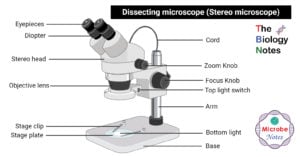
Dissecting microscope (Stereo or stereoscopic microscope)- Definition, Principle, Parts
May 27, 2022April 16, 2022 by Dr. Faith Mokobi
Labeled Dissecting microscope (Stereo or stereoscopic microscope)

What is a Dissecting microscope (Stereo microscope)? These are also known as stereoscopic microscopes. This is a type of digital optical microscope designed with a low magnification power (5x-250x), by … Read more

Pocket Microscope- Definition, Principle, Parts, Types, Uses

May 27, 2022April 14, 2022 by Dr. Faith Mokobi
Pocket Microscope

What is a Pocket Microscope? This is a microscope that has a special design that is small and portable, hence the name ‘pocket’. They are pocket-size but some are a … Read more

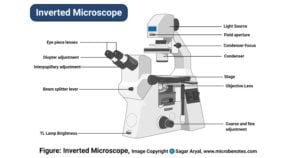
Inverted Microscope- Definition, Principle, Parts, Labeled Diagram, Uses, Worksheet

May 27, 2022April 10, 2022 by Dr. Faith Mokobi
Inverted Microscope

What is an Inverted Microscope? Invented in 1850 by a faculty member of Medical College of Louisiana, named J. Lawrence Smith, this microscope just like it sounds is a light … Read more

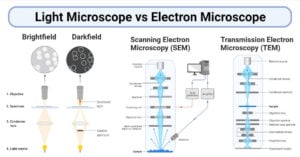
Light Microscope vs Electron Microscope- 36 Major Differences

May 27, 2022April 2, 2022 by Sagar Aryal, PhD
Light Microscope vs Electron Microscope

Both light microscopes and electron microscopes use radiation (light or electron beams) to form larger and more detailed images of objects which cannot be seen clearly through an unaided eye. Light Microscope … Read more

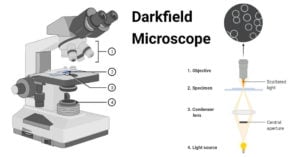
Darkfield Microscope- Definition, Principle, Uses, Diagram

May 27, 2022March 13, 2022 by Sagar Aryal, PhD
Darkfield Microscope

What is a Darkfield Microscope? Microbiology, the branch of science that has so vastly extended and expanded our knowledge of the living world, owes its existence to Antoni van Leeuwenhoek. … Read more

Phase Contrast Microscopy- Definition, Principle, Parts, Uses

May 27, 2022March 11, 2022 by Sagar Aryal, PhD
Phase Contrast Microscopy

What is Phase-contrast microscopy? Unstained living cells absorb practically no light. Poor light absorption results in extremely small differences in the intensity distribution in the image. This makes the cells … Read more

Newer posts
← Previous Page1 … Page3 Page4

Topics / Categories

  • Agricultural Microbiology (30)
  • Bacteriology (143)
  • Basic Microbiology (64)
  • Biochemical Test (114)
  • Biochemistry (226)
  • Bioinformatics (28)
  • Biology (147)
  • Biotechnology (63)
  • Botany (113)
  • Cancer Biology (3)
  • Cell Biology (107)
  • Culture Media (68)
  • Diagnostic Tests (6)
  • Difference Between (89)
  • Environmental Microbiology (15)
  • Epidemiology (30)
  • Food Microbiology (52)
  • Genetics (88)
  • Human Anatomy (50)
  • Human Physiology (37)
  • Immunology (124)
  • Infections and Diseases (53)
  • Instrumentation (73)
  • Medical Devices (20)
  • Microscopy (36)
  • Molecular Biology (138)
  • Mycology (44)
  • Parasitology (28)
  • Pharmacology (28)
  • Research Methodology (20)
  • Staining (30)
  • Syllabus (7)
  • Virology (64)
  • Zoology (40)
  • About Us
  • About Dr. Sagar Aryal
  • Our Team
  • Advisory Board
  • Contact Us
  • Editorial Guidelines and Policy
  • Disclaimer and Terms of Use
  • Privacy Policy
  • Cookie Policy
© 2026 Microbe Notes. Made with ♡ by Dr. Sagar Aryal.