
The three-domain system was introduced by Carl Woese and colleagues in 1990. It is therefore commonly referred to as Carl Woese’s classification system. This framework is also known as the Three-Domain, Six-Kingdom Classification because it organizes all living organisms into three domains and six kingdoms.
The three domains are Archaea, Bacteria, and Eukarya. Within these domains, organisms are classified into six kingdoms: Archaebacteria (within Archaea), Eubacteria (within Bacteria), Protista, Fungi, Plantae, and Animalia (all within Eukarya).
The three-domain system was developed using molecular evidence, particularly comparisons of 16S and 18S ribosomal RNA sequences, which revealed that archaea are evolutionarily distinct from bacteria despite their superficial similarities. As a result, the traditional kingdom Monera was divided into Archaebacteria and Eubacteria, providing a classification that better reflects evolutionary relationships.
The evaluating rRNA structure is very helpful. As a result of rRNA molecules, throughout nature perform the identical function, their structure modifications very little over time. Subsequently, similarities and dissimilarities in rRNA nucleotide sequences are a very good indication of how associated or unrelated completely different cells and organisms are.
In this classification, Carl Woese uses 16S ribosomal RNA (rRNA) as a ‘Chronometer’, because of;
- It is universally distributed means its presence in all species.
- It is functionally similar in all organisms.
- It can change its sequence slowly.
- Its sequences can be aligned, or matched up, between 2 organisms.
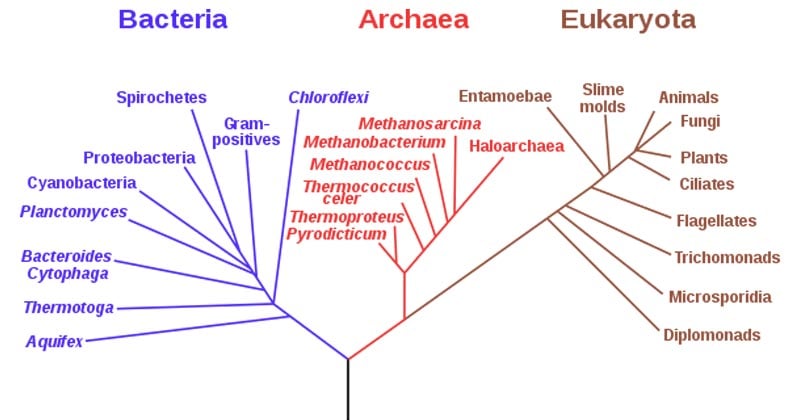
Image Source: Eric Gaba.
Domains of Carl Woese’s Classification
Carl Woese’s Classification is made of three domains such as
- Domain Archaea
- Domain Bacteria
- Domain Eukarya
1. Domain Archaea
The Archaea domain includes all prokaryotic cells, they lack nuclear membrane; have distinct biochemistry; contain RNA markers from bacterial cells. The Archaea are considered as the oldest species of organisms on Earth. They can survive in extreme, harsh environments that differentiate them from other domains. The cell wall of archaea lacks peptidoglycan. Archae also contain ether linkages in their membranes.
Archae has three phyla such as;
- Crenarchaeota: They can survive at extremely high temperatures and extremely low temperatures.
- Euryarchaeota: Some of them are known as extremely halophiles, which can prevent inhibit highly saline environments.
- Konarchaeota: It includes all those species were found in a single hot spring, Obsidian Pool, present in Yellowstone National Park (USA).
2. Domain Bacteria
These are also prokaryotic cells with bacterial rRNA and contain diacyl glycerol diester lipids in their membrane. They are also called eubacteria or “true bacteria”. Their cell membrane contains ester linkage between unbranched fatty acid chains and glycerol. Their cell wall made up of peptidoglycan.
There are present 5 phyla of the bacterial domain such as;
- Proteobacteria: The example of proteobacteria is E. coli, Salmonella typhus, Legionella, Heliobacter pylori (cause of many ulcers), Neisseria gonorrhea (cause of gonorrhea).
- Cyanobacteria: The example of Cyanobacteria is Photosynthetic ‘blue-green’ bacteria which produces O2 gas.
- Eubacteria: The example of Eubacteria is Clostridium (tetanus, botulism), Bacillus, Mycoplasma (walking pneumonia).
- Chlamydias: The example of Chlamydias is Giardia, Chlamydia (STD), etc.
- Spirochaetes: The example of Spirochaetes is Spiral bacteria that cause syphilis, Lyme disease.
3. Domain Eukarya
These are eukaryotic cells with a membrane-bound nucleus. Their membranes are composed of a phospholipid bilayer, consisting of unbranched fatty acid chains attached to glycerol and a phosphate group. They lack peptidoglycans on their cell wall. Eukarya inhibit the antibacterial antibiotics but sensitive to antibiotics that affect eukaryotic cells.
There are presently four Kingdoms of Eukarya such as;
- Protista: These are slime molds, euglenoids, algae, and protozoans.
- Fungi: These are sac fungi, club fungi, yeasts, and molds.
- Plantae: These are mosses, ferns, conifers, and flowering plants.
- Animalia: These are sponges, worms, insects, and vertebrates.
References and Sources
- 8% – http://faculty.ccbcmd.edu/courses/bio141/lecguide/unit1/3domain/3domain.html
- 3% – https://paleontology.fandom.com/wiki/Three-domain_system
- 2% – https://wikimili.com/en/Three-domain_system
- 2% – https://wikimili.com/en/Kingdom_(biology)
- 2% – http://www.biology.iupui.edu/biocourses/N100/2k43domainnotes.html
- 1% – https://www.researchgate.net/publication/281511514_Nanoarchaeota_Their_Sulfolobales_Host_and_Nanoarchaeota_Virus_Distribution_across_Yellowstone_National_Park_Hot_Springs
- 1% – https://www.ncbi.nlm.nih.gov/pmc/articles/PMC3720003/
- 1% – https://sciencing.com/list-singlecell-organisms-8543654.html
- 1% – https://quizlet.com/222479198/microbiology-ch-1-the-main-themes-of-microbiology-flash-cards/
- 1% – https://quizlet.com/102833324/prokaryotes-flash-cards/
- 1% – https://idoc.pub/documents/how-is-life-classified-qn858pq59kn1

¿En serio seis reinos? Por origen común los famosos cinco reinos no encuentran vinculación ancestral. Proponer un sexto reino (Archaea) a partir de la evidencia de que ese esquema (cinco reinos de Whittaker) es erróneo, sería un despropósito.
Thank you for your comment. The key point is that the six-kingdom model was not proposed simply by adding another kingdom to Whittaker’s system. It reflects new molecular evidence, particularly comparisons of ribosomal RNA sequences, which showed that organisms previously grouped together as “Monera” actually belong to two fundamentally different evolutionary lineages: Bacteria and Archaea.
Whittaker’s five-kingdom classification was a major milestone, but it was based primarily on cell structure, level of organization, and mode of nutrition. As molecular phylogenetics advanced, it became clear that this framework did not accurately represent evolutionary relationships. The recognition of Archaea as a separate kingdom, and later the development of the three-domain system by Carl Woese, was based on extensive genetic and biochemical evidence rather than on a desire to increase the number of kingdoms.
Classification systems evolve as new evidence becomes available, and each system reflects the best understanding of its time.
thanks your notes.and easy sentence so understand to easily this classification
“membranes contain their membranes” dont you think this is not correct
Thanks, it has been corrected 🙂
hay editor there spelling mistake, its ether linkage, not ether leakage in archaea…! lol
Thanks, corrected 🙂
Hi my name is penumaka harshini. I am very intrested to read this classification that which I can understand easily …because of easy sentence formation.. thanku soo much..