
The alkaline lysis method is one of the most widely used techniques for isolating plasmid DNA from bacterial cells, particularly Escherichia coli.
Originally developed by Birnboim and Doly in 1979, this method revolutionized molecular biology by providing a rapid, efficient, and reproducible approach for screening recombinant plasmids (Birnboim & Doly, 1979). Over time, the basic principle of alkaline lysis has been adapted and refined into both manual laboratory protocols and commercial spin-column kits, such as the QIAprep Spin Miniprep system (QIAGEN, 2019).
The core mechanism relies on alkaline conditions and detergent-mediated cell lysis, sometimes combined with heat, to disrupt bacterial cell membranes and denature cellular macromolecules. The method selectively isolates plasmid DNA while precipitating chromosomal DNA, proteins, and cell debris. Due to its simplicity and speed, alkaline lysis remains a foundational technique in molecular cloning, genetic engineering, and routine plasmid analysis (Bitesize Bio, 2024).
Key Reagents of Plasmid DNA Isolation (Alkaline Lysis Method)
The alkaline lysis method relies on a small number of well-defined reagents, each playing a specific role in cell disruption, DNA denaturation, and selective recovery of plasmid DNA.
| Reagent | Typical Concentration / Amount | Purpose |
| Tris-HCl | 10–50 mM (pH 8.0) | Maintains stable pH to protect DNA integrity |
| EDTA | 10 mM | Chelates divalent cations and inhibits DNases |
| Sodium hydroxide (NaOH) | 0.1–0.2 N | Creates alkaline conditions to denature DNA and proteins |
| Sodium dodecyl sulfate (SDS) | 1% (w/v) | A detergent that disrupts cell membranes and denatures proteins |
| Potassium acetate | 3 M (pH ~5.5) | Neutralizes alkaline conditions and precipitates contaminants |
| RNase A | ~100 µg/mL | Removes contaminating RNA |
| Ethanol or isopropanol | 70–100% | Precipitates DNA during cleanup |
Principle of the Plasmid DNA Isolation (Alkaline Lysis Method)
The alkaline lysis method is based on the differential denaturation and renaturation properties of plasmid DNA and chromosomal DNA under alkaline conditions. When bacterial cells are exposed to a mixture of sodium hydroxide and SDS, the cell membrane is solubilized, proteins are denatured, and both plasmid and chromosomal DNA become single-stranded (Birnboim & Doly, 1979).
Upon neutralization with potassium acetate, the small, circular plasmid DNA molecules rapidly renature into their native double-stranded form. In contrast, the large chromosomal DNA fragments fail to properly reanneal and become entangled with denatured proteins and detergent complexes, leading to their precipitation. This selective precipitation allows plasmid DNA to remain in solution, from which it can be recovered by centrifugation (Bitesize Bio, 2024).
Protocol / Steps of Plasmid DNA Isolation (Alkaline Lysis Method)
A generalized alkaline lysis protocol is outlined below, adapted from standard laboratory procedures and commercial guidelines.
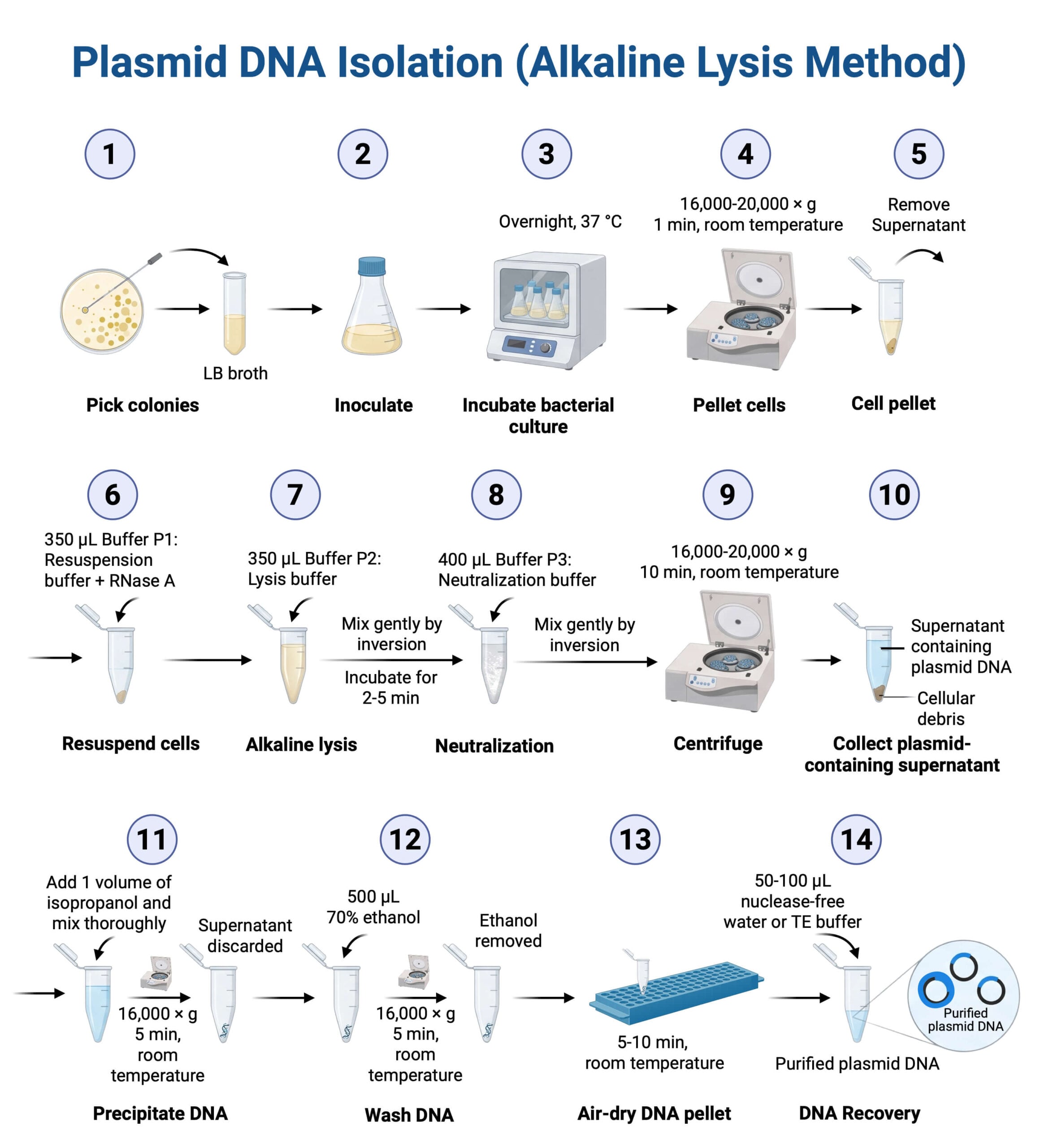
Buffers Required
- Buffer P1: 50 mM Tris-HCl, pH 8.0; 10 mM EDTA; 100 mg/mL RNase A, (store at 4 °C)
- Buffer P2: 0.2 M NaOH; 1 % (w/v) SDS
- Buffer P3: 3 M Potassium acetate, pH 5.5
Inoculation
- Inoculate 5 mL LB, supplemented with appropriate antibiotics, using a single colony. Grow overnight at 37 °C.
Cell Harvesting
- Centrifuge the culture at maximum speed (16,000-20,000 × g) at RT for 1 min.
Cell Lysis
- Completely remove supernatant. Resuspend in 350 µL buffer P1.
- Add 350 µL of buffer P2. Gently mix by inverting (do not vortex!). Incubate for up to 5 min at RT.
Note: If incubated for too long, sheared genomic DNA fragments may contaminate the sample. - Add 400 µL of buffer P3. Gently mix by inverting (do not vortex!).
- Centrifuge for 10 minutes at RT and maximum speed (16,000-20,000 × g).
- Carefully transfer the supernatant to a fresh tube, minimizing contamination from the pellet. If necessary, centrifuge the supernatant again to completely remove the pellet.
Isopropanol Precipitation
- Add 1 volume of isopropanol. Incubate on ice for at least 2 minutes.
Note: Incubation time can be increased to an hour if required. - Centrifuge the sample for 5 minutes at RT at maximum speed. Carefully remove the supernatant without discarding the DNA pellet.
- Wash the pellet by adding 500 µL of 70 % ethanol (do not resuspend). Centrifuge the sample for 5 minutes at RT at maximum speed (16,000-20,000 × g).
- Remove the ethanol and air-dry the DNA pellet for 5-10 minutes at room temperature.
DNA Recovery
- Resuspend the DNA pellet in 50-100 µL nuclease-free water or buffer of choice (e.g., TE buffer).
- Optional: The sample can be incubated at 65 °C to dissolve DNA more efficiently.
(Protocols.io, 2017)
Observations and Results
Following alkaline lysis, successful plasmid DNA extraction is typically indicated by the formation of a clear supernatant after high-speed centrifugation, reflecting effective precipitation of chromosomal DNA, proteins, and detergent complexes during the neutralization step. The absence of turbidity suggests proper lysis and efficient separation of plasmid DNA from cellular debris (Birnboim & Doly, 1979; Bitesize Bio, 2024).
When analyzed by agarose gel electrophoresis, purified plasmid DNA commonly appears as distinct bands corresponding to different conformational forms, including supercoiled, nicked, and occasionally linear plasmid DNA. The supercoiled form migrates faster through the gel matrix than linear DNA of the same size, serving as a reliable indicator of intact and properly isolated plasmid DNA (QIAGEN, 2019).
Spectrophotometric analysis further supports successful extraction, with A260/A280 ratios generally ranging around 1.8, indicating minimal protein contamination. Consistent absorbance readings suggest that inhibitory substances such as salts and residual detergents have been effectively removed. Functionally, the isolated plasmid DNA performs reliably in downstream applications, including restriction enzyme digestion and PCR amplification, confirming both the purity and structural integrity of the extracted DNA (QIAGEN, 2019; NEB, 2024).
Modifications of Plasmid DNA Isolation (Alkaline Lysis Method)
- Heat‑assisted lysis: Brief heating improves membrane disruption by weakening bacterial cell walls, leading to more efficient lysis. This modification is commonly used in teaching laboratories to simplify procedures and improve plasmid recovery consistency.
- Spin‑column purification: Silica membranes enhance DNA purity and consistency by selectively binding plasmid DNA while allowing proteins, salts, and other contaminants to be washed away, resulting in highly reproducible yields suitable for sensitive downstream applications (QIAGEN, 2019).
- RNase treatment: Reduces RNA carryover by enzymatically degrading cellular RNA during resuspension, improving downstream performance and accuracy in spectrophotometric measurements, restriction digestion, and PCR-based applications.
- High‑throughput adaptation: Parallel processing enables rapid screening of multiple clones by applying alkaline lysis in multi-well or automated formats, increasing efficiency and throughput in large-scale cloning and recombinant screening workflows.
- Sample preservation using FTA cards: Chemical lysis and DNA stabilization on FTA cards allow room-temperature storage and direct PCR analysis without conventional extraction steps, offering a simplified alternative for plasmid analysis in field studies or resource-limited settings (QIAGEN, 2023).
Troubleshooting of Plasmid DNA Isolation (Alkaline Lysis Method)
| Problem | Likely Cause | Solution |
| Low DNA yield | Incomplete lysis or poor cell growth | Ensure fresh cultures and proper mixing during lysis |
| Genomic DNA contamination | Over-mixing after lysis | Gently invert tubes instead of vortexing |
| RNA contamination | Insufficient RNase activity | Increase RNase concentration or incubation time |
| Poor downstream enzyme activity | Salt or ethanol contamination | Perform additional wash steps |
| DNA degradation | Prolonged alkaline exposure | Do not exceed the recommended lysis time |
Quality Assessment of the Isolated DNA
- Agarose gel electrophoresis: Confirms plasmid size, integrity, and absence of degradation by visualizing distinct plasmid conformations, such as supercoiled and nicked forms, and detecting any smearing indicative of DNA damage.
- Spectrophotometric analysis (A260/A280): Assesses purity by measuring absorbance ratios; values around 1.8 indicate good DNA quality with minimal protein contamination, while deviations suggest the presence of residual proteins or organic compounds.
- Restriction enzyme digestion: Verifies plasmid functionality and purity by confirming efficient cleavage at specific recognition sites, demonstrating that inhibitory contaminants are absent and the DNA is suitable for enzymatic reactions.
- PCR amplification: Confirms suitability for molecular applications by ensuring that the isolated plasmid DNA supports reliable amplification without inhibition, reflecting adequate purity, integrity, and compatibility with downstream molecular techniques.
(QIAGEN, 2019; NEB, 2024)
Safety Tips and Precautions of Plasmid DNA Isolation (Alkaline Lysis Method)
- Handle NaOH carefully: Sodium hydroxide is corrosive and can cause chemical burns; therefore, it should be handled with caution, avoiding skin or eye contact, and immediately neutralized or rinsed if accidental exposure occurs.
- Use gloves and eye protection: Prevents exposure to detergents and alkaline solutions, protecting the skin and eyes from irritation or injury, and also reduces the risk of sample contamination during routine handling steps.
- Avoid aerosol formation: Gentle mixing by inversion rather than vigorous shaking reduces contamination risk, prevents shearing of chromosomal DNA, and minimizes the spread of hazardous reagents within the laboratory environment.
- Dispose of waste properly: Follow institutional biosafety guidelines to ensure that chemical waste, especially solutions containing SDS and NaOH, is neutralized and discarded in a manner that protects personnel and the environment.
(Sigma-Aldrich, n.d.)
Storage and Long‑Term Stability of Isolated DNA
- Short-term storage at 4 °C: Suitable for immediate downstream applications.
- Long-term storage at −20 °C: Preserves DNA integrity for months to years.
- Avoid repeated freeze–thaw cycles: Prevents DNA shearing and degradation.
- Use TE buffer for storage: EDTA protects DNA from nuclease activity.
(QIAGEN, 2019)
Applications of Plasmid DNA Isolation (Alkaline Lysis Method)
- Molecular cloning: Provides plasmids for gene insertion and expression by yielding intact, supercoiled DNA suitable for restriction digestion, ligation into vectors, and propagation in bacterial hosts during recombinant DNA experiments.
- DNA sequencing: Supplies high-quality templates with minimal protein, RNA, and salt contamination, ensuring accurate base calling, reliable read lengths, and reproducible results in Sanger and other plasmid-based sequencing workflows.
- Restriction analysis: Enables plasmid mapping by producing purified DNA that can be efficiently digested with restriction endonucleases, allowing confirmation of insert size, orientation, and plasmid integrity through gel electrophoresis.
- Transformation and transfection studies: Essential for genetic engineering workflows, as purified plasmid DNA is required for efficient bacterial transformation and eukaryotic transfection, directly influencing expression efficiency and experimental reproducibility.
- Educational laboratory experiments: Demonstrates fundamental molecular biology principles.
(Birnboim & Doly, 1979; QIAGEN, 2019)
Advantages of Plasmid DNA Isolation (Alkaline Lysis Method)
- Rapid and time-efficient: The entire procedure can be completed within an hour, allowing quick plasmid recovery for same-day downstream applications such as cloning, restriction digestion, or screening of recombinant bacterial colonies.
- Cost-effective: Requires minimal reagents and basic laboratory equipment, making it suitable for teaching laboratories and research settings with limited budgets without compromising the quality of plasmid DNA obtained.
- Highly reproducible: Standardized protocols yield consistent results across different operators and experiments, ensuring reliable plasmid yield and purity when critical steps such as lysis and neutralization are properly controlled.
- Scalable: Easily adapted for small-scale minipreps or high-throughput applications, including spin-column and automated formats, while maintaining the same fundamental chemical principles of alkaline lysis.
- Well-validated: Supported by decades of experimental use, extensive literature, and commercial optimization, confirming its reliability and effectiveness for routine plasmid DNA extraction in molecular biology research.
(Bitesize Bio, 2024; Birnboim & Doly, 1979)
Limitations of Plasmid DNA Isolation (Alkaline Lysis Method)
- Limited to plasmid DNA: Not suitable for genomic DNA extraction.
- Lower purity without columns: Manual methods may retain contaminants.
- Sensitive to handling errors: Over-mixing can shear chromosomal DNA.
- Not ideal for low-copy plasmids: Yield may be insufficient without optimization.
- Alkaline damage risk: Prolonged exposure can irreversibly denature DNA.
(NEB, 2024; Sigma-Aldrich, n.d.)
Conclusion
The alkaline lysis method of DNA extraction remains a cornerstone technique in molecular biology. Since its introduction by Birnboim and Doly, it has enabled rapid plasmid screening and facilitated major advances in genetic engineering and biotechnology. Despite the availability of automated and kit-based systems, the fundamental principles of alkaline lysis continue to form the basis of modern DNA purification strategies.
Its simplicity, efficiency, and adaptability make it an indispensable method for both research laboratories and educational settings, provided that proper handling and troubleshooting measures are observed.
References
- Bitesize Bio. (2024). Alkaline lysis method: How it works in 5 simple steps. https://bitesizebio.com/180/the-basics-how-alkaline-lysis-works/
- Birnboim, H. C., & Doly, J. (1979). A rapid alkaline extraction procedure for screening recombinant plasmid DNA. Nucleic Acids Research, 7(6), 1513–1523. https://doi.org/10.1093/nar/7.6.1513
- New England Biolabs. (2024). Troubleshooting guide for DNA cleanup and plasmid purification. https://www.neb.com/en/tools-and-resources/troubleshooting-guides/troubleshooting-guide-for-dna-cleanup-and-plasmid-purification
- Protocols.io. (2017). Isolation of plasmid DNA from E. coli (alkaline lysis method) [Protocol]. https://www.protocols.io/view/isolation-of-plasmid-dna-from-e-coli-alkaline-lysi-14egn98ql5dy/v1
- QIAGEN. (2019). QIAprep Spin Miniprep Kit handbook [Handbook]. https://www.qiagen.com/us/resources/resourcedetail?id=8fe3936f-4948-487a-8a1e-35d92776cdba&lang=en
- Sigma-Aldrich (MilliporeSigma). (n.d.). Plasmid DNA preparation troubleshooting. https://www.sigmaaldrich.com/NP/en/technical-documents/technical-article/genomics/dna-and-rna-purification/problems-during-plasmid-dna-preparation
- BioInnovatise Plasmid DNA Team. (2026). Isolation of plasmid DNA. BioInnovatise. Retrieved January 2026, from https://bioinnovatise.com/articles/isolation-of-plasmid-dna/
