
The Kingdom Monera comprises unicellular prokaryotic organisms that lack a true nucleus and membrane-bound organelles. These have primitive cellular structures, with genetic material (DNA) located in a nucleoid rather than a nucleus.
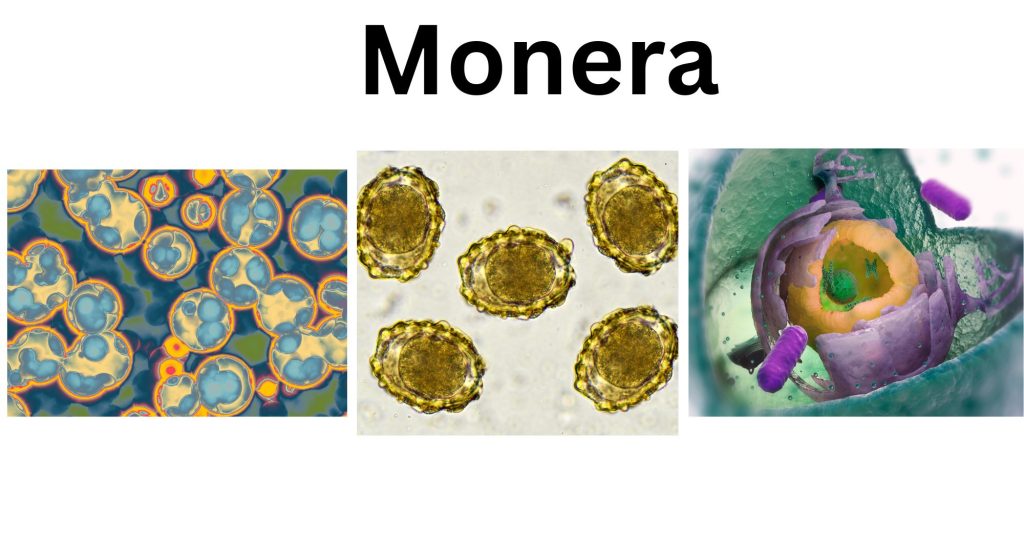
Monerans exhibit asexual reproduction (usually binary fission), display diverse modes of nutrition (autotrophy or heterotrophy), and inhabit extreme habitats. Monerans comprise mostly bacteria and cyanobacteria (blue-green algae).
Origin of Monera
Ernst Haeckel in 1866 proposed the third kingdom (Protista) that would include all the microorganisms. The individuality of prokaryotes and eukaryotes, however, was not discovered until the 20th century. In 1969, Robert H. Whittaker proposed the Five Kingdom system and coined the term Monera as a kingdom comprising all prokaryotic organisms. This was determined by basic cell differences, such as no nucleus, a less complex structure, and specialized metabolic pathways.
Subsequently, with improvements in molecular biology, Carl Woese extended prokaryotic classification to differentiate Archaea from Bacteria and thus created the three-domain system (Bacteria, Archaea, Eukarya). Though the term “Monera” has fallen into disfavor in contemporary taxonomy, it remains a basic concept in the study of the early evolution and diversity of microbial life.
Characteristic Features of Monera
Cell Type: They have prokaryotic cells, i.e., they lack a true nucleus and membrane-bound organelles.
Cell Structure: Cells are usually unicellular. The cell wall is usually made of peptidoglycan (in bacteria).
Reproduction: Reproduction takes place by binary fission, conjugation, transduction, and transformation.
Genetic Material: DNA is circular and not held inside a nucleus; it can also have plasmids (small circular molecules of DNA).
Metabolism: Autotrophic (e.g., cyanobacteria photosynthesis) or heterotrophic (e.g., organic matter breakdown).
Habitat: Diverse habitats, from extreme environments such as hot springs, deep sea, and soil.
Flagella/Pili: Movement in some bacteria or pili for attachment and genetic transfer.
Sub-Kingdoms of Monera
Kingdom Monera comprises three sub-kingdoms: Archaebacteria, Eubacteria, and Cyanobacteria.
Note: In modern molecular classification, Kingdom Monera is divided into 2 domains: Archaea and Bacteria, with Cyanobacteria classified within the Bacteria domain.
Archaebacteria
- They are the most primitive bacteria that inhabit the most extreme environments, like salty regions (halophiles), hot springs (thermoacidophiles), and swampy regions (methanogens).
- The cell wall structure is distinct from that of other bacteria, which enables them to live in extreme environments.
- The mode of nutrition is autotrophic.
- The nucleotide arrangement of its tRNA and rRNA is peculiar.
- Examples: Methanobrevibacter smithii, Haloquadratum walsbyi, etc.
Eubacteria
- Eubacteria are also referred to as “true bacteria.”
- The cell wall is rigid, and peptidoglycans are part of it.
- It is motile through the assistance of flagella.
- Some bacteria have short structures on the surface of the cell, referred to as pili, which assist the bacteria in sexual reproduction. Pili assist a pathogen in binding to the host.
- They are classified into two groups: gram-positive and gram-negative, based on the cell wall nature and the color they stain.
- Examples- Rhizobium and Clostridium are two eubacteria.
Cyanobacteria
- They are also referred to as blue-green algae.
- They are photosynthetic microorganisms.
- They possess chlorophyll, carotenoids, and phycobilins.
- They reside in the aquatic area.
- Some of these can fix nitrogen from the atmosphere.
- Examples- Nostoc, Anabaena, and Spirulina are some cyanobacteria.
Cell Wall Structure and Gram Stain Reaction of Monera
Bacteria, the largest group in the Kingdom Monera, possess a rigid cell wall composed mainly of peptidoglycan (murein), an amino sugar polymer cross-linked by short peptide chains. The cell wall offers structural support and defense against osmotic pressure.
Depending on the cell wall structure, bacteria are differentiated as Gram-positive or Gram-negative, employing the Gram staining method devised by Hans Christian Gram.
Gram-positive bacteria, including Bacillus subtilis and Staphylococcus aureus, possess a thick peptidoglycan layer and do not have an outer membrane, which enables them to hold the crystal violet stain and be purple under the microscope.
Gram-negative bacteria, including Escherichia coli and Salmonella Typhi, possess a thin peptidoglycan layer and an outer membrane that is lipopolysaccharide-rich. These lose the initial stain upon alcohol wash and retain the counterstain (safranin), showing a pink color. This difference holds clinical significance since Gram-negative bacteria are more resistant to antibiotics because of their outer membrane barrier.
Genetic Material of Monera
Monerans do not have a true nucleus but have genetic material in circular, double-stranded molecules of DNA found inside a nucleoid. This contains genes necessary for the metabolic processes, replication, and existence of the cell. Most bacteria also have small plasmids, replicating circular DNA pieces containing non-essential but beneficial genes.
For example, Escherichia coli (E. coli) frequently carries plasmids that encode for antibiotic resistance (R plasmids), metabolic functions, or toxins. These plasmids are transferable among bacteria through conjugation, facilitating quick adaptation to environmental stress or antibiotics.
Nutritional Modes of Monera
Kingdom Monera exhibits varied nutritional modes that enable it to survive in a variety of habitats.
Autotrophic Nutrition
Autotrophic bacteria produce their food from inorganic materials. Photoautotrophic bacteria, for example, Anabaena, Nostoc, and Spirulina (cyanobacteria), utilize sunlight and chlorophyll to perform oxygenic photosynthesis, similar to green plants. However, chemoautotrophic bacteria, for example, Nitrosomonas and Nitrobacter, obtain energy by oxidizing inorganic compounds like ammonia and nitrites. These bacteria are important in nitrification, a process used to maintain soil fertility.
Heterotrophic Nutrition
Heterotrophic bacteria are dependent upon the organic matter of other organisms. Saprophytic bacteria like Pseudomonas and Bacillus break down dead organic material, and they help in recycling nutrients. Parasitic bacteria like Mycobacterium tuberculosis (TB) and Treponema pallidum (syphilis) live in the tissues of hosts and usually cause disease. Symbiotic bacteria have mutually helpful relationships, for instance, Rhizobium species exist in the root nodules of legumes and fix nitrogen from the atmosphere, increasing soil fertility.
Chemosynthetic Bacteria
There exists a specialized group of chemosynthetic autotrophs, including Beggiatoa and Thiobacillus, that gain energy through the oxidation of sulfur or other inorganic substances and utilize this energy in fixing carbon dioxide. These bacteria thrive in extreme environments such as hot springs, sulfur vents, or deep-sea hydrothermal communities with no light present.
Reproduction in monera
Monera reproduces asexually by binary fission and sexually by conjugation, transduction, and transformation.
Binary fission– The major reproduction process of Monerans is binary fission. It is an asexual means, and it does not involve gamete fusion but just a simple cell division. E.coli, in its ideal conditions, is capable of reproducing within 20 minutes; that is why, with its exponential growth, there is a significant potential for its population.
Conjugation– Conjugation represents a kind of horizontal gene transfer, where the DNA of one bacterium (called the donor) physically makes direct contact with another (called the recipient). This is through a sex pilus, a tube that joins the two cells. The plasmid, which is carried by the donor cell most often, the F (fertility) plasmid, carries genes needed to make pilus and to transfer the DNA. When transferred, the recipient cell acquires new genetic traits, including antibiotic resistance. E. coli is a well-known conjugation model organism.
Transformation– Transformation is the event whereby free, naked fragments of DNA in the environment around the bacteria are absorbed by the bacteria. Homologous recombination can occur if this foreign DNA is sufficiently similar to the genome of the host. Transformation is an important aspect and feature of genetic engineering and natural genetic variation in microbial populations.
Transduction– Transduction is the type of reproduction in which a bacteriophage (a virus that infects bacteria) is used to transfer bacterial DNA among bacterial cells. This is of two types: generalized transduction and specialized transduction.
Ecological Roles of Monera
Decomposers
Most monerans, particularly bacteria, are decomposers that degrade organic materials, including dead plants and animals, as well as wastes. These bacteria are saprophytic, e.g., Bacillus subtilis and Pseudomonas fluorescens, which produce enzymes that break down complex organic substances into simple molecules. This decomposes vital nutrients such as nitrogen, carbon, and sulfur in the soil and atmosphere to sustain the nutrient cycle in the ecosystem. Without decomposers, nature would accumulate dead materials, and there would be no recycling of the nutrients, causing disturbance in the balance of the ecosystem.
Nitrogen Fixers
Some monerans also have an essential part in the nitrogen cycle as they transform atmospheric nitrogen (N) into usable forms. The bacteria that fix nitrogen include:
Bacteria that live freely in the soil, like Azotobacter and Clostridium, can fix nitrogen in aerobic or anaerobic conditions of the soil.
Some nitrogen-fixing bacteria, mainly of the genus Rhizobium, colonize the roots of legume plants and produce root nodules in exchange for carbohydrates.
Cyanobacteria such as Anabaena and Nostoc also fix nitrogen in the water and paddy fields.
The bacteria help in making the soil fertile without relying on the use of artificial fertilizers in the farming industry.
Extremophiles
Monera (Domain Archaea) include extremophiles, which can live in extreme environments to which most life cannot adapt. Examples include:
Thermoacidophiles such as Thermoplasma and Sulfolobus can thrive in hot acidic springs.
Halophiles are organisms that grow within a very salty environment, such as salt lakes, like Halobacterium.
Methanogenic bacteria include Methanobacterium, which dwells freely in anaerobic conditions like marshlands, sewage systems, and animal ruminants’ stomachs.
Economic and Medical Significance of Monera
Kingdom Monera, and particularly bacteria, have enormous economic and medical importance as organisms.
Some of these species are industrially exploited in the manufacture of dairy products such as curd (Lactobacillus), vinegar (Acetobacter aceti), and to ferment alcohol and bread (along with the fungus- Saccharomyces cerevisiae ).
Modern medicine revolves around antibiotic-producing bacteria, including Streptomyces (origin of streptomycin, tetracycline, and erythromycin).
In farming, the presence of N- fixing bacteria such as Rhizobium enhances the fertility of the soil, eliminating the need to use chemical fertilizers.
Conversely, others are monerans that cause diseases in humans and animal diseases. Tuberculosis is caused by Mycobacterium tuberculosis, typhoid by Salmonella typhi, and cholera by Vibrio cholerae as an example.
The Comparison Between Monera and Protista (Prokaryote and Eukaryote)
The first distinction between Monera and Protista is in the cellular arrangement. Monerans are a prokaryotic life form; in other words, they do not have a true nucleus, and their cells do not contain any membrane-bound organelles. They do not have a true nucleus, and in place of the nucleus is the nucleoid, where their DNA is located. Protists, on the contrary, are eukaryotes, which means that they have a distinct nucleus with the nuclear envelope and such other membrane-bound compartments as the mitochondria, endoplasmic reticulum, and Golgi apparatus.
The other important difference is in the structure and organization of the DNA. In Monera, DNA is generally circular, not bound to histone proteins. Protist DNA is linear and laid out into chromosomes and linked with histones, just like in advanced creatures.
The cell wall of most monerans is sturdy and composed of peptidoglycan (particularly among the bacteria), whereas the cell wall of protists is composed of cellulose, silica, or other complex carbohydrates or may be lacking.
Both kingdoms are diverse in terms of nutrition. Monerans can either be auto, hetero, or chemoautotrophic according to the species. Protists too exhibit autotrophy (in Euglena, Chlamydomonas), and heterotrophy (in Amoeba, Paramecium); however do not exhibit the chemosynthesis characteristic of some bacteria.
Monera reproduces primarily by asexual methods (reproduces asexually), via a binary fission process, but genetic exchange can also take place via conjugation, transformation, or transduction. The Protists, however, do both asexual and sexual reproduction, such as corresponding to binary fission and budding, formation of gametes, etc.
Modern Classification: Monera-Three Domain System
The classical five kingdoms system of classification, which was suggested by R.H. Whittaker in 1969, classified all the prokaryotic organisms, that are the bacteria as well as the archaea, under one kingdom, that is Monera.
This was mainly classified according to (1). Cellular organization (2). Mode of nutrition (3). Ecological role.
But as molecular biology and genetics have improved, and in particular the sequencing of ribosomal RNA (rRNA), researchers found there was variation among all prokaryotes.
Carl Woese and George Fox suggested a new classification scheme when they discovered in the late 1970s that some of the prokaryotes (now known as archaea) had genetic and biochemical developmental parameters that were distinctly different from the true bacteria. An example is that the archaeal cell membranes do not contain ester-linked lipids, as seen in bacteria. Their ribosomal RNA also showed greater sequence similarity to eukaryotes than to bacteria. Based on these findings, the Three-Domain System was proposed.
The Three-Domain System includes:
Bacteria– This is a kingdom that contains true bacteria or eubacteria. Their cell walls are made up of peptidoglycan, cells are simple in structure, and they possess circular DNA. Such examples are Escherichia coli and Streptococcus.
Archaea- These are prokaryotic, not having peptidoglycan in their cell wall, and many of them occur in extreme environments, i.e., in the form of high temperature, acidic, and salty conditions. The common ones are Methanogens, Halophiles, and Thermophiles.
Eukarya – It encompasses all eukaryotic living organisms, which are Protists, Fungi, Plants, and Animals. Their organelles are bound to membranes, they have a true nucleus, and the chromosomes are linear.
The change that came with the introduction of the Three-Domain System pointed to the evolutionary links between organisms better than the previous ones. It revealed that Archaea is closer to Eukarya than Bacteria, despite Archaea and Bacteria both being prokaryotic.
Based on this modern classification, the concept of Kingdom Monera that forms one single group is replaced with a concept of two fundamentally different domains, Bacteria and Archaea, and thus alters our perception of the tree of life.
Some Interesting Facts on Moneran Diversity
Kingdom Monera encompasses one of the most adaptable and yet diverse organisms on Earth. Although monerans are both unicellular and prokaryotic, they can be found almost in every ecological niche, including soil and water, hot springs as well as the human body.
Photosynthetic and oxygen-evolving examples of cyanobacteria include Anabaena, Nostoc, and Spirulina, which commonly establish symbiotic interactions with plants or fungi (in lichens). Some fix nitrogen in the air, and they enhance the fertility of soils, particularly in paddies.
Mycoplasma, the smallest free-living cell, recognizes the lack of a cell wall completely and can survive in an anaerobic environment. They have a great resistance to most antibiotics and trigger respiratory infections among human beings and animals.
Bacteria like Nitrosomonas and Nitrobacter are chemosynthetic organisms that obtain their energy by the oxidation of inorganic compounds such as nitrites and ammonia. They play an important role in soil nutrient cycling, especially nitrification.
Most extremophiles are Archaea (previously Monera).
Halobacterium (halophiles) can live in hyper-salty environments.
Thermoplasma and Sulfolobus (thermoacidophiles) are hot springs and acidic volcanic venting organisms.
Metanobacteria (methanogens) are located in the digestive system of ruminants and also in swamps, where they produce the gas as a result of the metabolic process.
Escherichia coli (E. coli), one of the most widely distributed bacteria in the gut, is a model organism in biotechnology and molecular biology applications relevant to genetic studies, recombinant DNA experimentations, and insulin manufacturing.
Conclusion
Kingdom Monera is huge and fundamental and is made up of microscopic organisms. Monerans include prokaryotic unicellular metabolically diverse organisms, capable of photosynthesis, nitrogen fixation, fermentation, and life in extreme environments. There are such things as decomposers, nutrient cyclers, and early-life pioneers, and their role in ecosystems and evolution is essential.
The role of the monerans is enormous through their medical use, industrial biotechnology, ecological factors, and the evolution of these. Bacteria and archaea research not only allows us to better understand how life on Earth arose, but also brings innovation in healthcare, agriculture, and environmental control.
Since the introduction of the Three-Domain System, the pre-existing Kingdom Monera has been divided into Bacteria and Archaea, in recognition of the extensive genetic and evolutionary disparities between the two groups. Although having a simple structure, monerans are very potent organisms present on the earth, and their research keeps extending biological science knowledge.
References
- Admin. (2020, October 30). Monera. BYJUS. https://byjus.com/biology/monera/
- Study.com | Take online courses. Earn college credit. Research schools, degrees & careers. (n.d.). https://study.com/academy/lesson/monerans-definition-examples-types.html
- Salient features of Kingdom monera. (2022, April 18). Unacademy. https://unacademy.com/content/neet-ug/study-material/biology/salient-features-of-kingdom-monera/
- Bruslind, L. (2019, August 1). Bacteria: cell walls. General Microbiology. https://open.oregonstate.education/generalmicrobiology/chapter/bacteria-cell-walls/
- Kingdom monera. (n.d.). BIOLOGY4ISC. https://biology4isc.weebly.com/kingdom-monera.html
- Admin. (2022, August 1). Bacterial Genetics. BYJUS. https://byjus.com/biology/bacterial-genetics/
- Vedantu, & Vedantu. (2025, June 25). Difference between monera and protista. VEDANTU. https://www.vedantu.com/neet/difference-between-monera-and-protista
- Sharma, A. (2025, July 4). Kingdom monera. CK-12 Foundation. https://flexbooks.ck12.org/cbook/ck-12-cbse-biology-class-11/section/2.2/primary/lesson/kingdom-monera-24854949/
- Libretexts. (2023, August 31). 1.3: Classification – the three domain system. Biology LibreTexts. https://bio.libretexts.org/Bookshelves/Microbiology/Microbiology_(Kaiser)/Unit_1%3A_Introduction_to_Microbiology_and_Prokaryotic_Cell_Anatomy/1%3A_Fundamentals_of_Microbiology/1.3%3A_Classification_-_The_Three_Domain_System
- Kingdom monera. (n.d.). SlideShare. https://www.slideshare.net/slideshow/kingdom-monera-196873790/196873790
- National Council of Educational Research and Training. (2022). Biology: Textbook for Class XI. NCERT.
- https://ncert.nic.in/textbook.php?kebi1
