
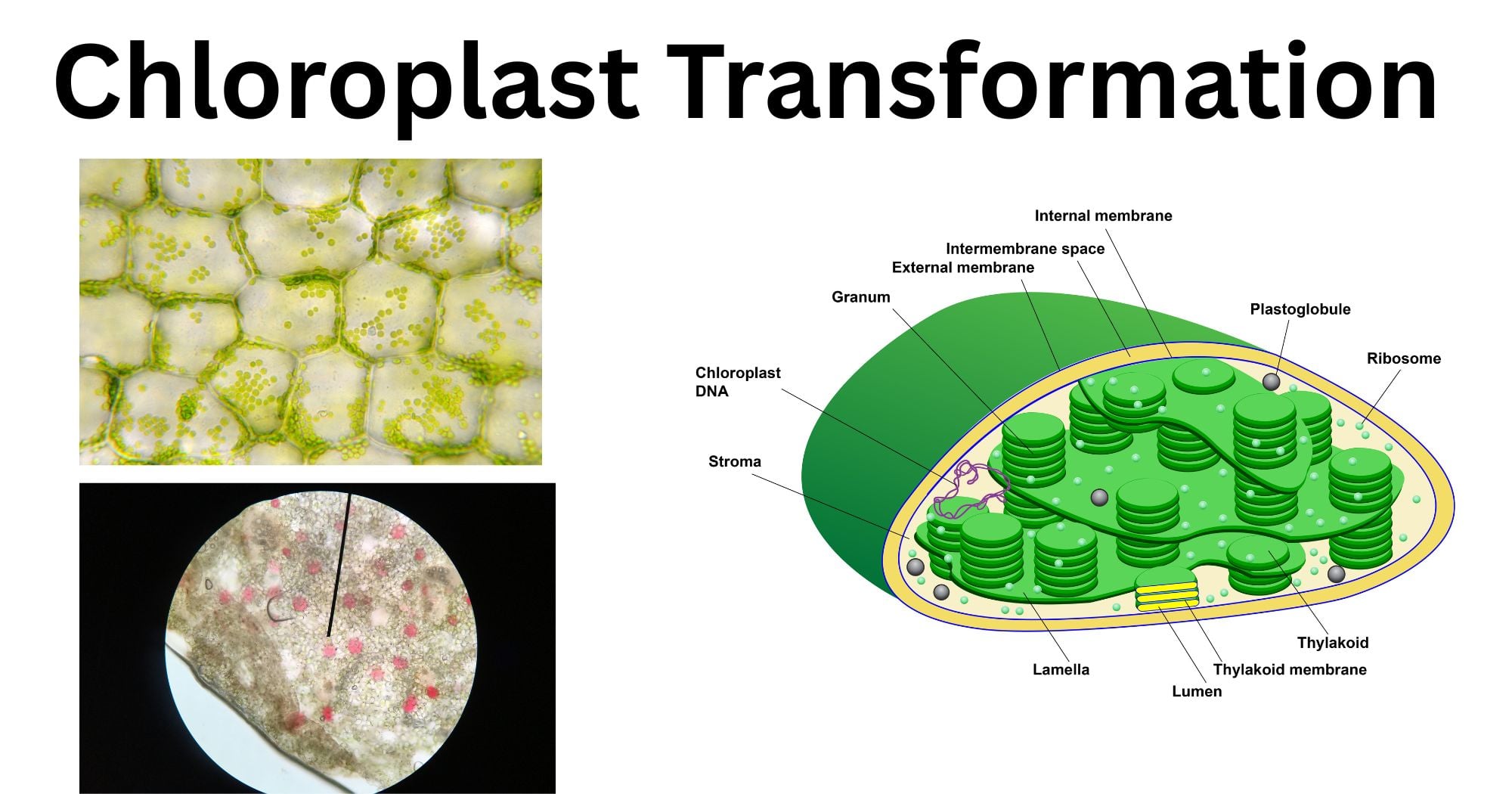
DNA in plants is segregated into three compartments: the nucleus, the chloroplasts, and the mitochondria. Each of these three carries its own genome and expresses traits based on its function. In recent years, the integration of foreign genes into chloroplasts, known as chloroplast transformation, has gained increasing popularity in plant cells.
What is Chloroplast Transformation?
Chloroplast transformation is a process that involves modifying chloroplasts by introducing a new foreign gene.
The method enables high levels of transgene expression without epigenetic or positional effects. It requires a chloroplast-specific vector, a DNA delivery system such as biolistic, and a selection marker like spectinomycin resistance.
What are Chloroplasts?
A chloroplast is a plastid that contains the photosynthetic organelle, chlorophyll, and other pigments in plants and eukaryotic algae.
- Chloroplasts are the precursor for photosynthesis. They are used for processes that require starch production, carbon sequestration, amino acid synthesis, fatty acid metabolism, pigment synthesis, and storage.
- The genetic material in plants is distributed into the nucleus, plastids, and mitochondria. Chloroplasts have their own genome, known as the chloroplast genome (cpDNA), which is responsible for conducting photosynthesis.
- The chloroplast genome (cpDNA) is an essential part of plant metabolism. It encodes several genes for photosynthesis, energy production, and other functions.
- The chloroplast genome is about 110-150 kb, which encodes about 150 genes. Its size varies across the plant species, depending on the size of their genome, structure, and the number of genes. In the case of Arabidopsis thaliana, the chloroplast genome encodes 117 proteins.
- A single plant cell contains up to 300 chloroplasts, depending on the type of cell, with mesophyll cells having the highest number of the organelle.
| Nuclear genome | Chloroplast genome | |
| Chromosomes | Two copies of chromosomes | About 60 copies of a single circular chromosome |
| Genes per chromosome | Could be thousands | 120-150 |
| Transcription | Each gene is separately transcribed | Genes are transcribed together |
Why Chloroplasts for Transformation?
- Chloroplasts have a high copy number inside the plant cells. For this reason, chloroplast transformation exists as an alternative option to nuclear transformation. Higher levels of expression can be achieved from a chloroplast than with nuclear transformation.
- Chloroplasts exist as endosymbionts like mitochondria in the host cell. It possesses prokaryotic transcription and translation machinery. This means that it can express multiple proteins from polycistronic mRNA simultaneously. In contrast to this, eukaryotic machinery is monocistronic, with one expression at a time.
- The ability of gene integration by homologous recombination in chloroplasts is not random like that of nuclear transformation. Its transformation can be used to precisely insert the foreign DNA at a specific site of interest, eliminating position effects.
- In most angiosperms, the chloroplasts (plastids) are maternally inherited. Because of this reason, there is a lower risk of inheriting a transgenic plant.
- The purification of protein in the chloroplast is relatively easier because of its prokaryotic machinery. It has no post-translational machineries and does not glycosylate proteins, which can be optimal for obtaining a few desired proteins.
Difference between chloroplast transformation and nuclear transformation
| Chloroplast transformation | Nuclear transformation |
| Chloroplasts have a high copy number, and as a result, there is higher gene expression. | Nuclear transformation has lower expression levels. |
| It contains a single promoter for the expression of a multi-subunit complex protein. | Several promoters exist with their respective subunits. |
| Since it is prokaryotic, it can simultaneously express several genes. | The eukaryotic system cannot undergo simultaneous expression of several genes. |
| There is reduced gene dispersal with the absence of non-coding regions and site-specific homologous recombination. | There is extensive gene dispersal because of the vast amounts of coding regions. |
Principle of Chloroplast Transformation
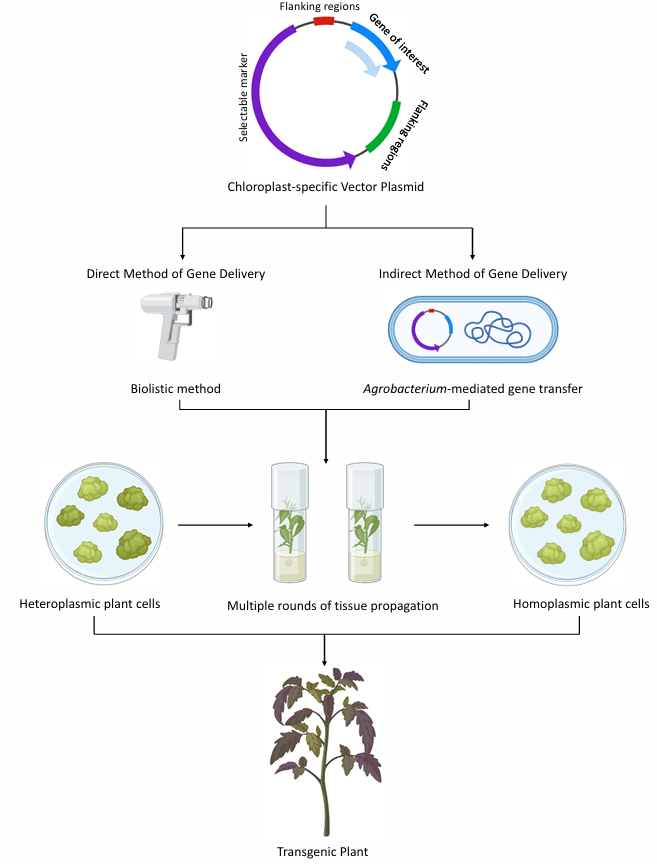
The basis of chloroplast transformation involves inserting foreign DNA into the chloroplast genome (plastome) of a plant. In contrast to nuclear transformation, this technique uses homologous recombination to integrate foreign DNA into a specific site in the chloroplast genome. This is done via the use of chloroplast-specific vectors carrying a gene of interest with a suitable selectable marker. Then the vector can be delivered by the use of the biolistic method (gene gun) or by the use of PEG-mediated transformation, i.e., protoplasts. Then, the plant cells with the required expression are identified and regenerated using plant tissue culture.
What is a Chloroplast Vector?
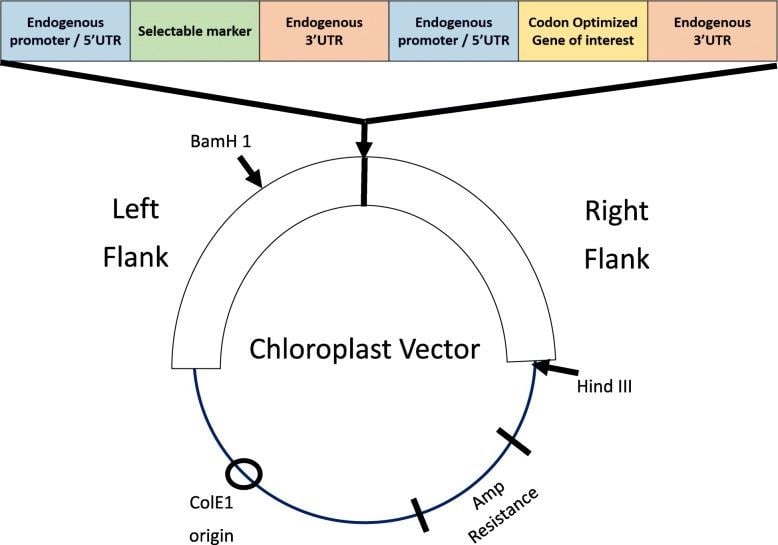
A chloroplast vector mainly comprises the gene of interest flanked by homologous regions complementary to those of the chloroplast genome and a selectable marker gene.
- Gene of interest: The gene of interest is based on the function of the plant after the transformation. It depends on the research and the gene to be expressed in the plant. The foreign gene sequence is flanked by intergenic sites (between 1 and 1.5 kb in size) for transgene incorporation.
- Selectable marker genes: The selectable marker genes are significant for determining if the plant cell has been successfully transformed (positive transformants). One of the most commonly used and efficient marker genes is the aminoglycoside adenylyl transferase (aadA) gene, providing strong dual resistance to the antibiotics spectinomycin and streptomycin. Apart from antibiotic-mediated selection, green fluorescent protein is also used by the integration of gfp gene to fluorescently label the cells in the dark. Other selectable marker genes include npt II, aphA-6, tobramycin, ACC-2, etc.
- 5’ UTR and 3’ UTRs: The vector plasmid also contains 5’ and 3’ regulatory UTR regions for transcription initiation and termination. The 5’ UTR contains a conserved motif, such as the Shine-Dalgarno sequence for ribosomal binding and mRNA stability, whereas the 3’ UTR comprises transcriptional termination machinery for mRNA termination and sites for cleaving polycistronic mRNA’s into monocistronic transcripts for translation.
Chloroplast Transformation Methods
Plant transformations usually involve the use of direct or indirect methods to transfer the desired vector to the target plant. The direct method uses physical or chemical reactions, whereas the indirect method utilizes Agrobacterium-mediated transformation.
Direct gene delivery method: The biolistic method, or particle bombardment method, uses gold/tungsten particles coated with the desired DNA construct at high speed and pressurized gas to transfer the genetic content to the chloroplast. Polyethylene glycol (PEG)-mediated transformation involves the use of the chemical PEG to disrupt the cell membrane and incorporate the plasmid into the chloroplast in protoplasts (plant cells devoid of cell walls).
Indirect gene delivery method: Agrobacterium tumifaciens is the most commonly used vector for plants. It normally transfers genes, called T-DNAs, from the Ti-plasmid to the host cell, causing tumor formation in plants. The Ti-plasmid can be genetically modified, and appropriate genes can be inserted in its place to achieve the desired transformation.
Regeneration of Homoplasmic cells
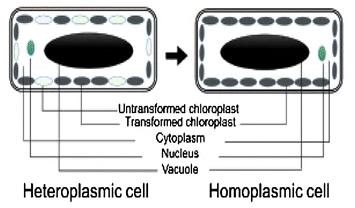
Since each plant cell contains numerous chloroplasts, the transgene is only expressed in a few of them. At this stage, a mixture of transformed and untransformed chloroplasts exists in a single plant cell, a condition termed heteroplasmy. All the chloroplasts inside the plant cells need to have the same genetic constituents, i.e., they need to be in a homoplasmic state. Therefore, several rounds of repeated tissue culture and regeneration are required to recover a stable homoplasmic transcriptomic plant line.
Applications of Chloroplast Transformation
Phytoremediation
Phytoremediation is the process in plants to convert the contaminants or remove them from the environment. Transgenic plants can be used to uptake toxic heavy metal contaminants like mercury through the introduction of chelators such as metallothionein, and enzymes, mercuric ion reductase (merA) and organomercurial lyase (merB). These three components can be integrated into the chloroplast genome and allowed to be expressed. Such an intervention has been performed in transgenic tobacco plants.
Plant vaccine production
The antigen (ag) of the virus can be inserted and transferred into the chloroplast for inexpensive and large-scale production of plant-based vaccines. Plant-based vaccines require no maintenance of the cold chain and is highly efficient for administering vaccines in remote areas. Furthermore, the post-translational modification in the chloroplast is much easier in the chloroplast than in the nucleus. One of the most successful plant-based vaccines is the synthesis of Cholera Toxin B antigen to target the pathogen, Vibrio cholerae.
Abiotic and biotic stress tolerance
Plants are faced with increasing biotic and abiotic stresses like pathogens, drought, salinity, etc., which detrimentally impact the crop yield. Chloroplast transformation can be used to introduce stress tolerance genes into the plants, mitigating such stresses. The first successful chloroplast transformation was in eggplant and carrot, in which the betaine aldehyde dehydrogenase (BADH) gene was inserted to tolerate high salinity.
A few of the crop plants that have been transformed using chloroplast transformation are:
| Crop Plant | Transgene expressed | Purpose |
| Tobacco (Nicotiana tabacum) | cry1Ac and cry2Aa2 | Resistance against Lepidopteran pests |
| Maize (Zea mays) | bar (phosphinothricin acetyltransferase) | Herbicide resistant |
| Tomato (Solanum lycopersicum) | accD and psbA (photosynthesis and fatty acid synthesis) | Enhanced photosynthetic ability |
| Tobacco (Nicotiana tabacum) | HPT, TCY, TMT | Biosynthesis of vitamin E |
Limitations of Chloroplast Transformation
Chloroplast transformation is a decade-old concept; however, only a few successful transformations have been reported in plants. There are many challenges with chloroplast transformation, which are as follows:
- Limited range of target plant species: Chloroplast transformation is difficult in most monocots, such as rice, wheat, maize, etc., because of the unavailability of selectable marker systems and species-specific flanking sequences. Similarly, homologous recombination is not well-characterized in many plants. Therefore, species-specific protocols are essential for the technique.
- Selection of homoplasmic cells: Homoplasmic plant cell lines need to be extensively propagated and regenerated, which can be time-consuming and difficult.
- Maternal Inheritance: Maternal inheritance of chloroplasts is advantageous to contain the transgene in the offspring; however, its limitations lie in breeding. The transgenes are difficult to breed into other lines.
- Limited expression in non-green tissues: Since chloroplasts mainly reside in the leaves of the plant, their expression is either absent or minimal in roots, seeds, and other non-green tissues.
- Pleiotropic effects in transformed plants: The transformed plants have irregular abnormalities such as infertility, reduced growth, absence of flowering, yellowing of leaves, and many more.
References
- Adem, M., Beyene, D., & Feyissa, T. (2017). Recent achievements obtained by chloroplast transformation. Plant Methods, 13(1), 30. https://doi.org/10.1186/s13007-017-0179-1
- Kumar, A. U., & Ling, A. P. K. (2021). Gene introduction approaches in chloroplast transformation and its applications. Journal of Genetic Engineering & Biotechnology, 19, 148. https://doi.org/10.1186/s43141-021-00255-7
- Narra, M., Nakazato, I., Polley, B., Arimura, S., Woronuk, G. N., & Bhowmik, P. K. (2025). Recent trends and advances in chloroplast engineering and transformation methods. Frontiers in Plant Science, 16, 1526578. https://doi.org/10.3389/fpls.2025.1526578
- Ruf, S., Kroop, X., & Bock, R. (2021). Chloroplast Transformation in Arabidopsis. Current Protocols, 1(4), e103. https://doi.org/10.1002/cpz1.103
- Verma, D., & Daniell, H. (2008). Chloroplast Vector Systems for Biotechnology Applications. Plant Physiology, 145, 1129–1143. https://doi.org/10.1104/pp.107.106690
- Zhang, C., Li, W., Wu, Y., Li, S., Hua, B., & Sun, H. (2025). Chloroplast Functionality at the Interface of Growth, Defense, and Genetic Innovation: A Multi-Omics and Technological Perspective. Plants, 14(6), Article 6. https://doi.org/10.3390/plants14060978
