
Vaccines are substances that train or activate the immune system to fight against a certain disease against which it has not previously come into contact. Vaccine production is a difficult process and requires a large amount of investment for manufacturing and delivery, especially in underdeveloped or developing countries. In contrast, edible plant-based vaccines are cheaper, relatively easier to administer, and have superior temperature stability.
What are Plant-Based Vaccines?
Plant-based vaccines are recombinant protein subunit vaccines that are expressed in plants. They function by isolating a specific protein antigen in plants and eliciting the response in humans. Plant-based vaccines are far cheaper and more efficient than traditional vaccination techniques.
In 1989, Hiatt and his co-workers attempted to produce vaccines using plants. Then, Dr. Arntzen and his colleagues brought the concept of utilizing transgenic plants to produce the first vaccine in tobacco plants. Presently, over 200 proteins have been developed in plants, which could lead to a promising future for plant-based vaccines.
Principle of Plant-Based Vaccines
The plant-based vaccine is developed by inserting the desired gene of interest into a vector (bacteria or virus) and infecting the plant cells. The plant cells then develop an antigen protein. This expressed antigen is extracted, engineered, and developed as a vaccine. This vaccine can then be used to elicit an immune response in humans or animals.
Production of Plant-Based Vaccines
The production of plant-based vaccines primarily involves the integration of a transgene, an artificially produced gene, into the plant cells. Firstly, a vector (bacteria) is integrated with the desired gene sequence. Then the bacteria are injected into the plant cell. Depending on the location of the inserted transgene, the transgene can be manifested in two ways:
- Stable transformation (by nuclear or plasmid): Stable transformation refers to the unchangeable modifications made in the host plant cells.
- Transient transformation: Transient transformation refers to when the transgene remains temporarily in the host plant, i.e., the modified genome is not incorporated into the plant genome. Whole-plant regeneration is not required, and protein expression is higher.
Researchers commonly use two delivery methods for achieving expression in plants, which are the direct delivery method (biolistic method) and Agrobacterium-mediated transformation (indirect method).
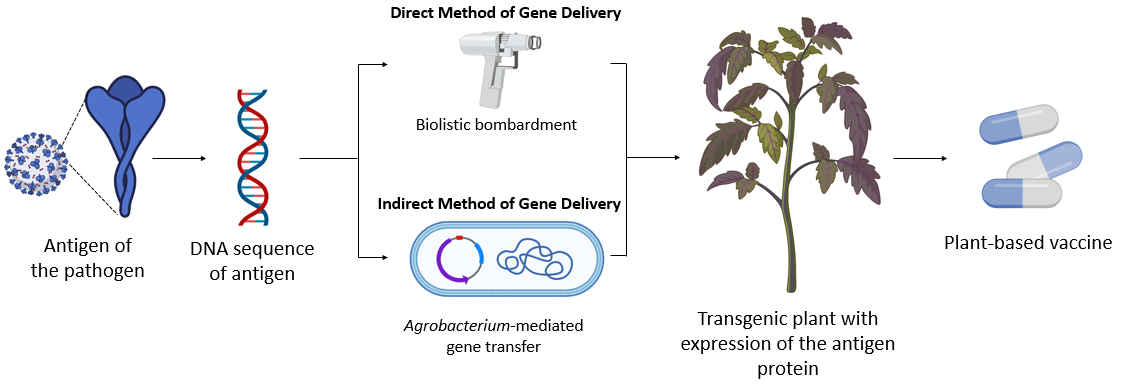
Methods for Production of Plant-Based Vaccines
Direct Gene Delivery Method
The direct gene delivery method involves the quick and precise projection of genetic materials directly into the plant tissues/cells. The biolistic approach and chloroplast transformation are a few popular examples of a direct gene delivery method.
Biolistic method
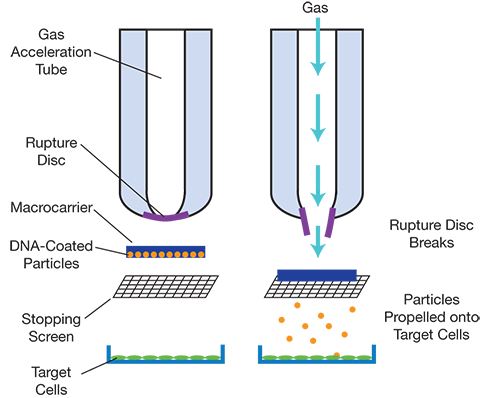
- The biolistic method, also known as microprojectile bombardment or the gene gun method, is a vector-independent method used to directly inject genetic materials into the target plant.
- It involves the use of gold or tungsten particles infused with DNA for swift delivery.
- The device shoots these particles at high velocity and pressure.
- Then the DNA gets incorporated once it comes in contact with the plant cell.
- The method requires no vectors but an expensive projectile device and may heavily destroy the plant tissue.
Indirect Gene Delivery Method
The indirect gene delivery method involves the use of Agrobacterium species to infect the plant cells and generate a transgenic plant. This method has better efficacy than the direct delivery method in vaccine production.
Agrobacterium-Mediated Gene Transfer
- Agrobacterium, often called nature’s genetic engineer, is a gram-negative bacterium initially discovered as the cause of crown gall disease in plants. The infection of Agrobacterium has beneficial properties essential for initiating infection and the development of tumors.
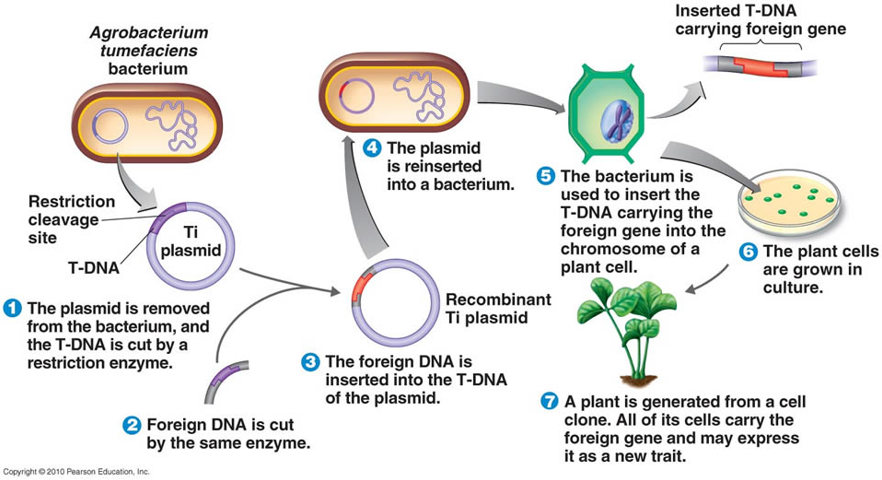
- Agrobacterium tumefaciens is commonly used as a biological vector for plants. It transfers genes, known as T-DNAs, from the Ti-plasmid to the host cell.
- The Ti-plasmid of the bacterium can be genetically modified, and appropriate genes can be inserted into its sequence.
- In plant-based vaccine production, the antigen of the virus can be inserted and transferred into the plants by the use of Agrobacterium infection.
- Then the plants will express the specified antigen for large-scale production.
Agroinfiltration
- Agroinfiltration is a method to induce the temporary expression of genes in a plant, its organs, and even cultured tissues.
- This is done by using a syringe called syringe agroinfiltration or by submerging the leaves in an infiltration buffer called vacuum infiltration.
- The former method is simpler and far cheaper than the latter.
Chloroplast Transformation
- Chloroplast transformation is a popular method to express the antigen in transgenic plants. The desired gene of interest is delivered into the chloroplasts of the plant cells. This can be achieved through direct or indirect methods.
- The chloroplast, consisting of 100-250 genes, is smaller than the nuclear genome and can easily create proteins without modified gene crossing via pollen grains.
- It is inexpensive and has a rapid production rate due to its high duplication number in the plant cells.
Applications of Plant-Based Vaccines
- Infectious Disease Prevention: Pharmaceutical companies use plants like Nicotiana benthamiana (a tobacco relative) to produce virus-like particles for human diseases. Example targets: COVID-19, influenza, and norovirus.
- Veterinary Medicine: Plant-based vaccines protect livestock and poultry. Example: Treatments for Newcastle disease in birds and foot-and-mouth disease in cattle.
- Needle-Free Administration: Development of edible vaccines that can induce immunity through oral administration. Example: Eating bananas and potatoes carrying antigens delivers the vaccine directly to the gut mucosa and stimulates a localized immune response.
- Autoimmune Disease Management: Plant-produced autoantigens can be administered orally to induce immune tolerance.
- Cancer Immunotherapy: Development of personalized vaccines, such as patient-specific cancer vaccines.
- Production of recombinant vaccine antigens, virus-like particles (VLPs), and monoclonal antibodies for immunization.
- Rapid production of vaccines during disease outbreaks and pandemics.
- Development of multivalent vaccines that protect against multiple pathogens simultaneously.
- Development of next-generation vaccines against neglected tropical diseases and antimicrobial-resistant pathogens.
- Production of low-cost vaccines for use in low- and middle-income countries.
Advantages of Plant-Based Vaccines
- Reduced manufacturing costs: Plant-based vaccines significantly decrease vaccine manufacturing costs. Plants are inexpensive and easier to grow in large-scale greenhouses. Moreover, no special reagents or laboratory setting is required for plant growth, immensely decreasing their costs.
- Eliminate cold chains: Vaccines often require a stable maintenance of cold temperatures. On the other hand, plant-based vaccines require no such cold chains. This is one of the main benefits of transferring vaccines in rural areas.
- Easy administration: Most plant-based vaccines are made to be administered orally, i.e., edible. This is more convenient, and needless injection administration can be avoided.
- Comparable post-translational modifications: The post-translational modifications, protein folding, and assembly of proteins produced in plants are comparable to those of animal cells. This is essential for immunogenicity.
- Environment-friendly: As plants utilize the solar energy and capture CO2 for their well-being, they are an environmentally friendly production system for recombinant protein. Moreover, the plants require little to no special additional reagents.
- Therapeutic usage: These vaccines are also good for therapeutic purposes. To elaborate, the US Food and Drug Administration (FDA) approved a therapeutic enzyme for Gaucher disease in 2012, produced by carrots. This plant enzyme was found to be better than the one made with animal cells.
Limitations of Plant-Based Vaccines
- Edible plant-based vaccines may cause allergic reactions because the antigen itself is expressed in plants. They might have varying post-translational modifications such as glycosylation, which can hamper immunogenicity.
- Plant-based vaccines can be costly, with the infrastructure requirement for downstream processing and purification.
- There is a risk of transgenic plants escaping the lab, causing a myriad of problems. Transgenic plants might be consumed by other animals if left unchecked. A robust biosafety system needs to be maintained.
- Selection of the antigen and the right plant expression host can be challenging, as not all transgenic plants are compatible with one specific antigen.
- Researchers must maintain a consistent dosage, as the expression of transgenic plants may differ from one plant to another. If left unchecked, the patient may suffer heavy losses.
- Producing plant-based vaccines according to Good Manufacturing Practice (GMP) may be difficult. They require fermenters and sterile conditions to ensure GMP compliance. An enclosed greenhouse might be difficult to maintain.
Plant-based vaccines in clinical trials phase
There are several plant-based vaccines in the clinical trials phase. They are as follows:
| Host | Pathogens or disease | Antigen | Plant | Expression system | Administration route |
| Human | Norovirus | Capsid protein | Potato | Transgenic | Oral |
| Human | Hepatitis B virus | Viral major surface protein | Lettuce | Transgenic | Oral |
| Human | Influenza virus (H5N1) | HA | Nicotiana benthamiana | Launch vector (transient) | Intramuscular |
| Human | Cholera | CTB | Rice | Transgenic | Oral |
| Chicken | Newcastle disease | Hemagglutinin-neuraminidase | Tobacco suspension cells | Transgenic | Subcutaneous |
| Pig | ETEC | Fimbriae (F4) | Tobacco | Chloroplast transformation | Oral |
Conclusion
The usage of plant-based vaccines offers numerous advantages, making them an attractive alternative in a rapidly growing world. In developing countries, where vaccine production is costly, this technique significantly reduces expenses.
Plant-based vaccines eliminate the need for cold-chain stabilization, further enhancing their accessibility. There are a few unavoidable risks, like infection from transgenic plants to animals or even humans. More research is essential to optimize and implement this technology for safe, commercial use.
References
- Biolistic Transformation—An overview | ScienceDirect Topics. (n.d.). Retrieved May 11, 2025, from https://www.sciencedirect.com/topics/immunology-and-microbiology/biolistic-transformation
- Demirer, G. S., & Landry, M. P. (2017). Traditional methods of gene delivery to plants are labor- and time-intensive, are suitable for only a small number of hosts, and have high toxicity and limited practical applicability. This article discusses how nanoparticle-based approaches could enable efficient gene transfer into plants.
- jamiepighin. (2006, August 20). TRANSGENIC CROPS: HOW GENETICS IS PROVIDING NEW WAYS TO ENVISION AGRICULTURE | SCQ. https://www.scq.ubc.ca/transgenic-crops-how-genetics-is-providing-new-ways-to-envision-agriculture/
- Kumar, A. U., & Ling, A. P. K. (2021). Gene introduction approaches in chloroplast transformation and their applications. Journal of Genetic Engineering & Biotechnology, 19, 148. https://doi.org/10.1186/s43141-021-00255-7
- Plant-based Vaccine Design Services—Creative Biolabs. (n.d.). Retrieved May 11, 2025, from https://www.creative-biolabs.com/vaccine/plant-based-vaccines.htm
- Plant-based COVID-19 vaccine enters Phase I trials. (n.d.). European Pharmaceutical Review. Retrieved May 11, 2025, from https://www.europeanpharmaceuticalreview.com/news/124092/plant-based-covid-19-vaccine-enters-phase-i-trials/
- Rosales-Mendoza, S., Nieto-Gómez, R., & Angulo, C. (2017). A Perspective on the Development of Plant-Made Vaccines in the Fight against Ebola Virus. Frontiers in Immunology, 8, 252. https://doi.org/10.3389/fimmu.2017.00252
- Sala, F., Manuela Rigano, M., Barbante, A., Basso, B., Walmsley, A. M., & Castiglione, S. (2003). Vaccine antigen production in transgenic plants: Strategies, gene constructs and perspectives. Vaccine, 21(7), 803–808. https://doi.org/10.1016/S0264-410X(02)00603-5
- Takeyama, N., Kiyono, H., & Yuki, Y. (2015). Plant-based vaccines for animals and humans: Recent advances in technology and clinical trials. Therapeutic Advances in Vaccines, 3(5–6), 139–154. https://doi.org/10.1177/2051013615613272
