
Whole genome duplication, or polyploidy, is a product of non-disjunction during meiosis, which results in additional copies of the entire genome. The process might be evolutionarily beneficial for the organism or detrimental.
- Polyploidy is common in plants; in animals, it has occurred at least two times during early vertebrate evolution.
- The event generates many additional sets of genes, which are occasionally lost, returning to the default genome state. However, there are a few genes, like the Hox genes, which retain and develop into an adaptive state.
Discovery of Whole Genome Duplication
- In 1997, Wolfe and Shields discovered gene duplication in the genome of Saccharomyces cerevisiae (yeast).
- They found numerous homologues located at different regions in 32 pairs of yeast chromosomes. With these observations, they determined that the present yeast underwent whole genome duplication, splitting from Kluyveromyces, a genus of ascomycetous yeast.
- The yeast genome duplication occurred about 108 years ago.
- With time, the genes were lost or became non-functional. The duplicated chromosomes became fragmented, generating the current homologous chromosomal regions.
Mechanism of Gene Duplication
Whole-genome duplication normally occurs because of a failure in cell division during meiosis or mitosis, in which the chromosome fails to segregate properly. This results in additional copies of the entire genome.
The following are the mechanisms of whole-genome duplication or gene duplication:
Ectopic recombination
Ectopic recombination refers to the crossing-over event between homologous DNA sequences that are not located at the same position on homologous chromosomes. This kind of recombination occurs in dramatic chromosomal rearrangement, which can often be harmful to the organism. However, in some conditions, it might be beneficial as it results in gene duplication. Ectopic recombination can occur in mitosis and meiosis.

Replication slippage
Slipped-strand mispairing (SSM) is a mutation that occurs during DNA replication. During replication, the enzyme that copies the DNA, DNA polymerase, dissociates from the DNA and halts. Once the polymerase reattaches to the DNA, it does so in an incorrect position and copies the same section more than once. Replication slippage mainly occurs with tandem repeats, sequences of repetitive nucleotides. These repetitive sequences are unstable, leading to frequent insertions and deletions of nucleotides. This instability causes certain genes to be duplicated.

Retrotransposition
Retrotransposons are mobile elements that randomly move in the host genome by reverse transcription of RNA into DNA. These sequences amplify themselves and become abundant in eukaryotic genomes. The retrotransposons create retrogenes, which lack introns and contain poly-A sequences that are integrated into the genome. Because of these reasons, many retrogenes bring about changes in gene regulation, resulting in novel functions.
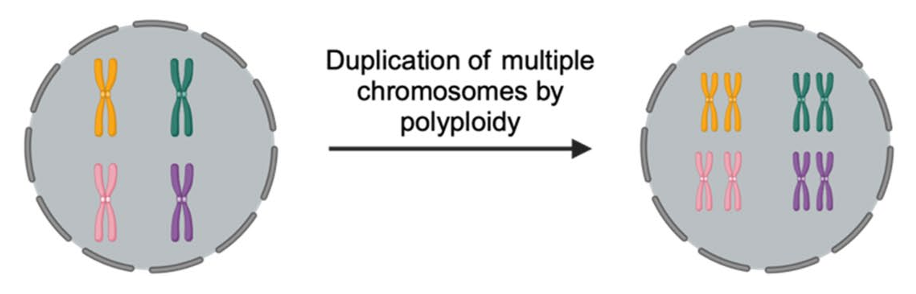
Polyploidy
In meiosis, the homologous pair of chromosomes fails to separate into individual elements. Both copies are then transferred to the offspring, generating extra copies of the genome in a single organism. After the duplication event, the genome becomes unstable with extensive gene loss, elevated levels of mutation, and frequent network rewiring.
Most of the extra gene copies are lost; however, a considerable amount still survives, with a few being non-functional pseudogenes. Apart from these, the duplicated genes can undergo either neofunctionalization or sub-functionalization.
- Neofunctionalization: The duplicated genes accumulate mutations more rapidly than their functional counterparts. These genes might develop a novel function with selective pressure throughout several generations. This process is known as neofunctionalization. To elaborate, the presence of duplicated genes means more transcription of these genes, with rapid evolution of protein phosphorylation motifs.
- Sub-functionalization: Another possible fate of genomic duplication is that both copies of genes equally accumulate degenerative mutations. This results in the distribution of function in two copies with no beneficial or detrimental effects. Therefore, both of the genes become essential for the organism, and neither can achieve a novel functionality. However, in some cases, the copies may provide an adaptive benefit.
Whole Genome Duplication in Evolution
Genome diversity
Whole genome duplication can significantly enhance an organism’s genomic diversity. The increase in gene quantity can lead to substantial cellular changes in gene expression and cell size. This process can result in both long-term and short-term evolutionary effects in the natural environment.
Speciation
In polyploidy, the offspring possess a varying number of chromosomes compared to the parental species. For this reason, they become unable to interbreed with non-polyploid organisms. Polyploids can undergo a myriad of genetic changes, including deletion, pseudogenization, neofunctionalization, or sub-functionalization of duplicated genes. These organisms may acquire adaptive traits in response to environmental selective pressure and, over thousands of years, can give rise to a novel species.
The 2R Hypothesis
- In 1970, a Japanese evolutionary biologist and geneticist, Susumu Ohno, proposed that there are two rounds of WGD events in the origin of vertebrates, known as the two-round (2R) hypothesis. The duplication events occurred between 550 and 450 million years ago.
- The hypothesis was based on the comparison of genomic sizes (4:1 gene copies) and karyotypes in numerous organisms, especially in fishes and amphibians, as tetraploid species naturally occur in them.
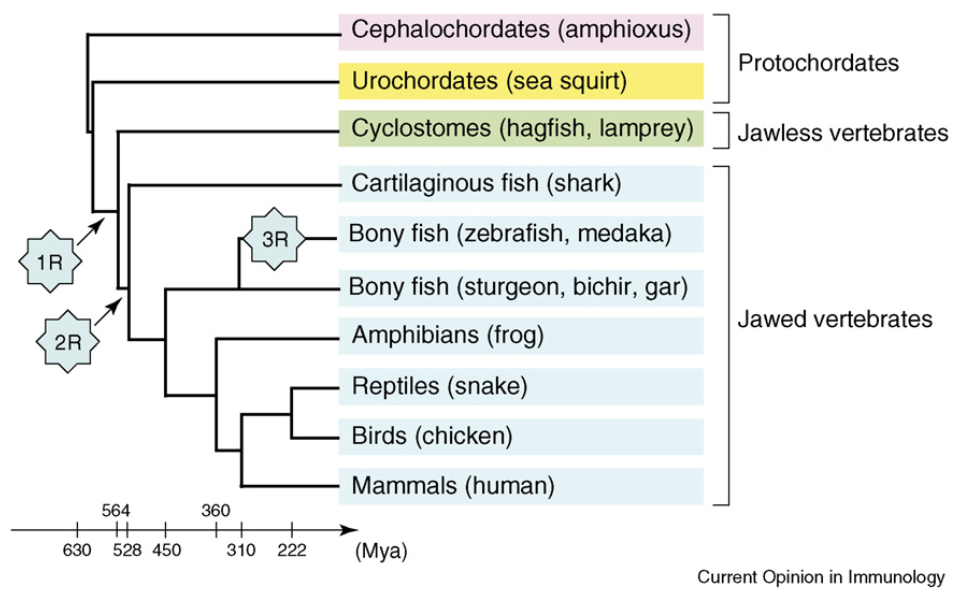
- The genome of the early vertebrate lineage underwent two complete genome duplications after the emergence of urochordates and before the evolution of jawed vertebrates.
- This suggests that the 1st round of WGD occurred in the common ancestor of jawed and jawless vertebrates (hagfish and lampreys), and subsequently the 2nd in the common ancestor of jawed vertebrates.
- This is indicated by the HOX gene clusters in the sea lamprey. To elaborate, the cephalochordate amphioxus has only a single HOX gene cluster in a single chromosome, whereas humans have four located in varying chromosomes. Other genes adjacent to the cluster are also quadruplicated, suggesting that the genes underwent two rounds of duplication events.
- Since the entire genome is replicated, the organism develops a set of genes with novel functions, including those related to immunity.
- The Major Histocompatibility Complex (MHC) is an essential genetic region in vertebrates that encodes molecules responsible for presenting peptide fragments from pathogens to T cells. WGD can induce multiple copies of the MHC genes, developing new or specialized functions for both MHC class I and class II. This enhances the immune system’s complexity.
Occurrence of Whole Genome Duplication
The occurrence of polyploidy is common in plants, making their genome exceedingly larger than those of other organisms. The vertebrate lineage went through two rounds of WGD (2R) and a third round, known as the teleost-specific genome duplication (TSGD), to teleost fishes (3R).
| Organism/Group | Occurrence of WGD |
| Saccharomyces cerevisiae (Yeast) | One round |
| Vertebrates Lineage | Two rounds (1R, 2R) |
| Teleost fishes | One round (3R) |
| Zea mays (Maize) | Two rounds |
| Arabidopsis thaliana | Three rounds |
| Triticum aestivum (Wheat) | Three rounds |
References
- 18.4C: Whole-Genome Duplication. (2018, July 13). Biology LibreTexts. https://bio.libretexts.org/Bookshelves/Introductory_and_General_Biology/General_Biology_(Boundless)/18%3A_Evolution_and_the_Origin_of_Species/18.04%3A_Evolution_of_Genomes/18.4C%3A_Whole-Genome_Duplication
- Anatskaya, O. V., & Vinogradov, A. E. (2021). Whole-Genome Duplications in Evolution, Ontogeny, and Pathology: Complexity and Emergency Reserves. Molecular Biology, 55(6), 813–827. https://doi.org/10.1134/S0026893321050022
- Crow, K. D., & Wagner, G. P. (2006). What Is the Role of Genome Duplication in the Evolution of Complexity and Diversity? Molecular Biology and Evolution, 23(5), 887–892. https://doi.org/10.1093/molbev/msj083
- Inoue, J., Sato, Y., Sinclair, R., Tsukamoto, K., & Nishida, M. (2015). Rapid genome reshaping by multiple-gene loss after whole-genome duplication in teleost fish suggested by mathematical modeling. Proceedings of the National Academy of Sciences, 112(48), 14918–14923. https://doi.org/10.1073/pnas.1507669112
- Rabier, C.-E., Ta, T., & Ané, C. (2014). Detecting and Locating Whole Genome Duplications on a Phylogeny: A Probabilistic Approach. Molecular Biology and Evolution, 31(3), 750–762. https://doi.org/10.1093/molbev/mst263
- Tasnim, M., Wahlquist, P., & Hill, J. (2024). Zebrafish: Unraveling genetic complexity through duplicated genes. Development Genes and Evolution, 234, 99–116. https://doi.org/10.1007/s00427-024-00720-6
- Yu, D., Ren, Y., Uesaka, M., Beavan, A. J. S., Muffato, M., Shen, J., Li, Y., Sato, I., Wan, W., Clark, J. W., Keating, J. N., Carlisle, E. M., Dearden, R. P., Giles, S., Randle, E., Sansom, R. S., Feuda, R., Fleming, J. F., Sugahara, F., … Pascual-Anaya, J. (2024). Hagfish genome elucidates vertebrate whole-genome duplication events and their evolutionary consequences. Nature Ecology & Evolution, 8(3), 519–535. https://doi.org/10.1038/s41559-023-02299-z
