
Phytohormones or plant hormones are the organic substances formed in minute amounts by plants that have a key function in growth and developmental responses to environmental stimuli in plants.
They are not secreted by endocrine glands as in the case of animal hormones but are synthesized in several tissues. They function as signal molecules inducing cell division, elongation of cells, differentiation of cells, flowering, fruiting, and stress response.
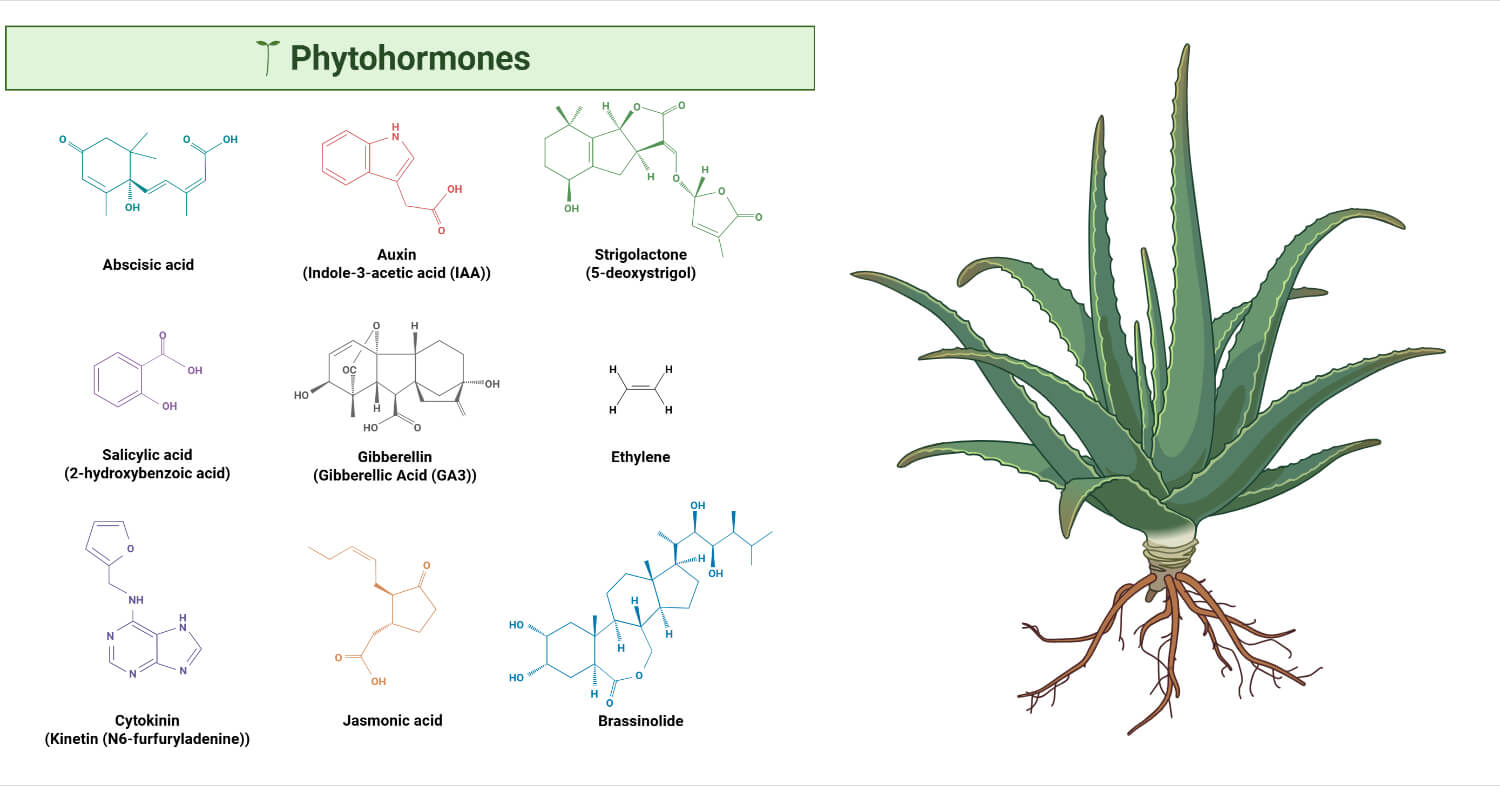
Types of phytohormones
There are various types of phytohormones in plants including auxins, gibberellins, cytokinins, ethylene, abscisic acid, brassinosteroids, jasmonates, salicylic acid, and strigolactones. They are elaborated below:
1. Auxins
Auxins are a group of phytohormones of the Indole category and naturally exist as Indole-3-acetic acid (IAA). Auxins are primarily synthesized in the tips of roots and shoots, young leaves, and germinating seeds. Auxins are internally transported in the plant by means of polar transport, which aids in forming connection gradients that regulate several processes of growth. Synthetic auxins like 2, 4- Dichlorophenoxyacetic acid and Naphthalene acetic acid (NAA), are used extensively in agriculture and horticulture.
Functions of auxin
- Cell elongation– Auxins induce cell elongation by stimulating the plasma membrane proton pumps which in turn stimulate expansin protein that loosens the cell wall so that it can expand, this activity is essential for the elongation of the stem.
- Apical dominance– Auxins cause apical dominance. It is a process in which the development of the main shoots’ apical bud prevents the development of lateral buds. Auxin formed at high levels at the shoot tip inhibits the outgrowth of axillary buds.
- Root initiation– Auxins induce adventitious root formation and are employed in cuttings. The use of synthetic auxins on cuttings promotes root initiation.
- Tropism– Tropisms which are growth responses in a specific direction to environmental stimuli like light, gravity, etc. are caused by auxins.
- Vascular tissue differentiation– Vascular tissue differentiates because of auxin which results in the development of continuous vascular strands that transport water, minerals, and nutrients in an efficient manner all over the plant.
- Parthenocarpy– The development of seedless fruits is also caused by auxins.
2. Gibberellins
Gibberellins or gibberellic acids are a class of phytohormones of the diterpenoid group. There are more than 100 gibberellins but few are known to perform functions. They are synthesized mainly in young leaves, roots, seeds, and young fruits and transported by vascular bundles.
Functions of gibberellins
- Stem elongation– Gibberellin is accountable for stem elongation. It induces cell division and elongation in stem internodes. This is usually observed in dwarf plants with genetically shorter internodes where the exogenous application of these hormones can reinstate normal height.
- Breaking dormancy– Gibberellins are accountable for breaking seed dormancy and inducing germination. It initiates the formation of α-amylase that hydrolyzes starch reserves in endosperm that supplies energy for the developing embryo.
- Induce flowering– Gibberellins induce flowering in some long-day plant species. In rosette plants, gibberellins induce bolting, which is a sudden extension of the flowering stem.
- Gibberellins control fruit growth and also may induce parthenocarpy in certain species.
3. Cytokinins
Cytokinins are plant phytohormones that stimulate cell division in the shoots and roots of plants. Zeatin is the best-known natural cytokinin, and kinetin and benzylaminopurine (BAP) are the synthetic ones. Cytokinins are produced primarily in root tips and move to the rest of the plant via the xylem.
Roles of Cytokinins
- Cell division– Cytokinins promote cell growth and division, particularly in shoots and roots.
- Delays senescence– Cytokinins slow down leaf senescence (aging) by enhancing the mobilization of nutrients and chlorophyll retention.
- Reverse apical dominance– Cytokinins work in contrast to auxins to reverse apical dominance, which promotes the outgrowth of lateral buds.
- Increases photosynthesis– Cytokinins facilitate the maturation of chloroplasts and thereby increase photosynthesis.
4. Ethylene
Ethylene is a gaseous phytohormone that is synthesized in almost all plant tissues, especially during senescence, fruit ripening, and stress conditions. It is synthesized from methionine amino acid through the intermediate 1-aminocyclopropane-1-carboxylic acid (ACC).
Functions of Ethylene
- Fruit ripening– Ethylene triggers fruit ripening by accelerating the processes of cell wall softening, color changes, and flavor maturation.
- Triggers senescence– Ethylene triggers flower and leaf abscission and senescence.
- Stress responses– Ethylene is produced under stressful situations (pathogen infection, flood, drought), and it acts as a signal for adaptive responses.
- In etiolated seedlings, ethylene causes a triple response i.e. horizontal growth, reduced growth, and radial swelling.
5. Abscisic Acid (ABA)
Abscisic acid (ABA) is a sesquiterpenoid phytohormone that occurs in the majority of plant tissues, particularly in seeds and mature leaves. Abscisic acid has a role in seed dormancy and stress responses.
Functions of Abscisic Acid
- Increase seed dormancy– Abscisic acid keeps seed dormant in unfavorable conditions by inhibiting germination.
- Stomatal closure– Abscisic acid regulates stomatal closure in water stress conditions, which decreases water loss.
- Abscisic acid accumulates in drought and salinity stress, which reduces plant death.
- The abscisic acid is generally a growth inhibitor that decreases the rate of elongation and cell division.
6. Brassinosteroids
Brassinosteroids are polyhydroxysteroid-like structurally related steroid hormones in animals. They are present ubiquitously in the plant, especially in pollen, seeds, and juvenile vegetative tissues.
Functions of Brassinosteroids
- The brassinosteroids are responsible for cell elongation and division, which cause stem and root growth.
- They assist in vascular tissue differentiation, enhancing nutrient as well as water transport.
- Brassinosteroids enhance plant resistance to abiotic stresses such as temperature stress, salinity stress, and pathogen infection.
- They regulate flowering and seed formation.
7. Jasmonates
Jasmonates, including jasmonic acid and its derivatives, are lipid-derived messengers that are synthesized upon sensing abiotic and biotic stress.
Functions of Jasmonates
- Jasmonates trigger defense responses against pathogens and herbivores and lead to the formation of protective chemicals.
- They regulate flower formation and pollen maturation.
- Jasmonates inhibit root growth and induce senescence under stressful conditions.
8. Salicylic Acid
Salicylic acid is a phenolic phytohormone that plays a role in plant defense and systemic acquired resistance (SAR).
Functions of salicylic acid
- Salicylic acid induces defense gene-associated pathways and genes, increasing resistance against pathogens.
- Salicylic acid encourages heat production in flowers in certain plants to attract pollinators.
- It controls the process of growth and development.
9. Strigolactones
Strigolactones are phytohormones derived from carotenoids, produced in roots, and transported by xylem vessels.
Function of Strigolactones
- Strigolactones inhibit axillary bud growth, aiding in apical dominance.
- They stimulate arbuscular mycorrhizal fungal hyphal branching to facilitate nutrient uptake in a symbiotic association with plants.
- Strigolactones stimulate germination in seeds of parasitic plants.
10. Peptide and Small-Molecule Hormones
- Apart from the classical plant hormones, recent findings have discovered peptide and small-molecule hormones, which play vital signaling molecules during plant growth, development, and defense.
- These include Systemin, Phytosulfokine (PSK), CLAVATA3 (CLV3), and rapid alkalinization factors (RALFs).
- Peptide hormones typically function through receptor-like kinases (RLKs) on the plasma membrane. They are involved in cell-to-cell signaling and play significant roles in such processes as meristem maintenance, root and shoot patterning, and defense responses.
- Small-molecule hormones like strigolactones and nitric oxide also contribute specialized signaling activities toward environmental adaptation and growth. The novel hormones add more complexity and specificity to plant signaling pathways, making physiological responses more accurate.
Hormone Crosstalk
- Plant hormones do not act in solos; instead, their action occurs by a complex system of crosstalk. Cytokine and hormonal crosstalk enable plants to attain coordinated growth, development, and defense in a dynamic environment.
- Auxins and cytokinins, for example, act antagonistically in shoot and root development.
- Similarly, gibberellins and abscisic acid act antagonistically in seed germination, in which gibberellins induce and ABA inhibits the process.
- Ethylene tends to cross-talk with jasmonates and salicylic acid in defense reaction modulation against pathogens.
- Crosstalk allows for the integration of internal developmental signals with external stress cues, facilitating maximum resource reallocation for survival vs. growth.
- Deciphering hormone crosstalk is key to deciphering the intricacy of adaptive plant responses and engineering hormone networks for crop development.
Agricultural Applications
- Plant hormones and their synthetic analogs find extensive use in agriculture and horticulture to promote growth, yield, and stress tolerance in plants.
- Auxins cause root formation in cuttings and control of fruit drop. Synthetic auxins like 2,4-D are applied as herbicides for the selective killing of broadleaf weeds.
- Gibberellins are used to promote fruit enlargement, stimulate seed germination, and break seed dormancy in crops.
- Cytokinins prevent senescence and are used to maintain post-harvest freshness of vegetables and cut flowers.
- Ethylene-releasing agents like ethephon are used to induce uniform ripening of fruit.
- The abscisic acid analogs are under investigation as agents to enhance drought tolerance.
- Precise use of these growth regulators allows farmers to regulate plant physiology according to the needs of agriculture, achieving higher productivity and crop quality.
Recent Advances and Future Perspectives
- Recent advances in molecular biological, genomic, and synthetic biology have significantly enhanced our understanding of phytohormone biosynthesis, signaling circuits, and interactions.
- CRISPR/Cas9 genome editing, transcriptome analysis, and hormone-responsive reporters have revealed novel hormone receptors, transporters, and signaling intermediates. Researchers are starting to shed light on the roles of previously unappreciated hormones and identifying new crosstalk processes between hormones and environmental stimuli.
- In addition, efforts are being made to engineer hormone pathways in crops, for example, enhancing stress tolerance and yield by regulated, tailored hormone management.
- Prospective directions in phytohormone biology include deconvoluting the functions of peptide hormones, exploring microbiome-hormone interactions, and developing specific agrochemicals that modulate distinct aspects of hormone signaling networks for sustainable agriculture.
Conclusion
Plant hormones are essential for the regulation of all stages during the life span of a plant, from germination to senescence, and from organogenesis to stress response. Principal hormone classes like auxins, gibberellins, cytokinins, ethylene, and abscisic acid are well characterized, while newer hormones like brassinosteroids, jasmonates, and strigolactones assist in contributing to knowledge in plant physiology.
The discovery of peptides and small-molecule hormones also contributes to the intricate system of plant signaling molecules. The crosstalk among hormones also produces a delicate balance between defense and growth, which is vital for survival amidst changing environments.
The application of plant growth regulators in agriculture has enhanced crop production, while ongoing research keeps finding new ways that will shape the future of plant biotechnology and sustainable agriculture.
References
- Libretexts. (2022, July 27). 4.2: Plant hormones. Biology LibreTexts. https://bio.libretexts.org/Bookshelves/Botany/The_Science_of_Plants_-Understanding_Plants_and_How_They_Grow(Michaels_et_al.)/04%3A_How_Plants_Grow_Part_2/4.02%3A_Plant_Hormones
- Vaishnav, D., & Chowdhury, P. (2023). Types and function of phytohormones and their role in stress. In IntechOpen eBooks. https://doi.org/10.5772/intechopen.109325
- Liao, K., Peng, Y., Yuan, L., Dai, Y., Chen, Q., Yu, L., Bai, M., Zhang, W., Xie, L., & Xiao, S. (2019). Brassinosteroids Antagonize Jasmonate-Activated Plant Defense Responses through BRI1-EMS-SUPPRESSOR1 (BES1). PLANT PHYSIOLOGY, 182(2), 1066–1082. https://doi.org/10.1104/pp.19.01220
- https://www.sciencedirect.com/science/article/pii/S0981942825003675/pdf
- Ali, J., Mukarram, M., Ojo, J., Dawam, N., Riyazuddin, R., Ghramh, H. A., Khan, K. A., Chen, R., Kurjak, D., & Bayram, A. (2024). Harnessing phytohormones: Advancing plant growth and defense strategies for sustainable agriculture. Physiologia Plantarum, 176(3). https://doi.org/10.1111/ppl.14307
- Oh, M., Honey, S. H., & Tax, F. E. (2020). The control of cell expansion, cell division, and vascular development by brassinosteroids: a Historical perspective. International Journal of Molecular Sciences, 21(5), 1743. https://doi.org/10.3390/ijms21051743
- International Journal of Molecular Sciences. (n.d.). https://www.mdpi.com/journal/ijms/special_issues/Plant_Phytohormone
- Beale, M. H., & Sponsel, V. M. (1993). Future directions in plant hormone research. Journal of Plant Growth Regulation, 12(4), 227–235. https://doi.org/10.1007/bf00213039
- Plant hormones. (n.d.). https://www.maxapress.com/ph
- Davies, P. J. (2007). The plant hormones: their nature, occurrence, and functions. In Springer eBooks (pp. 1–15). https://doi.org/10.1007/978-1-4020-2686-7_1

This is a nice lesson, how can i john the group