Paper-based DNA extraction is an innovative solid-phase approach that utilizes porous paper matrices, primarily cellulose or cellulose-derived substrates, to isolate nucleic acids from biological samples.
Unlike conventional extraction methods that rely on centrifugation, organic solvents, or silica spin columns, paper-based systems exploit capillary action and surface chemistry to enable sample lysis, DNA capture, washing, and, in many cases, direct downstream amplification without elution.
This simplicity makes the method particularly attractive for low-resource, field, and point-of-care (POC) settings.
The method has evolved from simple filter-paper DNA capture to sophisticated microfluidic paper-based analytical devices (µPADs), origami-folded papers, chemically modified cellulose, and commercially optimized platforms such as FTA (Fast Technology for the Analysis of Nucleic Acids) cards, which are widely regarded as the gold standard in paper-based DNA extraction. These systems integrate multiple processing steps into a single disposable device, allowing rapid DNA stabilization and transport at room temperature.
Recent research demonstrates the broad applicability of paper-based DNA extraction across clinical diagnostics, food safety, forensic science, metagenomics, and GMO detection. Improvements in paper chemistry, such as bamboo paper, cotton paper, mixed cellulose ester (MCE), and polymer-modified cellulose, have significantly enhanced DNA binding efficiency, purity, and reproducibility. As a result, paper-based extraction is increasingly recognized as a viable alternative to conventional laboratory-based DNA isolation methods.
Key Reagents of the Paper-Based Method of DNA Extraction
Although paper-based DNA extraction minimizes reagent use, specific chemicals are essential for efficient lysis, DNA binding, inhibitor removal, and stabilization. These reagents may be pre-embedded within the paper matrix (as in FTA cards) or applied externally during processing.
| Reagent | Typical Concentration / Amount | Purpose |
| Guanidine thiocyanate | 1-6 M (impregnated or buffer-based) | Cell lysis, protein denaturation, and nuclease inactivation |
| SDS (sodium dodecyl sulfate) | 0.5-2 % | Disruption of lipid membranes and protein unfolding |
| PEG (polyethylene glycol) | 5-20 % (w/v) | Molecular crowding to promote DNA binding |
| Tris-HCl | 10-50 mM (pH 8.0) | pH stabilization and DNA integrity |
| EDTA | 1-10 mM | Chelation of divalent cations to inhibit nucleases |
| Isopropanol/ethanol | 70-100 % | Removal of proteins and inhibitors during washing |
| Chitosan (modified papers) | Surface-bound | Enhances DNA adsorption and reduces protein fouling |
| Antioxidants (e.g., urate) | Embedded (FTA cards) | Protection of DNA from oxidative damage |
Principle of the Paper-Based Method of DNA Extraction
Paper-based DNA extraction exploits the capillary-driven transport of liquids through porous cellulose or mixed-cellulose-ester substrates, enabling sequential biochemical processing without mechanical force. The core principle relies on the interaction between nucleic acids and the paper matrix under specific chemical conditions.
Fundamental Mechanism
The solid phase is typically an anionic or hydrophilic paper matrix that retains DNA through hydrogen bonding and electrostatic interactions. When samples are introduced in a high-salt or PEG-rich environment, DNA preferentially binds to the cellulose surface, while proteins, lipids, and cellular debris migrate away by wicking. This phenomenon is commonly referred to as the “paper-as-filter” concept.
In the PASAP (Paper-Assisted Solid-Phase) approach, a PEG-based alkaline lysis buffer rapidly disrupts cells and creates molecular crowding, driving DNA toward negatively charged MCE paper. As the lysate wicks upward, DNA remains immobilized at the base of the strip. Similar mechanisms operate in composite papers such as PEG-CF/COS-CF/CF, where PEG and chitosan provide hydrophilic surfaces that selectively capture DNA while minimizing protein adsorption, achieving binding efficiencies of approximately 40-45 %.
FTA Cards: The Gold Standard in Paper-Based DNA Extraction
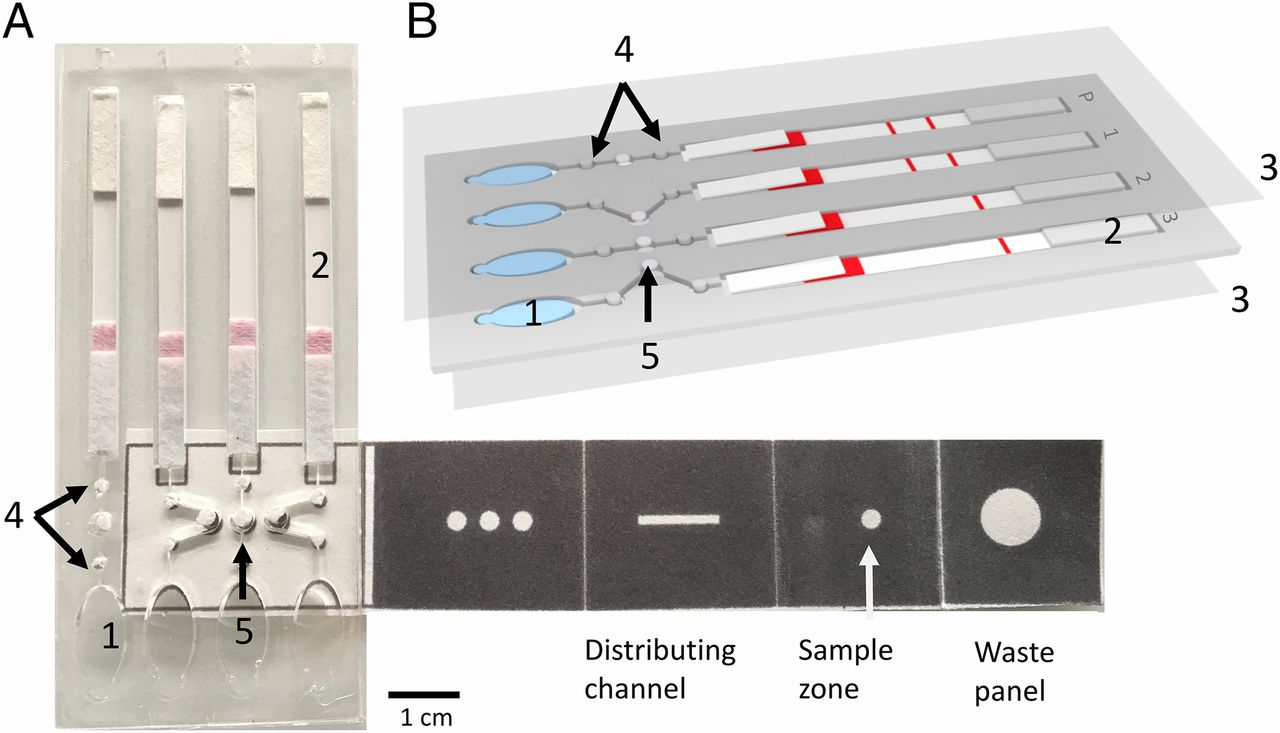
FTA cards represent the most established and widely used paper-based DNA extraction platform. Developed in the 1980s at Flinders University by Burgoyne and Fowler, the FTA paper consists of a chemically impregnated cellulose matrix that integrates cell lysis, DNA purification, pathogen inactivation, and long-term stabilization in a single device.
What Makes FTA Special
- The FTA paper contains a proprietary formulation including:
- Guanidine thiocyanate – a chaotropic agent for rapid lysis
- SDS – anionic detergent for protein denaturation
- Uric acid/urate – an antioxidant protecting DNA
- Weak base – maintains pH around 8.0
Upon sample contact, cells are instantly lysed, proteins are denatured, and DNA binds to cellulose fibers through hydrogen bonding and electrostatic interactions. Importantly, infectious agents are rendered non-viable, allowing safe handling and shipment at ambient temperature.
Source: https://www.pnas.org/doi/full/10.1073/pnas.1812296116
Protocol of the Paper-Based Method of DNA Extraction
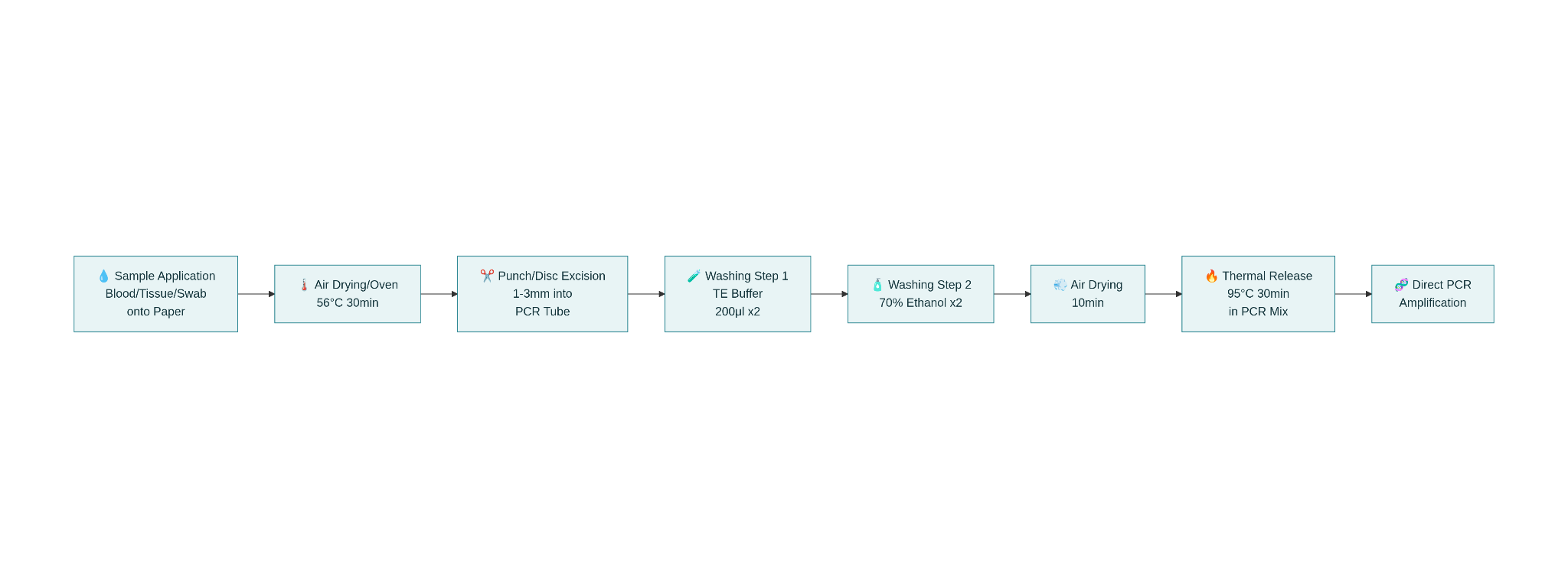
While protocols vary by paper type and application, a generalized paper-based DNA extraction workflow is outlined below.
Sample Application
Biological samples (blood, saliva, feces, plant homogenates, or cultured cells) are applied directly onto the paper substrate or into paper-based microfluidic devices.
Note: The porous and hydrophilic nature of cellulose enables rapid absorption and uniform spreading via capillary action. Minimal pre-processing may be required for complex samples to improve flow and consistency. In microfluidic or origami-based devices, predefined channels guide sample movement toward specific reaction zones. In FTA cards, the sample application alone initiates downstream processing due to pre-embedded reagents.
Cell Lysis
- Cell disruption occurs either through chemicals pre-impregnated in the paper or through externally applied lysis buffers.
- FTA cards achieve immediate lysis upon sample contact using chaotropic salts and detergents.
- External lysis buffers may contain SDS, guanidine salts, or PEG to disrupt membranes and denature proteins.
- PEG-based lysis buffers also promote molecular crowding, aiding subsequent DNA capture.
- Simplified lysis approaches, including alcohol-based treatments, are effective for mammalian cells.
DNA Binding
- Released DNA binds to cellulose fibers through hydrogen bonding and electrostatic interactions.
- High-salt or crowding conditions enhance DNA retention on the paper matrix.
- As liquid continues to wick, proteins, lipids, and debris migrate away from the DNA capture zone.
- This selective retention forms the basis of the “paper-as-filter” mechanism.
- Surface-modified papers (e.g., PEG- or chitosan-coated) further improve DNA binding efficiency and purity.
Washing
- Washing removes residual inhibitors such as proteins, pigments, and salts.
- Alcohol-based (ethanol or isopropanol) or mild aqueous washes are commonly used.
- DNA remains bound to the paper during washing, minimizing loss.
- In microfluidic formats, washing occurs automatically through capillary-driven flow.
- Effective washing is essential for inhibitor-rich samples like blood and feces.
DNA Elution
- DNA can be eluted using low-salt buffers, water, or mild alkaline solutions.
- Elution weakens DNA–cellulose interactions, releasing DNA into solution.
- Alternatively, DNA-containing paper can be directly added to PCR or LAMP reactions.
- Heat or reaction conditions facilitate DNA release during amplification.
- Elution-free workflows reduce processing time, reagent use, and contamination risk.
Modifications of the Paper-Based Method of DNA Extraction
- Origami-folded paper devices: Enable sequential lysis, washing, and amplification in malaria diagnostics.
- Bamboo and cotton paper substrates: Increased crystallinity and hygroscopicity improve DNA yield and purity.
- Polymer-modified cellulose (PEG, chitosan): Enhances DNA adsorption while reducing protein fouling.
- Elution-free IPA-wash protocols: Allow direct PCR from paper-bound DNA.
- Dipstick and HotSHOT adaptations: Simplified extraction for GMO detection and food testing.
Troubleshooting of the Paper-Based Method of DNA Extraction
| Problem | Likely Cause | Solution |
| Low DNA yield | Insufficient lysis or poor paper binding | Increase lysis time or use PEG-enhanced buffer |
| PCR inhibition | Residual proteins or salts | Add additional wash steps |
| Uneven DNA distribution | Non-uniform sample application | Apply the sample centrally and evenly |
| DNA degradation | Improper storage | Store paper in dry, dark conditions |
| Variable results | Paper batch inconsistency | Use standardized or commercial substrates |
Quality Assessment of the Paper-Based Isolated DNA
- Spectrophotometric purity ratios: A260/A280 ratios of 1.6–1.9 are typically observed in optimized papers.
- PCR amplification efficiency: Successful amplification indicates functional DNA quality.
- Gel electrophoresis: Confirms DNA integrity and fragment size.
- Comparative yield analysis: Yield comparisons with spin-column methods validate performance.
Safety Tips and Precautions of the Paper-Based Method of DNA Extraction
- Use gloves to prevent contamination.
- Handle alcohols in ventilated areas.
- Dispose of bio-contaminated paper safely.
- Avoid prolonged UV exposure of DNA.
- Store chemical-treated papers away from moisture.
Storage and Long‑Term Stability of Paper-Based Isolated DNA
- Room-temperature stability (FTA cards): DNA is stable for years.
- Moisture control: Use desiccants, avoiding microbial growth.
- Dark storage: Prevent UV damage.
- Minimal handling: Reduces contamination risk.
Applications of the Paper-Based Method of DNA Extraction
- Point-of-care (POC) molecular diagnostics: Detection of infectious diseases (Malaria, blood-borne pathogens, tuberculosis, HIV, etc.)
- Metagenomics: Remote fecal sampling, Environmental DNA (eDNA) analysis.
- Food safety and GMO detection: detection of foodborne pathogens, species identification in meat and seafood.
- Forensic analysis: DNA collection from blood, saliva, and hair.
- Plant genetics: plant pathogen detection, crop disease diagnosis, and plant genotyping.
- Resource-Limited and Field Settings: Mobile diagnostic laboratories, Rural healthcare, Low-cost molecular testing, On-site sample collection and storage.
- Education and training: Low-cost, simple DNA extraction demonstrations in teaching labs, since the technique requires minimal equipment.
Advantages of the Paper-Based Method of DNA Extraction
- Low cost and minimal equipment: Paper-based DNA extraction uses inexpensive cellulose substrates and simple reagents, eliminating the need for centrifuges or automated systems. Capillary-driven processing allows DNA isolation with minimal infrastructure, making the method accessible for low-resource laboratories and teaching environments.
- Rapid processing time: By integrating lysis, DNA capture, and washing on a single paper matrix, paper-based workflows significantly reduce extraction time. Elution-free formats further enable direct downstream amplification, supporting rapid diagnostic and screening applications.
- Suitability for field and point-of-care applications: The portability and robustness of paper-based platforms, including origami devices and FTA cards, allow DNA extraction to be performed outside conventional laboratories. This makes the method highly suitable for on-site diagnostics in remote or resource-limited settings.
- Reduced reagent toxicity: Unlike conventional extraction methods that rely on hazardous organic solvents, paper-based systems use milder detergents, alcohols, or embedded reagents. This improves user safety and simplifies waste management, particularly in field and educational settings.
- Long-term DNA stability: Chemically treated papers, such as FTA cards, enable long-term DNA preservation at room temperature by inactivating nucleases and protecting DNA from degradation. This feature supports reliable sample storage and transport without cold-chain requirements.
Limitations of the Paper-Based Method of DNA Extraction
- Lower absolute yield than silica columns.
- Sensitivity to paper variability.
- Limited scalability.
- Potential PCR inhibitors if poorly washed.
- Less suitable for high-molecular-weight genomic DNA.
Conclusion
Paper-based DNA extraction represents a transformative shift toward simplified, accessible, and field-deployable molecular workflows. With smart use of cellulose chemistry, capillary action, and embedded reagents, these systems enable efficient DNA isolation without complex instrumentation. Platforms such as FTA cards illustrate the technology’s maturity, while ongoing innovations in paper modification and microfluidic design continue to expand its capabilities.
Although limitations remain, particularly in yield and standardization, paper-based DNA extraction has firmly established itself as a powerful tool for modern diagnostics, research, and education.
References
- Lee SM, Doeven EH, Yuan D, Guijt RM. Method for lysis and paper-based elution-free DNA extraction with colourimetric isothermal amplification. Sci Rep. 2024;14(1):14479. Published 2024 Jun 24. doi:10.1038/s41598-024-59763-4
- Thi Ngoc Diep Trinh, Nguyen Tran Truc Phuong, Kien Cuong Tran, Kieu The Loan Trinh, Hanh An Nguyen; Integration of paper-based DNA extraction with digitized image analysis for colorimetric LAMP-based V. parahaemolyticus detection. Anal. Methods 2026; 18 (23): 4927–4936. https://doi.org/10.1039/d6ay00702c
- Shi, R., Panthee, D.R. A novel plant DNA extraction method using filter paper-based 96-well spin plate. Planta 246, 579–584 (2017). https://doi.org/10.1007/s00425-017-2743-3
- Shi R, Lewis RS, Panthee DR (2018) Filter paper-based spin column method for cost-efficient DNA or RNA purification. PLoS ONE 13(12): e0203011. https://doi.org/10.1371/journal.pone.0203011
- Shruti Soni, Bhushan J. Toley; Integrated bacterial cell lysis and DNA extraction using paper-based isotachophoresis. Lab Chip 2025; 25 (4): 686–697.
- Nguyen HA, Lee NY. Pipette-Free and Fully Integrated Paper Device Employing DNA Extraction, Isothermal Amplification, and Carmoisine-Based Colorimetric Detection for Determining Infectious Pathogens. Sensors. 2023; 23(22):9112.
- J. Mei, D. Wang, Y. Zhang, D. Wu, J. Cui, M. Gan, P. Liu, Portable Paper-Based Nucleic Acid Enrichment for Field Testing. Adv. Sci. 2023, 10, 2205217. https://doi.org/10.1002/advs.202205217
- Mason, M.G., Botella, J.R. Rapid (30-second), equipment-free purification of nucleic acids using easy-to-make dipsticks. Nat Protoc 15, 3663–3677 (2020).
- Wupeng Gan, Bin Zhuang, Pengfei Zhang, Junping Han, Cai-Xia Li, Peng Liu; A filter paper-based microdevice for low-cost, rapid, and automated DNA extraction and amplification from diverse sample types. Lab Chip 2014; 14 (19): 3719–3728.
- Zou Y, Mason MG, Wang Y, Wee E, Turni C, Blackall PJ, et al. (2017) Nucleic acid purification from plants, animals and microbes in under 30 seconds. PLoS Biol 15(11): e2003916. https://doi.org/10.1371/journal.pbio.2003916
