
Manual plasmid isolation is the hands-on laboratory procedure used to extract and purify plasmid DNA from cells such as bacterial and yeast cells, typically at a laboratory scale for research purposes.
Manual methods of plasmid isolation techniques are widely used for recombinant DNA research, restriction enzyme mapping, transformation, PCR, sequencing, and gene expression studies.
The Alkaline Lysis Method
The Alkaline Lysis Method was first introduced by Birnboim and Doly in 1979. It is the “method of choice” for manual isolation because it is simple, rapid, and inexpensive.
Principle of Manual Plasmid Isolation (Alkaline Lysis Method)
The method relies on the selective alkaline denaturation of high molecular weight chromosomal DNA while leaving small, covalently closed circular plasmid DNA intact. This occurs within a narrow pH range of approximately 12.0 to 12.6. Bacterial cells are treated with a solution containing sodium dodecyl sulfate (SDS) and sodium hydroxide (NaOH), which dissolves the cell membrane and denatures proteins. Sodium hydroxide creates a narrow, specific alkaline pH range (typically 12.0 to 12.6).
When the alkaline lysate is neutralized by an acidic high-salt solution (such as potassium acetate or sodium acetate), the environment changes rapidly. Because of the high molecular weight of chromosomal DNA and the fact that its strands have been separated, it undergoes “inter-strand reassociations” at multiple sites that cause it to renature and aggregate into an insoluble network or “clot”.Simultaneously, the high concentration of salt causes protein-SDS complexes and high molecular weight RNA to precipitate.
The result of neutralization is a mixture where the three major contaminating macromolecules, chromosomal DNA, protein, and RNA, are co-precipitated into an insoluble mass; the plasmid DNA remains in the supernatant. A single centrifugation step is then used to remove the insoluble precipitate, leaving the partially purified plasmid DNA in the clear liquid to be recovered, usually via ethanol precipitation.
Key Reagents of Manual Plasmid Isolation (Alkaline Lysis Method)
The key reagents used in manual plasmid isolation comprise three primary solutions followed by recovery and purification agents.
Solution I: Resuspension Buffer
This solution is used to suspend the bacterial cell pellet and prepare it for lysis.
- Glucose (50 mM): Acts as a pH buffer and maintains an osmotic pressure during the subsequent lysis step.
- Tris-HCl (25 mM, pH 8.0): Maintains a stable pH.
- EDTA (10 mM, pH 8.0): These are chelating agents. EDTA stabilizes the cell membrane by binding the divalent cations of Mg2+ and Ca2+. RNase can also be added at this stage to degrade the RNA when the cells are lysed.
- Lysozyme (1–2 mg/ml): An enzyme used to weaken the bacterial cell wall.
Solution II: Lysis Solution
This solution breaks open the cells and denatures the DNA.
- NaOH (0.2 N): Provides the alkaline environment (typically pH 12.0–12.6) necessary for the selective denaturation of linear chromosomal DNA.
- Sodium Dodecyl Sulfate (SDS) (1%): An ionic detergent that dissolves the cell membrane and denatures proteins.
Solution III: Neutralization buffer (High Salt Solution)
This solution neutralizes the alkaline lysate and causes the precipitation of contaminants.
- 3 M Potassium Acetate or Sodium Acetate: High concentrations of these salts cause denatured chromosomal DNA to renature and aggregate into an insoluble form.
- Glacial Acetic Acid or Formic Acid: These are used to adjust the high-salt solution to an acidic pH (typically 4.8 to 5.5). Formic acid is sometimes used because it is easier to prepare and adjust to the desired pH.
Recovery and Purification Reagents
- Cold Ethanol (95% or 100%): Used to precipitate the plasmid DNA from the supernatant after the insoluble contaminants have been removed by centrifugation.
- Isopropanol: Can be used as an alternative to ethanol for precipitation.
- RNase A: A stock solution (often 1 mg/ml) used to remove contaminating RNA that might interfere with subsequent analysis, such as gel electrophoresis.
- 70% Ethanol: Used to wash the final DNA pellet to remove excess salts before drying and resuspending it in water or a buffer like Tris-EDTA (TE).
Steps of Manual Plasmid Isolation (Alkaline Lysis Method)
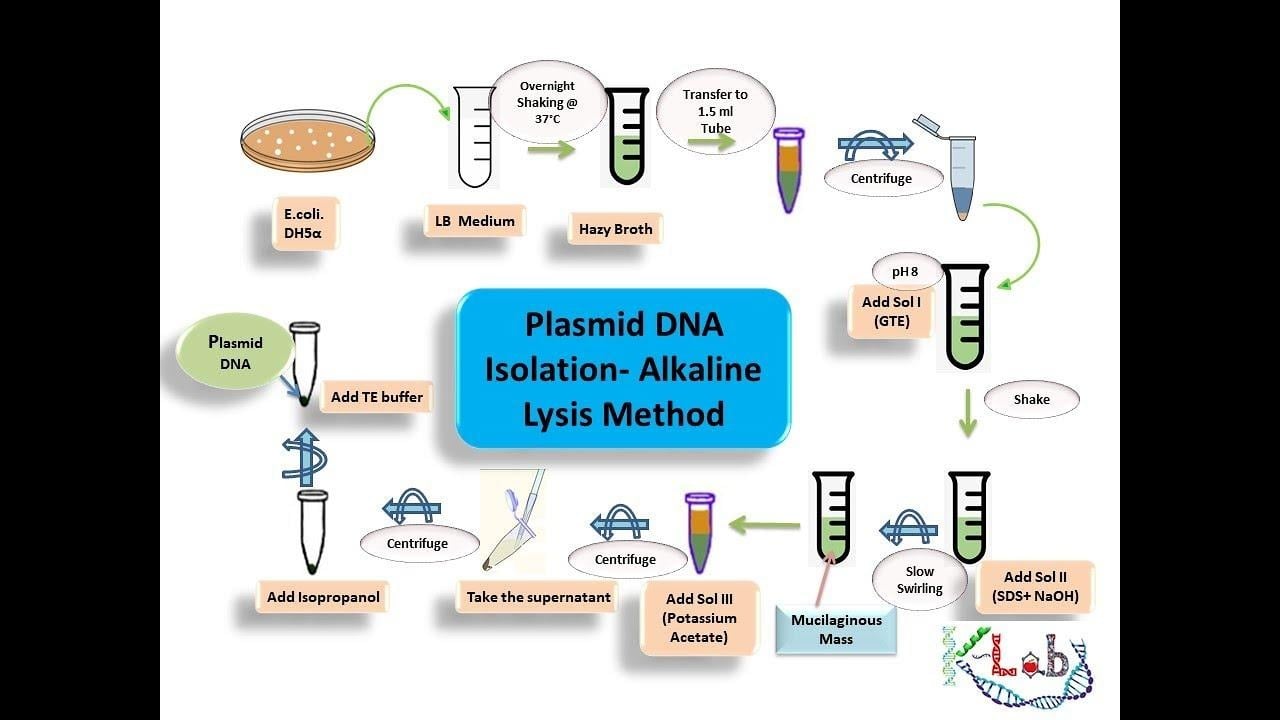
- Pick a single colony of transformed cells and culture it in appropriate media. (For example: LB+ampicillin broth (5ml) for transformed DH5alpha cell with ampicillin as a selectable marker).
- Keep on incubation at 37°C overnight.
- Next day (18-20 hrs for DH5alpha), centrifuge the grown culture at 4000 rpm for 5 mins.
- Remove the supernatant, resuspend the pellet in 350 ul of Buffer I solution, and transfer it into a fresh epitube.
- Add 2 ul RNAse A.
- Add 350 ul Buffer II solution.
- Gently and slowly invert the tube 10 times (texture should appear slimy).
- Centrifuge the mixture at max speed (15000rpm) for 10 mins.
- Transfer the supernatant into a fresh epitube.
- Add 700 ul of isopropanol.
- Centrifuge at max speed (15000) for 10 mins.
- Remove the supernatant.
- Add 500 ul of 70 % ethanol.
- Vortex shortly.
- Centrifuge at 15000 rpm for 5 mins.
- Remove the supernatant.
- Open the epitube and let it dry on a tissue paper.
- Add 50 ul NFW/TE Buffer.
Source: https://i.ytimg.com/vi/qXgtRq74TqE/maxresdefault.jpg
Quality Control: Nanodrop and Gel Electrophoresis Analysis
Quality control following manual plasmid isolation typically involves two major techniques: Ultraviolet (UV) Spectrometry (the technology used by instruments like the Nanodrop) to assess concentration and chemical purity, and Agarose Gel Electrophoresis to assess the structural integrity, size, and presence of macromolecular contaminants.
Nanodrop and UV Spectrometry Analysis
Spectrometry is a standard method for the quantification and purity assessment of DNA based on its light absorption characteristics. DNA absorbs light maximally at a wavelength of 260 nm. This measurement is used to estimate the concentration of DNA in the extract. For a “clean” or high-quality DNA extract, the 260/280 absorbance ratio should typically fall between 1.8 and 2.0.
Agarose Gel Electrophoresis Analysis
Gel electrophoresis is considered a “quick and easy” method for analyzing both the quality and quantity of extracted DNA while providing a visual indication of the size of the molecules. Protocols often utilize 0.8% to 1% agarose gels. Gels are typically stained with ethidium bromide (e.g., 1 μg/ml) and visualized under UV illumination. Because different topological forms of plasmid DNA migrate at different rates, electrophoresis allows for the identification of several distinct bands: Supercoiled (CCC) form, Open Circular (OC) Form, and CCC DNA. Chromosomal DNA appears as high-molecular-weight material that either remains at the origin (well) or appears as a diffuse smear near the top of the gel. RNA typically appears as intensely staining material or a smear near the bottom of the gel.
Troubleshooting: Avoiding Genomic DNA Contamination
To avoid genomic DNA (gDNA) contamination during manual plasmid isolation, troubleshooting should focus on maintaining the structural integrity of the high-molecular-weight chromosomal DNA so that it remains large enough to precipitate out of the solution during neutralization.
- High molecular weight gDNA is extremely sensitive to shear forces. If the lysate is vortexed or stirred too vigorously, the large chromosomal DNA molecules can fragment into smaller pieces that are similar in size to plasmid DNA. Protocols recommend mixing by gentle inversion of the tubes rather than mechanical vortexing, especially during the lysis and neutralization steps.
- Transferring the supernatant gently is required in order not to disturb the pellet.
Applications of Manual Plasmid Isolation (Alkaline Lysis Method)
Deciding between manual extraction and the use of commercial kits depends on the sample complexity, the required scale of production, and the specific research goals.
When to Use Manual Extraction
- Manual extraction is ideal for rapidly screening large numbers of clones (100 or more per day) in a laboratory setting because it is simple, inexpensive, and reliable.
- Manual procedures allow to adapt chemical concentrations and the addition of specific enzymes (like proteinase K or RNase A) to meet individual needs, a flexibility often missing in pre-formulated commercial kits.
- Commercial kits designed for pure bacterial cultures often fail when applied to complex samples like soil or feces. These samples can block the spin columns used in kits, resulting in little to no DNA recovery. In such cases, specialized manual techniques like exogenous isolation are more consistent and effective.
- Manual extraction is useful for teaching and learning basic molecular biology techniques, and in case the kits are not available.
When to Use Commercial Kits
- Kits are specifically intended for use with pure bacterial cultures, where they work very efficiently to provide clean DNA for standard downstream applications.
- Used when there is a need for high-purity DNA (sequencing, cloning, qPCR).
- Less risk of gDNA/protein contamination.
Conclusion
Manual plasmid isolation is a laboratory method used to extract plasmid DNA from cells (commonly bacteria like Escherichia coli DH5α), using the alkaline lysis technique, a simple, rapid, and cost-effective approach introduced in 1979. It works on the principle that under alkaline conditions (pH ~12–12.6), chromosomal DNA and proteins are denatured while small, circular plasmid DNA remains intact; upon neutralization, genomic DNA, proteins, and RNA precipitate, leaving plasmid DNA in the supernatant for recovery using alcohol precipitation.
The process involves key reagents such as resuspension buffer (Tris, EDTA, glucose), lysis buffer (NaOH, SDS), and neutralization buffer (potassium/sodium acetate), followed by ethanol or isopropanol purification. Quality is checked using Nanodrop (ideal 260/280 ratio ~1.8–2.0) and agarose gel electrophoresis to confirm integrity and absence of contamination. Proper handling, especially gentle mixing and careful supernatant transfer, is critical to avoid genomic DNA contamination.
Manual methods are preferred when cost, flexibility, large-scale screening, or complex samples are involved, whereas commercial kits are favored for faster processing, higher purity, reproducibility, and sensitive downstream applications like sequencing and qPCR.
References
- Delaney, S., Murphy, R., & Walsh, F. (2018). A Comparison of Methods for the Extraction of Plasmids Capable of Conferring Antibiotic Resistance in a Human Pathogen From Complex Broiler Cecal Samples. 9(August). https://doi.org/10.3389/fmicb.2018.01731
- Laboratoire, D., Moleculaire, B., & Received, F. (1979). Nucleic Acids Research. 7(6), 1513–1523.
- Malik, M., Archana, A., Praveen, P., Neela, K., & Vammi, T. K. S. (2021). DNA Pro fi ling in Forensic Science : A Review.
- Micard, D., Midicale, L. D. B., Cnrs, L. A., & Midecine, F. De. (1985). Purification of RNA-Free Plasmid DNA Using Alkaline Extraction by Ultrogel A2 Column Chromatography. 126, 121–126.
- Of, I., & Dna, P. (1983). H. c. birnboim. 100(1979), 243–255.
- Urthaler, J., Ascher, C., Helga, W., & Necina, R. (2007). Automated alkaline lysis for industrial scale cGMP production of pharmaceutical grade plasmid-DNA. 128, 132–149. https://doi.org/10.1016/j.jbiotec.2006.08.018

then why should we prepare solution 3