
Human sex is determined by a pair of sex chromosomes, the X and Y chromosomes. These sex chromosomes form one of the 23 pairs of human chromosomes in each cell. Females have two X chromosomes (XX), and males have one X and one Y chromosome (XY).
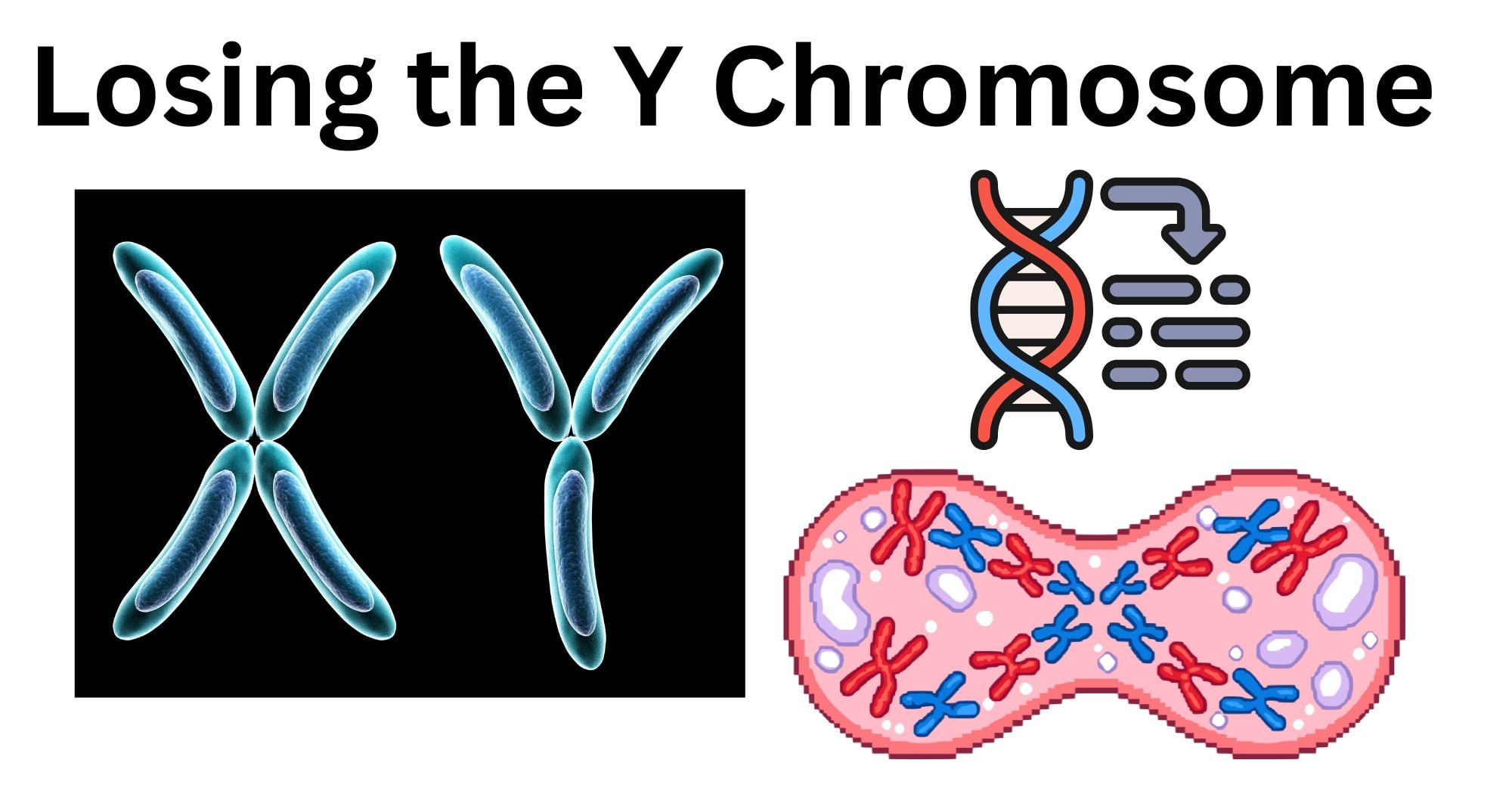
The human Y chromosome plays a vital role in determining the male sex. This chromosome, however, is slowly degenerating and may disappear in a few million years.
Sex Determination Systems
Sex determination is a complex interplay of sex chromosomes that ultimately determines the sex of an organism. Over time, living organisms have evolved bizarre sex determination systems that take advantage of their specific environment.
- In humans, a pair of sex chromosomes determines the sex of the offspring. If the chromosome is double X (XX), the baby is female, whereas if it is XY, the baby is male. However, this system of sex only exists in certain mammals.
- Birds have a similar kind of sex determination system compared to ours; however, they have a Z chromosome as well. A male chicken has two Z chromosomes (ZZ), and females have one Z chromosome and one Y chromosome.
- A few species of fish, reptiles, and insects determine their sex through environmental cues. Reptiles like turtles and crocodiles have temperature-dependent sex determination (TSD) following the incubation temperature of the egg.
- A more complex and extreme example is the platypus, which has ten sex chromosomes (five X and five Y) in males.
The sex determination system is not fixed and can change depending on the external conditions.
What is the Y chromosome?
The Y chromosome is an integral component of human male biology. It is one of the two sex chromosomes found in humans and most mammalian species. It spans more than 59 million base pairs and represents 2% of the total DNA in cells. The chromosome is tiny compared to the X chromosome. which contains about 900 genes that function beyond sex. Compared to this, the Y chromosome is tiny and holds about 568 genes, each separated by repetitive non-coding regions of DNA. It comprises all the significant genes that facilitate male development. One of such genes is the male sex determining gene, the SRY gene. It is responsible for the development of male characteristics. This includes the formation of testes and the production of male hormones, testosterone, cortisol, luteinizing hormone (LH), follicle-stimulating hormone (FSH), and prolactin.
Structure of the Y chromosome
- The Y chromosome is Y-shaped, but its name is not derived from its shape; rather, it was coined to pair up with the X chromosome.
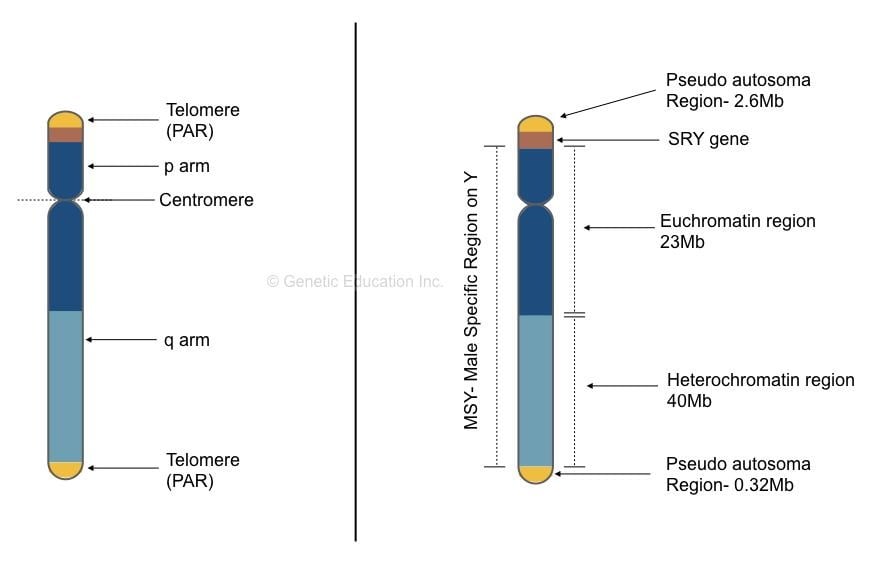
- Unlike other autosomes, the Y chromosome is smaller in size and acrocentric in shape, meaning it has a long p arm and a short q arm. The p arm contains genes related to maleness. This arm is also euchromatin in nature and can be encoded into proteins.
- A centromere is localized between the p and q arms at 10.4 Mb. It assists in chromosomal dissociation during mitosis.
- The telomeres, situated at the extreme ends of each chromosomal arm, are home to repetitive sequences of DNA. They protect the arms and are responsible for chromosomal stability.
- The Y chromosome mostly comprises the male-specific region (MSY), which makes up about 95% of its length. The rest consist of repetitive non-coding regions of DNA.
- Unlike normal chromosomes, the MSY gene does not undergo reciprocal recombination with a homologous chromosome in meiosis.
- In comparison, regions of the Y chromosome known as the pseudo-autosomal region (PAR) are located at the extreme ends of the Y, undergo recombination. PARs are present in the X chromosome as well.
- The Y chromosome holds 568 genes, only 71 of which are coding regions, whereas the remaining 27 genes are for distinct MSY proteins. 109 genes produce long and short non-coding RNAs, which might have significance in gene regulation. The remaining 388 genes are pseudogenes and have no particular function.
Functions of the Y Chromosome
- The sex-determining region (SRY) gene, located at the p arm, functions as the master regulator for male development. It is responsible for the development and differentiation of the testis from the embryonic stage.
- Genes such as SOX9, RSPO1, WNT, WT3, and SF1 facilitate the development of male sexual organs through the production of male sex hormones such as testosterone, cortisol, luteinizing hormone (LH), follicle-stimulating hormone (FSH), and prolactin.
- The DAZ1 gene is involved in spermatogenesis and its maturation. It also plays a role in male fertility.
- Secondary masculine characteristics such as facial hair, vocal changes, Adam’s apple, etc., are also developed through the complex interactions of the Y chromosome.
- As only the PAR region participates in the homologous recombination, it maintains the integrity of the Y chromosome.
- The Y chromosome is passed down to the male offspring. The male sex-determining genes are transmitted without any alteration from father to son along the paternal line.
Why is the Y Chromosome Disappearing?
Over the past 180 million years, the Y chromosome has been gradually losing its genetic material. It is regarded as the ‘genetic wasteland’ and is known to completely disappear from the human genome. Presently, it has lost about 1500 (about 97%) genes. To understand this degeneration, it is essential to know about the evolution of sex chromosomes:
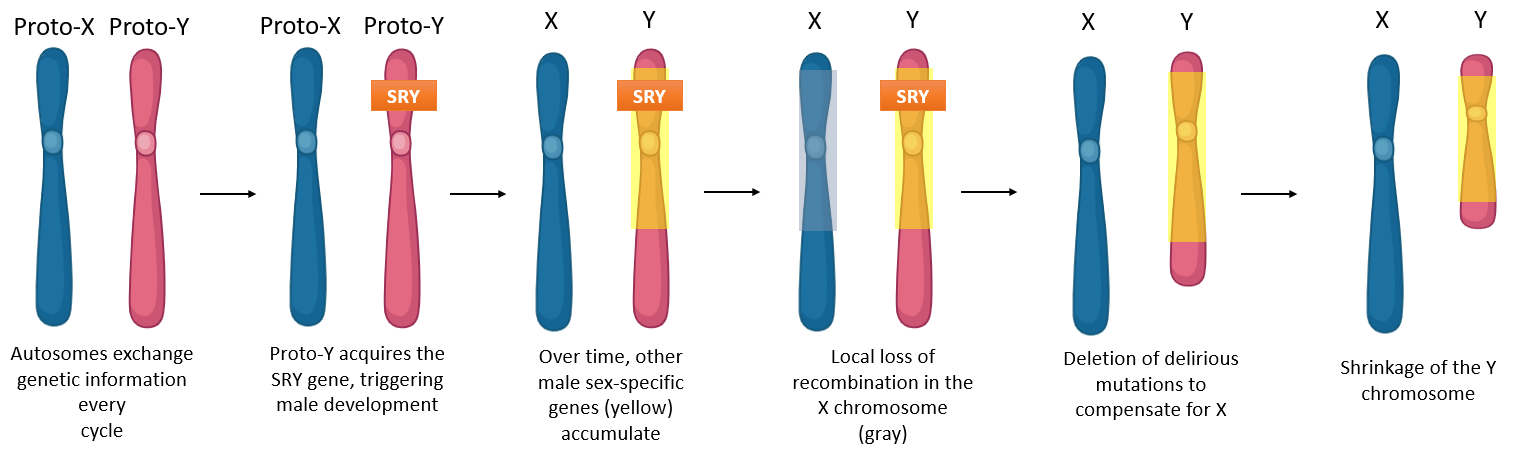
- Sex chromosomes (X and Y) are believed to have originated from a homologous pair of identical autosomes (Proto-X and Proto-Y). One of these chromosomes (Proto-Y) acquired the master regulator of male development, the SRY gene.
- Over time, other male sex-determining genes accumulated in the SRY locus.
- As time progressed, recombination during meiosis was suppressed to preserve the sex-determining region, the SRY locus.
- This prevented the mixing of alleles between the proto-X and proto-Y chromosomes. The absence of recombination in the SRY locus also hinders the homologous repair of harmful mutations. Without repair, the mutations, such as frameshifts, nonsense mutations, insertions, deletions, etc., accumulate.
- This created an imbalanced dosage in these chromosomes. To account for this, there was a deletion of the delirious mutations of the Y chromosome.
- This led to the loss of function of genes and their pseudogenization, resulting in the shrinking of the Y chromosome.
Effects of Loss of Y Chromosome (LOY)
In humans, the Y chromosome degrades with increasing age. This gradual loss of the Y chromosome (LOY) is known to be associated with life expectancy and numerous diseases, such as cardiovascular, neurodegenerative, and many types of cancer.
Aging and cellular function: LOY increases with age. This is especially true for blood cells. Cells without the Y chromosome have a weakened immune response, which leads to tissue damage. LOY is also known to shorten life span.
Higher disease risk: The effect of LOY is commonly observed in the leukocytes of elderly men. It poses a higher risk of blood-related cancers, such as leukemia. Similarly, a few studies have also shown its connection to neurodegenerative diseases such as Alzheimer’s and cardiovascular diseases.
Infertility: The deletion of AZF regions of the Y chromosome disrupts sperm production. This results in male infertility.
Conclusion
Few species, such as mole voles and Japanese spiny rats, have lost their Y chromosome completely, evolving novel sex-determination systems. In humans, the Y chromosome is slowly degenerating. In a few million years, the chromosome is speculated to entirely disappear. This sounds daunting; however, the event could change the system of sex determination in humans. Future humans would likely be a separate species with each unique chromosome.
References
- Bruhn-Olszewska, B., Markljung, E., Rychlicka-Buniowska, E., Sarkisyan, D., Filipowicz, N., & Dumanski, J. P. (2025). The effects of loss of Y chromosome on male health. Nature Reviews Genetics, 26(5), 320–335. https://doi.org/10.1038/s41576-024-00805-y
- Chauhan, D. T. (2020, October 12). Y Chromosome—Structure and Function [An In-depth Review]. Genetic Education. https://geneticeducation.co.in/y-chromosome-structure-and-function/
- Decline of the Y chromosome: Are men to go extinct? (2024, August 28). The Times of India. https://timesofindia.indiatimes.com/life-style/health-fitness/health-news/decline-of-the-y-chromosome-are-men-to-go-extinct/articleshow/112858405.cms
- Gutiérrez-Hurtado, I. A., Sánchez-Méndez, A. D., Becerra-Loaiza, D. S., Rangel-Villalobos, H., Torres-Carrillo, N., Gallegos-Arreola, M. P., & Aguilar-Velázquez, J. A. (2024). Loss of the Y Chromosome: A Review of Molecular Mechanisms, Age Inference, and Implications for Men’s Health. International Journal of Molecular Sciences, 25(8), 4230. https://doi.org/10.3390/ijms25084230
- Molecular and evolutionary dynamics of animal sex-chromosome turnover | Nature Ecology & Evolution. (n.d.). Retrieved April 26, 2025, from https://www.nature.com/articles/s41559-019-1050-8
- Rhie, A., Nurk, S., Cechova, M., Hoyt, S. J., Taylor, D. J., Altemose, N., Hook, P. W., Koren, S., Rautiainen, M., Alexandrov, I. A., Allen, J., Asri, M., Bzikadze, A. V., Chen, N.-C., Chin, C.-S., Diekhans, M., Flicek, P., Formenti, G., Fungtammasan, A., … Phillippy, A. M. (2023). The complete sequence of a human Y chromosome. Nature, 621(7978), 344–354. https://doi.org/10.1038/s41586-023-06457-y
- University, L. T., & Fellow, J. G., Distinguished Professor of Genetics and Vice Chancellor’s. (n.d.). Men are slowly losing their Y chromosome. Retrieved April 24, 2025, from https://www.latrobe.edu.au/news/articles/2022/opinion/men-are-slowly-losing-their-y-chromosome
- Wilson, J., Staley, J. M., & Wyckoff, G. J. (2020). Extinction of chromosomes due to specialization is a universal occurrence. Scientific Reports, 10(1), 2170. https://doi.org/10.1038/s41598-020-58997-2
