
The discovery of the Polarizing microscope or polarized light microscope took place in the nineteenth century, with the development of polarizing filters. The evidence of polarized light, the nature of light’s polarity, and investigations into interference in polarized light led to the development of this microscopy technique.
Initially, the polarization of light was achieved by reflecting it off a series of glass plates positioned at a 57⸰ angle relative to the plane of incidence rather than using transmission-polarizing materials. Subsequently, more sophisticated instruments utilized a crystal made from refracting materials such as calcite that was specially cut and bonded to create a prism.
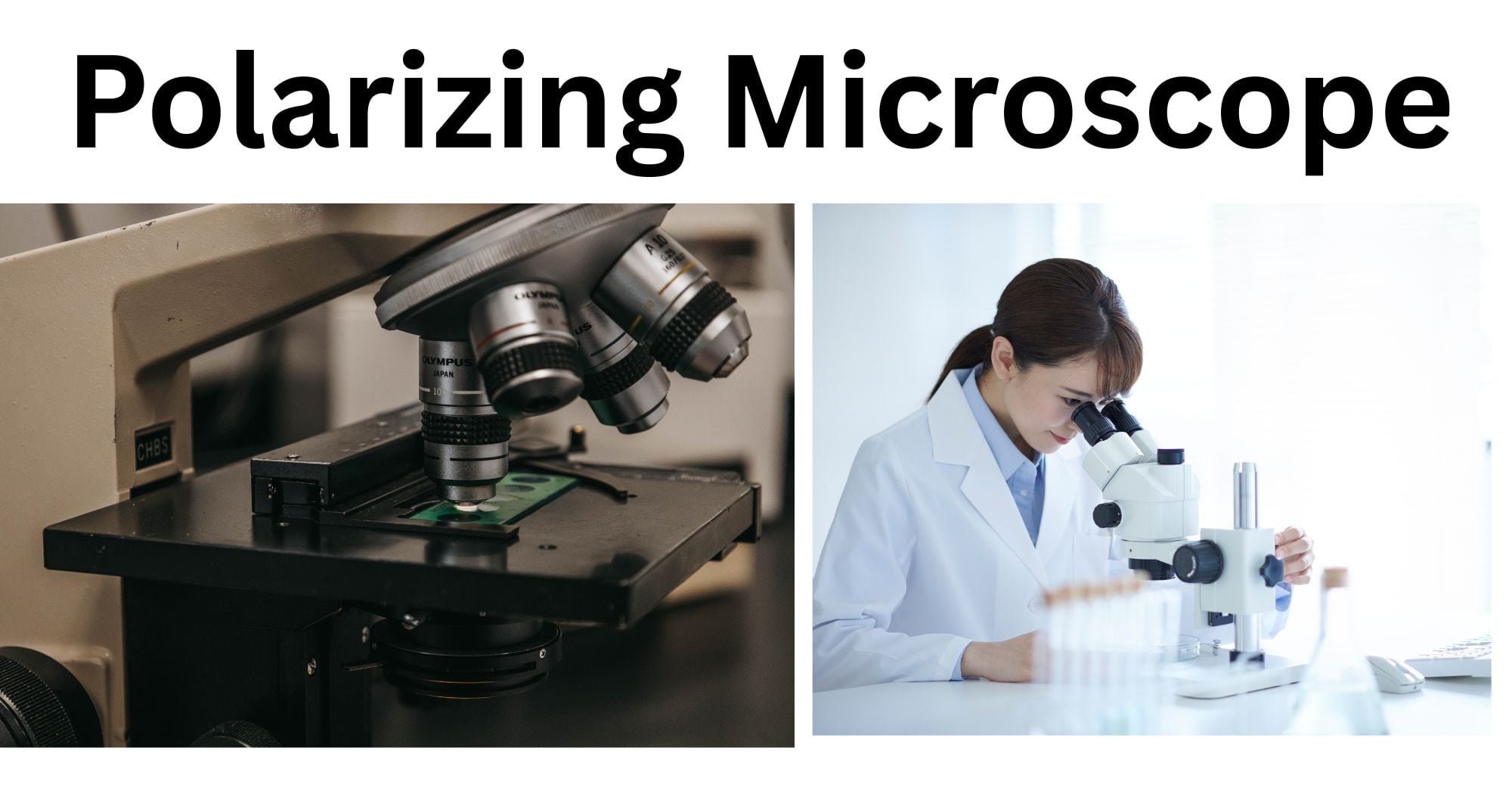
A polarizing microscope is a microscope that transforms ordinary light into polarized light to visualize and study various materials, including their structures and optical properties. Widely used in geological studies, it is also called a petrographic microscope.
This technique is utilized in either transmitted or reflected light for both quantitative and qualitative research and analysis of optically anisotropic substances like chemicals, rocks, and minerals. When inspecting opaque specimens, the reflected polarizing microscope is employed, which is also referred to as an ore microscope. Similarly, the transmitted polarizing microscope is used for transparent or translucent samples and is commonly known as a petrographic microscope. Most commonly, beyond its specific fields of applications, the reflected and transmitted polarizing microscope is the most frequently used type in fields such as biology, cytology, histology, medicinal chemistry, and various other research activities.
Principle of the Polarizing Microscope
Light, an electromagnetic wave, travels in different directions. However, it typically oscillates in two perpendicular directions. The light that vibrates in multiple directions is referred to as ‘unpolarised light,’ while a light wave oscillating in one specific direction is known as ‘polarised light.’ It is known that the human eye does not detect the direction of light vibration. The principle of polarizing microscopy is based on the phenomenon of the transformation of unpolarized light into polarized light.
One method to accomplish this is through the absorption of light vibrational movements in a particular direction. Certain natural minerals, such as tourmaline, or synthetic films that serve a similar purpose, can achieve this. In a polarized light microscope, the setup consists of polaroid filters made up of tiny crystals of iodoquinine sulfate. These are aligned in the same direction and embedded within a polymeric filter. This filter prevents the crystals from shifting or altering their orientation. A polarizer selects plane-polarized light from natural or unpolarized light and is positioned between the light source and the specimen.
Consequently, the polarized light source is transformed into plane-polarized light before reaching the sample. This plane-polarized light then interacts with a doubly refracting specimen, producing two wave components that are perpendicular to each other. These two waves are termed ordinary and extraordinary light rays.
As the waves pass through the specimen, they do so at different phases. Through constructive and destructive interference, an analyzer subsequently combines these waves. This process results in the formation of a high-contrast image.
Instrumentation of a Polarizing Microscope
The basic instrumentation of a polarizing microscope can be described as a conventional light microscope with two polarizing materials, i.e., the polarizer and the analyzer. Various components arranged in this microscopy setup are briefly explained below:
- Polarizer: The polarized light is produced by the component called a polarizer, which passes unpolarized light through the plates with various orientations. Situated in between the light source and analyzer, it is found in different sizes and shapes. It is considered one of the most crucial instruments in this technique.
- Analyzer: The device that accomplishes the visualization of images is the polarizing analyzer. Its main function includes combining the two beams of polarized light in such a way that they remain perpendicular to each other, resulting in the formation of images with contrast and quality. It is situated between the source of light and the human eye or a device used to view the sample.
- Condenser: The condenser construction in this technique is similar to that of a traditional microscope. It is strain-free and achromatic, with the value of NA ranging between 0.90 and 1.35 and the ability to illuminate at low magnifications. This feature especially helps to visualize crystals and anisotropic materials. Certain polarized light microscopes come with a fixed condenser, i.e., without a swing lens, which aims to achieve both conoscopic and orthoscopic illumination. The degree of illumination convergence can be modified by adjusting the diaphragm of the condenser aperture or by altering the height of the condenser.
Stage: Primarily, the function of the polarizing rotating stage is to eliminate or filter out the non-polarized light, which helps in the differentiation of objects from their background. It enables a polarizing microscope to be calibrated along three axes (X-Y-Z). It is placed on a base and can be rotated in any direction. Typically, a vernier scale is employed to ensure a precision of 0.1 at the angle of rotation on the stage.
Objectives: The objectives used in the polarizing microscope should be strain-free with high numerical aperture and high magnification; their appropriate selection is of utmost importance. This is because if any kind of stress is observed during the installation of the objectives, it can cause changes in the properties of the lens, thereby reducing its optical performance. Therefore, it is important to check if the lens is placed too tightly. Moreover, the assessment of refractive properties and anti-reflection coating must be carried out, as it influences the polarization and contrast. - Nosepiece: Polarizing microscopes consist of the rotating stage and objectives, which allow for versatile viewing angles of the specimen. Its facilitation in these microscopes is carried out with a revolving nosepiece. This feature ensures that even when the stage is rotated to change perspectives or view different areas of the specimen, the image remains focused in the center of the field of view. It maintains a stable view, due to which one can easily switch between different magnifications and optimize their observational experience.
Bertrand Lens: This is a particular type of lens placed in an intermediate tube or within the observation tubes in the setup. It projects an interference pattern created at the objective’s rear focal plane into focus at the microscope’s image plane. This lens is intended to facilitate the examination of the objective’s rear focal plane, enable precise adjustment of the illuminating aperture diaphragm, and allow for the observation of interference figures - Compensator: Compensators, also known as retardation plates, are placed between the two crossed polarizers in the optical setup. Its main function is to enhance the difference in the optical path length of the light that passes through the sample. This characteristic feature significantly improves the contrast and overall quality of the image.
Sample Preparation for Observation
The preparation of samples for observation under the polarizing microscope is simpler; however, it depends on the type of sample being examined.
Samples of organic compounds/chemicals can be prepared using the process of melt-recrystallization, which melts the compounds without decomposing.
Similarly, another method allows the formation of crystallites with an increase in concentration as the solvent evaporates. This method is used to prepare salts for visualization in crossed polarized microscopy.
For geological studies, the thin sections of rock should have a standard thickness in the range of 25-30 micrometers. Diamond-impregnated wheels are used to grind the sample, and abrasive powders are used to maintain the accurate size and thickness. The prepared samples with the cover glass are affixed with an optically transparent adhesive.
Biological samples are prepared at sizes 1 to 40 micrometers thick with the use of a microtome. The specimens are placed between a slide and a cover glass using a mounting medium, depending on the chemical and physical properties of the specimen. This is especially important in the analysis of synthetic polymers, as certain mounting media may chemically interact with the materials, leading to alterations in their structure and potentially creating artifacts.
Operating Procedure of the Polarizing Microscope
- The light source is switched on.
- The slide with the specimen is placed on the stage.
- Light intensity is adjusted to the desired level using the control lever.
- Next, ensure that the field diaphragm is adjusted to the boundary of the field of view.
- The sample is focused by making coarse and fine adjustments for the selected objective.
- The microscope slide is moved around to visualize the specimen. Accordingly, adjust the focus.
- Then, the filter is pushed in first with the polar crossed to visualize the specimen. Similarly, it can be pulled out with uncrossed polars to view the sample.
- In case the objective is changed, the fine focus is adjusted. Then the field diaphragm is positioned within the field of view. Later, the aperture diaphragm is adjusted for maximum resolution and high contrast.
Applications of the Polarizing Microscope
Its application of polarizing microscopes ranges from the biomedical field to industries and geological analysis, as mentioned below:
- In biomedical research, this technique is used to visualize and study neurons, nerve fibers, actomyosin fibers, muscle tissue, and striated muscle. Moreover, it is used to diagnose gout by examining synovial fluid. It is also used to diagnose diseases such as arthritis and lithiasis.
- It has been used to detect the presence of amyloid proteins, as indicated by the bright green color on the microscope.
- It is used in geological studies to examine the structures of rocks and minerals, including their optical characteristics. Furthermore, its use in metallographic examinations of opaque, anisotropic, and ferromagnetic substances has been observed.
- It is used in the food industry to determine the properties and impurities present in butter and cream.
- The physical properties of glass and ceramics, including color, refractive index, and impurities, are studied using polarizing microscopy to assess quality and defects.
- Similarly, surface impurities, properties, and composition of metals are inspected using this technique.
- It has been used in plant pathology to identify and study pathogen invasion. Further, it is used to examine the chemical changes in plant tissues.
Examples of Polarizing Microscope
Olympus BX53-P
- It is a versatile microscope used for polarized-light observation and assessment in any domain.
- It has a unique optical design consisting of robust components, including a precise rotating stage.
BS-5095TRF Trinocular Research Polarizing Microscope
- A scientific research polarizing microscope, it is specifically used for laboratory research and high-level educational purposes due to its practical, easy-to-use operation.
- It is useful for single-polarization, perpendicular-polarization, and conoscopic light observation. Its multipurpose use is widely applicable in areas including geology and mineralogy.
- It produces high-quality, reliable outputs with high resolution and contrast.
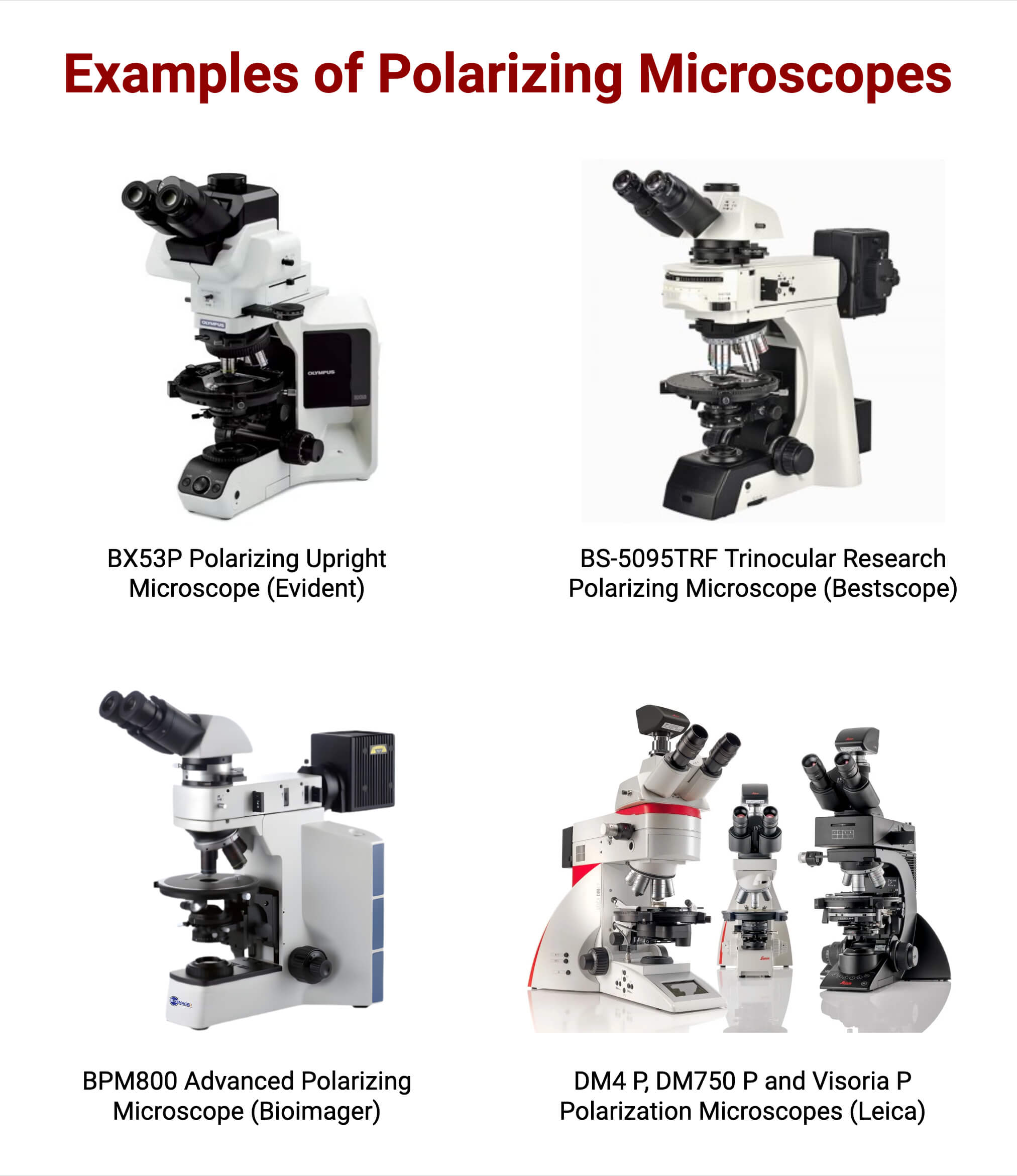
BPM800 Advanced Polarizing Microscope
- It is an advanced technique that uses reflected and transmitted light.
- It is built with exceptional quality components, including a stress-free objective and condenser.
- It is a microscope of choice for petrography studies of minerals and rock samples, meeting the qualification standards.
DM4 P Microscope
- Various information from the sample can be obtained, as the 6-objective nosepiece provides a wider range of magnifications.
- It uses LED illumination that provides homogeneous light and consumes less energy.
- The microscopic setup consists of stress-free optics that deliver optimum output.
- It is best used for conoscopic observation of crystalline structures in minerals, polymers, and pharmaceuticals.
Advantages of the Polarizing Microscope
- It does not require the staining of samples with dyes or contrast agents.
- It is a non-invasive technique that produces high-resolution, high-contrast images.
- It analyzes the birefringence of materials, revealing how they can split light into two beams vibrating in different planes. This helps in understanding the structures of materials.
- It is a multipurpose technique advantageous in diverse fields of application such as metallurgy, petrography, biology, and geology.
- It consists of a highly accurate, robust, and stable rotating stage, offering easy operation and exceptional output quality.
Limitations of the Polarizing Microscope
- It is not applicable to opaque materials and is limited to visualizing transparent and semi-transparent materials.
- It requires the use of polarizing filters and an understanding of their correct orientation.
- It is expensive due to its technical components.
- Because it examines specimens in transmitted light, it cannot inspect surface details or structures.
Precautions Before Using a Polarizing Microscope
- The laboratory should be shockproof, moisture-free, and dust-free.
- Avoid contact between the objective lens and the sample to prevent scratches in the lens.
- The brightness must be adjusted to a minimum.
- Avoid touching the halogen lamp directly with your hands. The temperature must be checked when using the lamp.
- When turned off, cover the device only after it cools down.
- The objective lens should be cleaned with a 1:1 mixture of absolute alcohol and ether. Avoid using other liquids.
Conclusion
In conclusion, specialized polarized light microscopes offer advanced capabilities for observing birefringent specimens with clarity; however, conventional microscopes can also be effectively adapted for polarized light studies with careful modifications in their setup and instrumentation. The broad range of applications and advantages demonstrates that the polarization of light is a useful feature in optical microscopy. It serves as a powerful tool in the observation and study of birefringent materials, offering distinct advantages over conventional microscopy techniques.
Moreover, this technique provides clearer, more detailed observations of the intricate structures within specimens by enhancing image contrast. Furthermore, the ability to measure the optical properties of minerals and similar materials underscores the importance of this approach in mineralogy and materials science.
From the identification and classification of unknown substances to a deeper study of their physical and chemical characteristics, this technique stands out as an essential methodology for both research and industry.
References
- Introduction to polarized light. (n.d.). Nikon’s MicroscopyU. Retrieved from: https://www.microscopyu.com/techniques/polarized-light/introduction-to-polarized-ligh
- BX53-P | Polarizing Microscope | Olympus LS. (n.d.). Retrieved from: https://www.olympus-lifescience.com/en/microscopes/upright/bx53f2-p/
- What is Polarizing Microscope?. (2022, September). BestScope. Retrieved from: https://www.bestscope.net/solution/what-is-polarizing-microscope%EF%BC%9F/
- AZoLifeSciences. (2024, October 3). What are Polarized Light Microscopes and How Do They Work? Retrieved from: https://www.azolifesciences.com/article/What-are-Polarized-Light-Microscopes-and-How-Do-They-Work.aspx
- AZoLifeSciences. (2022, September 8). Applications of polarized light microscopy. Retrieved from: https://www.azolifesciences.com/article/Applications-of-Polarized-Light-Microscopy.aspx
- Holik, A. S. (2001). Optical Microscopy. Encyclopedia of Materials: Science and Technology, 6458–6463. DOI:10.1016/b0-08-043152-6/01142-6
- Polarizing Microscopy Imaging (Basics & Applications). (n.d.). Bioimager. Retrieved from: https://www.bioimager.com/polarizing-microscopy-imaging-basics-applications/?srsltid=AfmBOoqL6J2lXLSMtyRNhd4bcDExTKPOvslH5mgqdtFLkQxFpC3L4EGH
- Polarizing Microscopes – Principle, Definition, Parts, Applications. (2024, April). Biology Notes Online. Retrieved from: https://biologynotesonline.com/polarizing-microscopes/
- DM4 P, DM2700 P & DM750 P Polarization Microscopes. (n.d.). Retrieved from: https://www.leica-microsystems.com/products/light-microscopes/p/leica-dm4-p/
- Polarizing microscope use and precautions. (2023, April). GDVA. Retrieved from: https://www.gvda-instrument.com/info/polarizing-microscope-use-and-precautions-81164636.html
- Molecular expressions: Science, Optics and You – Intel Play QX3 Computer Microscope – Samples for polarized light microscopy. (n.d.). Retrieved from: https://micro.magnet.fsu.edu/optics/intelplay/polsamples.html
- Polarized Light Microscopy – Microscope Configuration | Olympus LS. (n.d.). Retrieved from: https://www.olympus-lifescience.com/de/microscope-resource/primer/techniques/polarized/configuration/
- Polarized light microscopy. (n.d.). Nikon’s MicroscopyU. Retrieved from: https://www.microscopyu.com/techniques/polarized-light/polarized-light-microscopy
