Molecular identification, or DNA barcoding, is the method of using short, standardized segments of DNA to identify organisms at the species level. The DNA marker is selected based on its low intraspecific and high interspecific variability. This means that they should be conserved within genera but distinguishable at the species level.
Several DNA barcodes have been used for the identification of organisms, such as 16s rRNA for bacteria, mitochondrial cytochrome oxidase (COX1) for mammals, and internal transcribed spacers (ITS) for plants and fungi. Sequencing these DNA barcodes helps in identifying the species of an organism.
Internal Transcribed Spacer (ITS) sequencing is an amplicon-based sequencing method that is used to identify and classify fungi. The method uses the conserved non-coding sequence, ITS, present in fungi and plants to differentiate between species.
What is the Internal Transcribed Spacer (ITS)?
Internal Transcribed Spacer (ITS) is a significantly conserved nuclear ribosomal DNA (rDNA) for the identification of plants and fungal species. They are non-coding regions with extensive variation because of their functional constraints. ITS are spacers in between the nuclear ribosomal DNA (rDNA) genes, the 18S, 26S, and 5.8S coding regions that encode the rRNA core of the ribosome. The biomarker is hypervariable and distinctive among plants and fungi but is unchanged among organisms of the same species.
ITS sequence is divided into ITS1 and ITS2. ITS1 is located between 18S and 5.8S rRNA genes, whereas ITS2 lies between 5.8S and 28S (25S in plants) rRNA genes. These fragments are short, about 350 and 400 base pairs (bp) respectively, which is why they can be used for amplification with a conserved primer.

Principle of ITS Sequencing
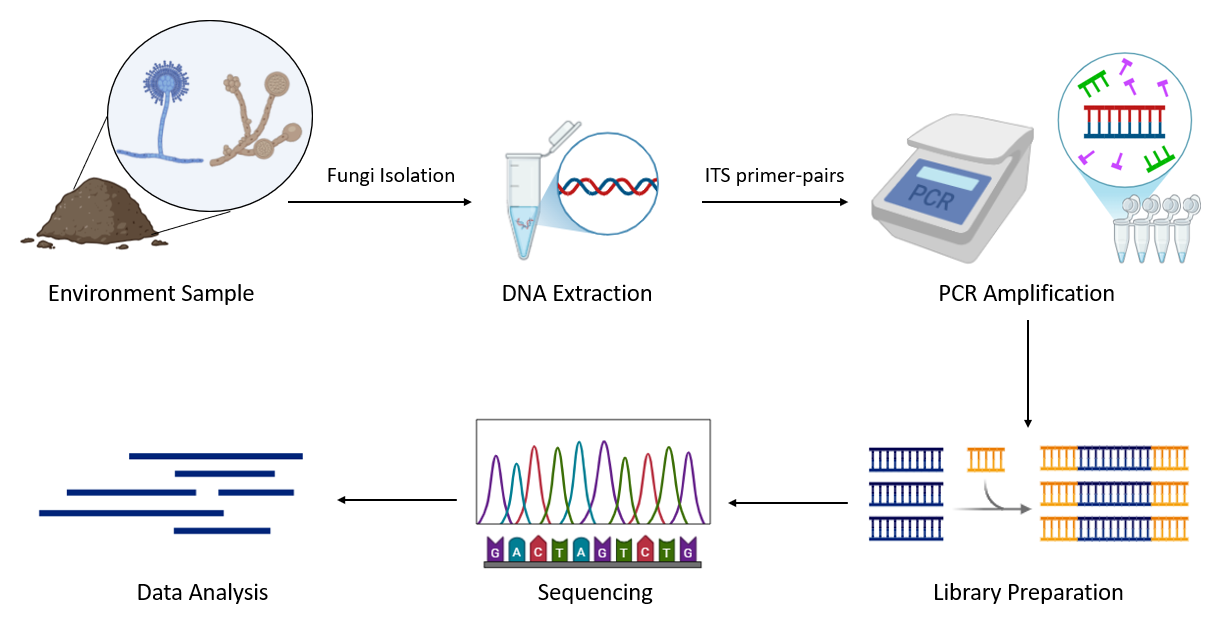
The principle of ITS sequencing is based on amplicon sequencing that targets the non-coding region, the ribosomal ITS region. ITS sequencing reads the genetic information of the ITS region found in fungi to identify and classify fungal species. The ITS region is highly variable but remains conserved for similar organisms. The process of ITS sequencing involves the extraction of DNA from a fungal sample, PCR amplification using an ITS-specific primer pair, sequencing, and bioinformatics analysis.
Fungal Barcoding
The ITS region has been proposed as a universal barcode sequence for fungi because of its wide usage in the molecular biology of fungi. It is easily amplified by PCR with conserved primers. Presently, there are numerous ITS primers available. Some of them are as follows:
| Primer | Sequence (5’ to 3’) |
| Forward Primer | |
| ITS1 | TCCGTAGGTGAACCTGCGG |
| ITS2 | GCTGCGTTCTTCATCGATGC |
| Reverse Primer | |
| ITS2-R | TGTGTTCTTCATCGATG |
| ITS4 | TCCTCCGCITATTGATATGC |
The ITS sequence has more variability between closely related species than other DNA regions, such as DS2. Within the ITS region, the ITS2 is more common as it is known to be more conserved than the ITS1 region. According to the International Barcode of Life Consortium, this region is regarded as a ‘gold standard’ for fungal identification. Moreover, there is a large number of ITS copies per cell (up to 250), which makes it an appealing target for sequencing environmental samples even when the DNA obtained is low.
The sequence alone, however, cannot be used to distinguish fungal species. The ITS sequence is conserved in many fungal species groups, within Sordariomycetes and a few classes of Ascomycota; however, they vary strongly in other groups. To elaborate, for Trichoderma, translation elongation factor 1-alpha (tef1) and RNA polymerase subunit 2 (rpb2) genes need to be sequenced in addition to the ITS region for identification of their species. Therefore, fungal species require other phylogenetic markers for precise identification of their species.
Steps / Methods of ITS Sequencing
Sample Collection and Culture
- The sample from the environment (soil, plant, dead matter, etc.) is collected. The methods for sample collection will differ per the source.
- The fungi are isolated in either Potato Dextrose Agar (PDA) media or in a selective medium as desired. They are sub-cultured to obtain a single fungal species.
DNA Extraction
- DNA extraction of fungal species requires mechanical or enzymatic stress to break the fungal cell wall. One of the most common methods is to grind the fungal tissue with liquid nitrogen. The cell wall can also be disrupted by using small beads and vortexing the sample.
- The DNA is isolated by the use of Cetyltrimethylammonium bromide (CTAB), detergents, enzymes, and lysis buffers. The process involves incubation and centrifugation at specific parameters.
- Lastly, it is purified by chloroform extraction, ethanol purification, or silica columns.
- DNA quantification is done to estimate the amount of DNA extracted.
Polymerase Chain Reaction (PCR) and Library Construction
- The obtained DNA sequence is amplified by the use of ITS primers based on the sample.
- The step involves the optimization and selection of suitable parameters, which include the concentration of reagents and cycle parameters.
- Gel electrophoresis is carried out to determine the PCR amplicons.
- The amplified DNA is then processed to create a library for sequencing. This involves the fragmentation of DNA into shorter segments and the attachment of adaptors to the fragments.
Sequencing
- The DNA library is then sequenced by using Sanger sequencing, Oxford Nanopore, Illumina, Ion Torrent, or PacBio.
- The sequence generates raw data in the form of FASTQ format.
Data analysis
- Bioinformatics tools are used for quality control of the raw data to determine low-quality reads, adaptor contamination, read distribution length, and so on.
- The FASTQ format undergoes several analyses to remove adaptors.
- The sequence reads are then assembled into contigs, i.e., fragments of DNA are assembled by overlapping regions and presenting a consensus sequence. This step requires using a reference sequence of fungi.
- Finally, BLAST is used to identify the best matches in the NCBI database.
Advantages of ITS Sequencing
- ITS sequencing enables precise identification of fungal species within a genus.
- The sequencing method, like 16s rRNA sequencing, is a cost-effective way to identify microbes that may prove to be difficult using traditional methods.
- By using sequencing technology, evolutionary studies such as genetic variation between populations or species can be assessed.
- Methods such as ITS sequencing are amplicon sequencing techniques that target a specified gene or a region of interest of an organism. This enables targeted analysis of the species, rather than computing the whole genome.
Limitations of ITS Sequencing
- The ITS sequence alone cannot be used to distinguish between fungal species. Few fungal groups, such as Trichoderma spp., require genes like tef1 and rpb2 for differentiation.
- ITS sequencing, like other sequencing methods, is prone to DNA contamination from other organisms. Careful isolation of fungal cultures and DNA extraction are critical to ensure high-quality sequencing results.
- PCR requires optimization of specific parameters, which can sometimes be challenging.
- Sequencing data requires analysis and interpretation, which vary depending on the sequencing method. Raw data analysis can be complicated.
- Next Generation Sequencing (NGS) is more accurate, but it is expensive.
Application of ITS sequencing
- ITS sequencing can be used for the identification of fungal families from environmental samples such as soil, trees, decaying matter, gut microbiota, and so on.
- It can be used to study the gut microbiome in animals and their digestion.
- Numerous plant diseases are associated with fungal pathogens. ITS sequencing can be used to diagnose such fungal diseases.
- Fungi are known for the production of a wide range of bioproducts, such as beverages, petroleum, antibiotics, antifungals, etc. ITS sequencing can be used to identify fungi that produce such bioproducts and optimize/up-scale their production in industrial manufacturing.
References
- Ahmed, A. (2016). Analysis of Metagenomics Next Generation Sequence Data for Fungal ITS Barcoding: Do You Need Advanced Bioinformatics Experience? Frontiers in Microbiology, 7. https://doi.org/10.3389/fmicb.2016.01061
- Bellemain, E., Carlsen, T., Brochmann, C., Coissac, E., Taberlet, P., & Kauserud, H. (2010). ITS as an environmental DNA barcode for fungi: An in silico approach reveals potential PCR biases. BMC Microbiology, 10(1), 189. https://doi.org/10.1186/1471-2180-10-189
- Buehler, A. J., Evanowski, R. L., Martin, N. H., Boor, K. J., & Wiedmann, M. (2017). Internal transcribed spacer (ITS) sequencing reveals considerable fungal diversity in dairy products. Journal of Dairy Science, 100(11), 8814–8825. https://doi.org/10.3168/jds.2017-12635
- Dou, K., Lu, Z., Wu, Q., Ni, M., Yu, C., Wang, M., Li, Y., Wang, X., Xie, H., Chen, J., & Zhang, C. (2020). MIST: A Multilocus Identification System for Trichoderma. Applied and Environmental Microbiology, 86(18), e01532-20. https://doi.org/10.1128/AEM.01532-20
- Fathy, W. A., Techen, N., Elsayed, K. N. M., Essawy, E. A., Tawfik, E., Alwutayd, K. M., Abdelhameed, M. S., Hammouda, O., & Ross, S. A. (2023). Applying an internal transcribed spacer as a single molecular marker to differentiate between Tetraselmis and Chlorella species. Frontiers in Microbiology, 14. https://doi.org/10.3389/fmicb.2023.1228869
- Fungal ITS Sequencing Services. (n.d.). Charles River. Retrieved April 20, 2025, from https://www.criver.com/products-services/qc-microbial-solutions/microbial-id-strain-typing/sequencing/fungal-identification
- ITS Sequencing in Microbiological Research: Introduction, Bioinformatics, and Applications—CD Genomics. (n.d.). Retrieved April 17, 2025, from https://www.cd-genomics.com/microbioseq/resource-its-sequencing-in-microbiological-research-introduction-bioinformatics-and-applications
- Letsiou, S., Madesis, P., Vasdekis, E., Montemurro, C., Grigoriou, M. E., Skavdis, G., Moussis, V., Koutelidakis, A. E., & Tzakos, A. G. (2024). DNA Barcoding as a Plant Identification Method. Applied Sciences, 14(4), Article 4. https://doi.org/10.3390/app14041415
- Nilsson, R. H., Ryberg, M., Abarenkov, K., Sjökvist, E., & Kristiansson, E. (2009). The ITS region as a target for characterization of fungal communities using emerging sequencing technologies. FEMS Microbiology Letters, 296(1), 97–101. https://doi.org/10.1111/j.1574-6968.2009.01618.x
- Srinivas, M., Walsh, C. J., Crispie, F., O’Sullivan, O., Cotter, P. D., van Sinderen, D., & Kenny, J. G. (2025). Evaluating the efficiency of 16S-ITS-23S operon sequencing for species-level resolution in microbial communities. Scientific Reports, 15(1), 2822. https://doi.org/10.1038/s41598-024-83410-7
