
The Chelex method of DNA extraction is a rapid, simple, and cost-effective technique primarily developed to obtain PCR-ready DNA from biological samples.
First introduced for forensic applications by Walsh et al. (1991), this method uses Chelex® 100 resin, a chelating ion-exchange resin, to protect DNA from degradation during extraction.
Unlike conventional organic extraction methods such as phenol-chloroform, the Chelex method eliminates the need for hazardous chemicals and lengthy purification steps, making it particularly suitable for forensic, diagnostic, and field-based molecular applications (Walsh et al., 1991; Butler, 2009).
The method has since been widely adapted for diverse sample types, including blood, buccal swabs, tissue fragments, skeletal remains, microbial cultures, and pathogen-infected samples (Singh et al., 2018; Schmerer, 2021; Yang et al., 2024). While the DNA yield and purity may not match column-based or organic extraction techniques, Chelex-extracted DNA is generally sufficient for PCR-based assays, short tandem repeat (STR) typing, and pathogen detection (NIJ, 2023).
Key Reagents of the Chelex Method of DNA Extraction
The Chelex method relies on a minimal set of reagents, which contributes to its simplicity and rapid execution.
| Reagent | Typical Concentration / Amount | Purpose |
| Chelex® 100 resin | 5–10% (w/v) suspension | Chelates divalent metal ions (e.g., Mg²⁺) to inhibit DNases |
| Distilled or nuclease-free water | Variable | Solvent for Chelex suspension and DNA extraction |
| Proteinase K (optional) | 0.1–0.2 mg/mL | Enhances cell lysis and protein digestion |
| Sample material (blood, tissue, swab, etc.) | Variable | Source of genomic DNA |
| Heat (boiling) | 95–100 °C | Cell lysis and DNA release |
The simplicity of this reagent list distinguishes Chelex extraction from more complex protocols and supports its use in low-resource laboratory settings (Butler, 2009; ENGL Guidance Document, 2024).
Principle of the Chelex Method of DNA Extraction
The Chelex method is based on the ability of Chelex® 100 resin to chelate divalent metal ions, particularly magnesium ions (Mg²⁺), which are essential cofactors for DNase activity. During the extraction process, cells are lysed by heat, releasing nucleic acids into the solution. The Chelex resin binds metal ions, thereby inhibiting DNases and protecting DNA from enzymatic degradation during boiling (Walsh et al., 1991).
Importantly, the resin also sequesters metal ions that could otherwise interfere with downstream PCR reactions. After centrifugation, the Chelex resin and cellular debris form a pellet, while the DNA remains in the supernatant. This DNA is not highly purified but is sufficiently intact and inhibitor-free for amplification-based applications (NIJ, 2023; Bio-Rad, 2025).
Steps / Protocol of the Chelex Method of DNA Extraction
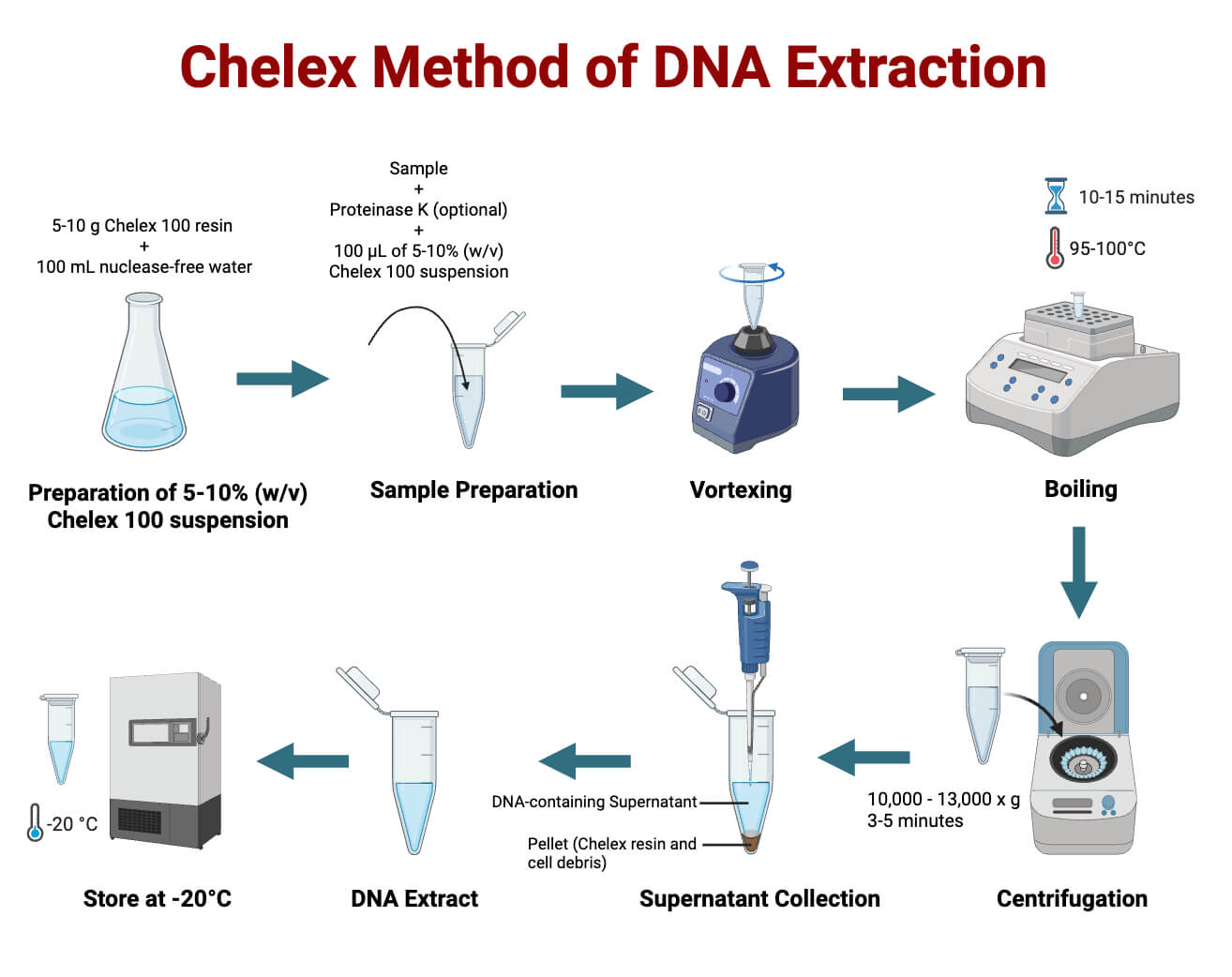
Preparation of Chelex Suspension
- Prepare a fresh Chelex® 100 resin suspension (10% w/v).
-Weigh Chelex resin and add nuclease-free water (e.g., 1 g Chelex to 9 mL water).
-Rationale: Chelex resin chelates divalent cations (e.g., Mg²⁺), inhibiting DNases and preventing degradation during boiling.
- Mix thoroughly.
-Use a magnetic stirrer to keep resin in suspension.
-Tip: Chelex particles settle quickly; constant mixing ensures an even distribution.
Sample Preparation and Pretreatment
- Prepare sample material.
-For tissue or bone: cut into small fragments (~1–2 mm).
-For blood/fresh soft tissue: add directly.
-For swabs: cut the swab tip into the tube.
- Optional Pre-digestion (Proteinase K step).
-Add Proteinase K (0.1–0.2 mg/mL) to improve cell lysis and protein removal.
-Incubate at 56 °C for 1–2 hours (longer for tough tissues).
-Rationale: Proteinase K digestion facilitates the complete release of DNA from cells and partially degrades protein contaminants that might later inhibit PCR.
- Vortex briefly after Proteinase K addition to ensure contact between the sample and Chelex resin.
Heat-Lysis Extraction
- Heat the sample + Chelex mixture:
-Place tubes in a heat block or thermocycler set to 95–100 °C for 10–15 minutes.
-Interrupt the heating halfway (every 5 minutes) with a brief vortex to improve lysis.
-Rationale: High temperature lyses cells, denatures proteins, and releases DNA into solution.
- Cool to room temperature.Minimizes shearing and helps resin settle.
Separation and Recovery
- Centrifuge at high speed (10,000–14,000g) for 3–5 minutes.
-Resin and debris form a pellet; DNA remains in the supernatant.
- Carefully transfer the supernatant (DNA lysate) to a clean tube without disturbing the resin.
-Avoid resin carryover (Chelex in PCR reactions can inhibit amplification).
-Rationale: Resin beads chelate Mg²⁺; carryover reduces PCR efficiency.
(Walsh et al., 1991; Butler, 2009; Yang et al., 2024; Schmerer, 2021)
Modifications of the Chelex Method of DNA Extraction
Several protocol modifications have been proposed to improve DNA quality and applicability:
- Proteinase K pre-digestion: Improves DNA yield and reduces protein contamination, especially from blood and tissue samples (Singh et al., 2018).
- Extended incubation time: Enhances DNA recovery from difficult samples such as aged or degraded tissues (Schmerer, 2021).
- Lower Chelex concentration: Reduces PCR inhibition when very small DNA quantities are required (NIJ, 2023).
- Automation: Partial automation has been explored for high-throughput forensic workflows (Liu et al., 2023).
Troubleshooting of the Chelex Method of DNA Extraction
| Problem | Likely Cause | Solution |
| Poor PCR amplification | Chelex carryover in DNA | Avoid disturbing resin pellet |
| Low DNA yield | Incomplete lysis | Increase boiling time or add Proteinase K |
| DNA degradation | Insufficient chelation | Ensure correct Chelex concentration |
| PCR inhibition | Excess Chelex resin | Further dilute DNA sample |
| Variable results | Inconsistent resin mixing | Vortex Chelex suspension thoroughly |
These issues are commonly encountered and can be addressed with careful handling and protocol optimization (NIJ, 2023; ENGL Guidance Document, 2024).
Quality Assessment of the Chelex Isolated DNA
- Spectrophotometry: A260/A280 ratios are often inaccurate and have limited use due to residual proteins and resin (Butler, 2009).
- PCR amplification: The most reliable indicator of Chelex DNA quality, as spectrophotometric ratios are often unreliable due to impurities (Walsh et al., 1991).
- Gel electrophoresis: Typically shows smearing rather than high-molecular-weight bands, reflecting partial fragmentation.
- Quantitative PCR (qPCR): Used in forensic settings to estimate amplifiable DNA (NIJ, 2023).
Safety Tips and Precautions of the Chelex Method of DNA Extraction
- Avoid Chelex inhalation or contact: The resin is a fine particulate material and should be handled carefully.
- Use heat-resistant tubes: Boiling steps require appropriate labware to prevent tube deformation.
- Prevent resin carryover: Chelex particles inhibit PCR if transferred into the DNA solution.
- Follow biosafety practices: Particularly for forensic and pathogen-containing samples (NIJ, 2023; ENGL Guidance Document, 2024).
Storage and Long‑Term Stability of Chelex Isolated DNA
- Short-term storage (4 °C): Chelex-extracted DNA is best used shortly after extraction. Suitable for immediate PCR use within 24–48 hours.
- Long-term storage (−20 °C): DNA degradation is slowed but not completely prevented. Because Chelex extracts lack buffering agents and purification steps, DNA stability decreases over time, making them unsuitable for prolonged storage or archival purposes.
- Avoid repeated freeze–thaw cycles: Doing so accelerates DNA fragmentation and reduces amplification efficiency. Aliquoting samples before freezing is recommended to preserve DNA integrity (Butler, 2009).
Applications of the Chelex Method of DNA Extraction
- Forensic DNA profiling: Particularly for short tandem repeat (STR) analysis from blood, saliva, and trace evidence. Its rapid processing time and PCR compatibility make it suitable for low-template and degraded samples, while minimal handling reduces the risk of contamination and sample loss (Walsh et al., 1991).
- Pathogen detection: Rapid DNA extraction is essential for timely diagnosis and disease surveillance. In aquaculture and microbial studies, Chelex extraction enables fast, cost-effective processing of samples and provides DNA of sufficient quality for PCR-based detection of pathogens (Yang et al., 2024).
- Educational laboratories: Teaching basic DNA extraction principles due to low cost.
- Field-based diagnostics: Suitable as it requires minimal equipment and reagents, and offers rapid turnaround. This makes it particularly useful for preliminary screening and on-site analyses where laboratory infrastructure is limited (ENGL Guidance Document, 2024).
Advantages of the Chelex Method of DNA Extraction
- Rapid and simple workflow: Allows DNA extraction to be completed within a short time frame using minimal procedural steps. This simplicity reduces hands-on time and minimizes opportunities for sample contamination or loss during processing.
- Cost-effective: It requires inexpensive reagents and basic laboratory equipment. This makes Chelex extraction particularly suitable for high-throughput screening, educational laboratories, and low-resource settings where budget constraints are a concern.
- No hazardous chemicals: Eliminates phenol and chloroform use. This improves laboratory safety, simplifies waste disposal, and makes the protocol more accessible for routine use and student training.
- PCR-compatible DNA: Which is the primary requirement for many forensic, diagnostic, and research applications. Despite limited purity, the extracted DNA is generally sufficient for reliable amplification and downstream analysis (Walsh et al., 1991; Butler, 2009).
Limitations of the Chelex Method of DNA Extraction
- Low DNA purity: The protocol does not include washing or purification steps. Residual proteins, cellular debris, and chelating resin remain in the extract, making it unsuitable for high-resolution applications such as next-generation sequencing or long-read sequencing (Liu et al., 2023).
- DNA fragmentation: High-temperature lysis can shear DNA. While fragmented DNA is adequate for short amplicon PCR and STR analysis, it limits the applicability of Chelex extraction for studies requiring intact, high-molecular-weight DNA.
- Not suitable for long-term storage: The lack of stabilizing buffers and purification leads to faster degradation over time compared to DNA obtained using column-based or organic methods. As a result, the extracts are best used shortly after preparation.
- PCR inhibition risk: Chelex carryover can inhibit enzymatic reactions. Since Chelex strongly chelates magnesium ions required for DNA polymerase activity, careful handling and dilution strategies are necessary to ensure reliable amplification (NIJ, 2023).
Conclusion
The Chelex method of DNA extraction remains a valuable technique for rapid, low-cost DNA preparation, particularly in forensic, diagnostic, and educational settings. Although it does not produce highly purified or high-molecular-weight DNA, its simplicity, safety, and effectiveness for PCR-based applications have ensured its continued relevance for over three decades. With appropriate modifications and careful handling, the Chelex method provides a reliable solution where speed, affordability, and practicality are prioritized over maximum DNA purity.
References
- Butler, J. M. (2009). DNA extraction from forensic samples using Chelex (Protocol). Cold Spring Harbor Protocols. https://doi.org/10.1101/pdb.prot5229
- Guidance Document on DNA extraction methods (ENGL). (2024). European Commission Joint Research Centre. https://gmo-crl.jrc.ec.europa.eu/doc/ENGL%20Guidance%20on%20DNA%20extraction.pdf
- Liu, A. W., Villar-Briones, A., Luscombe, N. M., et al. (2023). Automated phenol-chloroform extraction of high-molecular-weight genomic DNA for use in long-read single-molecule sequencing (includes a Chelex comparison) [Preprint]. bioRxiv. https://doi.org/10.1101/2023.05.12.540123
- National Institute of Justice. (2023). DNA extraction and quantitation for forensic analysts: Chelex® 100 extraction. https://nij.ojp.gov/nij-hosted-online-training-courses/dna-extraction-and-quantitation-forensic-analysts/chelexr-100-extraction
- Bio-Rad Laboratories. (2025). Chelex 100 resin for DNA and RNA sample preparation [Technical note]. https://www.bio-rad.com/en-us/feature/Chelex-100-Resin-for-Viral-RNA-Preparation-for-COVID-19-Detection.html
- Schmerer, W. M. (2021). Optimized protocol for Chelex-based extraction of DNA from historical skeletal remains and forensic trace samples [Preprint]. Research Square. https://doi.org/10.21203/rs.3.pex-1652/v1
- Singh, U. A., Kumari, M., & Iyengar, S. (2018). Method for improving the quality of genomic DNA obtained from minute quantities of tissue and blood samples using Chelex 100 resin. Methods, 136, 13–22. https://doi.org/10.1186/s12575-018-0077-6
- Yang, H., et al. (2024). Chelex-100 DNA extraction for shrimp pathogen detection: A simple, rapid, and cost-effective method. Journal of Invertebrate Pathology. https://doi.org/10.1016/j.jip.2024.108012
- Walsh, P. S., Metzger, D. A., & Higuchi, R. (1991). Chelex® 100 as a medium for simple extraction of DNA for PCR-based typing from forensic material. BioTechniques, 10(4), 506–513. https://doi.org/10.2144/000114018
- Chauhan, T. (2018, October 21). 10 different types of DNA extraction methods (updated). Genetic Education. https://geneticeducation.co.in/10-different-types-of-dna-extraction-methods-updated/
- Brown, T. A. (2020). Gene cloning and DNA analysis: An introduction (8th ed.). Wiley-Blackwell.
- Kathmandu University. (2025). Phenol–chloroform extraction manual for human urine samples. Unpublished laboratory protocol.
