
The principle of cDNA synthesis revolves around using a DNA polymerase that can interpret an RNA template to generate a complementary DNA strand. Reverse transcriptase catalyzes the addition of deoxynucleotide triphosphates to the 3′ end of a primer that is annealed to the RNA template.
The enzyme moves along the RNA, synthesizing a DNA strand that is complementary to the RNA sequence. Because the reaction is dependent on an RNA template and a primer, primer choice and annealing conditions influence the representation of transcripts within the cDNA pool.
In most cDNA synthesis workflows, the first strand of cDNA is generated by reverse transcription. In some applications, such as the construction of cDNA libraries or complete double-stranded cDNA synthesis, an additional step is required to synthesize the second DNA strand. The RNA of the RNA-DNA hybrid can be degraded enzymatically (e.g., via RNase H activity) or by denaturation; the remaining DNA is then used as a template for DNA polymerase to produce a complementary DNA strand.
The quality and fidelity of cDNA synthesis are governed by enzyme properties such as processivity (ability to synthesize long DNA strands without dissociating) and thermostability (ability to function at high temperatures to reduce RNA secondary structures). Higher reaction temperatures can reduce the occurrence of inhibitory secondary structures in RNA, improving full-length cDNA yield from complex templates.
Key Reagents of cDNA Synthesis from RNA
| Reagent | Typical Concentration / Amount | Purpose |
| Total RNA | 1 ng–1 µg per reaction | Template for cDNA synthesis |
| Reverse Transcriptase | 200 U per 20 µL reaction | Synthesizes cDNA from RNA |
| Oligo(dT) Primer | 1 µL of 50 µM | Targets poly(A) mRNA |
| Random Hexamer Primers | 1 µL of 50 ng/µL | Enables random priming |
| Gene-Specific Primer | 1 µL of 10 µM | Targets specific RNA |
| dNTP Mix | 1 µL of 10 mM each | Supplies DNA building blocks |
| 5× RT Buffer | 4 µL per 20 µL reaction | Maintains optimal conditions |
| MgCl₂ | 2 µL of 25 mM (if required) | Enzyme cofactor |
| DTT | 2 µL of 0.1 M | Stabilizes enzyme |
| RNase Inhibitor | 20–40 U per reaction | Prevents RNA degradation |
| RNase H (optional) | 1–2 U per reaction | Removes RNA template |
| Nuclease-Free Water | Variable | Adjusts final volume |
Principle of cDNA Synthesis from RNA
cDNA synthesis is based on the process of reverse transcription, in which RNA is enzymatically converted into complementary DNA (cDNA) using an RNA-dependent DNA polymerase known as reverse transcriptase. In this method, purified RNA, typically messenger RNA (mRNA), acts as the template, while a short DNA primer anneals to a complementary region on the RNA to initiate synthesis. Reverse transcriptase then extends the primer by incorporating deoxynucleotide triphosphates (dNTPs), producing a DNA strand that is complementary to the RNA sequence.
The choice of primer plays a critical role in determining the nature of the cDNA produced. Oligo(dT) primers bind to the poly(A) tail of eukaryotic mRNA, enabling selective synthesis of cDNA from mature transcripts. Random hexamer primers anneal at multiple positions along RNA molecules, allowing broad representation of transcripts, including fragmented RNA. Gene-specific primers initiate cDNA synthesis only from targeted RNA sequences, enabling focused analysis of specific genes.
Reverse transcription efficiency and fidelity depend on enzyme characteristics such as processivity and thermostability, as well as optimized reaction conditions including temperature, buffer composition, and magnesium ion concentration. Elevated reaction temperatures help reduce RNA secondary structures, improving full-length cDNA synthesis.
The resulting first-strand cDNA can be used directly for PCR-based applications or further processed to generate double-stranded cDNA for cloning and sequencing, thereby enabling stable and precise analysis of gene expression.
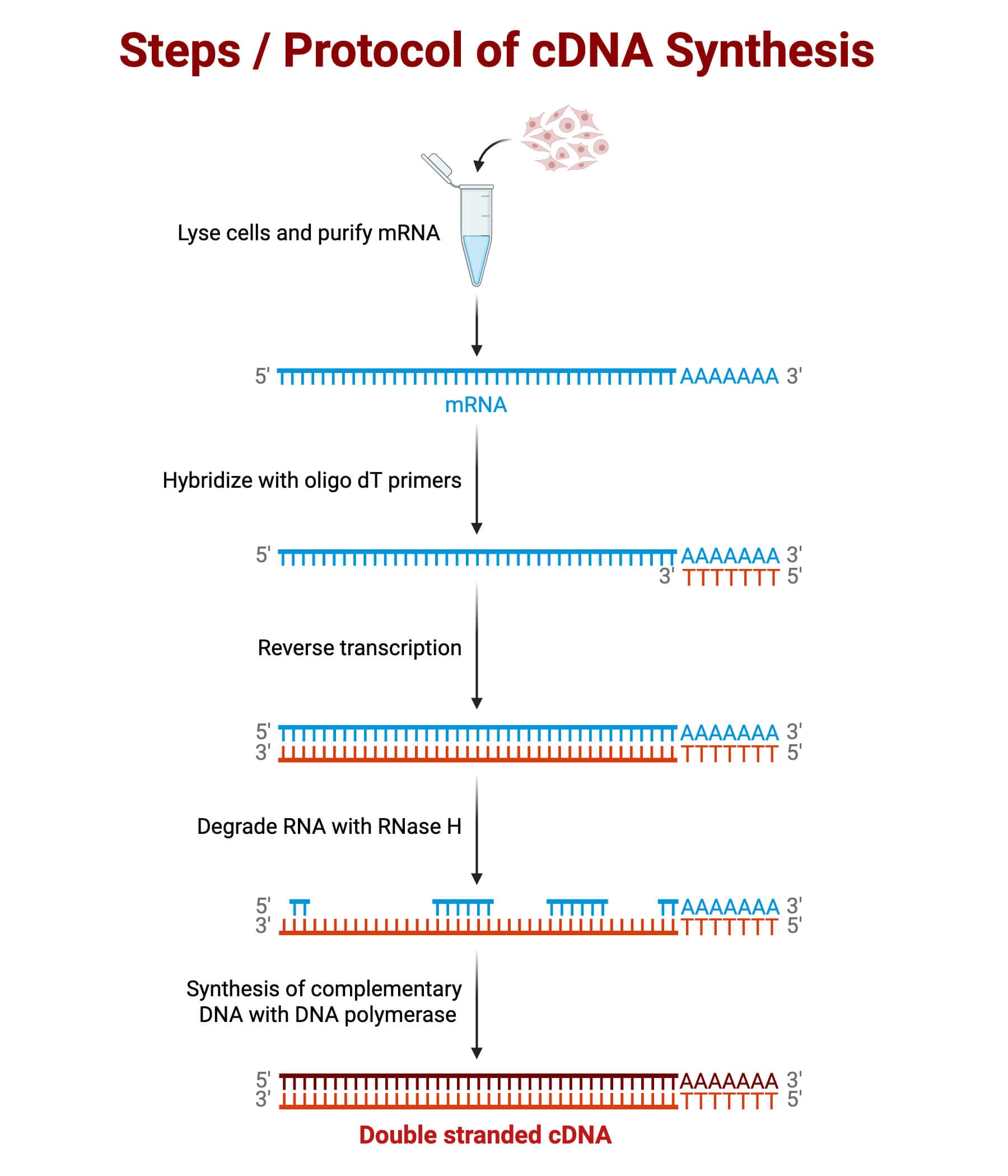
Steps / Protocol of cDNA Synthesis from RNA
Preparation of RNA Template
- Use 1 ng–1 µg of total RNA per reaction (typical: 500 ng–1 µg).
- Ensure RNA is dissolved in RNase-free water.
- RNA purity requirement: A260/A280 ratio: 1.8–2.1
- Optional DNase treatment:
-Incubate RNA with DNase at 37 °C for 15–30 min
-Heat-inactivate DNase at 65 °C for 10 min (if applicable).
Primer Annealing
Prepare the following mixture in an RNase-free PCR tube (final volume 10 µL):
- Total RNA: up to 1 µg
- Primer (choose one):
-Oligo(dT) (50 µM): 1 µL
-Random hexamers (50 ng/µL): 1 µL
-Gene-specific primer (10 µM): 1 µL
- dNTP mix (10 mM each): 1 µL
- Nuclease-free water: to 10 µL
- Incubation:
-Heat mixture at 65 °C for 5 min
-Immediately chill on ice for at least 1 min
Purpose: Denatures RNA secondary structures and promotes efficient primer binding.
Preparation of Reverse Transcription Master Mix
Prepare the following 10 µL master mix per reaction on ice:
- 5× Reverse Transcription Buffer: 4 µL
- MgCl₂ (25 mM): 2 µL (if not included in buffer)
- DTT (0.1 M): 2 µL
- RNase Inhibitor (20–40 U/µL): 1 µL (20–40 U)
- Reverse Transcriptase enzyme (200 U/µL): 1 µL (200 U)
First-Strand cDNA Synthesis
- Add 10 µL master mix to the 10 µL primer-annealed RNA.
- Final reaction volume: 20 µL
- Gently mix and briefly centrifuge.
- Incubation conditions (typical for M-MLV or equivalent RT):
- Primer extension: 25 °C for 10 min (only required for random primers)
- Reverse transcription: 42 °C for 50–60 min
- Enzyme inactivation: 70–85 °C for 5–10 min
- Hold at 4 °C
Optional RNA Template Removal
- Add 1 µL RNase H (2 U) to the reaction.
- Incubate at 37 °C for 20 min
Purpose: Removes RNA from RNA–cDNA hybrids to improve downstream PCR efficiency.
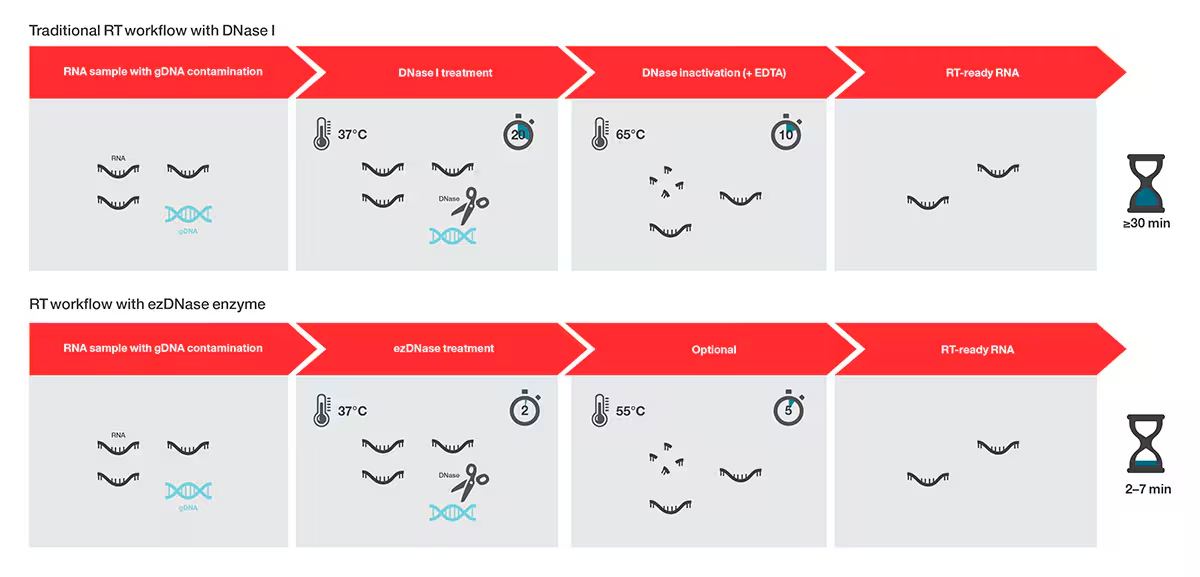
Source: Thermo Fisher Scientific.
Observations and Results
Successful cDNA synthesis results in the efficient conversion of RNA into complementary DNA suitable for downstream molecular analyses. High-quality cDNA is indicated by reliable PCR or RT-qPCR amplification, with consistent Ct/Cq values across replicates, reflecting uniform reverse transcription efficiency. When analyzed by agarose gel electrophoresis, properly synthesized cDNA typically appears as a smear within the expected size range rather than distinct degradation products. Minimal or no amplification in no-RT controls confirms the absence of genomic DNA contamination, while successful amplification of both 5′ and 3′ regions of transcripts suggests effective full-length cDNA synthesis.
In contrast, poor outcomes such as low cDNA yield, high Ct values, or non-specific amplification patterns indicate issues including degraded RNA, residual inhibitors, inefficient primer annealing, or suboptimal reaction conditions. These observations highlight the importance of RNA quality assessment and careful optimization of reverse transcription parameters to ensure reliable experimental results.
Modifications of cDNA Synthesis from RNA
To improve cDNA quality and yield, several operational modifications can be implemented:
- Increase initial RNA amount: Using more input RNA (within enzyme capacity) increases available template, especially for low-expression targets.
- Optimize primer strategy: Try switching between oligo(dT), random hexamers, or a combination of both, depending on transcript type; mixed primers often broaden transcript representation.
- Denaturation before reverse transcription: Pre-incubating RNA with primers at elevated temperature (e.g., ~70°C for 5–10 minutes) helps reduce secondary structures that inhibit enzyme progression.
- Adjust reaction temperature: Some reverse transcriptases tolerate higher temperatures (e.g., up to 55°C) to melt RNA secondary structures, improving synthesis of difficult templates.
- Prolong RT incubation time: Extending the time for reverse transcriptase activity enhances the synthesis of longer transcripts.
Each of these modifications must be tested empirically, as their efficacy depends on template quality, length, and GC content.
Troubleshooting of cDNA Synthesis from RNA
A troubleshooting table summarises common problems, likely causes, and solutions encountered in the cDNA synthesis workflow:
| Problem | Likely Cause | Solution |
| Low or no cDNA yield | Degraded RNA | Check RNA integrity (agarose gel or RIN); re-extract if needed. |
| Reaction inhibitors present (salts, guanidine, phenol) | Re-purify RNA via precipitation (ethanol/LiCl) or alternative protocol. | |
| Secondary structures in RNA | Increase reaction temperature; pre-denature RNA/primers. | |
| High Ct in RT-qPCR | Inhibitory contaminants or inefficient RT | Dilute cDNA before PCR or optimize enzyme and primer concentrations. |
| Smears/non-specific PCR products | Primer dimers or off-target priming | Redesign primers; adjust reaction temperature and template amounts. |
| Inconsistent results | Variable RNA quality | Standardize RNA extraction and quantify purity (A260/A280, A260/A230). |
Quality Assessment of the Isolated cDNA
Monitoring the quality of cDNA after synthesis is essential to ensure downstream reliability. Key assessment points include:
- Agarose Gel Electrophoresis: Visualizes distribution and integrity of cDNA products; a smear of expected sizes suggests successful full-length synthesis.
- Spectrophotometric Ratios: Although less informative for cDNA than RNA, unusually low 260/280 ratios may indicate impurities.
- RT-qPCR Control Genes: Consistent Ct values for housekeeping genes (e.g., GAPDH) across samples suggest uniform cDNA synthesis.
- No-RT and No-Template Controls: Confirm absence of genomic DNA contamination and reagent contamination, respectively.
These checks help validate that cDNA reflects the original RNA population and is suitable for analysis.
Safety Tips and Precautions of cDNA Synthesis from RNA
cDNA synthesis protocols involve handling biological samples and enzymes. Important safety practices include:
- Wear appropriate PPE: Lab coat, gloves, and eye protection throughout all steps.
- Use RNase-free consumables: To prevent RNA degradation, use dedicated RNase-free tubes, tips, and reagents.
- Work in clean conditions: Wipe down benches with RNase-decontaminating solutions before starting.
- Proper disposal: Follow institutional biosafety guidelines for disposing of biological waste.
- Avoid cross-contamination: Use filter tips and separate aliquots for pre- and post-RT steps.
These precautions minimize contamination risks and protect both the researcher and the experiment’s integrity.
Storage and Long‑Term Stability of Isolated cDNA
Ensuring cDNA stability is important for reproducible results:
- Short-term storage: Store cDNA at 4°C for up to 24–48 hours if immediate analysis is planned.
- Long-term storage: Freeze at –20°C to –80°C; aliquot to avoid repeated freeze–thaw cycles.
- Labeling and tracking: Clearly label tubes with sample ID and date to prevent mix-ups.
- Protect from nucleases: Use nuclease-free water and consumables to maintain integrity.
Applications of cDNA Synthesis from RNA
- RT-qPCR: Quantitative measurement of gene expression levels in biological samples by amplifying cDNA templates.
- Cloning and Sequencing: cDNA serves as a template for cloning full or partial gene sequences into vectors for further analysis.
- cDNA Library Construction: Pools of cDNA represent transcriptomes used for high-throughput sequencing and gene discovery.
- Transcriptome Analysis: cDNA is fundamental for RNA-seq and profiling of transcript abundance across conditions.
- Diagnostic Assays: Detection of pathogen RNA (e.g., viral genomes) by converting to cDNA for amplification.
Advantages of cDNA Synthesis from RNA
- Stabilizes RNA information: Converts labile RNA into stable DNA for downstream manipulation.
- Enables sensitive detection: Facilitates detection of low-abundance transcripts through amplification.
- Broad applicability: Used in PCR, qPCR, sequencing, and cloning workflows.
- Flexibility in primer choice: Users can tailor priming to full-length, targeted, or broad transcript coverage.
- Compatibility with difficult templates: Thermostable enzymes allow synthesis from GC-rich or structured RNA regions.
Limitations of cDNA Synthesis from RNA
- Dependent on RNA quality: Degraded or contaminated RNA severely reduces yield and representation.
- Primer biases: Different primer types can skew transcript coverage.
- Enzyme limitations: Some reverse transcriptases may struggle with long or structured templates without optimization.
- Inhibitors from samples: Residual extraction chemicals (salts, phenol) can inhibit reaction efficiency.
- Quantitative variability: Without proper controls, quantification may be imprecise.
Conclusion
cDNA synthesis from RNA is a molecular biology technique that converts transient RNA messages into stable DNA suitable for PCR, sequencing, and expression analyses.
Despite its power, the method demands careful attention to RNA quality, primer strategy, enzyme and buffer conditions, and avoidance of inhibitors. With systematic troubleshooting and adherence to best practices, high-quality cDNA can be reliably produced, enabling meaningful biological insights across research and clinical applications.
References
- Thermo Fisher Scientific. (n.d.). Reverse transcription basics. https://www.thermofisher.com/np/en/home/life-science/cloning/cloning-learning-center/invitrogen-school-of-molecular-biology/rt-education/reverse-transcription-basics.html
- Thermo Fisher Scientific. (n.d.). Reverse transcription setup. https://www.thermofisher.com/np/en/home/life-science/cloning/cloning-learning-center/invitrogen-school-of-molecular-biology/rt-education/reverse-transcription-setup.html
- Walsh Medical Media. (n.d.). An overview on RNA isolation and complementary DNA (cDNA) synthesis. https://www.walshmedicalmedia.com/open-access/an-overview-on-rna-isolation-and-complementary-dna-cdna-synthesis-131440.html
- CD-Genomics. (n.d.). cDNA synthesis: An overview. https://www.cd-genomics.com/resource-overview-cdna-synthesis.html
- Sigma-Aldrich. (n.d.). Standard reverse transcription protocol (two-step). https://www.sigmaaldrich.com/NP/en/technical-documents/protocol/genomics/pcr/standard-reverse-transcription-protocol-two-step
- PCR Biosystems. (n.d.). What troubleshooting is there for low cDNA yield? https://pcrbio.com/usa/resources/faqs/ultrascript-reverse-transcriptase/what-troubleshooting-is-there-for-low-cdna-yield-2/
- PCR Biosystems. (n.d.). Tips and tricks for cDNA synthesis. https://pcrbio.com/tips-and-tricks-for-cdna-synthesis/
- ZAGENO. (n.d.). cDNA synthesis troubleshooting. https://go.zageno.com/blog/cdna-synthesis-troubleshooting

thanks for sharing