The boiling method of DNA extraction is one of the simplest, fastest, and most cost-effective procedures for isolating nucleic acids from biological samples.
Unlike conventional chemical extraction methods, such as phenol-chloroform extraction or silica-based column purification, the boiling approach relies primarily on exposing cells to high temperatures to achieve lysis and DNA release (Dimitrakopoulou et al., 2020; Shin et al., 2021). This technique is especially applicable for laboratories with limited resources, point-of-care diagnostics, and rapid screening workflows.
Across various fields (food microbiology, macroalgal identification, clinical diagnostics, and environmental DNA studies), the boiling method has been adapted to meet diverse extraction needs. Its simplicity and reproducibility have made it a useful alternative to commercial kits, particularly when objective outcomes depend mainly on DNA amplification quality rather than high-molecular-weight purity (Khan, Mansour, & El Samak, 2025).

Key Reagents of the Boiling Method of DNA Extraction
Although minimalistic, the boiling method includes some crucial reagents that ensure cell lysis, DNA stability, and compatibility with downstream PCR-based assays. Modifications to this method often incorporate buffers, detergents, or stabilizers to enhance output DNA integrity (Shin et al., 2021; Lim et al., 2022).
| Reagent | Typical Concentration / Amount | Purpose |
| Sterile distilled water or TE buffer | 20–100 µL | Hydration of the sample maintains DNA stability; prevents nuclease degradation |
| Lysis buffer (optional) | Variable (e.g., Tris-EDTA, low-salt) | Enhances cell disruption and DNA solubility |
| Detergent (optional; e.g., SDS, Tween-20) | 0.1–1% | Disrupts cell membranes and denatures proteins |
| Heating at 95–100°C | 5–20 minutes | Thermal lysis of cells; protein denaturation; DNA release |
| Optional RNase | 10–20 µg/mL | Removal of RNA contaminants |
| Optional proteinase K (pre-boiling step) | 50–200 µg/mL | Enhances lysis for tough samples such as fungi or tissues (Sepp et al., 1994) |
Principle of the Boiling Method of DNA Extraction
The underlying principle of boiling-based DNA extraction is thermal lysis, in which exposure to high temperatures disrupts cell membranes, denatures structural proteins, and releases genomic material into the supernatant. Heating at 95–100°C for several minutes breaks hydrogen bonds, increases membrane fluidity, and causes intracellular macromolecules to spill out.
The DNA remains stable during boiling because of its robust phosphodiester backbone; however, prolonged heating can lead to fragmentation. Hence, optimized boiling periods (5–10 minutes) are generally recommended (Dimitrakopoulou et al., 2020). Some variants integrate low-ionic-strength buffers or detergents to facilitate the lysis of bacteria, yeasts, algae, or clinical pathogens such as Candida spp. (Lim et al., 2022).
Because this method does not rely on organic solvents or solid-phase matrices, the final extract may contain inhibitors or degraded proteins. Nevertheless, for PCR-based workflows, the method is frequently adequate and validated by multiple studies (Shin et al., 2021; Lim et al., 2022).
Steps / Protocol of the Boiling Method of DNA Extraction
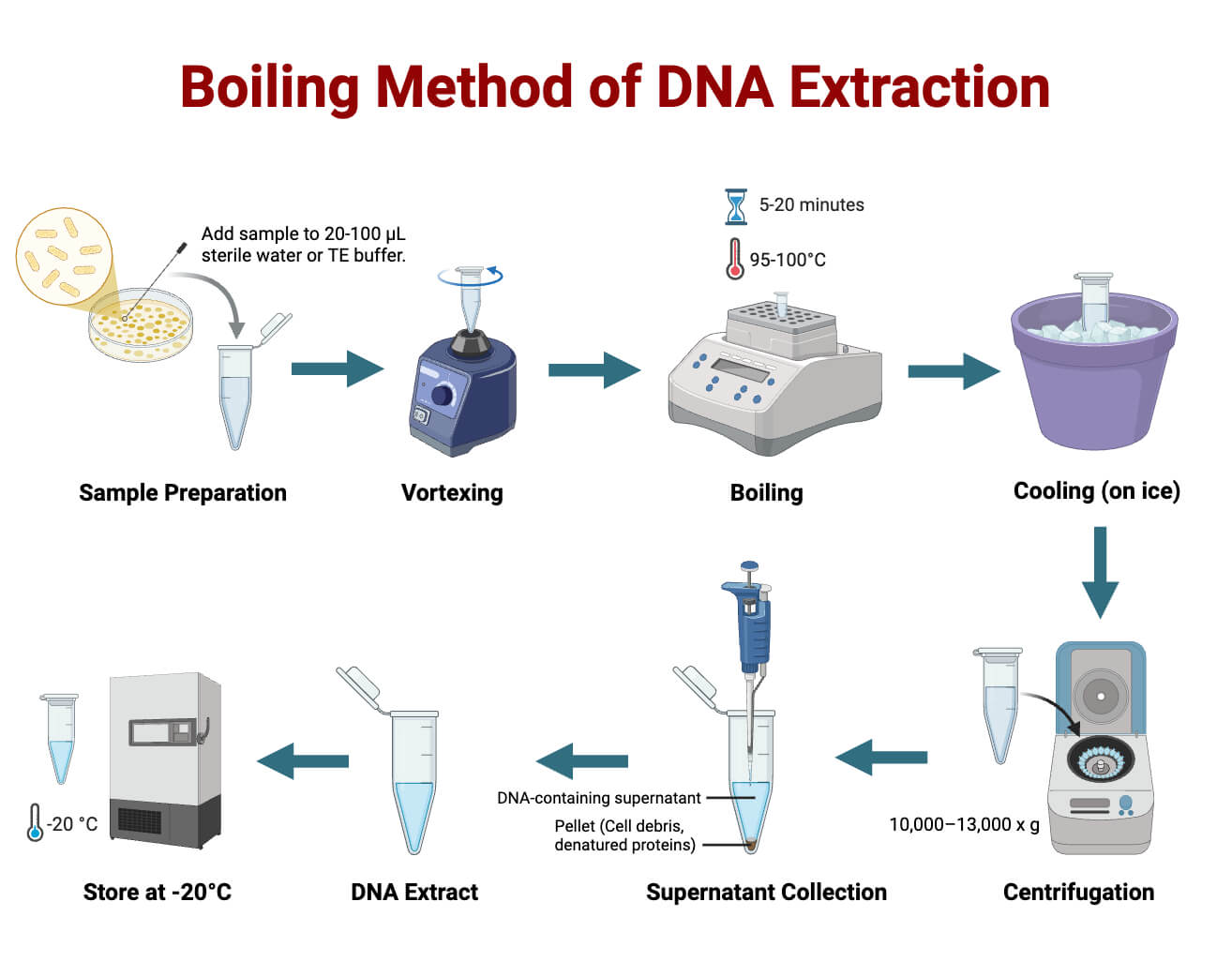
The general protocol below is based on procedures described by Dimitrakopoulou et al. (2020), Shin et al. (2021), Lim et al. (2022), and the Cold Spring Harbor Laboratory (2017):
Sample Preparation:
Transfer bacterial colonies, tissue fragments, or algal material into a sterile microcentrifuge tube. Add 20–100 µL of sterile water or TE.
Mixing:
Vortex briefly to create a uniform suspension.
Boiling:
Heat the tube at 95–100°C for 5–20 minutes, depending on the sample. This step lyses the cells and denatures proteins.
Cooling and Centrifugation:
Let the tube cool on ice for a few minutes, then centrifuge at high speed (10,000–13,000g) to remove debris.
Collection of DNA-Containing Supernatant:
Carefully transfer the clear supernatant to a new tube. Avoid disturbing the pellet.
Storage or Use:
Use the extracted DNA immediately for PCR or store it at −20°C.
For tougher samples, such as archival tissues, proteinase K is often added before boiling (Sepp et al., 1994).
Modifications of the Boiling Method of DNA Extraction
- Chelex-Assisted Boiling Extraction: This modification incorporates Chelex-100, a chelating resin that binds divalent metal ions such as Mg²⁺, which are required for nuclease activity. By removing these ions during the boiling step, Chelex helps prevent DNA degradation and improves the stability of the extracted nucleic acids. The approach is especially helpful for samples prone to nuclease-driven DNA loss, such as blood, fungal cells, or partially degraded specimens. Although the DNA obtained is still crude, it is generally cleaner and more PCR-compatible than extracts produced by boiling alone, making this variation valuable in both research and teaching laboratories.
- Boiling-Only Macroalgal DNA Extraction: This adaptation uses heat as the sole lysis method, allowing DNA to be isolated without detergents or chemical reagents. It is particularly useful for laboratories working with macroalgae where simplicity and minimal reagent dependence are priorities (Shin et al., 2021).
- Detergent-Assisted Boiling Method: In this variation, mild detergents are incorporated into the boiling step to help disrupt tough or resilient cell walls. This modification improves DNA release in organisms with rigid cellular structures and is commonly used in microbiological applications.
- Boiling–Hot-Water Variant in Automated Workflows: Integrated into automated phenol-chloroform extraction pipelines, this approach uses a brief boiling step to enhance cell disruption. While effective, it has limitations because excessive heat can shear DNA, making it less suitable for long-read sequencing technologies (Liu, Villar-Briones, & Luscombe, 2022).
- Boiling-Based Extraction for Candida: This version was optimized specifically for Candida species to support rapid diagnostic workflows such as LAMP assays. Its strength lies in generating DNA quickly without the need for extensive purification steps (Lim et al., 2022).
- Rapid Boiling Method for FFPE Tissues: Developed for formalin-fixed, paraffin-embedded (FFPE) tissue samples, this modification enables fast DNA release despite chemical crosslinking in the tissue matrix. It is valuable in clinical or archival sample analysis where time and sample integrity are of importance (Sepp et al., 1994).
- Boiling Step Within Phenol-Chloroform Protocols: Some phenol-chloroform extraction procedures incorporate a short boiling step to strengthen cell lysis before organic extraction. This small adjustment has been shown to improve DNA yield in both classic and modern workflows (Cold Spring Harbor Laboratory, 2017; Gand et al., 2023).
Troubleshooting of the Boiling Method of DNA Extraction
| Problem | Likely Cause | Solution |
| Weak or no PCR amplification | Presence of inhibitors; inadequate lysis | Dilute DNA 1:10; increase boiling time; include detergent or proteinase K |
| DNA appears smeared or fragmented | Over-boiling | Reduce incubation time; use TE buffer |
| Low DNA yield | Incomplete cell lysis | Ensure thorough mixing; increase boiling temperature or duration |
| RNA contamination | No RNase step | Add RNase treatment |
| Pellet disruption during transfer | Improper pipetting | Aspirate carefully; use low-retention tips |
| DNA degradation during storage | Repeated freeze–thaw cycles | Aliquot DNA; store at −20°C or −80°C |
Quality Assessment of the Boiling Isolated DNA
- Spectrophotometric Analysis: Quantification using absorbance at 260 nm remains standard, although A260/A280 ratios from boiled extracts often fall below the ideal range. This reduced purity reflects residual proteins and cell debris, yet several studies report that such DNA remains sufficiently clean for amplification-based applications (Dimitrakopoulou et al., 2020).
- Gel Electrophoresis: When visualized on agarose gels, boiled DNA frequently appears as a smear rather than distinct high-molecular-weight bands. This pattern is expected because high heat leads to partial shearing. Despite the apparent fragmentation, the DNA fragments typically fall within sizes compatible with routine PCR workflows.
- PCR Performance: Functional validation through PCR is considered the most reliable indicator of extract usability. Shin et al. (2021) showed that even though boiled DNA is not highly purified, it still works reliably for PCR and can accurately identify species. This highlights how dependable the method is for both diagnostic and ecological studies.
- LAMP-Based Amplification: The method has also been validated for isothermal techniques. Lim et al. (2022) showed that boiled DNA performs effectively in LAMP assays, yielding strong amplification signals suitable for rapid, field-friendly diagnostics.
- Sequencing Compatibility: While adequate for targeted amplification, boiled DNA is suboptimal for workflows requiring long, intact molecules. Studies indicate that heat-induced fragmentation limits compatibility with long-read sequencing platforms such as Nanopore, where high-molecular-weight DNA is essential (Gand et al., 2023).
Safety Tips and Precautions of the Boiling Method of DNA Extraction
Although simple, the boiling method involves working with high temperatures, so several precautions are necessary:
- Use heat-resistant gloves and handle boiling tubes carefully to prevent burns.
- Do not fully tighten tube caps, as pressure buildup can cause tubes to burst.
- Allow tubes to cool before opening to prevent aerosol formation.
- Treat biological samples as potentially infectious and follow proper disposal guidelines.
- Work carefully to avoid cross-contamination, especially when preparing samples for PCR.
Storage and Long‑Term Stability of Boiling Isolated DNA
- Short-term storage: −20°C for several weeks to a few months.
- Long-term storage: DNA may degrade over time; storing in TE buffer and minimizing freeze–thaw cycles can help.
- High-quality preservation: If the DNA needs to be stored for extended periods (months to years), performing an additional purification step (such as ethanol precipitation or column purification) is recommended.
Studies comparing DNA stability across extraction methods consistently show that boiling-extracted DNA degrades more quickly, particularly when left in simple aqueous solutions (Gand et al., 2023; Liu et al., 2022).
Applications of the Boiling Method of DNA Extraction
- Food Microbiology: One of the most common applications is the rapid isolation of bacterial DNA from food samples. Dimitrakopoulou et al. (2020) demonstrated that the boiling method can effectively release DNA from food-associated microbes, supporting both routine monitoring and research-focused analyses.
- Algal Species Identification: Shin et al. (2021) showed that boiling alone is sufficient to extract DNA from macroalgae for PCR-based species determination. Their findings highlight the method’s usefulness in ecological surveys and biodiversity studies, where simple but dependable extraction methods are essential.
- Clinical Diagnostics: In clinical settings, the boiling method has been applied to detect pathogens quickly and cost-effectively. Lim et al. (2022) optimized a boiling-based extraction approach for Candida cells, enabling robust LAMP amplification for diagnosing candidemia. This underscores its value for rapid, point-of-care diagnostics.
- Archival Tissue Studies: Boiling has even been used to recover DNA from challenging sample types, such as formalin-fixed tissues. Sepp et al. (1994) demonstrated that short boiling steps can release DNA suitable for PCR from archival specimens, expanding research possibilities when working with preserved samples.
- Field or Point-of-Care Applications: Because the method requires only basic heating equipment, it is ideal for use outside traditional laboratories. Its speed and simplicity make it especially suitable for fieldwork, onsite monitoring, and low-resource settings where conventional extraction kits may not be available.
- Educational Purposes: The low cost and straightforward workflow also make the method highly popular in teaching laboratories. Undergraduate students can perform DNA extraction with minimal reagents while still learning core molecular biology principles such as cell lysis, DNA stability, and PCR-based detection.
Advantages of the Boiling Method of DNA Extraction
The boiling method offers several practical advantages:
- Very fast: Results can be obtained within 15–20 minutes (Dimitrakopoulou et al., 2020).
- Extremely affordable, requiring only basic reagents and a heat source.
- PCR-compatible even when purity is low (Shin et al., 2021).
- Suitable for high-throughput processing.
- Adaptable to different biological materials.
- Ideal for low-resource environments, field laboratories, and teaching settings.
Limitations of the Boiling Method of DNA Extraction
- Lower DNA Purity: Absence of washing and purification steps leads to contamination with proteins and cellular debris.
- DNA Fragmentation: High-temperature boiling can shear genomic DNA, making it unsuitable for long-read sequencing applications.
- Carryover of PCR Inhibitors: Co-extracted inhibitory substances may interfere with PCR amplification and consistency.
- Limited Use in Quantitative Assays: Variability in DNA purity and concentration reduces reliability in qPCR and other quantitative analyses.
- Reduced Effectiveness With Certain Organisms: Inefficient lysis of fungi, spores, and Gram-positive bacteria without additional treatment.
Conclusion
The boiling method of DNA extraction remains a valuable and accessible tool in molecular biology. It allows rapid and inexpensive preparation of DNA suitable for PCR, LAMP, and other routine amplification techniques. Research across different fields—including food analysis, macroalgal genetics, clinical diagnostics, and archival tissue studies—consistently supports the method’s reliability when high purity or long-fragment DNA is not required (Dimitrakopoulou et al., 2020; Shin et al., 2021; Lim et al., 2022; Sepp et al., 1994).
However, the simplicity of the method comes with trade-offs. Boiled extracts typically contain inhibitors, show reduced long-term stability, and have fragmented DNA that is inappropriate for high-end applications such as long-read sequencing (Liu et al., 2022; Gand et al., 2023). Thus, while the boiling method is excellent for quick, qualitative analyses, it is not a replacement for more robust extraction techniques when precision and DNA integrity are essential.
References
- Dimitrakopoulou, M., Stavrou, V., Kotsalou, C., & Vantarakis, A. (2020). Boiling extraction method vs. commercial kits for bacterial DNA isolation from food samples. Journal of Food Science and Nutrition Research, 3, 311‑319. https://doi.org/10.26502/jfsnr.2642-11000057
- Shin, S. K., Lee, Y., Kwon, H., & Rhee, J. S. (2021). Validation of direct boiling method for simple and efficient genomic DNA extraction and PCR‑based macroalgal species determination. Journal of Phycology, 57, 13175‑20‑256. https://doi.org/10.1111/jpy.13175-20-256
- Khan, A., Mansour, S. M., & El Samak, M. (2025). Narrative review of bacterial DNA extraction: key points and challenges. SINAI International Scientific Journal, 1(3), 64‑72.
- Liu, A. W., Villar‑Briones, A., & Luscombe, N. M. (2022). Automated phenol‑chloroform extraction of high molecular weight genomic DNA for long‑read sequencing. bioRxiv. https://doi.org/10.1101/2022.01.26.477939
- Lim, D. H., Jee, H., Moon, K. C., & Jang, W. S. (2022). Development of a simple DNA extraction method and Candida pan LAMP assay for diagnosis of candidemia. Pathogens, 11, 111. https://doi.org/10.3390/pathogens11020111
- Sepp, R., Szabó, I., Uda, H., & Sakamoto, H. (1994). Rapid techniques for DNA extraction from routinely processed archival tissue for use in PCR. Journal of Clinical Pathology, 47, 318‑323. https://doi.org/10.1136/jcp.47.4.318
- Cold Spring Harbor Laboratory Press. (2017). Phenol‑chloroform method of DNA extraction. CSH Protocols. https://cshprotocols.cshlp.org/content/2017/3/pdb.prot093484
- Gand, C. M., et al. (2023). Comparison of six DNA extraction methods for high‑molecular‑weight DNA for Nanopore sequencing. BMC Genomics, 24, 438. https://doi.org/10.1186/s12864-023-09537-5
- Chauhan, T. (2018, October 21). 10 different types of DNA extraction methods (updated). Genetic Education. https://geneticeducation.co.in/10-different-types-of-dna-extraction-methods-updated/
