
Total RNA isolation from bacteria is a fundamental molecular biology technique used to study gene expression, transcriptional regulation, and cellular responses to environmental or experimental conditions.
Unlike eukaryotic cells, bacterial cells possess a rigid cell wall and often produce high levels of RNases, which makes RNA extraction technically challenging. To overcome these difficulties, robust chemical and enzymatic strategies are employed to efficiently lyse bacterial cells, inactivate RNases, and preserve RNA integrity (Microbe Notes, 2023).
The methods discussed in this article primarily focus on TRIzol-based extraction and silica column–based purification using QIAGEN RNeasy kits, both of which are widely used for isolating high-quality total RNA from Gram-negative and Gram-positive bacteria. TRIzol extraction relies on phenol–guanidinium chemistry to disrupt cells and separate RNA from DNA and proteins, whereas column-based methods use selective binding of RNA to silica membranes under high-salt conditions (QIAGEN, 2023).
These methods are adaptable to different bacterial species, culture volumes, and downstream applications such as RT-PCR, qPCR, and RNA sequencing. Proper optimization and handling are essential to ensure reproducibility, yield, and purity of RNA samples (Ruthazer Lab, n.d.).
Key Reagents of Total RNA Isolation from Bacteria
Several critical reagents are required to achieve efficient bacterial lysis, RNase inhibition, and RNA purification. These reagents work synergistically to protect RNA from degradation while allowing selective recovery.
| Reagent | Typical Concentration / Amount | Purpose |
| TRIzol reagent | 1 mL per ≤10⁷–10⁸ cells | Cell lysis, RNase inactivation, phase separation |
| Chloroform | 200 µL per 1 mL TRIzol | Phase separation of RNA from DNA and proteins |
| Isopropanol | 0.5–1 volume | RNA precipitation |
| Ethanol (70–75%) | 1 mL | Washing RNA pellet or column |
| Lysozyme | 1–3 mg/mL | Enzymatic digestion of bacterial cell wall |
| RLT buffer (QIAGEN) | As per kit protocol | Cell lysis and RNase inactivation |
| Silica spin column | Supplied in kit | Selective RNA binding |
| RNase-free water | Variable | RNA elution |
| Glycogen (optional) | 10–20 µg | Carrier to improve RNA precipitation |
(QIAGEN, n.d.; Microbe Notes, 2023; Ruthazer Lab, n.d.)
Principle of Total RNA Isolation from Bacteria
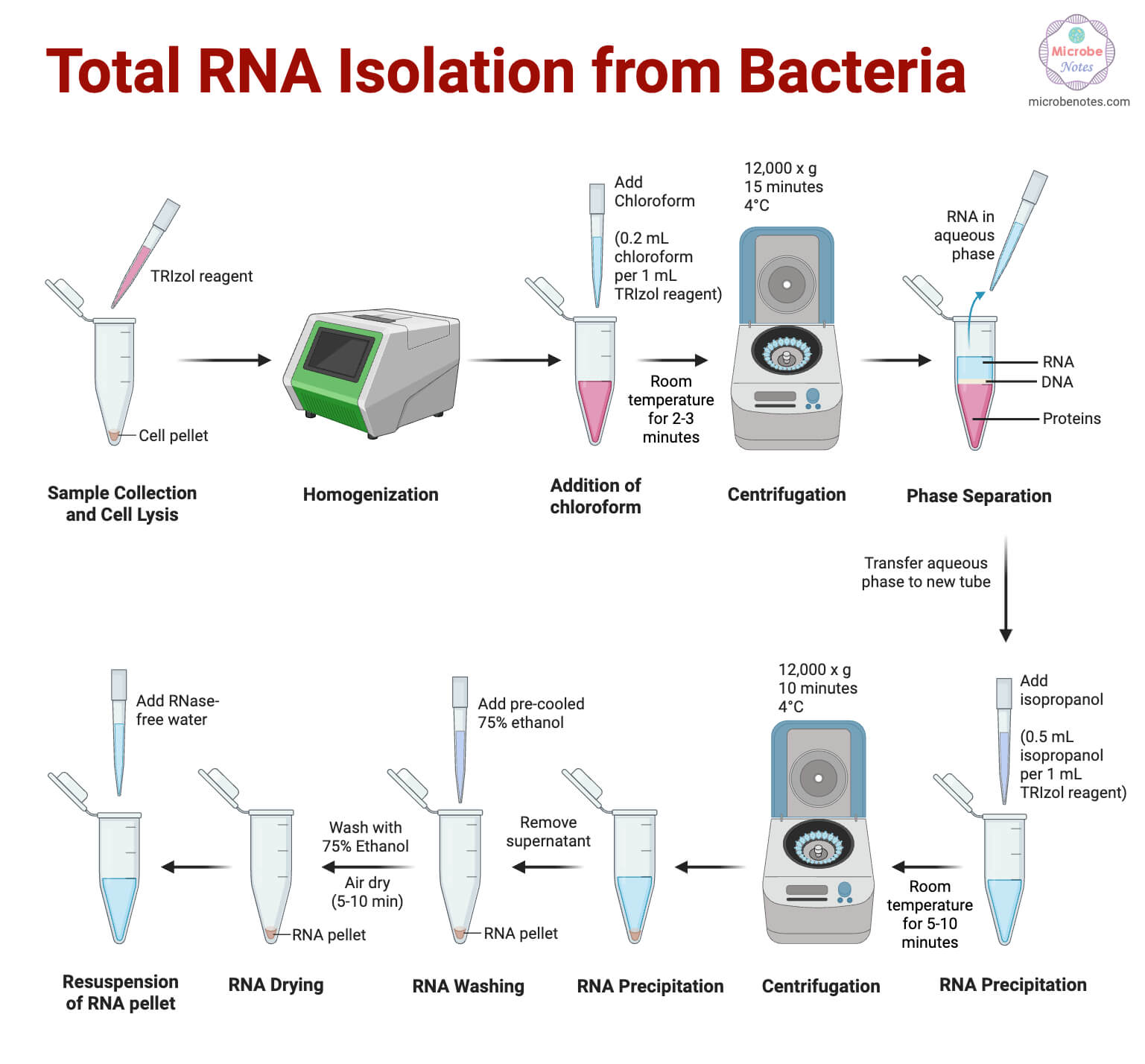
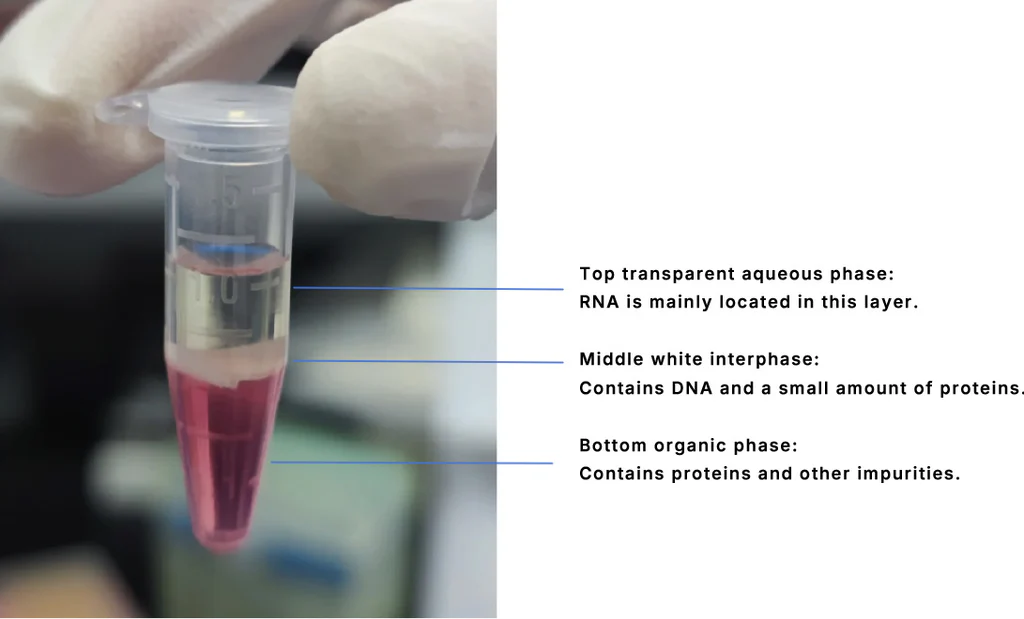
The principle of bacterial RNA extraction is based on rapid cell disruption, denaturation of proteins, including RNases, and selective separation of RNA from other macromolecules. In TRIzol-based methods, guanidinium thiocyanate denatures proteins while phenol dissolves lipids and proteins. Upon addition of chloroform and centrifugation, the mixture separates into three phases: an aqueous phase containing RNA, an interphase containing DNA, and an organic phase containing proteins (Microbe Notes, 2023).
In contrast, silica column–based methods utilize chaotropic salts to promote binding of RNA to a silica membrane. Contaminants are removed through successive washing steps, and purified RNA is eluted using RNase-free water or low-salt buffer (QIAGEN, 2023). Both approaches rely on stringent RNase control to prevent degradation.
Steps / Protocol of Total RNA Isolation from Bacteria
Sample Collection and Cell Lysis (TRIzol Method)
- Transfer 800 µL of actively growing bacterial culture into a sterile, RNase-free 1.5 mL microcentrifuge tube.
- Add 160 µL of TRIzol reagent (1/5 of the culture volume).
- Mix thoroughly by pipetting up and down several times until the solution is homogeneous.
- Incubate the mixture at room temperature (15-25 °C) for 5 minutes to allow complete dissociation of nucleoprotein complexes.
Phase Separation
- Add 32 µL of chloroform (1/5 volume of TRIzol used).
- Cap the tube securely and mix vigorously by shaking or pipetting for 15–20 seconds.
- Incubate at room temperature for 2–5 minutes.
- Centrifuge at 12,000 rpm for 15 minutes at 4 °C.
- Following centrifugation, three phases will be visible:
- Upper aqueous phase (RNA)
- Interphase (DNA)
- Lower organic phase (proteins)
- Carefully transfer the upper aqueous phase into a new RNase-free microcentrifuge tube without disturbing the interphase.
RNA Precipitation
- Add an equal volume of isopropanol to the collected aqueous phase.
- Mix gently by inverting the tube several times.
- Incubate at 15–30 °C for 10 minutes.
- Centrifuge at 10,000 rpm for 10 minutes at 4 °C.
- A small, translucent RNA pellet should be visible at the bottom of the tube.
RNA Washing
- Carefully discard the supernatant without disturbing the pellet.
- Add 1 mL of 70–75% ethanol (RNase-free) to the pellet.
- Gently resuspend the pellet by flicking or brief vortexing.
- Centrifuge at 10,000 rpm for 10 minutes at 4 °C.
- Discard the supernatant completely.
- Repeat the ethanol wash once if higher purity is required.
RNA Drying and Resuspension
- Air-dry the RNA pellet at 37 °C for 10–15 minutes (do not overdry).
- Resuspend the pellet in 50 µL of TE buffer or DEPC-treated RNase-free water.
- Dissolve RNA completely by gentle pipetting.
- Keep samples on ice during handling.
Optional Cleanup Using RNeasy Mini Kit (For Higher Purity)
- If exceptionally pure RNA is required (e.g., for qPCR or RNA-seq), the TRIzol-extracted aqueous phase or lysate may be processed using the RNeasy Mini Kit:
- Add 1 volume of 70% ethanol to the lysate and mix well.
- Transfer up to 700 µL of the mixture to an RNeasy spin column.
- Centrifuge at ≥8,000 × g for 15 seconds and discard flow-through.
- Wash the column with:
- 700 µL Buffer RW1
- 500 µL Buffer RPE (twice)
- Perform a final dry spin at 12,000 × g for 2 minutes.
- Elute RNA using 30–50 µL RNase-free water.
- Repeat elution if a higher yield is required.
Observations and Results
Successful RNA isolation is typically indicated by the formation of a visible RNA pellet after isopropanol precipitation or by measurable RNA concentration following column elution. Clear phase separation during TRIzol extraction is a critical observation; contamination of the aqueous phase with phenol or interphase material may reduce RNA quality (Ruthazer Lab, n.d.).
High-quality RNA appears colorless and dissolves easily in RNase-free water. Spectrophotometric analysis generally reveals A260/280 ratios close to 2.0, indicating minimal protein contamination (University of Maryland, Department of Biology, Cichlid Lab, n.d.).
Modifications of Total RNA Isolation from Bacteria
- Increased lysozyme concentration: Increasing lysozyme concentration enhances enzymatic degradation of the peptidoglycan layer, particularly in Gram-positive bacteria, resulting in more complete cell lysis, improved RNA release, and higher extraction efficiency (QIAGEN, 2023).
- Use of glycogen as a carrier: Glycogen acts as an inert carrier that co-precipitates with RNA, improving pellet visibility and recovery when working with low biomass samples or dilute RNA preparations (Ruthazer Lab, n.d.).
- High-throughput TRIzol adaptation: This adaptation allows simultaneous processing of multiple samples using standardized volumes, reducing handling variability and enabling efficient transcriptomic analyses in large-scale bacterial gene expression studies (JAPS Online, 2023).
- Mechanical shearing: Passing lysates through fine-gauge needles fragments high-molecular-weight DNA, decreasing sample viscosity, minimizing DNA carryover, and facilitating cleaner phase separation during RNA extraction (University of Maryland, Department of Biology, Cichlid Lab, n.d.).
Troubleshooting of Total RNA Isolation from Bacteria
| Problem | Likely Cause | Solution |
| Low RNA yield | Incomplete lysis | Increase the lysozyme incubation |
| RNA degradation | RNase contamination | Use RNase-free consumables |
| Phenol contamination | Poor phase separation | Carefully aspirate the aqueous phase |
| Low A260/280 ratio | Protein contamination | Repeat ethanol wash |
| No visible pellet | Low cell number | Add glycogen carrier |
(QIAGEN, n.d.; Ruthazer Lab, n.d.)
Source: https://www.yeasenbio.com/blogs/molecular-biology/common-issues-and-troubleshooting-in-rna-extraction-using-trizol
Quality Assessment of the Isolated RNA
- Spectrophotometric analysis: Absorbance ratios near 2.0 at A260/280 indicate minimal protein contamination, while A260/230 values help assess residual phenol or salt impurities (University of Maryland, Department of Biology, Cichlid Lab, n.d.).
- Agarose gel electrophoresis: The presence of sharp and distinct rRNA bands without smearing confirms RNA integrity and indicates minimal degradation during extraction and handling.
- Yield measurement: RNA concentration directly reflects extraction efficiency and determines whether sufficient template is available for sensitive downstream applications such as qPCR or RNA sequencing (JAPS Online, 2023).
Safety Tips and Precautions of Total RNA Isolation from Bacteria
- Handle TRIzol and chloroform in a fume hood: Both chemicals release harmful vapors and pose health risks upon inhalation; therefore, all handling steps must be performed in a certified chemical fume hood (Microbe Notes, 2023).
- Wear appropriate PPE: Laboratory gloves, coats, and protective eyewear minimize exposure to hazardous reagents while also reducing the risk of introducing RNases from skin contact.
- Use RNase-free consumables: Certified RNase-free tubes, tips, and solutions are essential to prevent enzymatic degradation of RNA and ensure reproducibility of experimental results (QIAGEN, n.d.).
Storage and Long‑Term Stability of Isolated RNA
- Short-term storage at −20 °C: RNA samples may be stored briefly at −20 °C for routine analysis, provided exposure to RNases and repeated handling is minimized.
- Long-term storage at −80 °C: Deep freezing at −80 °C preserves RNA integrity for extended periods, making it suitable for future molecular analyses and archiving (QIAGEN, n.d.).
- Avoid repeated freeze–thaw cycles: Repeated temperature fluctuations accelerate RNA degradation; aliquoting samples before storage helps maintain RNA stability and experimental reliability.
Applications of Total RNA Isolation from Bacteria
Reverse transcription PCR (RT-PCR)
Isolated RNA serves as a template for cDNA synthesis, enabling qualitative assessment of gene expression under different physiological or experimental conditions. This technique is particularly useful for detecting the presence or absence of specific transcripts, validating gene expression patterns, and confirming results obtained from broader transcriptomic analyses in bacterial research studies.
Quantitative real-time PCR (qPCR)
High-quality RNA allows accurate and sensitive quantification of transcript abundance, supporting comparative gene expression and regulatory studies (JAPS Online, 2023). It enables precise measurement of fold changes in gene expression, normalization against housekeeping genes, and statistical evaluation of transcriptional responses under stress, antibiotic exposure, or varying environmental conditions.
RNA sequencing (RNA-seq)
Purified RNA enables comprehensive transcriptome profiling, revealing global gene expression patterns, regulatory pathways, and bacterial responses to environmental changes. RNA-seq also facilitates identification of novel transcripts, operon structures, small regulatory RNAs, and differential expression analysis, providing high-resolution insights into bacterial physiology and molecular adaptation mechanisms.
Advantages of Total RNA Isolation from Bacteria
High RNA purity
Effective removal of proteins, DNA, and enzymatic inhibitors produces RNA suitable for highly sensitive molecular biology techniques. High purity improves downstream enzymatic efficiency, enhances reproducibility of amplification-based assays, and minimizes background interference, ensuring reliable interpretation of gene expression data across multiple experimental replicates.
Broad applicability
The method can be adapted to diverse bacterial species, growth conditions, and sample volumes with minimal protocol modifications. It is compatible with both Gram-positive and Gram-negative bacteria and can be optimized for clinical isolates, environmental samples, or laboratory strains without requiring extensive changes in reagents or equipment.
Scalability
The procedure accommodates both small-scale analytical experiments and large-scale studies requiring higher RNA yields (QIAGEN, 2023). It can be adjusted for high-throughput workflows using multiple samples simultaneously, making it suitable for comparative transcriptomic studies, industrial microbiology research, and large experimental designs.
Limitations of Total RNA Isolation from Bacteria
Use of hazardous chemicals
TRIzol and chloroform pose chemical hazards and require careful handling, appropriate ventilation, and proper waste disposal procedures. Exposure risks include toxicity and irritation, necessitating the use of personal protective equipment and fume hoods, which may limit accessibility in laboratories with restricted safety infrastructure.
Time-consuming
Multiple centrifugation and washing steps increase total processing time, especially when handling numerous samples simultaneously. Delays between steps may also increase the risk of RNA degradation, and the procedure demands careful attention to timing and temperature control to ensure consistent and reproducible RNA yield.
Sensitivity to RNases
RNA is highly susceptible to degradation, necessitating strict laboratory hygiene and meticulous technique throughout the extraction process (Ruthazer Lab, n.d.). RNase contamination from surfaces, reagents, or human contact can significantly compromise RNA integrity, thereby affecting downstream applications such as qPCR and RNA sequencing reliability (Ruthazer Lab, n.d.).
Conclusion
Total RNA isolation from bacteria is a critical technique that underpins modern molecular and microbial research. TRIzol-based and silica column–based methods provide reliable strategies for extracting high-quality RNA when appropriate precautions and optimizations are applied. Understanding the principles, reagents, and potential pitfalls of these methods allows researchers to obtain reproducible and biologically meaningful results. When performed correctly, bacterial RNA isolation enables powerful downstream analyses that advance our understanding of gene regulation, microbial physiology, and pathogenic mechanisms.
References
- Microbe Notes. (2023). RNA isolation protocol. https://microbenotes.com/rna-isolation-protocol/
- Ruthazer Lab. (n.d.). Total RNA isolation using TRIzol (bacterial optimization). McGill University. https://ruthazerlab.mcgill.ca/protocols/Total_RNA_Isolation.htm
- JAPS Online. (2023). High-throughput RNA extraction method for Pseudomonas aeruginosa using TRIzol. Journal of Applied Pharmaceutical Science, 12(1). https://doi.org/10.7324/JAPSONLINE.2023.120115
- QIAGEN. (n.d.). Purification of total RNA from bacteria using RNeasy Mini Kit. https://www.qiagen.com/us/resources/download.aspx?id=60ec1159-4828-4f27-b4e6-b98772bdf7e1
- University of Maryland, Department of Biology, Cichlid Lab. (n.d.). Total RNA isolation from bacteria (TRIzol method). https://science.umd.edu/biology/cichlid/protocols/Basic/rna.html
- CD Genomics. (2023). TRIzol RNA extraction protocol. CD Genomics. https://rna.cd-genomics.com/resource/trizol-protocol.html
- Yeasen Biotech. (2025). Common issues and troubleshooting in RNA extraction using TRIzol. Yeasen Biotechnology. https://www.yeasenbio.com/blogs/molecular-biology/common-issues-and-troubleshooting-in-rna-extraction-using-trizol
