
Total Internal Reflection Fluorescence (TIRF) microscopy is a fluorescence-based technique used to observe and study cellular activities occurring at the surfaces and boundaries of living cell membranes.
In 1965, a German physician, Hirschfeld, introduced TIRF as an imaging method for targeted surface illumination at a solid-liquid interface.
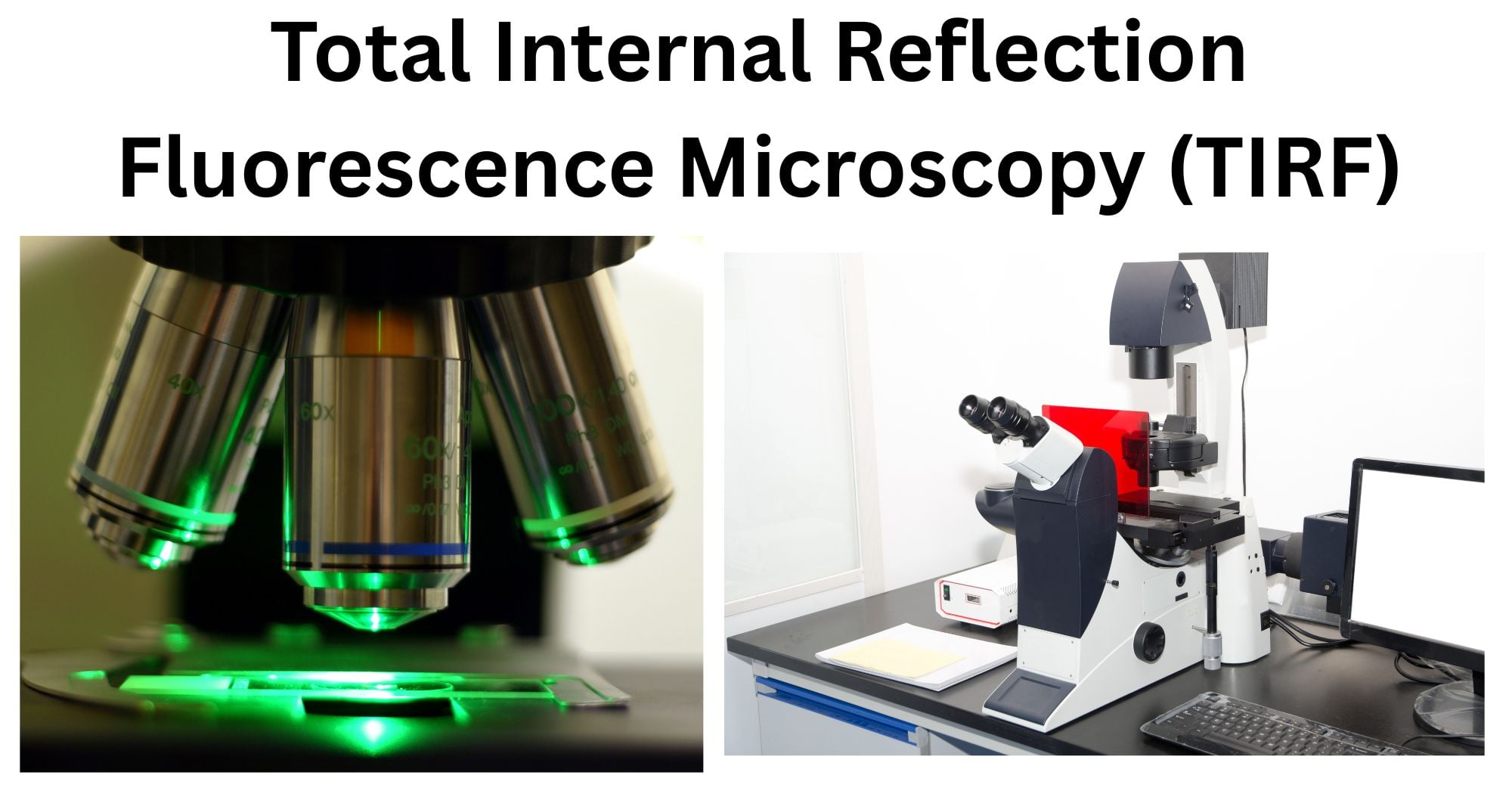
It is an effective method specifically used for visualizing fluorescent substances, such as membrane dyes or fluorochromes linked to antibodies in a water-based environment that is very close to a solid material with a high refractive index, like cover glass. A sophisticated method of optical imaging, it allows for the excitation of fluorophores within an extremely thin axial area or the optical section. In addition, it can be used to visualize the dynamic processes of membranes and micromorphology of cell structures and investigate single molecules and nanostructures with a high signal-to-noise ratio.
In optics, two approaches, namely, prism-based and objective-based, have been utilized to achieve total internal reflection. As the name suggests, a prism is placed on the surface of the coverslip in the prism-based TIRF technique. The prism directs a concentrated beam of light or laser to the interface between the coverslip and the medium. Moreover, the angle of the light penetrating the surface is adjusted to the critical angle using the prism.
Contemporary TIRF microscopy setups are typically based on objectives. Through the objective, laser light is directed onto the specimen, capturing the fluorescence emitted from the specimen. In this approach, the objectives used must have a high numerical aperture (NA > 1.45) to enable an angle of incidence that exceeds the critical angle. The increase in the NA of the objective decreases the possible penetration depth of the evanescent field, as the light can strike at a flatter angle.
In contrast to the prism-based approach, the objective-based TIRF approach is considered more user-friendly in terms of better accessibility to the specimen and easy adjustment of the laser light’s angle of incidence.
Principle of Total Internal Reflection Fluorescence (TIRF) Microscopy
The phenomenon of total internal reflection, termed TIR, is the basis of TIRF microscopy. When light traveling through a medium containing a greater refractive index (n1) strikes the interface of a medium with a lower refractive index (n2) at an angle larger than the critical angle (θc), total internal reflection occurs. Thus, using Snell’s law, the critical angle can be determined with the formula as follows:
θc = sin-1 n2n1
Following this, the beam of light is reflected to the first medium with the higher refractive index, while none is passed into the medium with a lower refractive index. Nevertheless, an electromagnetic field known as an evanescent wave extends and penetrates a short distance into the second medium. An evanescent wave is a standing wave generated at the interface between two media. It essentially retains energy through the enhancement of the electromagnetic field in a localized area around the interface. In this regard, the generated evanescent wave diminishes exponentially with distance from the interface. Through the activation of a small portion of the sample along the z-axis, this feature of the wave provides increased specificity, enabling enhanced resolution.
To sum up, the working principle of TIRF microscopy is based on the idea that the excitation light is fully reflected at the interface of a solid material (high refractive index) and a liquid (low refractive index). This causes the evanescent wave to generate in the liquid medium at the interface, which corresponds to the frequency of the excitation light. As the distance from the solid increases, and the intensity of the evanescent wave decreases exponentially, fluorescent molecules situated within a few hundred nanometers of the solid receive effective excitation.
Parts of Total Internal Reflection Fluorescence (TIRF) Microscopy
The setup of the TIRF microscope depends on the approach of the technique. Despite the convenience of building a prism-based TIRF system, an objective-based system is more commonly used. While preparing the arrangements for microscopy, it is important to make a proper selection of the camera, source of excitation light, dichroic mirror, emission filters, and acquisition software.
The key points on the instrumentation of the objective-based TIRF microscopy are briefly explained below:
- TIRF microscope configuration: The microscopic configuration for directing the excitation beam to the specimen depends on the use of a prism (quartz) or the objective. The use of a prism is more cost-effective and provides output with low background interference and minimized scattering of light. It is notably used for in vitro observations. However, it has limited accessibility to the sample and objective selection, hence the objective-based approach is preferred. This approach provides easy access to the sample and is relatively faster.
- Objective: In the TIRF microscope, the objective’s ability to collect light depends on the numerical aperture of the objective, it is one of the most crucial components of this technique. Moreover, the NA defines the maximum angle for both light collection and excitation beam incidence at the cover-slip–sample interface. For effective performance, the NA should be significantly greater than the sample’s refractive index. In this regard, various commercial objectives can be found with an NA exceeding 1.4. Objectives with an NA of 1.45 and 1.49 are widely used, and these are offered in magnifications of 60×, 100×, and 150×. Furthermore, these objectives are designed to be used with standard glass coverslips and standard immersion oil.
- Source of laser light: For TIRF excitation, lasers and arc lamps like xenon or mercury are useful as the laser light source. Arc lamps provide an easy selection of wavelength with filter wheels without any interference fringes. However, the light traveling at angles below the critical angle is discarded by it, causing reduced excitation intensity and dimmer images, hence preferred for intrinsically bright samples. On the other hand, lasers are more commonly used for TIRF, with systems typically having one optimized laser line for each fluorophore, which can be combined for simultaneous or alternating imaging.
- Camera: This component is used for capturing the full field of an image, not merely a single point. In this technique, a cooled charge-coupled device (CCD) camera, such as an electron-multiplying (EM) CCD, is used to capture the collection of images and achieve rapid imaging in dimmer light settings.
- Image splitter: As TIRF illumination focuses on a single focal plane and uses short exposure times, it is an ideal technique for capturing dynamic processes. It is capable of imaging multiple fluorophores either simultaneously or in an alternative manner. Image splitters enable the simultaneous capture of emissions from two to four distinct fluorophores, enhancing the imaging of rapid events.
Sample Preparation for Observation in TIRF
The method of TIRF is ideally used for visualizing live cells. In this technique, the majority of the imaged cells are unexposed to the excitation light due to a sparse excitation field, which leads to minimal phototoxic effects. In the case of fixed cells, PBS, a low refractive index media should be used to mount the sample. Similarly, solidifying mediums can be used for the storage of samples for a longer duration; however, their high refractive index might obstruct the imaging through TIRF. It is important to make sure that the sample is adequately washed after staining it with some frequently used dyes, such as FM4-64, as it can stick to the surface of the coverslip and hinder the process of imaging.
While preparing the sample, the selection and environment of the sample must be taken into consideration. The cells must adhere to the area closer to the coverslip as TIRF only illuminates that area; therefore, it is unsuitable for imaging non-adherent cells. Furthermore, the cells should have a refractive index less than the objective’s numerical aperture (NA). Live cell imaging typically requires the sample to be maintained at a stable temperature of 37°C, as any temperature variations can significantly contribute to focal drift.
Operating Procedures of Total Internal Reflection Fluorescence (TIRF) Microscopy
- Before beginning the experiment, the first step includes establishing both the angle of incidence and the penetration depths for the illumination wavelengths.
- The hardware equipment, including the objective, micro incubator, and imaging chambers, must be pre-heated for an hour, maintaining a temperature of up to 38.5 °C.
- The micro-incubator is inserted into the stage and heated with the use of a dual-channel heater controller.
- Next, the imaging chamber is placed in the incubator with the sample (eg, neurons).
- In the case of long-term experiments, a gravity-fed perfusion device consisting of a valve controller is set up. Use an in-line solution heater and place it in front of the imaging chamber to heat the sample at 37° C.
- A coverslip on which the sample is grown is inserted into the imaging chamber. The coverslip is covered with the imaging solution and is placed in the incubator. After 10 minutes, the imaging chamber is moved to the microscope. It is important to note that the bottom of the coverslip is cleaned.
- The immersion oil is added to the objective, and the imaging chamber is placed in the micro incubator. Then, the upper surface of the coverslip is focused to view the image.
Applications of Total Internal Reflection Fluorescence (TIRF) Microscopy
- TIRF microscopy is used to assess ligand-receptor interactions, dynamics of receptor endocytosis, and mechanisms of receptor channels, clustering, and lateral movements of receptors.
- It is widely utilized in the study of the exocytosis processes. Moreover, it has been used for the quantitative and qualitative analysis of proteins and their roles in exocytosis and endocytosis.
- TIRF microscopy can assess dimensions, movement, and the distance of contact between a cell and the solid surface.
- It has been extensively used for DNA mapping in genomic sequence assembly and identifying microbial pathogens.
- Viral particles, their lateral motility, and their mode of infection can be studied using TRIF microscopy by a single fluorescent particle tracking method.
Examples of Total Internal Reflection Fluorescence (TIRF) Microscopy
MultiColor Laser TIRF
- The system provides integrated solid-state lasers (four in number) for excitation at all necessary fluorophore wavelengths.
- It offers quick switching, automated alignment with constant penetration depth, and rapid image recording, enabling the study of dynamic processes in cells.
IXplore TIRF microscope
- It features a strong architectural frame and a precise focus drive design.
- It provides photostability by reducing the effects of vibrations and temperature fluctuations.
- It offers dependable time-lapse imaging with its consistent positioning of the Z-axis.
- Uniformity in the evanescence penetration allows high-contrast imaging of cells and molecules.
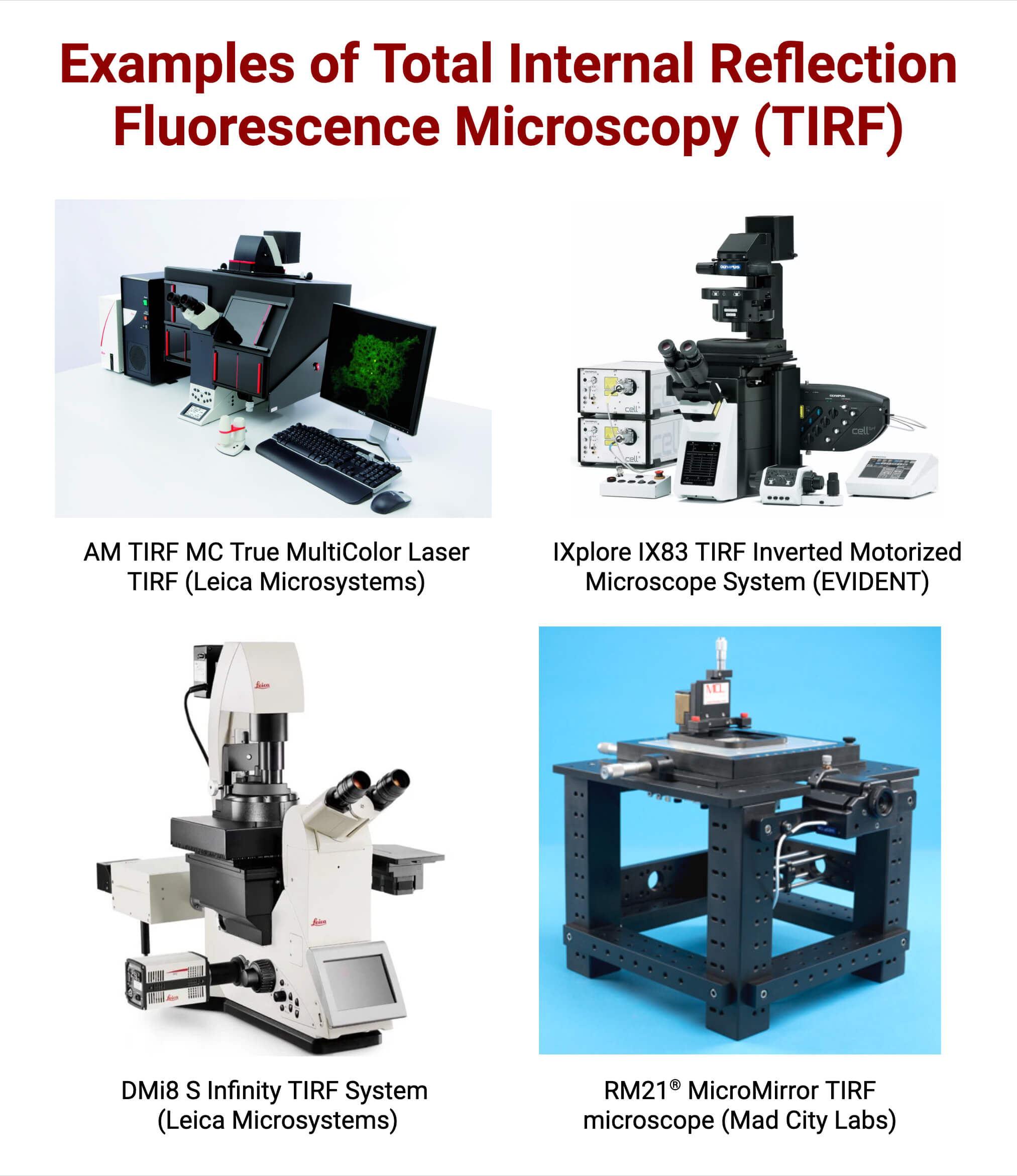
Infinity TIRF DMi8 S module
- This module allows the observation of samples with exceptional clarity and control.
- It maximizes the signal-to-noise ratio, hence providing high-resolution output.
MicroMirror TIRF microscope
- It is an objective-based TIRF microscope.
- In this system, two broadband microscopes replace the dichroic normally used in conventional systems. These micro-mirrors are secured to a precision mount with multiple axes, allowing adjustments in the optical pathway.
- It allows unrestricted access to both the entry and exit optical pathways.
Advantages of Total Internal Reflection Fluorescence (TIRF) Microscopy
- In contrast to traditional fluorescence imaging techniques, TIRF microscopy achieves higher axial resolution due to the rapid breakdown of the evanescent wave with distance.
- Optical sectioning is more natural with TIRF imaging.
- Optical noise is largely minimized or avoided due to the evanescent wave.
- This technique can visualize specimens below the diffraction limit.
- It is capable of illuminating and exciting specific fluorophores localized on and inside the cell. This advantage allows the study of cell interactions and dynamic membrane processes.
- When combined with the fluorescence labeling of particular molecules, TIRF can provide biochemical specificity of molecules.
Limitations of Total Internal Reflection Fluorescence (TIRF) Microscopy
- As the effect of total internal reflection occurs only at an interface between two media with different refractive indices, TIRF microscopy is known for its specific localization.
- TIRF is only effective at the interface between the cell and the substrate; therefore, it cannot be used to image deeper structures of the cell.
Precautions Before Using the TIRF
- Make sure that the surface of the total internal reflection, i.e., coverglass, is properly polished.
- Avoid direct laser exposure.
- The sample with a high refractive index, when used for TIRF imaging, can cause the propagated light to scatter through the sample.
- Care should be taken to minimize photobleaching and maximize photostability by proper selection of dyes, reducing the light needed, and increasing photon detection.
Conclusion
The development of the TIRF microscopy technique for studying nanostructure and single molecules makes it a powerful tool that significantly enhances our understanding of cellular dynamics at the membrane level. With its broad application in biological studies, it is considered an accessible microscopy technique having an approach to selectively exciting fluorophores and minimizing background noise.
In a field continuously expanding with numerous possibilities, this tool has been useful in providing information and insights into individual cellular and molecular processes. In this regard, as its application increases, it is of utmost importance to address common technical challenges that arise with its use to maximize its effectiveness in research and leverage its full potential.
References
- Specialized Microscopy Techniques – Total Internal Reflection Fluorescence Microscopy | Olympus LS. (n.d.). Retrieved from: https://www.olympus-lifescience.com/de/microscope-resource/primer/techniques/fluorescence/tirf/tirfintro/
- Ockenga, W. (2012, March 11). Total Internal Reflection Fluorescence (TIRF) Microscopy. Science Lab | Leica Microsystems. Retrieved from: https://www.leica-microsystems.com/science-lab/life-science/total-internal-reflection-fluorescence-tirf-microscopy/
- Total Internal Reflection Fluorescence Microscopy | Olympus LS. (n.d.). Retrieved from: https://www.olympus-lifescience.com/en/microscope-resource/primer/techniques/fluorescence/tirf/tirfhome/
- Total Internal Reflection Fluorescence (TIRF). (n.d.). Ibidi. Retrieved from: https://ibidi.com/content/221-tirf
- Total Internal Reflection Fluorescence (TIRF) Microscopy. (n.d.). Retrieved from: https://integratedoptics.com/total-internal-reflection
- Mattheyses, A. L., Simon, S. M., & Rappoport, J. Z. (2010). Imaging with total internal reflection fluorescence microscopy for the cell biologist. Journal of Cell Science, 123(21), 3621–3628. DOI: https://doi.org/10.1242/jcs.056218
- Fish, K.N. (2008). Total internal reflection fluorescence (TIRF) microscopy. Curr Protoc Cytom.18. DOI: 10.1002/0471142956.cy1218s50.
- Trache, A., & Meininger, G. A. (2008). Total Internal Reflection Fluorescence (TIRF) Microscopy. Current Protocols in Microbiology. DOI::10.1002/9780471729259.mc02a02
- MicroMirror TIRF System. (n.d.). Mad City Labs Inc. Retrieved from: https://www.madcitylabs.com/MicroMirrorTIRF.html
- Infinity TIRF DMi8 S module. (n.d.). Products | Leica Microsystems. Retrieved from: https://www.leica-microsystems.com/products/microscope-accessories/p/infinity-tirf/
- AM TIRF MC TIRF | Fluorescence Microscopes: Leica Microsystems. (n.d.). Products | Leica Microsystems. Retrieved from: https://www.leica-microsystems.com/products/light-microscopes/p/leica-am-tirf-mc/
- IXPLOre TIRF Microscope | Excellent Multi-Color Imaging | Olympus LS. (n.d.). Retrieved from: https://www.olympus-lifescience.com/en/microscopes/inverted/ixplore-tirf/
- Specialized Microscopy Techniques – Alignment of Objective-Based TIRF Systems | Olympus LS. (n.d.). Retrieved from: https://www.olympus-lifescience.com/en/microscope-resource/primer/techniques/fluorescence/tirf/objectivealign/
- Specialized Microscopy Techniques – Total Internal Reflection Fluorescence Microscopy | Olympus LS. (n.d.-c). Retrieved from: https://www.olympus-lifescience.com/en/microscope-resource/primer/techniques/fluorescence/tirf/tirfconfiguration/
