- The immune system serves as the body’s host defense mechanism, a complex network of innate and adaptive components designed to protect against pathogenic agents.
- Its fundamental and most critical function is the ability to accurately distinguish between the body’s own healthy cells (“self”) and foreign invaders (“non-self”). This precise recognition is essential, as its failure leads to the devastating conditions known as autoimmune diseases.
- Consequently, maintaining self-tolerance is the crucial function of a healthy immune system, enabling it to prevent autoimmune diseases rather than fight them.
- Severe Combined Immunodeficiency (SCID) is a congenital disorder that leaves newborns with a profoundly deficient immune system.
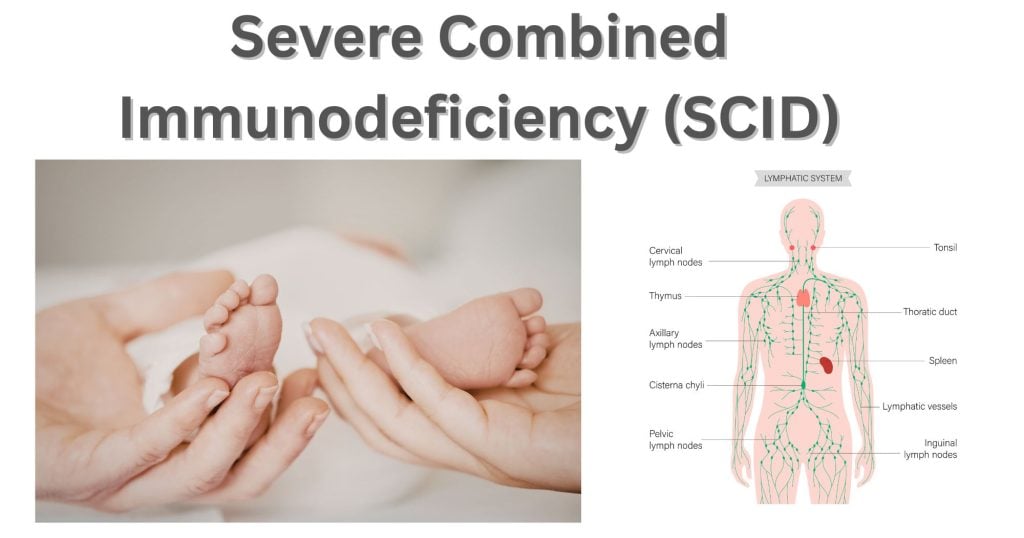
- Due to a genetic defect, they are unable to produce essential immune cells like T-cells and B-cells.
- T cells and B cells are the two main types of lymphocytes, the specialized white blood cells that form the core of the adaptive immune system
- T cells are responsible for cellular immunity; they identify and destroy infected host cells, and they also help regulate the activity of other immune cells.
- x B cells are responsible for humoral immunity; they produce antibodies that bind to and neutralize pathogens, marking them for destruction by other immune cells.
- This leaves them defenceless against infections and, without a cure like a bone marrow transplant, is a fatal condition.
Causes of Severe Combined Immunodeficiency (SCID)
- SCID is not a single disease but a spectrum of genotypic and phenotypic disorders.
- The condition is caused by specific mutations in genes that are essential for the production and function of key immune cells, particularly T cells and, in most cases, B cells.
- This genetic defect leaves the body unable to fight off infections, making it extremely vulnerable to pathogens that are typically harmless to healthy individuals.
- Biallelic or X-linked mutations basically cause the mutations
- Biallelic is when the individual inherited a mutated copy of the gene from both parents, while “X-linked” refers to mutations on the X chromosome, which primarily affect males.
- The fundamental issue in Severe Combined Immunodeficiency (SCID) is a genetic defect that prevents the proper development and function of immune cells, specifically lymphocytes like T cells and B cells. This genetic block essentially prevents the body from developing a functional immune system.
- The defining feature of all SCID types is a profound deficiency of T lymphocytes.
- The absence of these “helper” cells also prevents B cells from producing functional antibodies, even if B cells are present in normal numbers.
- This is why it’s a “combined” immunodeficiency, affecting both T-cell and B-cell-mediated immunity.
Types and mechanisms of Severe Combined Immunodeficiency (SCID)
- The classification of different SCID types is based on which specific gene is mutated and how that mutation affects the development and function of immune cells (T cells, B cells, and Natural Killer cells
X-linked SCID (SCID-X1)
- The IL2RG gene, found on the X chromosome, is responsible for producing a protein called the common gamma chain (γc). This protein is a vital part of the receptors on the surface of immune cells.
- The common gamma chain (γc) associates with other protein subunits to form receptors for multiple cytokines, including interleukins IL-2, IL-4, IL-7, IL-9, IL-15, and IL-21.
- These cytokines act as critical signaling molecules that regulate lymphocyte proliferation, differentiation, and survival.
- A mutation in the IL2RG gene leads to the production of either a defective common gamma chain protein or no protein at all.
- Because this protein is essential for signaling pathways in T cells and Natural Killer (NK) cells, its absence prevents these immune cells from developing correctly.
- Consequently, the body is left without a working T-cell and NK-cell immune system, which makes the person extremely vulnerable to severe, often fatal, infections.
Adenosine Deaminase (ADA) Deficiency
- The ADA gene is located on chromosome 20, which provides the instructions for producing the enzyme adenosine deaminase (ADA).
- This enzyme is crucial for breaking down a toxic byproduct called deoxyadenosine.
- Deoxyadenosine is not directly involved but is a result of its toxic metabolic conversion into dATP, deoxyadenosine triphosphate
- The buildup of high levels of dATP is detrimental to cells because it inhibits the enzyme ribonucleotide reductase, which is crucial for DNA synthesis, as it converts ribonucleotides into deoxyribonucleotides, the building blocks of DNA
- As DNA synthesis is hampered, Cell division is halted. This is particularly harmful to lymphocytes (T cells, B cells, and NK cells) since they must multiply rapidly to fight infections.
- The interruption of the cell cycle ultimately leads to apoptosis (cell death), which prevents the body from building a working immune system.
- A mutated ADA gene leads to a buildup of this toxin, which is particularly deadly to developing immune cells, causing a severe deficiency in T cells, B cells, and NK cells.
Recombinase-Activating Gene (RAG) Deficiency
- The RAG1 and RAG2 genes work together to produce a protein complex known as V(D)J recombinase. This complex is essential for a process called V(D)J recombination.
- V(D)J recombination is the genetic process by which T cells and B cells rearrange specific gene segments to create their unique receptors.
- This process allows the immune system to generate the vast diversity of receptors needed to recognize and respond to a wide array of pathogens.
- The mutation of the RAG1 or RAG2 genes leads to the malfunctioning of the V(D)J recombinase
- This failure prevents T cells and B cells from undergoing V(D)J recombination. As a result, they cannot develop their functional receptors and are blocked from maturing.
Clinical Presentation and Diagnosis of Severe Combined Immunodeficiency (SCID)
- Infants with SCID suffer from frequent, life-threatening infections caused by opportunistic pathogens
- Due to constant infections and malabsorption, affected infants fail to gain weight and grow normally.
- They do not show normal reactions to vaccines or infections, and live vaccines can be dangerous.
- Blood tests reveal a severely low count of lymphocytes, a key diagnostic sign.
- Some infants may also develop a rash due to graft-versus-host disease (GVHD) from maternal cells that crossed the placenta.
- Extremely low or absent immunoglobulin (IgG, IgA, IgM) levels.
Treatment and Management of Severe Combined Immunodeficiency (SCID)
- Hematopoietic Stem Cell Transplant (HSCT) aims to replace the patient’s faulty immune system with healthy stem cells from a donor, usually a matched sibling or an unrelated donor.
- Enzyme Replacement Therapy (ERT) is mainly for ADA-SCID, where regular injections of the missing ADA enzyme are given to reduce toxicity and improve immune function
- Gene therapy for Severe Combined Immunodeficiency (SCID) involves collecting a patient’s own stem cells, using a viral vector to insert a healthy copy of the defective gene into them, and then reinfusing these corrected cells to produce a new, functional immune system.
- This treatment is a promising alternative to bone marrow transplantation and has been particularly successful for specific types of SCID, such as ADA-SCID and X-linked SCID.
Reference
- untuk sumber yang Anda berikan:Vaillant, A. A. J., & Mohseni, M. (2023, 8 Agustus). Severe Combined Immunodeficiency. Dalam StatPearls. StatPearls Publishing. https://www.ncbi.nlm.nih.gov/books/NBK539762/
- https://www.chop.edu/conditions-diseases/severe-combined-immunodeficiency-scid
- https://www.genethon.com/our-pipeline/severe-combined-immunodefiency-scid/
- Notarangelo, L. D., Mazzolari, E., Forino, C., & Giliani, S. (2004). Mechanisms of primary immunodeficiencies: from bed-side to bench and back. Drug Discovery Today: Disease Mechanisms, 1(3), 383-390. https://doi.org/10.1016/j.ddmec.2004.10.008
- Fischer, A. (2001). Primary immunodeficiency diseases: an experimental model for molecular medicine. The Lancet, 357(9271), 1863-1869. https://doi.org/10.1016/S0140-6736(00)04959-X
- Dvorak, C. C., Haddad, E., Heimall, J., Dunn, E., Buckley, R. H., Kohn, D. B., Cowan, M. J., Pai, S. Y., Griffith, L. M., Cuvelier, G. D. E., Eissa, H., Shah, A. J., O’Reilly, R. J., Torgerson, T. R., D’Souza, A., Dávila, J. C., Dvorak, C. C., Fischer, A., Forbes Satter, L., … Puck, J. M. (2023). The diagnosis of severe combined immunodeficiency (SCID): The Primary Immune Deficiency Treatment Consortium (PIDTC) 2022 Definitions. Journal of Allergy and Clinical Immunology, 151(2), 539-546. https://doi.org/10.1016/j.jaci.2022.10.022
