
The TRIzol-based RNA isolation method is derived from the classical acid guanidinium thiocyanate-phenol-chloroform extraction technique first described by Chomczynski and Sacchi (1987). This method was specifically developed for the rapid and efficient isolation of total RNA from biological samples and remains a gold-standard approach in molecular biology.
In this method, biological samples such as cultured cells or tissues are lysed in a monophasic solution containing guanidinium thiocyanate and phenol, which disrupts cellular membranes, denatures proteins, and irreversibly inactivates RNases. Upon addition of chloroform and centrifugation, the mixture separates into aqueous, interphase, and organic phases. RNA selectively partitions into the upper aqueous phase, while DNA and proteins remain in the interphase and organic phase, respectively (Chomczynski & Sacchi, 1987).
Commercial formulations such as TRIzol™ Reagent (Thermo Fisher Scientific) and TRI Reagent® (Sigma-Aldrich) have standardized this chemistry, improving reproducibility and accessibility across laboratories. TRIzol-based RNA isolation is particularly valuable for gene expression studies due to its ability to yield high-quality, intact RNA suitable for sensitive downstream applications (Thermo Fisher Scientific, 2024).
Key Reagents of the RNA isolation using the TRIzol method
| Reagent | Typical Concentration / Amount | Purpose |
| TRIzol / TRI Reagent | ~1 mL per 50–100 mg tissue or 10⁶ cells | Cell lysis, RNase inactivation |
| Chloroform | 0.2 mL per 1 mL TRIzol | Phase separation |
| Isopropanol | 0.5–1 mL | RNA precipitation |
| Ethanol (75%) | Prepared in RNase-free water | Washing RNA pellet |
| DEPC-treated water / RNase-free water | As required | RNA resuspension |
Principle of the RNA Isolation Using the TRIzol Method
The principle of TRIzol-based RNA extraction relies on selective solubility and phase partitioning of biomolecules under acidic conditions. Guanidinium thiocyanate is a strong chaotropic agent that denatures proteins and disrupts hydrogen bonding, thereby inactivating DNases and RNases. Phenol further aids protein denaturation and lipid solubilization (Chomczynski & Sacchi, 1987).
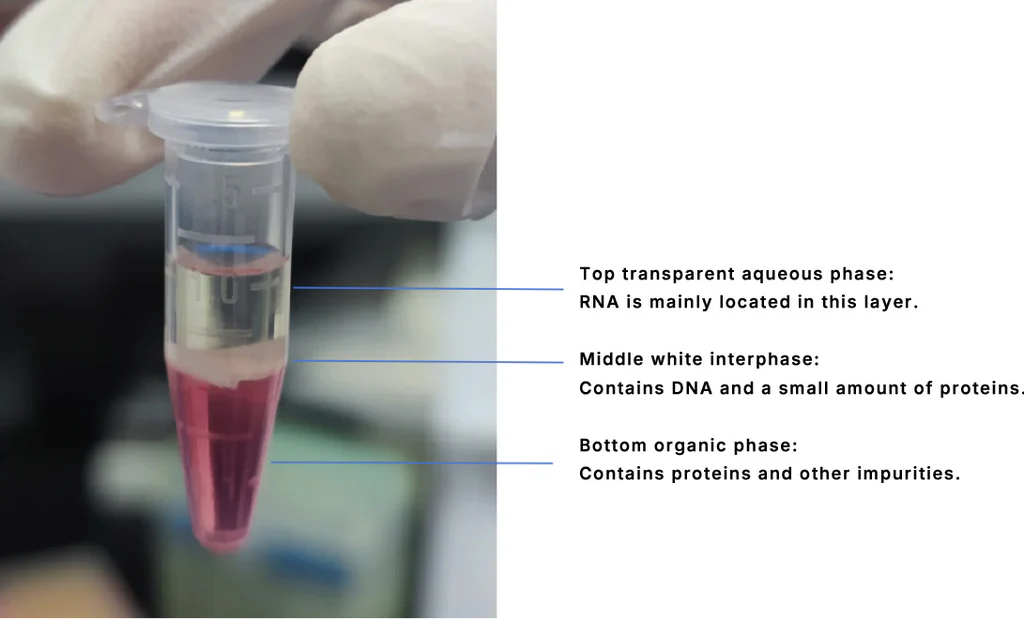
Upon addition of chloroform and centrifugation, the lysate separates into three distinct layers:
- Upper aqueous phase containing RNA
- Interphase enriched with DNA
- Lower organic phase containing proteins and lipids
RNA remains soluble in the aqueous phase due to its hydrophilic nature under acidic conditions. Subsequent isopropanol precipitation causes RNA to aggregate and form a visible pellet, which is then washed with ethanol to remove salts and residual phenol (Sigma-Aldrich, n.d.).
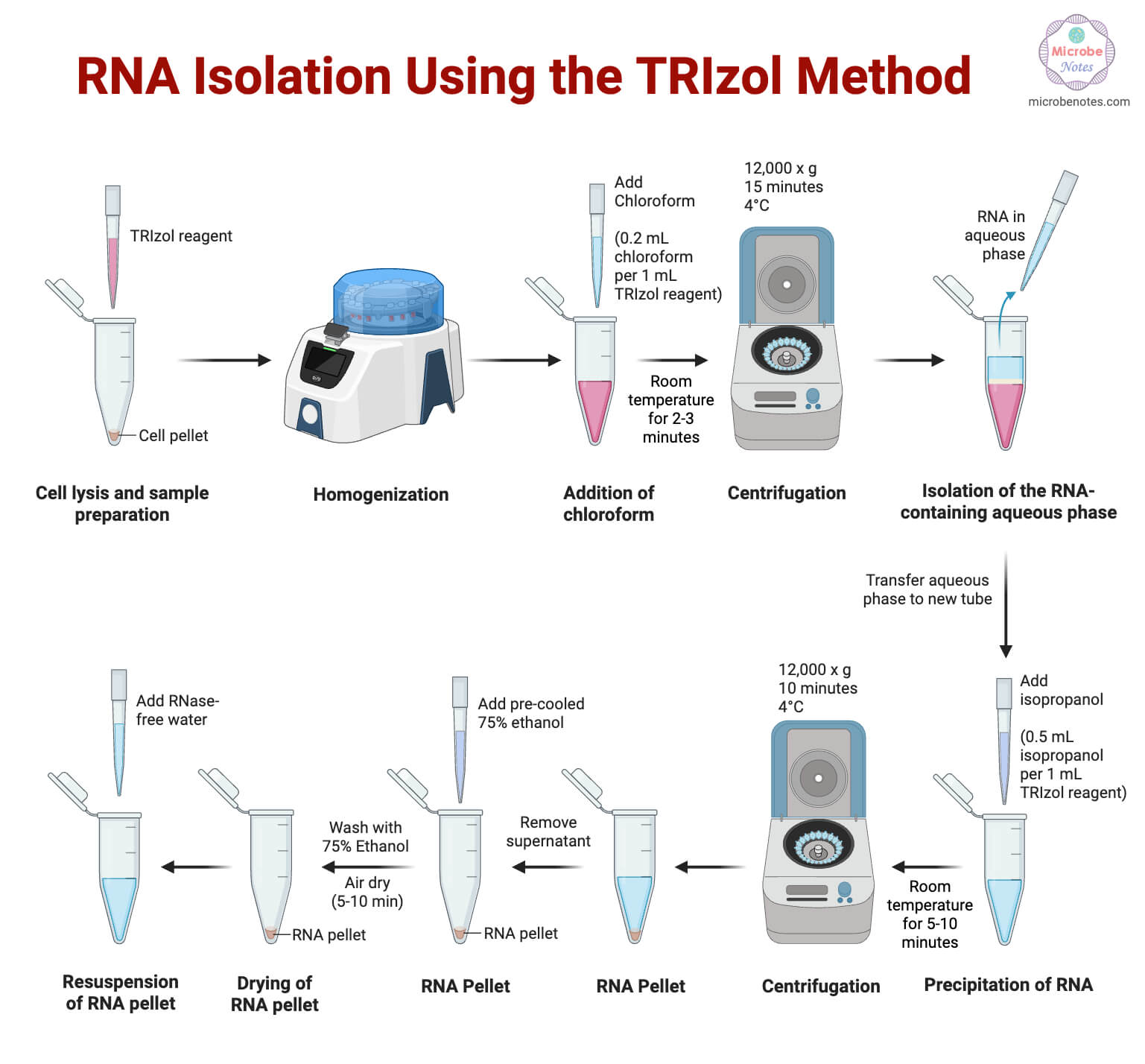
Steps / Protocol of the RNA isolation using the TRIzol method
Cell Culture
- Select cells in the logarithmic growth phase and inoculate them into a 6-well plate.
- Once the cell density exceeds 80%, add 500 µl TRIzol reagent (can be added after retrieval from a 4°C refrigerator).
- Mix thoroughly and perform repeated aspiration and agitation with a 1 ml tip.
- Allow it to stand at room temperature for 5 minutes to ensure complete separation of nucleic acid and protein complexes.
- For delayed RNA extraction, store the lysed sample at -80°C for long-term preservation.
Tissue Homogenization
- Place an appropriate amount of tissue block into a 5 ml centrifuge tube, cut it into pieces, and add 1 ml TRIzol reagent per 50-100 mg of tissue.
- Ensure the tissue volume does not exceed 10% of the TRIzol volume.
- Homogenize the tissue thoroughly using an electric homogenizer to obtain the tissue homogenate.
Chloroform Addition
- Add 200 µl of chloroform for every 1 ml of TRIzol reagent.
- Shake and mix for 15 seconds, then let it stand at room temperature for 2-3 minutes.
- Avoid using a vortexer to prevent genomic RNA breakage.
Centrifugation
- Centrifuge the sample at 4°C, 12,000 x g for 15 minutes.
- The sample will separate into three layers: the bottom yellow organic phase, the upper colorless aqueous phase, and an intermediate layer. RNA predominantly exists in the upper aqueous phase.
- Collect the upper aqueous phase into a new RNase-free 1.5 ml centrifuge tube. Do not aspirate the intermediate layer.
- Store the lower organic phase at 4°C if both DNA and protein extraction are intended.
Isopropanol Precipitation
- Add an equal volume of isopropanol to the centrifuge tube, mix gently by inverting, and let it stand at room temperature for 5-10 minutes.
Centrifugation
- Centrifuge at 4°C, 12,000 x g, for 10 minutes to precipitate RNA at the bottom or wall of the tube.
Wash with Ethanol
- Discard the supernatant, add 500 µl of pre-cooled 75% ethanol, mix well by gentle pipetting, and wash the precipitate.
Centrifugation
- Centrifuge at 4°C, 12,000g/min for 5 minutes.
Air Drying
- Discard the supernatant and allow the RNA pellet to air dry for 3-5 minutes on an ultra-clean surface, observing the degree of alcohol volatilization.
- Ensure the RNA samples are not excessively dry (control time < 5 minutes) to facilitate dissolution.
Dissolution
- Add an appropriate amount of DEPC water (RNase Free) to dissolve RNA based on the extracted RNA concentration (typically add 20 µl DEPC water).
Observations and Results
Successful TRIzol-based RNA isolation is indicated by the formation of a small, white or translucent RNA pellet following isopropanol precipitation. The pellet may be loosely attached to the tube wall and should be handled gently to avoid loss. According to Sigma-Aldrich (n.d.), RNA pellets obtained using TRI Reagent® may appear gel-like, particularly when isolating high-molecular-weight RNA.
When the protocol is performed correctly, agarose gel electrophoresis reveals distinct 28S and 18S rRNA bands (for eukaryotic samples) with minimal smearing, indicating intact RNA. Excessive smearing or faint bands may indicate RNase contamination, harsh mechanical mixing, or incomplete phase separation (Chomczynski & Sacchi, 1987; Thermo Fisher Scientific, 2024).
Modifications of the RNA Isolation Using the TRIzol Method
- Sample type–dependent TRIzol volume adjustment: For cell culture samples with low biomass, the volume of TRIzol reagent can be reduced while maintaining the recommended TRIzol-to-cell ratio. This modification minimizes reagent dilution and organic carryover, leading to improved RNA concentration without compromising RNase inactivation or lysis efficiency (CD Genomics, 2023; Thermo Fisher Scientific, 2024).
- Additional chloroform extraction for lipid-rich tissues: Tissues with high lipid or membrane content may require an additional chloroform extraction step to enhance phase separation. Improved removal of lipids increases aqueous phase clarity, reduces phenol contamination, and enhances RNA purity, particularly in fatty tissues (Sigma-Aldrich, n.d.; Bitesize Bio, 2024).
- Gentle mixing to preserve RNA integrity: Mixing by inversion rather than vortexing during chloroform addition reduces mechanical stress and prevents RNA fragmentation. This modification is particularly important for maintaining RNA integrity required for downstream gene expression and transcriptomic analyses (Chomczynski & Sacchi, 1987; Thermo Fisher Scientific, 2024).
- Temperature control during centrifugation: Performing centrifugation steps at 4 °C helps suppress residual RNase activity and improve RNA stability during phase separation and precipitation. Temperature control is especially important for sensitive samples or extended processing times (Thermo Fisher Scientific, 2024; Bitesize Bio, 2024).
Troubleshooting of the RNA Isolation Using the TRIzol Method
| Problem | Likely Cause | Solution |
| Low RNA yield | Incomplete lysis | Increase the lysozyme incubation |
| RNA degradation | RNase contamination | Use RNase-free consumables |
| Phenol contamination | Poor phase separation | Carefully aspirate the aqueous phase |
| Low A260/280 ratio | Protein contamination | Repeat ethanol wash |
| No visible pellet | Low cell number | Add glycogen carrier |
Source: https://www.yeasenbio.com/blogs/molecular-biology/common-issues-and-troubleshooting-in-rna-extraction-using-trizol
Quality Assessment of the Isolated RNA
- A260/A280 ratio: An absorbance ratio of approximately 1.9–2.1 indicates minimal protein contamination and effective removal of phenol during extraction, reflecting high RNA purity suitable for sensitive enzymatic and transcriptomic applications.
- A260/A230 ratio: Values greater than 2.0 indicate efficient removal of organic solvents, salts, and chaotropic agents, confirming minimal phenol or guanidinium thiocyanate carryover that could otherwise inhibit downstream reactions.
- Gel electrophoresis: The presence of sharp and well-defined rRNA bands with minimal smearing demonstrates intact RNA and low degradation, indicating successful RNase inactivation and gentle handling during extraction.
- Absence of phenol odor: The lack of a strong phenol smell confirms effective solvent removal during washing steps, reducing the risk of enzymatic inhibition and ensuring accurate RNA quantification and amplification performance.
(Thermo Fisher Scientific, 2024)
Safety Tips and Precautions of RNA Isolation Using The TRIzol Method
- Handle phenol-containing reagents in a fume hood: Phenol is corrosive, toxic, and volatile; therefore, all steps involving TRIzol or phenol-based reagents must be performed in a certified chemical fume hood to prevent inhalation and accidental exposure (Thermo Fisher Scientific, 2024).
- Wear appropriate personal protective equipment (PPE): Laboratory gloves, a buttoned lab coat, and safety goggles should be worn at all times to prevent skin contact, eye injury, and contamination when handling hazardous chemicals and biological samples.
- Dispose of chemical waste properly: Phenol- and chloroform-containing waste must be collected in designated hazardous waste containers and disposed of according to institutional and environmental safety regulations to prevent chemical hazards and environmental contamination.
Storage and Long‑Term Stability of the Isolated RNA
- Short-term storage at -20 °C: Storage at 4 °C for up to 24 hours is suitable for immediate downstream processing, such as cDNA synthesis, provided samples are protected from RNase contamination.
- Long-term storage at -80 °C: Storage at -80 °C preserves RNA integrity over extended periods by minimizing hydrolytic degradation and residual RNase activity, making it ideal for archival or delayed transcriptomic analysis.
- Avoid repeated freeze-thaw cycles: Repeated freeze–thaw cycles promote RNA fragmentation and loss of integrity; therefore, aliquoting RNA samples is recommended to maintain stability and reproducibility in downstream experiments.
(Sigma-Aldrich, n.d.)
Applications of RNA Isolation Using the TRIzol Method
- RT-PCR and qRT-PCR: High-quality RNA obtained using TRIzol is well suited for reverse transcription and quantitative PCR, enabling accurate detection and quantification of gene expression levels.
- RNA-Seq and transcriptome analysis: Intact RNA isolated via TRIzol supports next-generation sequencing workflows, allowing comprehensive analysis of transcript abundance, alternative splicing, and differential gene expression.
- Gene expression profiling: The method provides reliable RNA for comparative expression studies across tissues or conditions, supporting both targeted and global transcriptional analyses.
- Northern blotting: TRIzol-isolated RNA retains sufficient integrity and size resolution for Northern blot analysis, facilitating the detection and size estimation of specific RNA transcripts.
- cDNA synthesis: Purified RNA serves as a robust template for cDNA synthesis, forming the foundation for downstream molecular cloning, amplification, and expression studies.
Advantages of RNA Isolation Using the TRIzol Method
- High RNA yield and integrity: The method efficiently recovers total RNA while preserving transcript integrity through rapid RNase inactivation and effective disruption of cellular and nuclear structures.
- Effective RNase inactivation: Guanidinium thiocyanate and phenol rapidly denature RNases, protecting RNA from degradation during lysis and extraction, even in RNase-rich tissues.
- Cost-effective and widely validated: TRIzol is economical compared to column-based kits and has been extensively validated across diverse sample types and research applications.
- Compatible with downstream molecular assays: Properly purified RNA is compatible with enzymatic reactions, including reverse transcription, amplification, and sequencing, without significant inhibition.
Limitations of the RNA isolation using the TRIzol method
- Use of hazardous chemicals: The method involves phenol and chloroform, which are toxic and corrosive, requiring strict safety precautions, appropriate waste disposal, and trained personnel.
- Labor-intensive compared to spin-column kits: Multiple manual steps, including phase separation and precipitation, increase hands-on time and variability relative to rapid, kit-based extraction methods.
- Risk of phenol contamination if washing is inadequate: Incomplete removal of organic solvents can interfere with downstream enzymatic assays, emphasizing the need for careful phase separation and thorough ethanol washing.
Conclusion
RNA isolation using the TRIzol method remains a robust, versatile, and scientifically validated approach for isolating RNA from biological samples. Rooted in the foundational work of Chomczynski and Sacchi (1987), this method continues to be widely employed due to its ability to recover RNA alongside DNA and proteins from a single sample. While the use of hazardous reagents and the need for careful handling present limitations, adherence to optimized protocols and safety practices ensures reliable RNA yield and quality. Consequently, TRIzol-based RNA extraction remains an essential technique in molecular biology and biomedical research.
References
- Chomczynski P, Sacchi N. Single-step method of RNA isolation by acid guanidinium thiocyanate-phenol-chloroform extraction. Analytical Biochemistry. 1987;162(1):156-159. doi:10.1016/0003-2697(87)90021-2
- Thermo Fisher Scientific. (2024). TRIzol reagent RNA isolation protocol and troubleshooting guide. Thermo Fisher Scientific. https://www.thermofisher.com/np/en/home/references/protocols/nucleic-acid-purification-and-analysis/mrna-protocols/trizol-plus-rna-purification-kit.html
- CD Genomics. (2023). TRIzol RNA extraction protocol. CD Genomics. https://rna.cd-genomics.com/resource/trizol-protocol.html
- TRI Reagent® Protocol. https://www.sigmaaldrich.com/NP/en/technical-documents/protocol/protein-biology/protein-lysis-and-extraction/tri-reagent
- Yeasen Biotech. (2025). Common issues and troubleshooting in RNA extraction using TRIzol. Yeasen Biotechnology. https://www.yeasenbio.com/blogs/molecular-biology/common-issues-and-troubleshooting-in-rna-extraction-using-trizol
- Bitesize Bio. (2024). Troubleshooting RNA isolation. Bitesize Bio. https://bitesizebio.com/2345/troubleshooting-rna-isolation/
