
The term “Pteridophyta” originates from the Greek words “Pteron,” meaning “feather,” and “phyton,” meaning “plant,” i.e., plants with feather-like fronds. The pteridophytes formed a dominant part of the Earth’s vegetation about 282-230 million years ago during the Palaeozoic era.
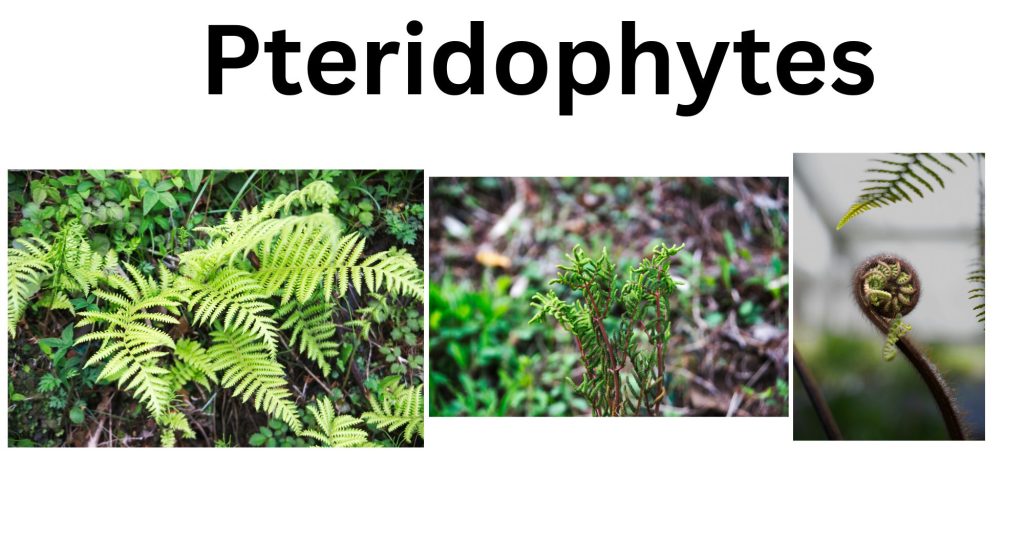
The Late Palaeozoic era can be regarded as the age of pteridophytes because during this period, pteridophytes were the dominant land plants on Earth. There are about 12,000 species of pteridophytes across the world.
Key Features of Pteridophytes
- The first vascular cryptogams having true roots, stems, and leaves are the pteridophytes.
- They have a primarily dominant and autotrophic generation of sporophyte, which is diploid.
- Water and food conduction is made by vascular tissues like xylem and phloem.
- During fertilization, water is needed where the sperm swims to meet the egg.
- There is an obvious alternation of already presented generations.
- They may be homosporous, producing a single type of spore, or heterosporous, with two types: microspores and megaspores.
- Leaves can be microphyllous (small with one vein) or megaphyllous (large with many veins).
Evolutionary Significance of Pteridophytes: The Earliest Vascular Land Plants
Pteridophytes are the first organisms that evolved another significant step in the evolution of the land plants due to the development of vascular tissues. Such tissues enabled the transportation of water and nutrients with the efficiency that fostered or led to increased structural complexity and the consequent ability to colonize terrestrial environments. They came out in the late Paleozoic era, which was considered a significant transition between non-vascular bryophytes and vascular plants. The transformation further led to the evolution of gymnosperms and angiosperms.
Major Classes of Pteridophytes
Psilopsida: These are primitive pteridophytes lacking true roots with simple stems. One is Psilotum.
Lycopsida: They are club mosses and spike mosses. They are microphyllous, and they reproduce through spores. E.g., Lycopodium, Selaginella.
Sphenopsida: Horsetails: their stems are segmented by whorls of leaves, and are propagated by cone-like strobili. One of them is Equisetum.
Pteropsida: This one comprises the true ferns with large and divided leaves known as the fronds. It is the highest in pteridophytes. Some of them are Adiantum and Pteris.
Alternation of generations in the life cycle of Pteridophytes
Pteridophytes show an evident alternation of generations:
- The predominant stage is the diploid sporophyte, producing the haploid spores by meiosis in sporangia.
- The spores give rise to the gametophyte (or prothallus), a free-living, haploid plant. It produces both male (antheridia) and female (archegonia) sex organs in the homosporous species.
- The fertilization takes place on the gametophyte, and the fertilized egg develops to form a new sporophyte.
Reproduction in Pteridophyta: By Sporangia, Spores, and Prothallus
Pteridophytes reproduce through both sexual and asexual reproduction:
Asexual reproduction– During asexual reproduction, the formation of spores takes place. Sporangia are formed within spores; they can either be solitary or in a cluster (sorus).
Sexual reproduction– sexual reproduction takes place through the gametophyte. The antheridia in the male germinate and produce motile sperm that swim in water to fertilize the female archegonia.
Most ferns have a heart-shaped, photosynthetic, small gametophyte (prothallus), which is green.
In homosporous species, there is only one type of spore, and the result is a bisexual gametophyte. Heterosporous forms produce two kinds of spores, allowing the formation of unisexual gametophytes.

Microphylls and Macrophylls Leaves in Pteridophytes
There are two kinds of leaves in pteridophytes:
In primitive groups such as Lycopsida, leaves are small, often single-veined, and are known as microphylls.
The larger, more complex leaves containing more than one vein and leaf gaps are called megaphylls (or macrophylls), which are found among ferns (Pteropsida).
The evolution of vascular Tissues and the emergence of actual roots, stems, as well as leaves in Pteridophytes
The development of the first true vascular tissues by plants occurred in pteridophytes:
A xylem serves as a transportation system that leads the water and dissolved minerals through the roots and to the rest of the plant.
Photosynthetic products (sugars) move out of the leaves to non-green tissues via the phloem.
They possess adventitious roots that are growing out of the rhizome roots.
The stems are aerial or underground rhizomes, and they are commonly dichotomously or laterally branching.
There is a clear distinction of the leaves that can be grouped in a whorl, spiral, or cluster.
Forms of Stele (Vascular Cylinder):
The stele is the main vascular cylinder of the roots and stems. There are various kinds of stelae in pteridophytes, which are:
Protostele: This is the most primitive one. It is made up of a solid core, which is xylem covered with phloem. Examples: haplostele and actinostele.
Siphonostele: This has a central pith bordered by concentric vascular tissue.
Phloem in ectophloic siphonostele occurs only on the outer surface of the xylem.
Phloem is on one side and outside the amphiphloic siphonostele.
Solenostele is one form of amphiphloic siphonostele, having a continuous or a complete vascular ring.
Dictyostele: A siphonostele dissected and with leaf gaps such that the siphonostele appears like a net. In highly evolved ferns such as Adiantum.
Plectostele: Vascular tissue is interrupted as strands with no central pith and randomly located. It occurs in certain ferns and horsetails.
Atactostele and Eustele: The vascular bundles will be distributed (atactostele) or in a partnership (eustele). These are evolutionary developments that are witnessed in seed plants.
Ecological Functions of Pteridophytes
The pteridophytes are ecologically important in several ways:
- They assist in moisture preservation in the forest environment through the covering of soil.
- Pteridophytes are natural pioneer species, particularly in degraded habitats.
- Host nesting locations and microhabitats for insects, amphibians, and other small living beings are also provided by pteridophytes.
Economic Applications of Pteridophytes
In different aspects, pteridophytes are economically important:
Ornamentals: Ornamental cultivation of ferns such as Nephrolepis, Adiantum, and Asplenium is generally common.
Medicinal: Different species are traditional painkillers for diseases such as fever, wounds, stomach pains, among others.
Water fern or Azolla is a kind of biofertilizer that is used in growing rice because of its symbiosis with Anabaena, in which it fixes nitrogen.
Pteridophytes act as air pollution and environmental health bioindicators because they react to changes in the environment.
There are edible species that are eaten as vegetable food in most societies.
Fern leaves are also ritually used in cultural traditions, particularly in South Asian and Pacific cultures.
Pteridophytes Fossil Record
Pteridophytes were dominant forms of plants in the Carboniferous period (about 300 million years ago). They added a lot of organic matter in creating coal beds. In the Swamp Forest of prehistoric time, the presence of fossil genera such as Lepidodendron, Sigillaria, and Calamites is to be seen.
Comparison of Pteridophytes, Bryophytes, and Gymnosperms
| Feature | Bryophytes | Pteridophytes | Gymnosperms |
| Vascular Tissue | Absent | Present | Present |
| Dominant Phase | Gametophyte | Sporophyte | Sporophyte |
| Reproduction | Takes place through spores | Takes place through spores | Takes place through Seeds (naked) |
| Fertilization | Needs water | Needs water | Autonomous of water |
| Habitat | Moist/shady | Moist/shady | Terrestrial (varied) |
| Examples | Mosses, Liverworts | Ferns, Horsetails | Pine, Cycas |
Status of Conservation and the Threatening of Fern Diversity
Several pteridophyte species are on the verge of extinction because of some environmental and other man-made causes. They have their natural habitats seriously diminished through deforestation, agricultural encroachment, and urban development. Climate change is also a threat because changes in rainfall and temperatures are influencing their growth and distribution.
Moreover, natural populations come under pressure due to over-harvesting used in the manufacture of medicines and as ornamental plants. They also decline owing to pollution and the invasion of invasive species. Preservation measures like setting up a protective area, growing them in botanical gardens, storing spores in banks, and creating awareness among the people, among others, are necessary to conserve diversity in ferns.
Conclusion
Pteridophytes are fertile land plants that are very important in the evolutionary progress of simple bryophytes to seed-bearing plants. They had a more effective transport of nutrients and water due to their vascular tissues, and the shift to the sporophyte dominant life cycle indicates more developed adaptations to life on land. Other than in their ecological functions of sustaining biodiversity, moisture, and soil health, pteridophytes are economically and culturally useful. Most of the species are endangered, even though they are so significant, and thus, have to be conserved. Conservation of pteridophytes helps in maintaining diversity and stability in the general ecosystem, which is sustainable.
References
- Banks, H.P. (1968). “The early history of Land Plants” Yale Univ. Symp. On Evolution and Environments. New Haven Conn.
- Hait, G., Bhattacharya, K., & Ghosh, A. K. (2012). A textbook of Botany, Volume I.
- Kawasaki, T. (1970), Reproductive Biology of Pteridophyta. IV. Ibid., 63 : 153-169
- Kholia, B.S., 2014. Fern and Fern-allies of Sikkim part II. ix+291 pp. .Sikkim State Biodiversity Board and BSI.
- Kholia, B.S. 2010. Fern and Fern-Allies of Sikkim, part I. pp.207. Sikkim State Biodiversity Board and BSI.
- Kholia, B.S., 2016. Traditional Uses of Pteridophytes in Sikkim Himalayas. https://www.researchgate.net/publication/290441020.
- KU – Botany III – U I – 2. (n.d.). https://www.winsomepublication.in/p/ku-botany-iii-u-i-2.html
- Pteridophyta by B.R. Vashishta, A.K. Sinha, Adarsh Kumar (S.Chand & Company Ltd)
- Sussex. IM.(1966). The origin and development of heterospory in vascular plants. Trends in Plant Morphogenesis. 140-152.
- Types of stele – Pteridophytes. (n.d.). BrainKart. https://www.brainkart.com/article/Types-of-Stele—Pteridophytes_32882/
