
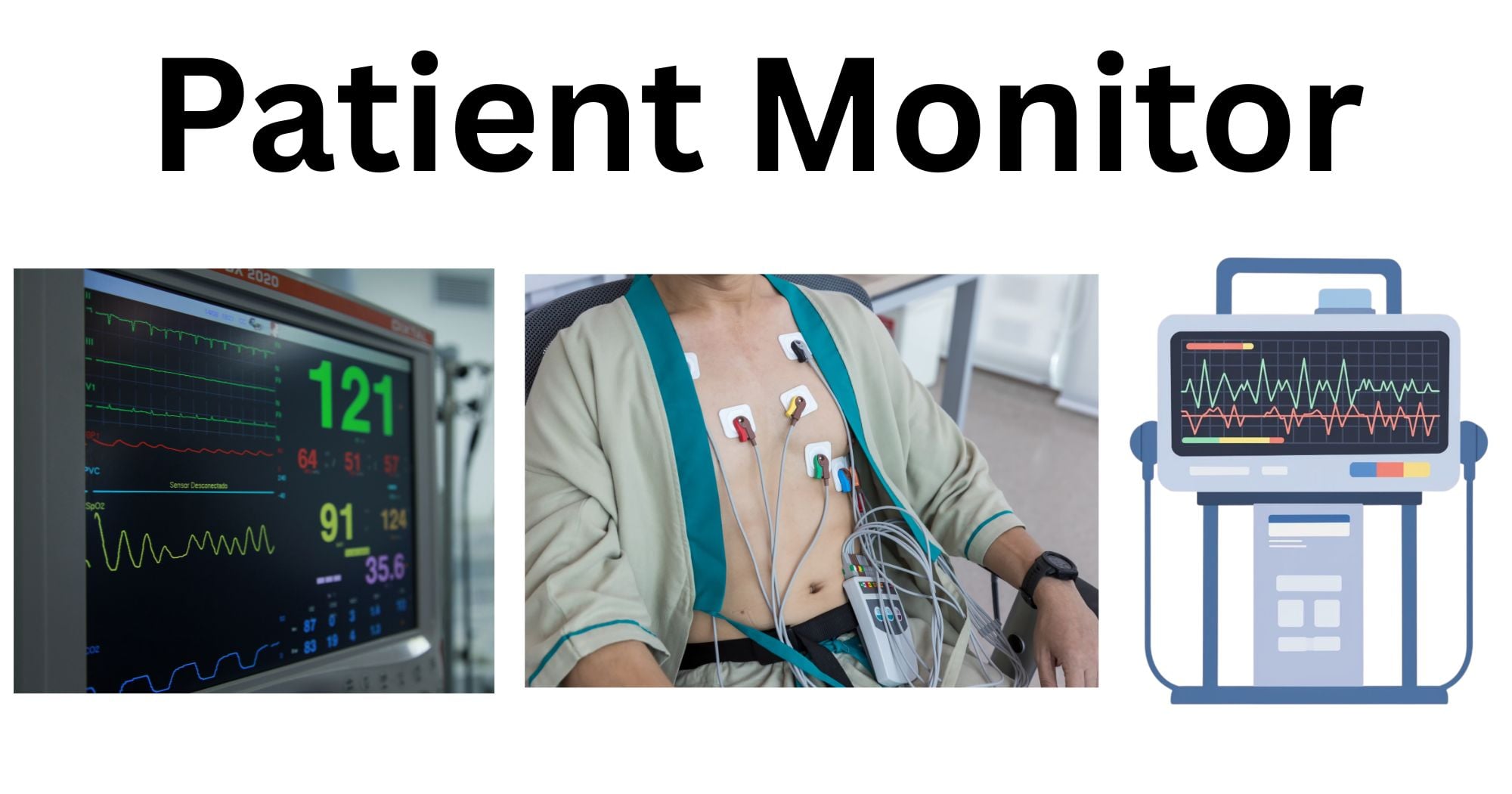
A patient monitor is a medical device that continuously observes, measures, records, and displays a patient’s vital physiological parameters, such as ECG, SpO2, blood pressure, respiration, and temperature.
This is necessary in clinical settings so that clinicians can detect deterioration early and respond quickly. It collects signals from sensors attached to the body, processes them, and presents numeric values, waveforms, and alarms on the screen. It acts as a “watchguard” for patient safety by alerting clinicians about changes in patient conditions. Modern patient monitors have evolved from simple single-parameter tools to advanced multiparameter systems capable of integrating data with hospital information systems (HIS) and electronic health records (EHR).
Principle and Working of a Patient Monitor
The basic working principle of a patient monitor is signal detection, signal conditioning, conversion, display, and alarm generation. Sensors attached to the patient detect physiological signals, which are converted into electrical signals. (For example, in ECG, electrodes detect electrical activity from the heart, and in pulse oximetry, red and infrared light pass through tissue, allowing for the analysis of absorption differences between oxygenated and deoxygenated hemoglobin). These signals are amplified, filtered to remove noise (such as motion artifacts), digitized by an analog-to-digital converter (ADC), and processed by a central processing unit (CPU) using specialized algorithms. The processed data generates numerical values, waveforms, and trends on the display, with alarms triggered when parameters exceed preset limits.
Types (Bedside, Multiparameter, Portable, and Remote Monitoring Systems)
Bedside Monitors: These are stationary devices mostly used in ICUs, operating rooms, recovery areas, and emergency departments for continuous observation of a patient at a fixed position. They support multiple parameters.
Multiparameter Monitors: These are versatile devices that can simultaneously track several vital signs, such as ECG, blood pressure, SpO2, etc. They are used in critical care units where multiple vital signs must be monitored simultaneously.
Portable Monitors: These are also known as transport monitors. They are small, battery-powered devices designed for movement within the hospital or during ambulance transfer. They offer mobility without sacrificing key functionalities.
Remote monitoring systems: They enable patient observation beyond the bedside and allow home-based care through wireless technology. These support chronic disease management.
Other specialized patient monitors include fetal monitors, capnography monitors, ECG monitors, pulse oximeters, blood pressure monitors, and temperature monitors.
Parts and Components of a Patient Monitor
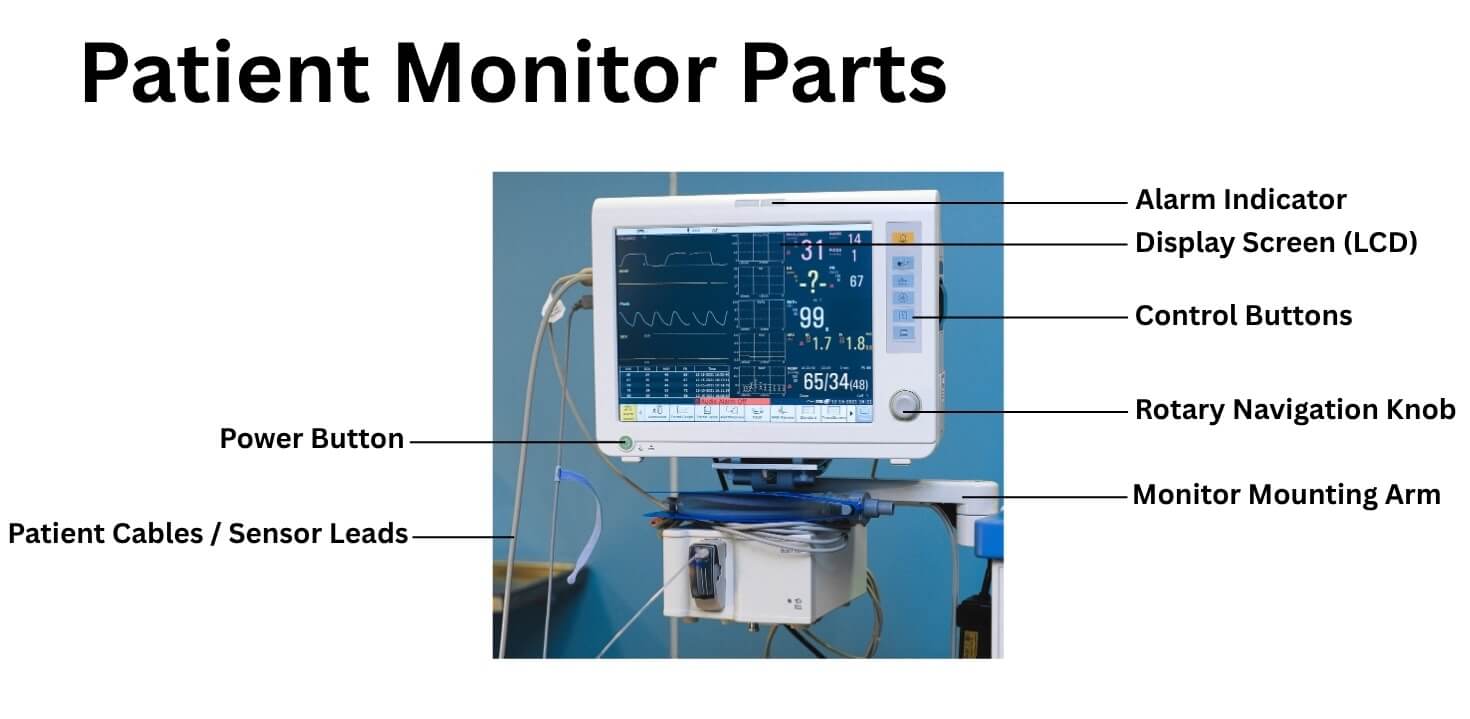
A typical patient monitor includes a display unit, sensor inputs, signal-processing circuitry, a processor, an alarm system, a power supply, and a user interface. The key components include:
- Sensors/ Probes: ECG electrodes, SpO2 finger clips, blood pressure cuffs, temperature probes, and respiration sensors.
- Display unit: A high-resolution LCD screen showing waveforms and numerical values.
- Central processing unit (CPU): processes signals and runs algorithms.
- Alarm system: audio-visual alerts when parameters deviate.
- Power supply: Main electrical supply with battery backup for uninterrupted monitoring.
Many modern systems also include data storage, network connectivity, and interfaces for hospital information systems.
Vital Parameters Measured (ECG, SpO₂, Blood Pressure, Respiration, Temperature)
The vital signs measured by the patient monitors are:
- ECG monitoring: It shows the electrical activity of the heart and helps clinicians assess heart rate, rhythm, and conduction abnormalities.
- SpO2 (oxygen saturation) monitoring: It estimates the percentage of hemoglobin saturated with oxygen, typically using a finger probe and light-based sensing.
- Blood pressure: It is measured non-invasively with a cuff or invasively with an arterial line in critical care.
- Respiration rate: It is commonly derived from chest impedance changes or waveform analysis.
- Temperature: It is measured using a connected probe.
Together, these values give a snapshot of the overall patient condition.
How to Use a Patient Monitor in Clinical Practice
Proper use of patient monitors is as follows:
- Select the appropriate monitor and accessories based on patient acuity.
- Attach sensors correctly. For example: attach ECG leads in standard positions, SpO2 on the finger or earlobe.
- Power on the device, enter patient demographics, and set age-specific alarm limits.
- Ensure good signal quality by checking waveforms and minimizing artifacts.
- Regularly verify connections and calibrate as needed.
Good clinical use also includes documenting values, noting trends, and reassessing the patient rather than relying on the monitor alone.
Interpretation of Patient Monitor Readings and Alarm Systems
The interpretation of patient monitors is done by reading the numbers and waveforms together and not in isolation. For instance, an ECG shows PQRST complexes for rhythm analysis; the SpO2 plethysmograph should correlate with pulse. The alarm systems are placed to warn clinicians and nurses about the fluctuations in patients’ vital signs. They are typically color-coded: red for critical (e.g., heart rate <50 or >120), and yellow for advisory. They can also create alarm fatigue when too many alarms are false or irrelevant. So, systems use thresholds, delays, and escalation to combat alarm fatigue. Also, alarm limits should be individualized, and staff should respond to true alarms promptly, as false alarms are common. The clinicians must interpret results in the context of the patient’s symptoms and clinical history and not rely fully on device results for decision-making.
Applications of Patient Monitors
- In Intensive care units, operating theatres, and emergency departments for critical care.
- Recovery rooms and cardiac wards for surveillance.
- Portable patient monitors are useful during transport inside hospitals and in ambulances.
- Remote monitoring supports post-surgical recovery, chronic disease management (eg, COPD)
- Neonatal care
- Anesthesia
Advantages
- Continuous real-time data for early detection of deterioration.
- Early intervention and reduced mortality.
- Faster clinical decision-making, especially in critical care.
- Data trending and integration.
- Improve documentation by storing trends, waveforms, and time-stamped events for review.
Limitations
- Alarm fatigue may cause staff to ignore important alerts when false alarms are frequent.
- Inaccurate readings due to motion, poor perfusion, or improper placement.
- High cost and need for training.
Maintenance, Calibration, and Safety Considerations
Routine maintenance includes checking cables, probes, batteries, displays, alarm volume, and network connections. Calibration ensures accuracy by comparing against standards. Calibration should follow manufacturer recommendations and be performed by trained personnel.
Safety considerations include:
- Using approved accessories
- Inspecting for damaged leads
- Ensuring proper grounding
- Verifying alarm settings before use
- Avoiding electromagnetic interference
Regulatory Standards and Guidelines
Patient monitors are governed by medical electrical safety and performance standards such as IEC 80601-2-49 for multifunction patient monitoring equipment and ISO 80601-2-61 for pulse oximeter equipment. IEC 60601-1 is for general safety. These standards focus on basic safety, essential performance, and expected use in professional, home, and emergency settings. Regulatory authorities such as the FDA also issue safety communications, enforcement policies, and cybersecurity and FDA 510(k) clearance. Compliance with ISO 13485 for quality management is essential. These guidelines emphasize risk management (ISO 14971) and alarm systems.
Conclusion
Patient monitors are vital medical devices that support healthcare by continuously monitoring physiological signs and warning clinicians when the patient’s condition changes. Their effectiveness depends upon correct placement, proper interpretation, routine maintenance, and awareness of limitations such as alarm fatigue and signal artifacts. They are indispensable tools in improving health care and evolving it towards personalized and remote care.
References
- The Ultimate Guide to Medical Patient Monitors—Unison Bio-Medical. (2024, February 14). https://unisonbiomed.com/the-ultimate-guide-to-medical-patient-monitors/
- Drews, F. A. (2008). Patient Monitors in Critical Care: Lessons for Improvement. In K. Henriksen, J. B. Battles, M. A. Keyes, & M. L. Grady (Eds.), Advances in Patient Safety: New Directions and Alternative Approaches (Vol. 3: Performance and Tools). Agency for Healthcare Research and Quality (US). http://www.ncbi.nlm.nih.gov/books/NBK43684/
- Benefits and Risks of Continuous Medical Monitoring. (n.d.). CCRPS Clinical Research Training. Retrieved May 23, 2026, from https://ccrps.org/clinical-research-blog/benefits-and-risks-of-continuous-medical-monitoring
- https://hengyamed.com/understanding-patient-monitors-a-comprehensive-overview/
- Chu, M. (2020, June 23). How to Read Patient Monitors—CanadiEM.
- Gardner, R. M., & Shabot, M. M. (n.d.). Patient-Monitoring Systems. https://collections.lib.utah.edu/dl_files/f0/a3/f0a3781fc948833aa480ad7085b49dc200e78de6.pdf
