
The larynx is an essential biological organ located between the pharynx and the trachea in the neck. It is a cartilaginous hollow tube that plays a significant role in the respiratory system and voice production (phonation).
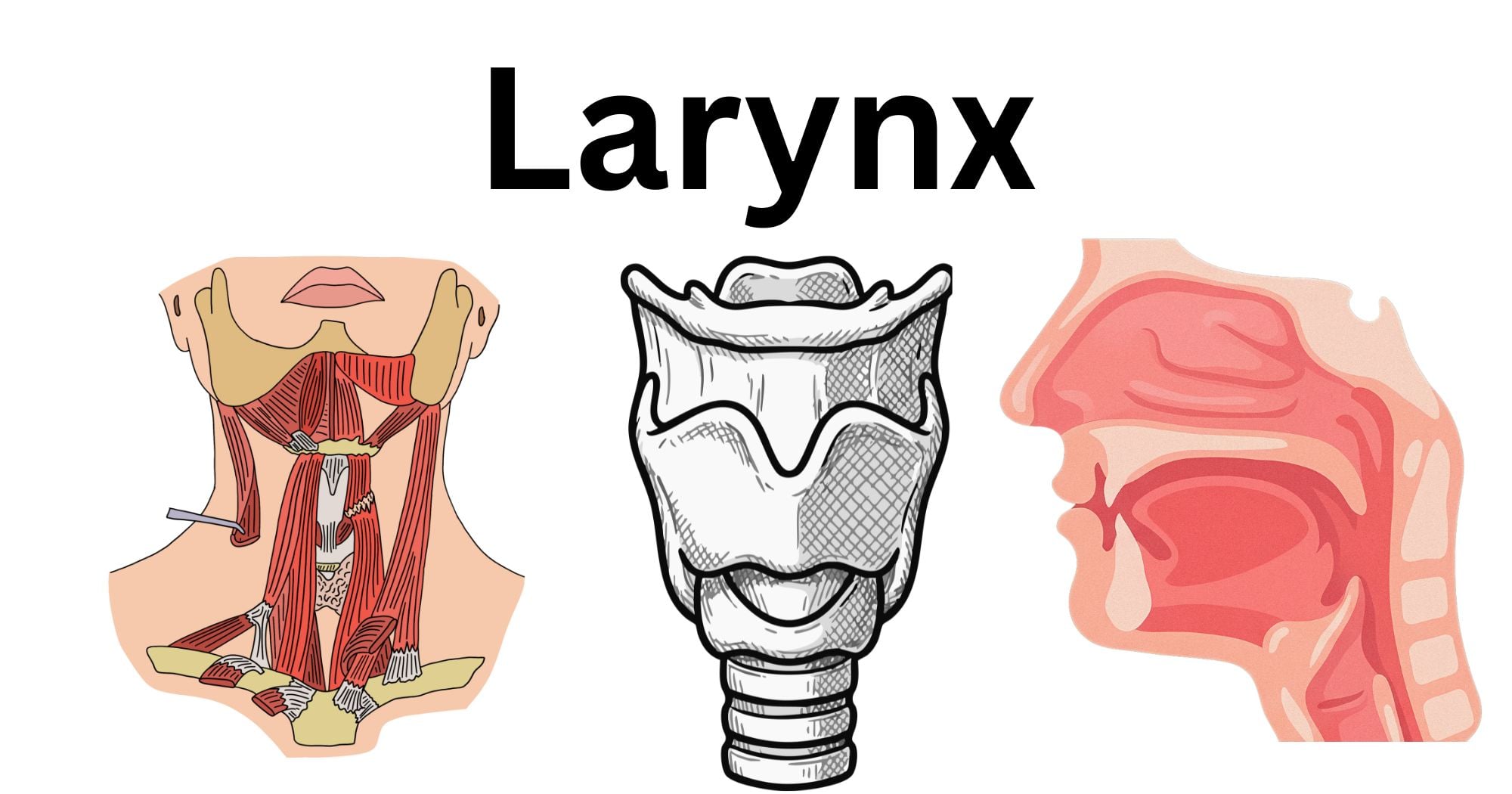
It is also called the voice box, as it houses the vocal cords.
Anatomy and Structure of the Larynx
- The larynx is a triangular-shaped organ made up of cartilaginous tissues.
- The ciliated columnar epithelial tissue forms the inner lining of the larynx, except for the vocal folds.
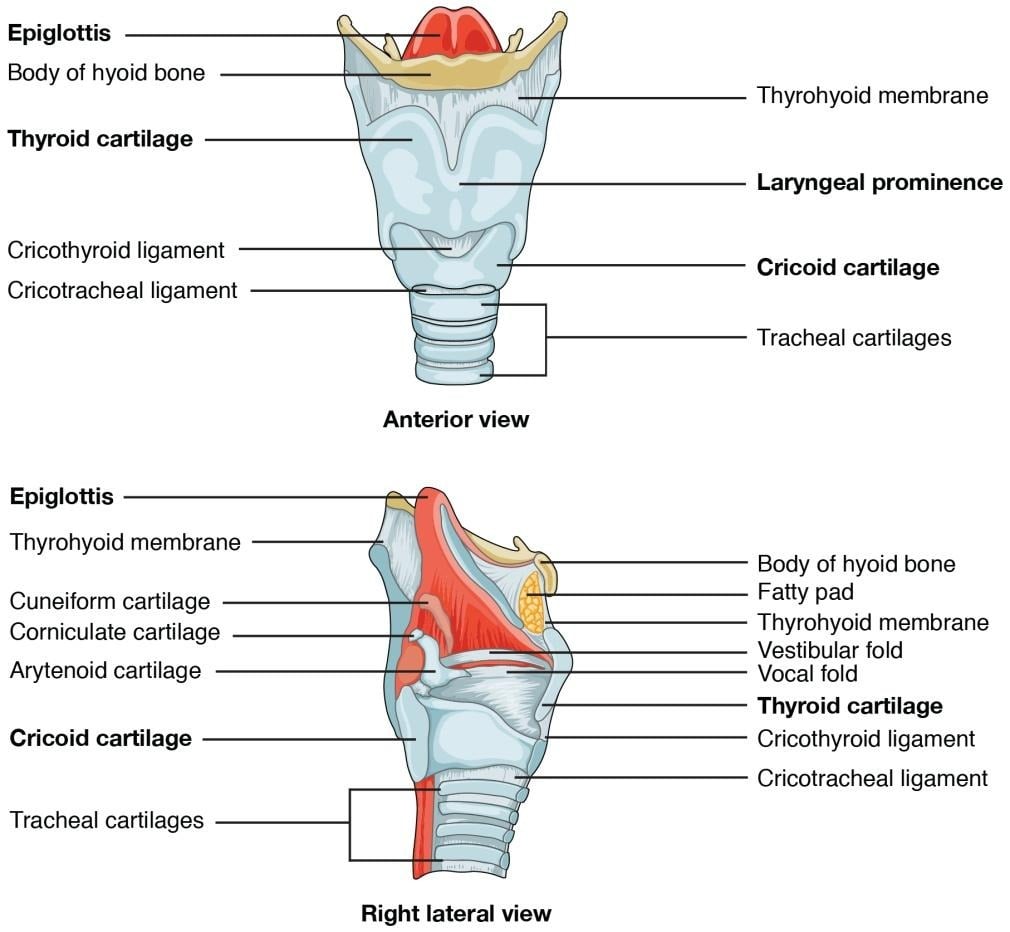
- It is supported by 9 types of cartilages (3 paired and 3 unpaired), 2 types of ligaments, and 2 sets of muscles.
Source: https://www.nursinghero.com/study-guides/contemporaryhealthissues/larynx
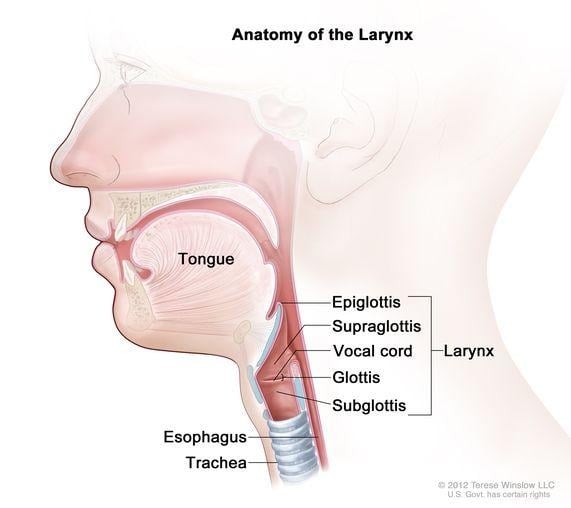
Anatomically, the larynx is divided into 3 parts:
- Supraglottis
- Glottis
- Subglottis
Source: https://www.cancer.gov/publications/dictionaries/cancer-terms/def/supraglottis
Supraglottis
- The supraglottis is the uppermost part of the larynx.
- It includes the epiglottis, false vocal cords, aryepiglottic folds, and arytenoid cartilages.
- It protects the airway, directs the food to the oesophagus, and prevents it from entering the tracheal region.
Glottis
- The gap between the two vocal folds is called the glottis. It is also referred to as the rima glottidis.
- It is the middle portion of the laryngeal anatomy, located between the supraglottis and subglottis.
- It is another significant part that prevents the entry of food/fluids into the windpipe (respiratory tract) and allows their passage to the food pipe (digestive organs).
- Since the glottis houses the vocal cords, it is essential to produce sounds. As the air flows through the vocal cords, it creates the vibration within the vocal folds, which allows the production of sound/voice. Therefore, the larynx is also called the voice box.
Subglottis
- It is the lowermost part of the larynx, situated above the trachea and below the glottis region.
- It is cylindrical in shape; however, it narrows down towards the vocal folds.
- It is also called Infraglottis.
- It acts as a significant section that protects the lower respiratory tract. It also assists in breathing, as it is involved in regulating the breathing temperature.
Larynx vs. Pharynx
| S.N. | Larynx | Pharynx |
| 1. | It is the cartilaginous organ present between the pharynx and trachea. | It is the hollow muscular tube that connects the nasal cavity and mouth to the larynx and esophagus. |
| 2. | It is located at C3-C6 vertebral levels. | It is present right behind the mouth. |
| 3. | It allows the passage of air and the production of sound simultaneously. | It is the pathway for both air (respiratory tract) and food (alimentary canal). |
| It is an essential part of the respiratory system. | It is a significant part of both the respiratory and digestive systems. | |
| 5. | The laryngeal walls are made of cartilage. | The pharyngeal walls are made of muscles. |
| 6. | The major anatomical subregions include the epiglottis and vocal folds. | The major anatomical sections include the nasopharynx, oropharynx, and laryngopharynx. |
| 7. | It consists of vocal cords and assists in phonatory actions. | It does not contain the vocal cords and is not associated with phonation. |
Functions of the Larynx
Functions of the Larynx in Breathing
- The larynx regulates the flow of air within the respiratory tract.
- It protects the lower respiratory tract by directing the food into the alimentary canal route during swallowing and preventing its passage into the trachea.
- During inhalation, the vocal folds present on the larynx open (abduction), while during exhalation, they close (adduction).
- It also functions as the controller/operator to control the air pressure within the respiratory tract. It facilitates the adduction of the vocal cords. This causes the intra-thoracic pressure to increase, and in order to release the pressure, the body coughs and also removes the foreign particles from the body.
Functions of the Larynx in Voice Production (Phonation)
- Sound production: During respiration, when the air passes through the vocal cords, they vibrate within the larynx. The continuous vibration of the vocal folds generates the voice/sound.
- Pitch (high/low notes) control: As the cricothyroid muscles stretch, the vocal folds get thinner, and their tension rises. Eventually, it leads to an increase in the speed of the vibration. This process produces the sound of higher notes. Likewise, the larynx relaxes the vocal folds and makes them thicker and shorter. Hence, it generates the sound of lower notes. Usually, the vocal folds in the males are shorter and thicker; therefore, it produces the sound of higher pitch in males.
Vocal Cords and Mechanism of Sound Production
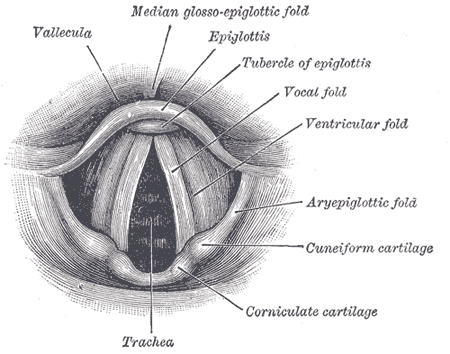
Vocal cords, also known as the vocal folds, are the soft, cylindrical-shaped cartilaginous tissues present in the throat.
There are two types of vocal folds, namely True vocal folds and false vocal folds.
True vocal folds (TVFs)
Generally called the vocal folds. Made of muscles and are more delicate, flexible, and resilient in comparison to the false vocal folds. Vibrate under normal circumstances and function to produce voices/sounds during regular phonation.
False vocal folds
Also called the vestibular folds or ventricular folds to distinguish them from the true vocal folds. They are the non-muscular structures, situated above the TVFs. They do not vibrate under normal conditions as they are responsible only for producing deep throat sounds and screams.
The shorter the vocal folds, the higher the sound frequencies. Therefore, the children tend to have the highest sound frequency, followed by the female voice and the male voice.
Vocal folds are composed of 3 layers: mucosa, the vocal ligament, and the thyroarytenoid muscle. In addition to these vocal folds, the larynx also comprises the supportive cartilages, muscles, and ligaments that play a crucial role in generating sound.
Source: https://en.wikipedia.org/wiki/Vocal_cords
The mechanism of voice production includes the following subsystems: the air-pressure system, the vibratory system (vocal cords), the filter/resonating system, and the articulatory system.
Air-pressure system:
- First, the arytenoid muscles pull back the glottis during exhalation and close the glottic space within the vocal folds.
- Consequently, the pressure in the subglottic region increases. When the subglottic pressure exceeds the glottis closure force, the air from the lungs passes through the vocal folds, resulting in the vibration.
- The diaphragm, chest muscles, and abdominal muscles coordinate together with the lungs in this system.
- The elasticity of the muscles and the Bernoulli effect play an essential role in bringing back the air pressure system.
Vibratory system:
- Afterwards, the airflow vibrates the vocal cords and generates a sequence of vibratory cycles.
- The vibration of the vocal folds, together with the movement of the tongue and the mouth, produces a voiced sound (the ‘buzz’ sound). The speed of airflow determines the intensity of the vibration and the loudness of the sound produced.
Resonating system in the vocal tract:
- The vocal tract consists of the resonators, such as the throat, pharynx, oral cavity, and nasal cavity.
- As the voiced sound propagates through them, they amplify/modify the quality of the sound. Thus, they are the modifiers that shape the buzz sound and produce the distinct perceptible characteristics of every linguistic sound.
Articulatory system:
- The lips, tongue, and soft palate help to articulate the voice produced. It helps in the formation of words during phonation and produces the recognizable voice.
Cartilages and Muscles of the Larynx
Laryngeal cartilages
- The larynx is composed of 2 sets of cartilages. Each set involves 3 types of cartilage.
- The first set of cartilages occurs in pair, while another set is unpaired.
- The paired cartilages include the arytenoid cartilage, the corniculate cartilage, and the cuneiform cartilages.
- The unpaired cartilages include the thyroid cartilage, the cricoid cartilage, and the epiglottis.
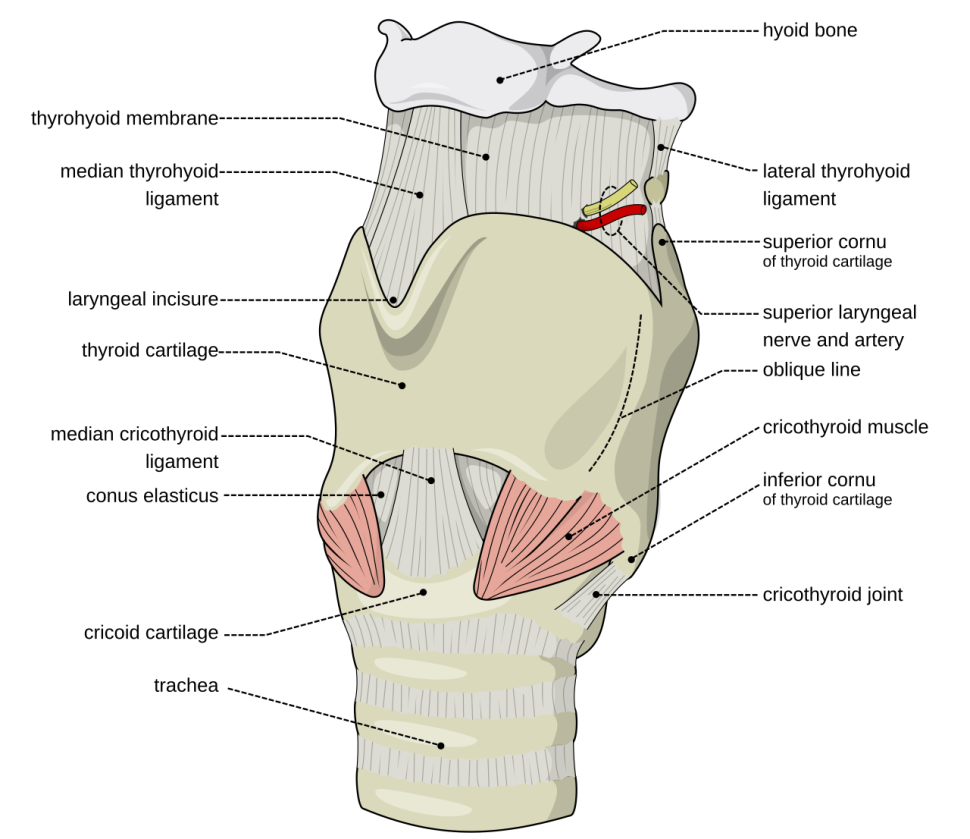
Source: https://en.wikipedia.org/wiki/Laryngeal_cartilages
| Two sets of Laryngeal cartilages | Types of Laryngeal Cartilages | Description |
| Paired cartilages | Arytenoid cartilages | A pyramid-shaped, flexible, and hard pair of cartilages that articulate with the cricoid cartilages and control the movement of vocal folds during phonation. |
| Corniculate cartilages | Cone-shaped, small, elastic cartilages that are also called the cartilages of Santorini. | |
| Cuneiform cartilages | Elongated rod-shaped cartilages that provide support to the lateral walls of the larynx and the epiglottis. They are not directly attached to other cartilages. | |
| Unpaired cartilages | Thyroid cartilages | Largest of all the cartilages. It also surrounds the anterior part of the larynx and forms the Adam’s apple. |
| Cricoid cartilage | Present in the lower part of the larynx. It is also known as the signet/cricoids ring. The anterior part of this cartilage is called an arch, while the posterior part is known as a lamina. | |
| Epiglottis | Leaf-shaped elastic cartilage that covers the laryngeal opening and folds during deglutition. It protects the airway by preventing the entry of food and fluids to the respiratory tract and directing them towards the alimentary canal. |
Laryngeal Muscles
- The muscles present in the larynx can be divided into 2 types: extrinsic muscles and intrinsic muscles.
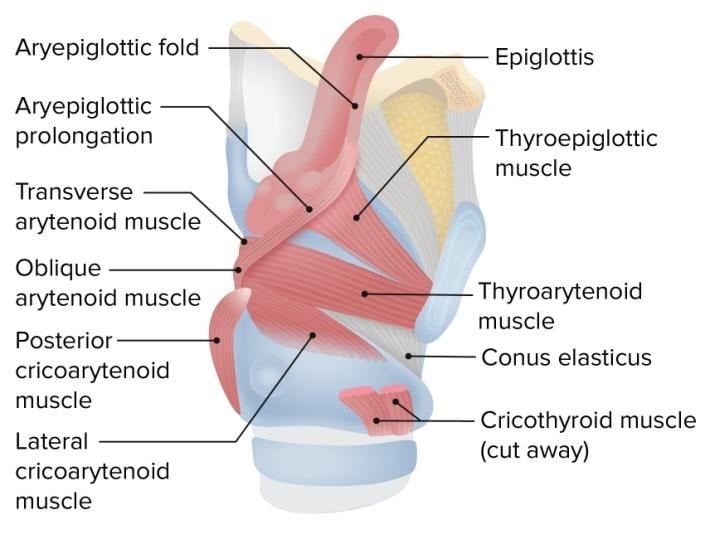
Source: https://www.lecturio.com/concepts/larynx/
| Types of Laryngeal Muscles | Subtypes | Description |
| External Muscles | Thyrohyoid muscles | It is present on the thyroid cartilage and the hyoid bone. It lowers the hyoid bone and lifts up the larynx. |
| Sternothyroid muscles | It is located on the sternum and first rib. They depress the larynx. | |
| Pharyngeal constrictor muscles | It assists in narrowing down the width of the pharynx during deglutition. | |
| Stylopharyngeal muscles | They help to elevate both the pharynx and larynx, as they extend from the styloid processes (in the temporal bone) to the thyroid regions. | |
| Palatopharyngeal muscles | The significant part of the soft palate that elevates the larynx and pharynx. | |
| Internal Muscles | Cricothyroid muscles | The superior and inferior cricothyroid muscles attach to the cricoid arch and lower lamina of the thyroid. They help to produce higher-pitched sounds by elongating the vocal cords. |
| The anterior and posterior cricoarytenoid muscles attach to the cricoid and arytenoid cartilages and are responsible for the adduction and abduction of the vocal folds, respectively. | ||
| Thyroarytenoid muscles | They relax the vocal cords. | |
| Aryepiglottic muscles | They adduct the aryepiglottic folds. | |
| Arytenoid muscles | They adduct the vocal cords. |
Blood supply and innervations of the larynx
Blood supply of the larynx:
- The blood is supplied to the larynx primarily by the superior and inferior laryngeal arteries, which form multiple branches bilaterally.
- The external carotid artery divides into several branches, one of which is the superior thyroid artery. The superior laryngeal artery originates from the superior thyroid artery and functions as the major blood supplier of the larynx. They supply blood to the structures between the top of the epiglottis and the glottis.
- The inferior laryngeal carotid artery originates from the inferior thyroid artery branch of the thyrocervical trunk. The thyrocervical trunk is one of the branches of the subclavian artery. They supply blood to the mucosal membrane and the muscles of the larynx.
Innervations of the Larynx:
- The vagus nerve (CN X) is the central point of origin of the innervations to the larynx.
- It divides into superior and inferior laryngeal nerves.
- The superior laryngeal nerves further divide into external and internal nerves. External nerves transmit efferent nerve signals to the cricothyroid muscle, while the internal branch transmits the sensory afferent signals to the structures of the supraglottis and glottis (laryngeal vestibule and vocal cords).
- Inferior laryngeal nerves, also called the recurrent laryngeal nerves, provide the motor nerve innervations to the subglottis as well as the extrinsic and intrinsic laryngeal muscles (except for the cricothyroid muscle).
Common Diseases and Disorders of the Larynx
There are several causes that can halt the function of the larynx and produce acute to chronic symptoms.
- Acute laryngitis: It is the inflammation of the laryngeal tissues that results in the swelling of the larynx. It is commonly caused during a cold or as a consequence of excessive shouting.
- Chronic laryngitis: It is a serious condition in which the larynx becomes inflamed due to dust, smoking, yelling, or polluted air.
- Laryngeal carcinoma: Prolonged exposure to cigarettes or alcohol results in the development of tumor cells in the larynx. The common types of cancer in the larynx include squamous cell carcinoma and verrucous carcinoma.
- Laryngopharyngeal reflux (LPR): When the acid from the stomach burns and irritates the laryngeal tissues, the condition is termed “laryngopharyngeal reflux”.
- Vocal polyps and cysts: The appearance of the blisters or cysts on the vocal cords is called “vocal polyps”. They are non-cancerous.
- Muscle Tension Dysphonia (MTD): Excessive, inappropriate tension in the muscles of the throat consequently results in the voice disorder known as dysphonia.
Some of the common signs and symptoms of these disorders/diseases include: hoarseness of sound, changes in voice, dysphagia, noisy breathing, and a feeling of a lump in the throat region.
Diagnostic Procedures: Endoscopy and Laryngoscopy
- In order to diagnose the medical conditions of the internal organs, the clinical specialists insert a narrow, flexible tube (provided with a light and a camera) inside the body. This kind of non-surgical diagnostic procedure is called an endoscopy, and the device is called an endoscope.
- In laryngoscopy, the endoscope is passed through the nose or mouth to view the vocal cords/larynx during medical examinations.
- It is the best method to diagnose any kind of inflammation in the larynx.
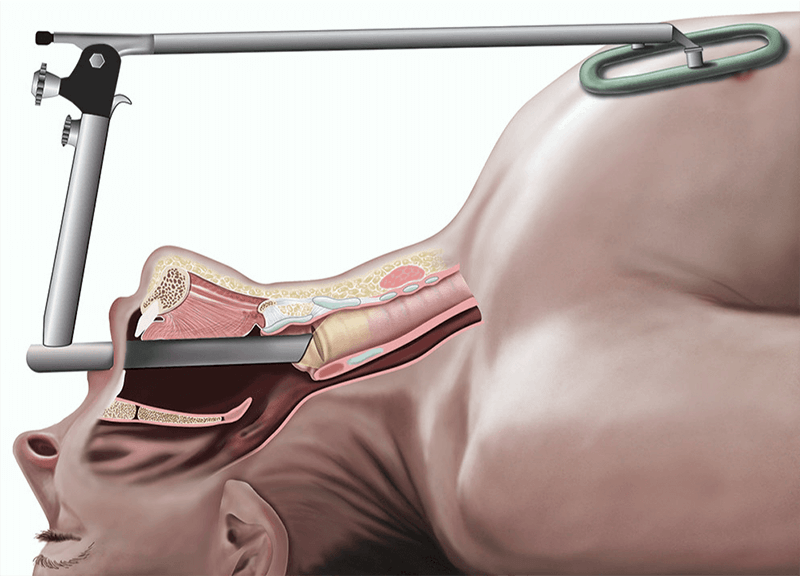
Source: https://www.healthdirect.gov.au/surgery/laryngoscopy
How to Keep the Larynx Healthy
In order to be able to speak clearly and produce different voices, we must take good care of our vocal cords and the larynx. Some of the ways to keep the larynx healthy are as follows:
- Drink water and stay hydrated.
- Avoid smoking, alcohol, and tobacco products, and also limit caffeine intake to reduce the risk of laryngeal tumors.
- Avoid eating spicy foods.
- Eat the foods containing Vitamin A, E, and C. They help to keep the throat healthy.
- Take rest amidst the busy routine. Physical weakness affects the vocal cords and the voice.
- Avoid screaming/loud shouting, as they strain the laryngeal tissues.
Conclusion
The larynx is a biological organ in the throat, which is made up of cartilage. It plays a significant role in both the alimentary canal and the respiratory tract. They consist of the vocal cords, several cartilages, muscles, and ligaments, which play a primary role in sound production; while on the other hand, they are also significant to prevent the entry of food into the respiratory system.
References
- Born, H. L. (2025, July 9). Overview of laryngeal disorders. MSD Manual Consumer Version. https://www.msdmanuals.com/home/ear-nose-and-throat-disorders/laryngeal-disorders/overview-of-laryngeal-disorders
- Childs, L. F. & American Laryngological Association. (2019). Mechanisms of voice production. In American Laryngological Association Comprehensive Laryngology Curriculum. https://alahns.org/wp-content/uploads/CLC/5-Mechanisms-of-Voice-Production.pdf
- Contributors to Wikimedia projects. (2006, July 19). Human Physiology/The respiratory system. Wikibooks, Open Books for an Open World. https://en.wikibooks.org/wiki/Human_Physiology/The_respiratory_system#Respiratory_System:_Upper_and_Lower_Respiratory_Tracts
- Institute for Quality and Efficiency in Health Care (IQWiG). (2024, March 27). In brief: How does the larynx work? InformedHealth.org – NCBI Bookshelf. https://www.ncbi.nlm.nih.gov/books/NBK534630/
- Lakna. (2017, October 4). Difference between pharynx and larynx. Pediaa.Com. https://pediaa.com/difference-between-pharynx-and-larynx/
- NCI Dictionary of Cancer Terms. (n.d.). Cancer.gov. https://www.cancer.gov/publications/dictionaries/cancer-terms/def/supraglottis
- OSD Healthcare. (2025, November 5). Nasal endoscopy and laryngoscopy – one stop healthcare. One Stop Healthcare. https://onestophospital.co.uk/treatments/nasal-endoscopy-and-laryngoscopy/
- Professional, C. C. M. (2025, December 23). Larynx (Voice Box). Cleveland Clinic. https://my.clevelandclinic.org/health/body/21872-larynx
- Professional, C. C. M. (2026, February 16). Glottis. Cleveland Clinic. https://my.clevelandclinic.org/health/body/glottis
- Radiopaedia.org. (n.d.). Radiopaedia. https://radiopaedia.org/articles/supraglottis
- Suárez-Quintanilla, J., Cabrera, A. F., & Sharma, S. (2023, September 4). Anatomy, head and neck: larynx. StatPearls – NCBI Bookshelf. https://www.ncbi.nlm.nih.gov/books/NBK538202/
- Taking care of your voice. (2025, June 11). NIDCD https://www.nidcd.nih.gov/health/taking care-your-voice
- THE VOICE FOUNDATION. (2019, February 7). Understanding voice production – THE VOICE FOUNDATION. THE VOICE FOUNDATION – Advancing Understanding of the Voice Through Interdisciplinary Research & Education. https://voicefoundation.org/health-science/voice-disorders/anatomy-physiology-of-voice-production/understanding-voice-production/
- Themes, U. (2021, August 28). Laryngeal function and speech production. Ento Key. https://entokey.com/laryngeal-function-and-speech-production/
- Wikipedia contributors. (2026, April 3). Larynx. Wikipedia. https://en.wikipedia.org/wiki/Larynx
- Zhang, Z. (2016). Mechanics of human voice production and control. The Journal of the Acoustical Society of America, 140(4), 2614–2635. https://doi.org/10.1121/1.4964509
