
The origin of Infrared Microscopy dates back to the eighteenth century, when a British astronomer, Sir Frederick William Herschel, discovered an unusual radiation in the range of the electromagnetic spectrum. Later in the twentieth century, infrared radiation was visualized through advancements in thermal detection.
Then, in the middle of the twentieth century, the gradual discovery and advancement of Fourier transform infrared (FTIR) spectroscopy led to the development of FTIR microscopy. Researchers were able to explore molecular structures and chemical composition through this technique. In the modern era, this technique has advanced and progressed to provide a wide range of applications with excellent outcomes, resolution, and acquisition speeds.
IR microscopy or IR microspectroscopy, one of the most multifaceted analytical tools, is a light microscopy technique that utilizes a light source to transmit infrared light wavelengths to produce an image of the specimen.
It uses reflective optics instead of absorbent optics, which are used in usual microscopes, to allow the visualization of the complete spectrum of infrared light. A wide range of light wavelengths comprises the electromagnetic spectrum, including visible light, UV radiation, and infrared rays. Infrared radiation extending from 700 nm further encompasses near-infrared (NIR), mid-infrared (MIR), and far-infrared (FIR) regions.
Infrared Microscopy is an imaging system that captures infrared radiation emitted or reflected by objects and transforms it into electrical signals, which are then processed to produce detailed thermal maps, uncovering information that is not visible to the human eye. In short, the conversion of signals to visual representations allows the visualization of unnoticed natural phenomena and opens up new paths for exploration and comprehension.
In recent years, IR microscopy has become a well-established technique providing a broad range of applications in the fields of biomedical science, environmental research, art conservation, gemological practices, and industrial applications. The combination of traditional microscopy with infrared spectroscopy in infrared microscopy has revolutionized scientific research by delivering exceptional spatial resolution and chemical specificity at the microscale level.
Principle of the Infrared Microscopy
Infrared microscopy has catalyzed the transformation of scientific research as it allows researchers to explore different dimensions of infrared radiation. This method employs contemporary Fourier transform infrared (FTIR) spectroscopy, delivering better spectral resolution, a higher signal-to-noise ratio, and quicker data collection. To comprehend the potential and capabilities of this technique, it is essential to understand the fundamental principles that drive its operation. Its basic working principle depends upon detecting specific absorption patterns displayed by molecules in a sample, thus revealing information about their chemical makeup and structural features.
When infrared (IR) light is directed onto the sample, it interacts with the material. This interaction causes the IR spectrum to be created, which is often referred to as the sample’s “chemical fingerprint”. The spectrum’s data can be utilized to identify, characterize, and quantify various substances in the sample. Similarly, the mode of analysis depends upon the nature of the sample. In the transmission method, IR light passes entirely through the sample and is then detected. In reflection mode, solid samples are analyzed by reflecting IR light off the surface of the sample, which is then detected. Lastly, the Attenuated Total Reflectance (ATR) method involves directing the IR light through a crystal, commonly made of germanium, that compresses the sample. The IR light interacts with the top few microns of the sample and is then reflected through the crystal for detection.
Instrumentation (Parts) of the Infrared Microscope
A conventional optical microscope consists of glass optics capable of absorbing a huge section of infrared light. Therefore, all-reflective optics are used in an infrared microscope, ensuring that the whole spectral range of infrared light is covered with maximum signal intensity. Infrared systems comprise optics within the mid- to near-infrared region. The core components of an infrared microscope include an optical microscope, a detector, a light source, an aperture, and reflective condensing objectives. The instrumentation of an infrared microscope is briefly explained below:
Light Source: For infrared analysis, a region of the sample is selected, and the infrared light source first interacts with the sample. Then, the IR light is sent to the detector through the aperture for analysis.
Aperture: Apertures are the components that allow the selective analysis of the IR light that has interacted with specific areas of the sample; hence, they are an essential part of the microscope. The two types of apertures used to filter out unwanted IR light before detection are:
- Pinhole apertures: It features a wheel with circular openings of different sizes, which can be rotated to choose the most appropriate aperture size for a given experiment.
- Knife-edge apertures: It has a rectangular opening framed by four adjustable blades. These blades can be moved independently to define the area of interest on the sample.
Detector: The infrared detector can sense infrared light from a single point, a linear array, or a focal plane array, allowing it to capture various sections of the sample. Either single-element detectors or imaging detectors are used for infrared imaging. To detect specific areas within the sample, single-element detectors (example: Liquid Nitrogen cooled MCTs (LN-MCTs)) are used, whereas chemical images are created using the imaging detectors.
Objectives: These are used to concentrate and collect light to and from the samples, enabling transmission and reflection modes of analysis. This technique features a set of reflective condensing objectives made of Schwarzschild or Cassegrain-type design.
Sample Preparation for Observation in an Infrared Microscope
The thickness of the sample is a crucial parameter that prevents total absorption. The optimal transmission sample should be quite thin, ideally around 10–50 µm, and therefore should be mounted on a suitable substrate. The substrate used is generally transparent in the analytical region, eg, glass, discs of salt windows, diamond, or silicon. Needles or tweezers are used for the isolation of different samples, including fibers and particulates, from the matrix.
Samples are prepared as thin laminates by placing the film between the two glass slides. The slides are pressed down, and the film from the surface of the top slide is sliced with the help of a razor. The top slide is then rotated to a small degree with balanced pressure, revealing a small fragment of the film. The fragment is then cut off using a razor through the edge of the slide. For proper mounting, a compression cell or a simple window is considered.
Usually, samples can be placed directly onto a salt window (KBr, NaCl, etc.) without a cover, which is effective for materials taken from bulk samples, such as particulates or fragments. If necessary, a roller wheel can be used to flatten the sample; however, careful precautions must be taken to prevent damage to the sample.
Therefore, the second window is preferred for flattening. Using adhesives should be avoided as they will interfere with the IR beam during transmission analysis. Similarly, a compression cell can also be used for IR transmission microscopy. It is preferred due to its features that protect the sample between two windows, as well as create compression that prepares thin samples, resulting in improved transmission performance.
Furthermore, epoxy mounting and microtomes can also be used; however, it is a time-consuming and complex process, but it delivers high-quality samples with stability, yielding excellent results.
Operating Procedure of the Infrared Microscope
- At first, the microscope should be turned on and allowed to warm up as per the instructions.
- The equipment, including the IR source, detector, and optics, is checked for proper functioning.
- Next, the software interface is opened, and the appropriate analysis mode (Transmission/ reflection/Attenuated Total Reflectance) and IR detector are selected. Initially, a background scan is performed to ensure the baseline measurement is ensured.
- The sample is prepared in a suitable substrate and secured properly on the microscopic stage.
- The sample is focused first under the visible light mode and then under the infrared mode, adjusting the field of view.
- The sample area is selected, and the spectral acquisition settings are configured, i.e., resolution, number of background scans, background frequency, and type and spectra format are selected.
- Then, the data are collected, and signal intensity is monitored. Simultaneously, the image is captured, and the acquired spectra are saved.
- The spectra are processed and analyzed using the reference databases.
- After use, the software applications are closed, and the system is logged out.
- The microscope is turned off, allowing it to cool down.
- The optical instruments are cleaned properly with the appropriate format, and the details of the usage are recorded in the logbook.
Applications of the Infrared Microscopy
- When combined with optical spectroscopy and advanced software, the infrared imaging system analyzes spectral characteristics through quantitative methods, including the ratios and principal components of species within a material.
- IR spectromicroscopy is significantly used in gemological studies, specifically to map defects and analyze features within the gemstones. This provides invaluable information about the origin, history, and the surrounding area to sort the samples.
- This technique is used for identifying and analyzing small diamonds as they possess restricted optical access.
- It is used for regular gem testing, detection of polymer treatments and their natural/synthetic origin, and chemical imaging.
- It is used as an investigative tool in environmental pollution, specifically for the study of the chemical composition of microplastics in soil, air, and water.
Examples of Infrared Microscopes
Nicolet™ iN10 Infrared Microscope
- It has an integrated design and is used for the spectral identification of pure compounds and mixtures without requiring an external spectrometer.
- It is a compact and budget-friendly device.
- It consists of a dual-monitoring system that allows maximal visualization of samples.
- It provides complete automation of system performance validation and has automated control by computers.
PI640i Infrared Microscope
- It is capable of measuring thermal fluctuations and identifying small targets with the help of detector resolution.
- The integrated system, in combination with a high-resolution infrared camera and German-engineered optics, along with precise adjustments, allows for accurate measurements.
- It consists of interchangeable and focusable lenses, ensuring the camera can be used flexibly in various situations.
- It features a camera that offers frame rates of 32 Hz and 125 Hz for detailed thermal imaging at a microscopic level.
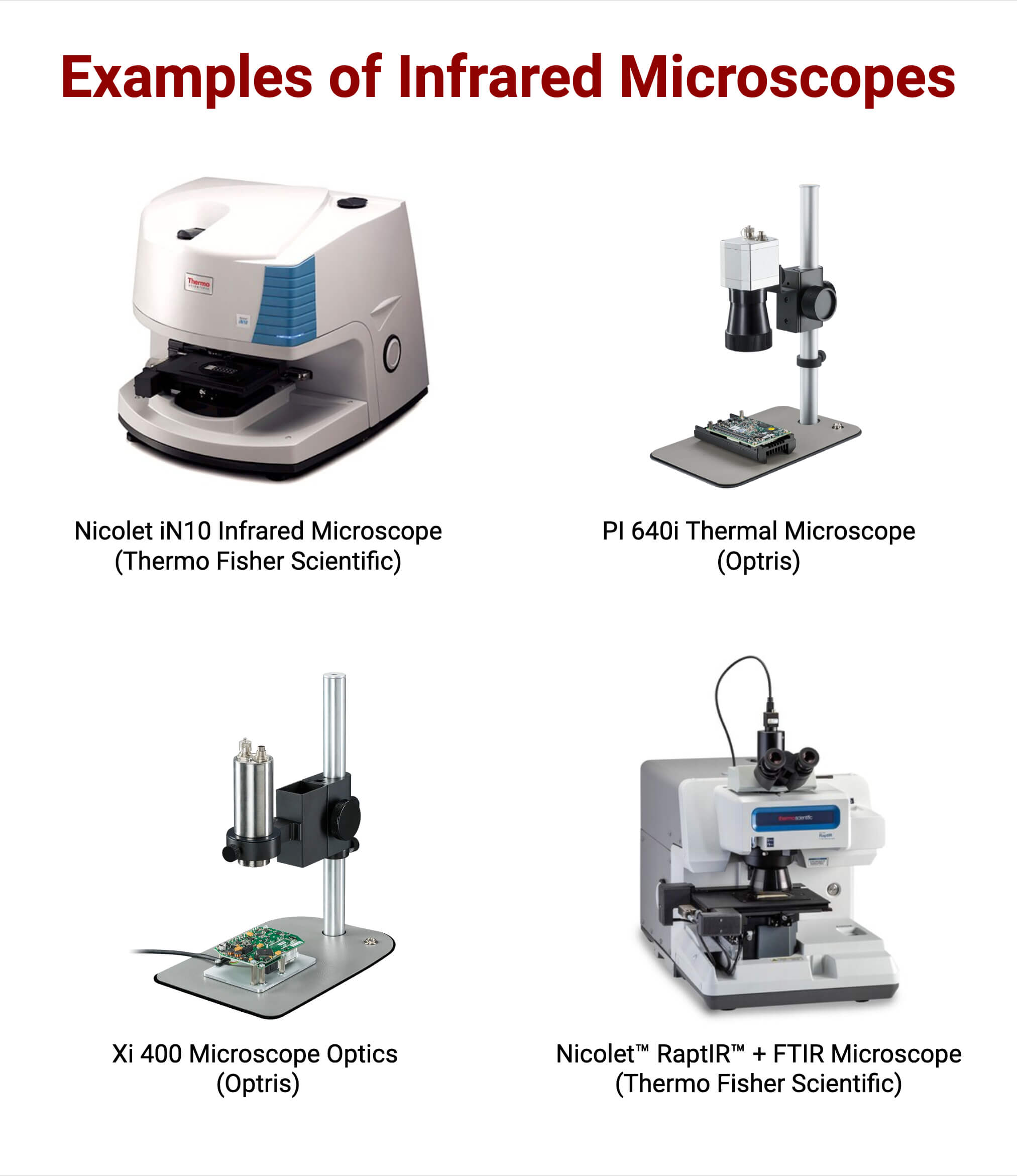
Xi 400 Infrared Microscope
- This system features an integration of a long-wave infrared camera with a microscope stage for accurate focusing.
- It comprises an industrial USB infrared camera and German-engineered infrared optics tailored for small target images and measurements.
- It is a compact, durable device that comes with motorized focusing capabilities.
- With a high frame rate of up to 80 Hz and easy computer connectivity, it is ideal for observing rapid thermal manufacturing processes.
Nicolet RaptIR+ FTIR Microscope
- It is a flexible system that offers rapid and precise analysis of samples.
- It features objectives that are diffraction-limited, which offer excellent performance in both visual and infrared applications.
- It is a versatile, research-grade microscope designed to be adaptable for researchers across different industries.
- It features reflectance, transmission, and Attenuated Total Reflectance (ATR) sampling modes with automated exchange capabilities, ensuring flexibility. Additionally, it includes built-in ATR sensors that safeguard the samples while maintaining precise pressure control.
Advantages of the Infrared Microscopy
- The advancements in Infrared microscopy have allowed quick measurements of larger sample areas with high lateral resolution.
- Integrating an infrared microscope with other analytical tools enables the study of the history, origin, and characteristic details of minute samples.
- It offers high visual standards and excellent spectral data quality.
- It has higher relevance for its application of biofluids, biomarkers, fibres, inclusions, and particulates.
- It is a useful technique for the study of thin samples that require accurate and precise measurements.
Limitations of the Infrared Microscopy
- Its spatial resolution is constrained by the diffraction of the IR light’s longer wavelength. Typically, most infrared microscopes available have a spatial limitation that’s about 1 to 3 times the wavelength of the light source.
- Similarly, it is challenging to achieve high-resolution images in the infrared spectrum compared to the visible spectrum due to the diffraction limit.
- When infrared light travels through the optics of a microscope, diffraction occurs. As diffraction leads to the dispersion of light, it results in an Airy disk pattern, which restricts the resolution of fine details in images.
- Reduced pixel pitches, although advantageous for achieving higher resolutions, diminish the effective absorption area of each pixel. This, in turn, impacts sensitivity and the signal-to-noise ratio.
Precautions for Using the Infrared Microscope
- Wear appropriate personal protective equipment (PPE), gloves, and safety goggles to prevent exposure to harmful radiation.
- Avoid looking directly at the infrared source.
- Samples should be prepared carefully to prevent contamination and damage.
- The detectors should be cooled according to the procedure.
Conclusion
In scientific and industrial research, IR microscopy has been recognized as a versatile, non-destructive, and well-established technique of microscopy. Its unique features, capabilities, and cutting-edge performance have expanded its applications in diverse areas of scientific advancement. It has become a technology of great interest in different scientific disciplines as it offers a combination of qualitative and quantitative chemical information.
From understanding a gem’s characteristics to its use in art restoration, from biomedical research to material science, it has been a fundamental tool contributing to scientific knowledge and assisting in innovative solutions in diverse domains. The emerging trends of IR microscopy, recent advancements, and the current landscape of its use have proved the efficiency, precision, and effectiveness of this technique. As it is an ever-evolving microscopy technique with researchers leveraging its dynamic prospects, it has become equally important to prioritize ethical considerations concerning data privacy and implications.
References
- Guide to FT-IR Microscopy. (n.d.). Bruker. https://www.bruker.com/en/products-and-solutions/infrared-and-raman/ft-ir-microscopes/what-is-ft-ir-microscopy.html
- Infrared microscopy applications. (n.d.). https://www.gia.edu/gia-news-research-Infrared-Microscopy-Applications
- News-Medical. (2019). What is Infrared Microscopy? https://www.news-medical.net/life-sciences/What-is-Infrared-Microscopy.aspx
- John Coates, Coates Consulting. (2014). Next-Generation IR microscopy: The devil is in the detail. https://www.photonics.com/Articles/Next-Generation_IR_Microscopy_The_Devil_Is_in/a44683
- Reffner, J. A. (2020). Advances in infrared microspectroscopy and mapping molecular chemical composition at submicrometer spatial resolution. Spectroscopy Online. https://www.spectroscopyonline.com/view/advances-infrared-microspectroscopy-and-mapping-molecular-chemical-composition-submicrometer-spatial
- NicoletTM iN10 Infrared Microscope. (n.d.). https://www.thermofisher.com/order/catalog/product/IQLAADGAAGFAHDMAPD
- Nicolet RaptIR+ FTIR Microscope. (n.d.). https://www.thermofisher.com/order/catalog/product/IQLAADGAAGFARMMBMN?SID=srch-srp-IQLAADGAAGFARMMBMN
- Optris (EU). (2025). PI 640i Microscope Optics with 2X Magnification – Optris (EU). https://optris.com/products/infrared-application-packages/ir-microscopes/pi-640i-microscope-optics-with-2x-magnification//
- Optris (EU). (2025). Xi 400 Microscope optics – Optris (EU). https://optris.com/products/infrared-application-packages/ir-microscopes/xi-400-microscope-optics/
- Ho, R., Phal, Y., Lux, L., & Bhargava, R. (2022). IR spectroscopy and imaging using polarized light with QCLs: instrumentation and applications. In Elsevier eBooks (pp. 409–431). https://doi.org/10.1016/b978-0-323-91249-5.00012-0
- Agha, A. S. A., Khalil, E., Al-Remawi, M., & Al-Akayleh, F. (2024). Infrared Microscopy: a multidisciplinary review of techniques, applications, and ethical dimensions. Jordan Journal of Pharmaceutical Sciences, 17(2), 267–291. https://doi.org/10.35516/jjps.v17i2.1882
- Bradley, M. S. (2024). FT-IR Microscopy: sampling by transmission. Spectroscopy Online. https://www.spectroscopyonline.com/view/ft-ir-microscopy-sampling-by-transmission
